Vocabulary
Phrasal Verbs in Context: Learn Them from the News
Know look and up, miss look up? A practical news method for phrasal verbs: 2-5 units per article, full sentences, split forms, and a 15-minute weekday loop.
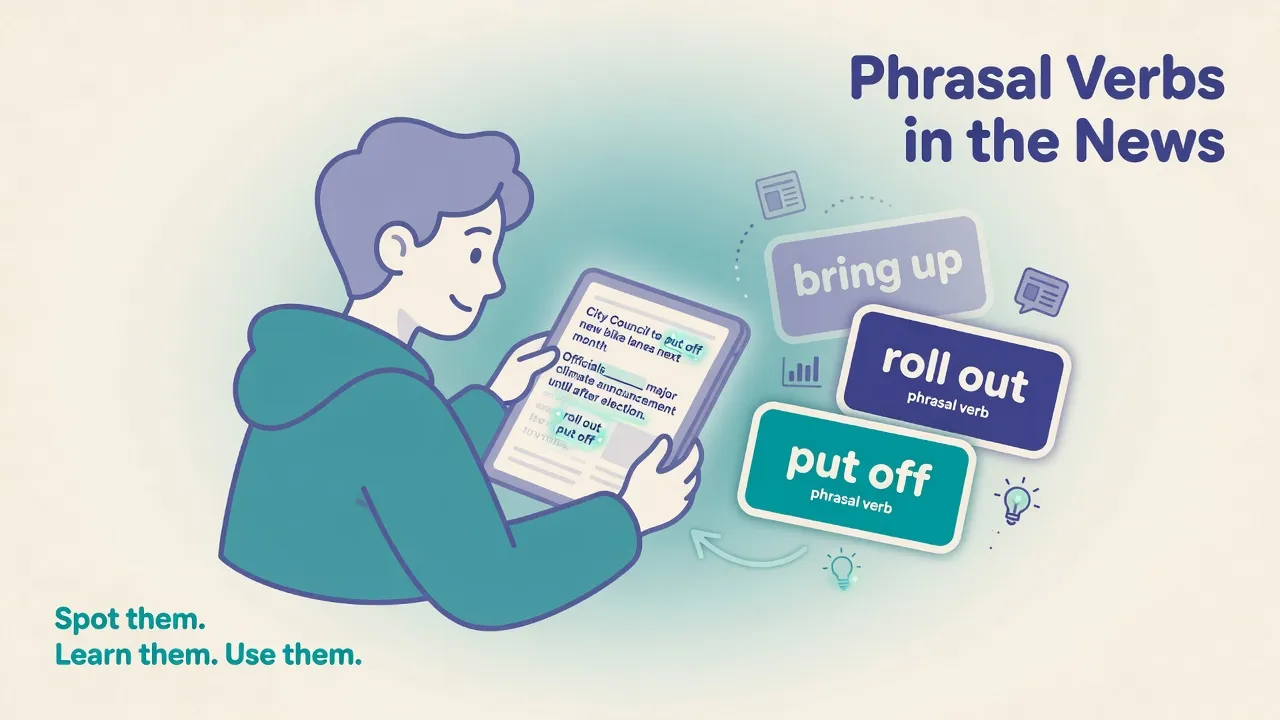
You know that feeling when every word looks familiar and the meaning still slips away? Look and up are fine alone. Together they mean search for information. If you have already asked yourself how to learn phrasal verbs without hating English, you are not alone.
This is a practical guide. You will get:
- Why dictionaries and lists often break on phrasal verbs
- A method for learning them from news and business texts
- A working set of frequent news and business phrasal verbs
- Practice with split constructions (put the meeting off)
- How MovaReader can help
Short answer
Phrasal verbs stick when you meet them in situations, not in alphabetized lists. Read a short news or business piece, keep the full sentence, note if it can split (put the vote off), and reuse 2-5 units the next day. Lists can be a reference. They should not be the whole method.
Frequency plus your topics (work, markets, tech) beat vanity counts.
Why classic lists almost fail
A list titled "100 phrasal verbs with GET" looks solid. Your brain sees something else: a pile of weakly linked rows with no emotion, no plot, and no need.
Typical problems:
| Approach | What goes wrong |
|---|---|
| Rote one translation | Many phrasal verbs are multi-meaning |
| Word-by-word calque | Bring up is not "carry upward" |
| Only the glued form verb + particle | Real text often splits: put it off, turn the offer down |
| Forty cards in one night | Tomorrow you recall 3-5, if you are lucky |
Lists stack bare forms. Context keeps a full sentence and a situation. That is the difference that sticks.
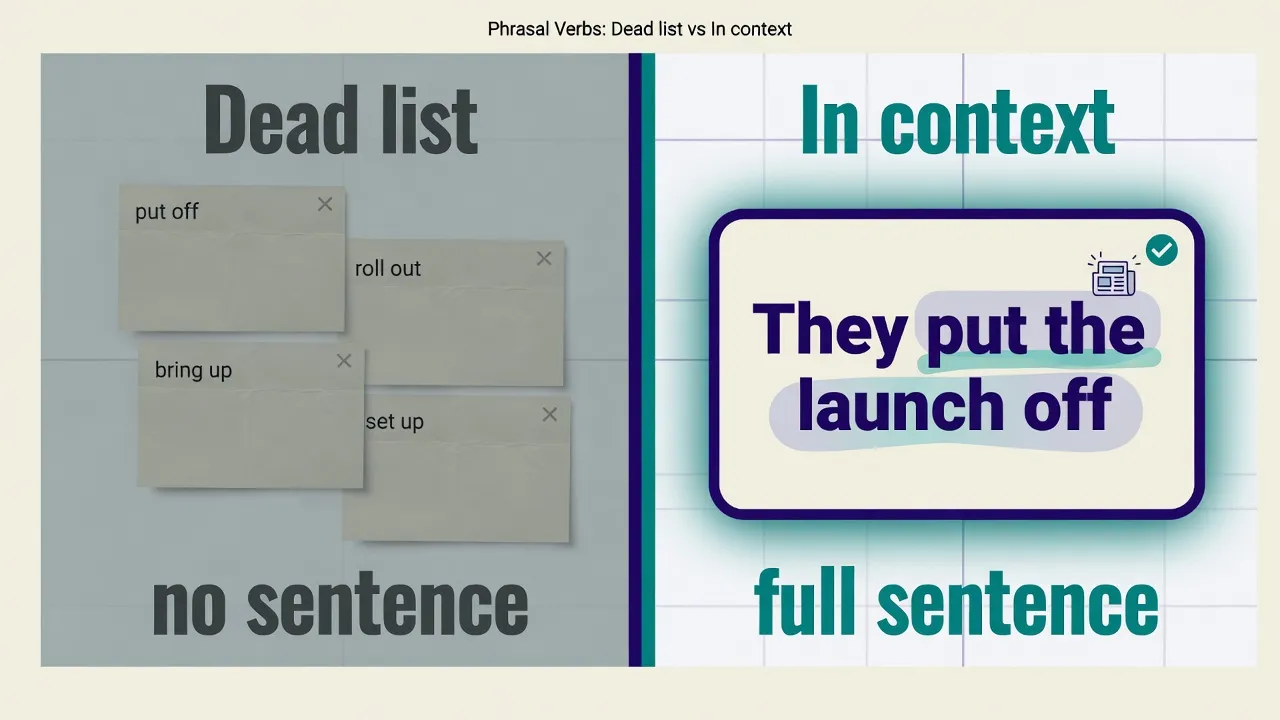
A phrasal verb lives in a situation. In an economy piece, break down may mean collapse or fall sharply. In a car story, it means stop working. Context picks the sense faster than any super-dictionary.
How to read news so phrasal verbs stay
Rule 1. One article, a few verbs - not fifty
From a news piece you care about (tech, business, sport, politics), write down 2-5 constructions that actually blocked meaning. Leave the rest.
Rule 2. Keep the full sentence
Weak: put off = delay / postpone
Better: The government put the vote off until next week.
Rule 3. Mark whether it can split
- Separable: put off the meeting / put the meeting off
- Often together: look for, look after (not look the child after)
Rule 4. Group by situation, not alphabet
Prefer folders like:
- work and meetings
- economy and markets
- conflict and politics
- tech and products
over "everything with up."
Rule 5. Reuse by using, not by marathon review
The next day, write three of your own sentences or briefly retell the news, deliberately inserting yesterday's phrasal verbs.
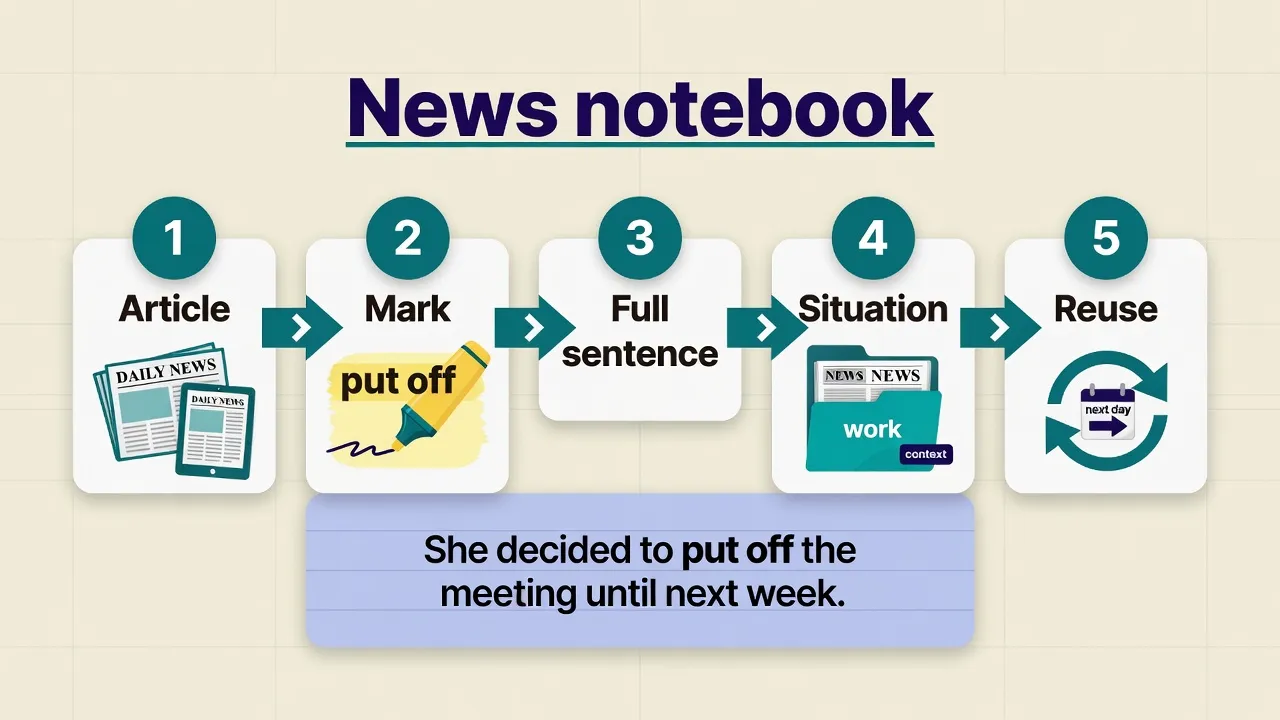
The useful part: small daily harvests beat a dead mega-list you never open again.
Phrasal verbs you often meet in the news
Below is a practical news-focused set, not a "complete English language list." Examples sit in a journalistic register.
Work, decisions, business
| Phrasal verb | Meaning in news context | Example |
|---|---|---|
| put off | delay / postpone | They put off the product launch. |
| call off | cancel | The strike was called off after talks. |
| carry out | perform / conduct | The agency carried out an investigation. |
| set up | create / launch | The company set up a new office in Kraków. |
| take over | acquire / take control | A larger firm took over the startup. |
| lay off | dismiss staff (redundancies) | The factory laid off 200 workers. |
| shut down | close / stop operating | Regulators forced the plant to shut down. |
| roll out | introduce / launch widely | The bank will roll out the app in May. |
| scale up | expand capacity | The team plans to scale up production. |
| phase out | remove gradually | The government will phase out the subsidy. |
Information, statements, media
| Phrasal verb | Meaning | Example |
|---|---|---|
| bring up | raise a topic | She brought up the privacy issue. |
| point out | note / highlight | Critics pointed out the missing data. |
| play down | minimize importance | Officials tried to play down the risk. |
| spell out | explain clearly | The CEO spelled out the new strategy. |
| follow up | continue / check further | Journalists will follow up on the leak. |
| come out | become known / be published | The report came out on Monday. |
| back up | support with evidence | The claim was not backed up by evidence. |
| leave out | omit / exclude | The summary left out key numbers. |
Growth, falls, crisis
| Phrasal verb | Meaning | Example |
|---|---|---|
| go up / go down | rise / fall | Energy prices went up again. |
| fall through | fail (of a deal) | The merger fell through at the last minute. |
| break down | collapse / fail (by context) | Talks broke down after six hours. |
| run out of | exhaust supply | Hospitals are running out of supplies. |
| cut back on | reduce spending on | Families are cutting back on travel. |
| wipe out | destroy / erase | The storm wiped out coastal roads. |
| bounce back | recover | Markets bounced back by Friday. |
| hold up | stay strong / delay (by context) | Demand has held up better than expected. |
Technology and products
| Phrasal verb | Meaning | Example |
|---|---|---|
| roll back | reverse a change | The company rolled back the update. |
| opt out of | choose not to take part | Users can opt out of data sharing. |
| sign up for | register | Thousands signed up for the beta. |
| switch off / turn off | disable | Please turn off tracking by default. |
| build on | base further work on | The paper builds on earlier research. |
| dig into | examine in depth | Analysts dug into the earnings report. |
That is already dozens of real units. If your goal is "100," build them from your own reading with the same categories - not from a random PDF list.
Split constructions: the real exam
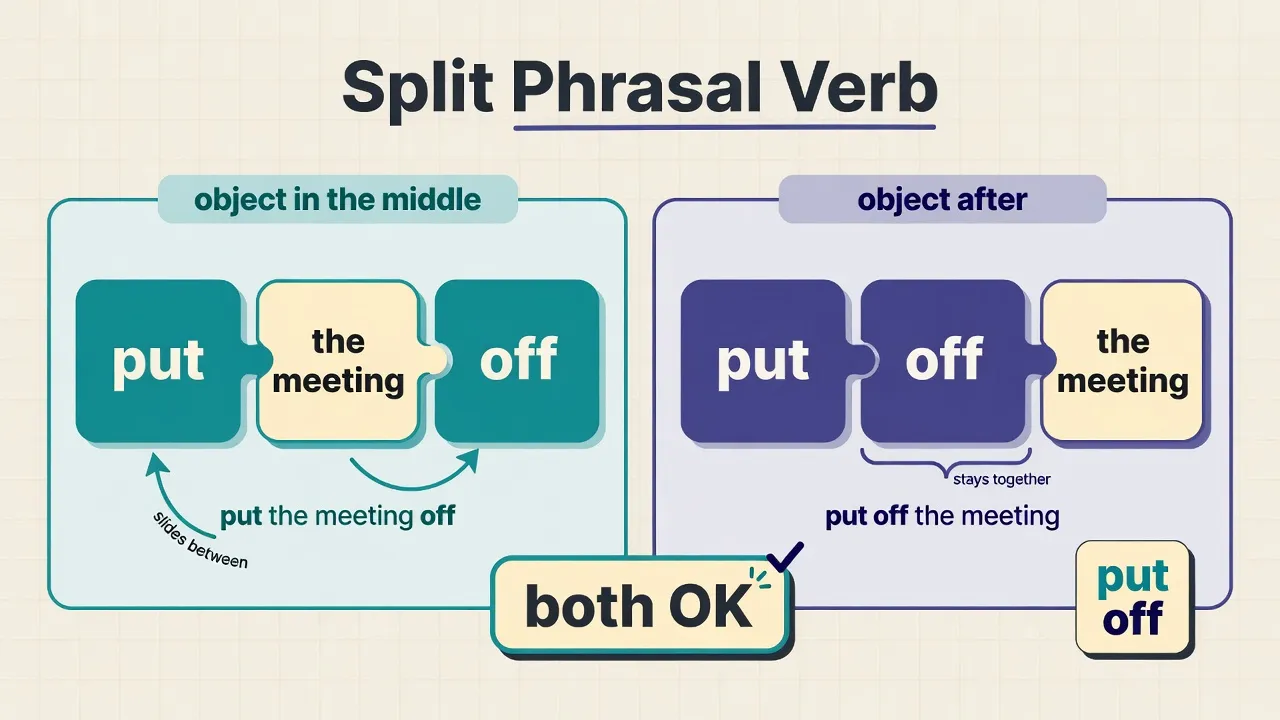
Compare:
The government decided to put off the new tax laws.
The government decided to put the new tax laws off.
Same meaning. A dictionary line or a word-by-word translator can tear the second form apart. So:
- Look for verb + particle even when a noun phrase sits between them.
- In your notes, keep both orders when both sound natural.
- Read one sentence aloud - the ear often catches the unit before the eye does.
More examples:
- They called the deal off.
- She turned the offer down.
- Investors wrote the project off.
If you only study the glued form, these lines feel broken. They are not. The particle just moved.
A 15-minute news routine
- 3 min - pick a short article on a familiar topic (not nuclear physics on day one).
- 7 min - read twice: first for overall sense, then mark phrasal verbs.
- 3 min - write 2-5 constructions with the full sentence.
- 2 min - make one sentence of your own with the most useful unit.
Do this five days a week. In a month you will not own a "dead list of 100." You will own a living mini-corpus.
Where to get texts:
- business or tech news from your field
- short explainers
- company press releases (often simpler than long features)
- graded English articles when original news still feels heavy: All articles, sample English A2
How MovaReader helps
MovaReader is a reading tool with help built in.
What is actually there:
- a free library of graded texts plus click-to-translate
- upload of your own files (for example EPUB), when you have rights to the text
- listening (unlimited on the free plan)
- practice of saved phrases in demos and on Pro
Useful links:
- How to use
- Phrases
- Word trainer demo
- Phrase trainer demo
- Trainers
- Pricing: freemium = 20 word translations per day + unlimited listening; Reader €1 = unlimited translations; Pro €5/month = full trainers
A practical loop:
- Read a graded English text or upload your own file.
- Tap only the words or phrases that break meaning.
- Save the phrasal verb with the full sentence.
- Practice a few phrases in a demo trainer.
- Return to the news text the next day.
Common mistakes
- Learning only a native-language gloss without an English example of the situation.
- Ignoring formal news register (carry out an investigation, not only do an investigation).
- Mixing prepositional verbs and true phrasal verbs without examples.
- Waiting for a perfect "list of 100" instead of reading content you care about.
FAQ
How many phrasal verbs do you need for B2?
There is no magic number. For solid B2, high-frequency units in your topics (work, news, daily life) matter more than chasing a round hundred.
Can you learn phrasal verbs from lists only?
Partly, yes. Retention is usually weak. Lists as a reference are fine. Lists as the only method often disappoint.
English news feels too hard. Where should I start?
Start with graded articles and short explainers. Move up to full news features when lookups drop.
What about multi-meaning verbs like break down?
Keep separate cards per sense plus context: car broke down / talks broke down / break down the costs.
Do I need American and British variants separately?
Catch the shared core first. Add regional notes when you already read steadily.
Does MovaReader have a separate "100 phrasal verbs" course?
No. You get reading, in-context lookup, phrase saving, and trainers. You build the list yourself from the texts you read.
Closing
Phrasal verbs do not like drilling in a vacuum. They like news, repeated situations, and short daily sessions.
Pick one article, pull a few living constructions, save full sentences, and come back tomorrow. If you want a reader with clear limits, start with free articles and check pricing only when you hit the daily translation limit.
Learning English?
The English version of MovaReader teaches Spanish and Ukrainian. To read English with a translation for every word, open the reader in Ukrainian or Spanish:
Книги англійськоюЦя стаття українськоюLibros en inglésEste artículo en español