Vocabulary
How the MovaReader Language Map Works
The language map is a vocabulary compass, not an exam. Guests see level ranges; your percentage appears after you sign in, pick English or Spanish and mark words you actually know.
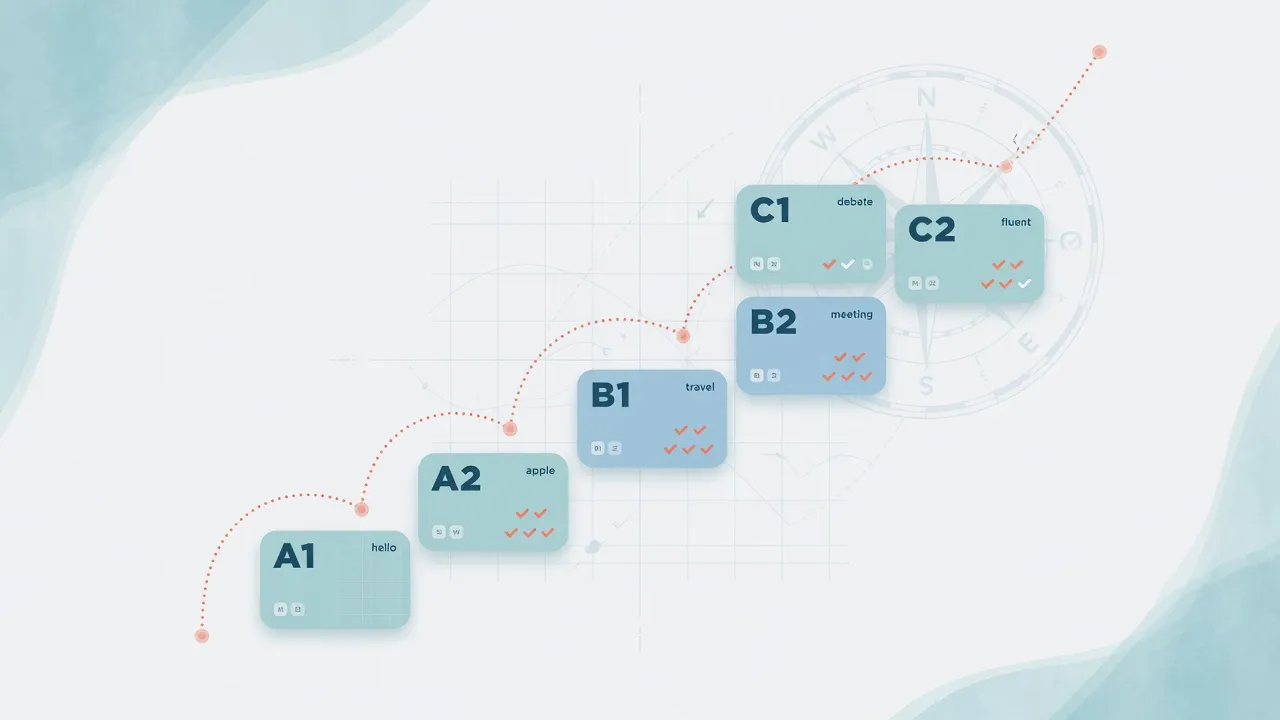
You open the language map, see nice A1-C2 cards - and maybe 0% under your progress. It feels broken. Usually it isn't.
The simple version: the map is a vocabulary compass, not a CEFR exam. Anyone can view research-style ranges for each level. Your personal percentage only appears after you sign in, choose English or Spanish as the learning language, and mark words and phrases as learned. It does not certify DELE, IELTS, or Cambridge. And yes: Ukrainian can be a site UI language, but it is not a learning target in the product.
Here's how to use it without panic.
What the map is (and isn't)
| Yes | No |
|---|---|
| A rough sense of vocabulary scale people discuss at each level | An official CEFR word quota |
| A dashboard of your MovaReader list | A 5-minute "you are B2" quiz |
| A helper that pairs with reading | An exam certificate |
In short: compass + checklist, not a diploma.
Two layers on one map
The most common mix-up is treating two different numbers as the same thing.
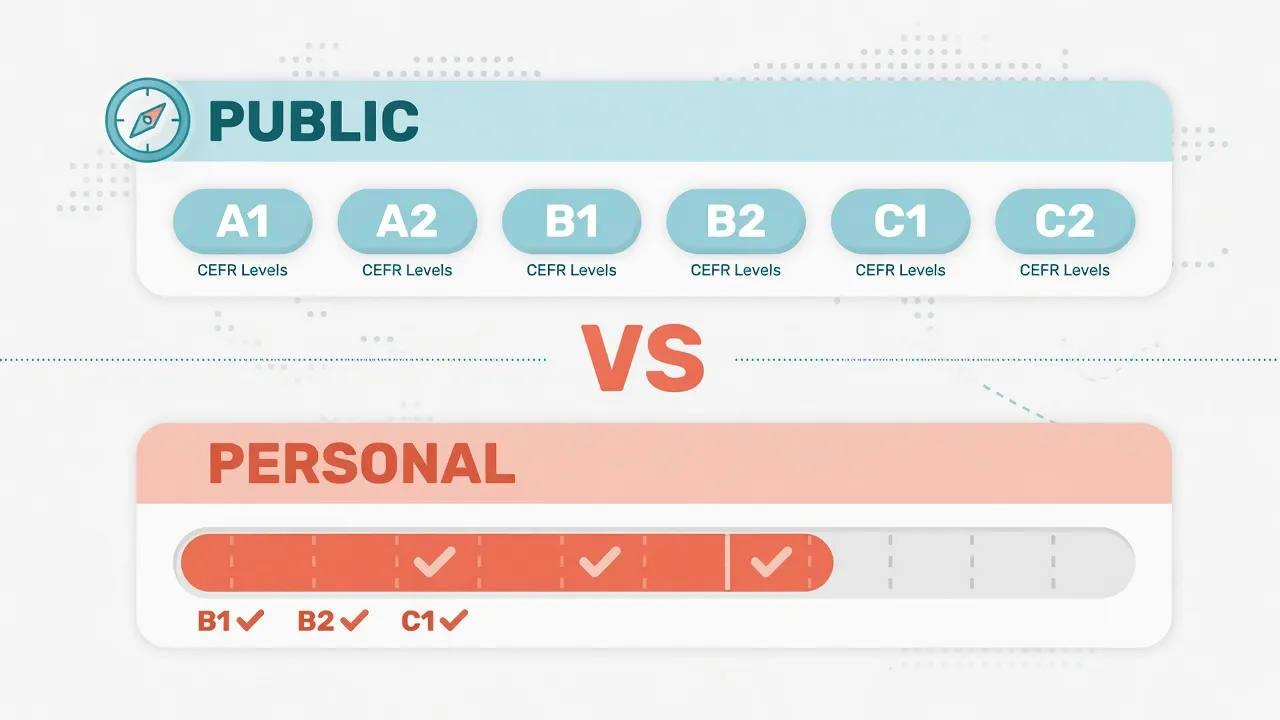
1) Public layer (everyone)
Level cards show research-style bands for frequent vocabulary. They answer: "about what scale of words do people talk about at A2 or B2?" They are not the size of MovaReader's internal catalogue and not CEFR law.
| Level | Orientation (frequent lemmas, approx.) |
|---|---|
| A1 | up to ~1,500 |
| A2 | ~1,500-2,500 |
| B1 | ~2,500-3,250 |
| B2 | ~3,250-3,750 |
| C1 | ~3,750-4,500 |
| C2 | ~4,500-5,000+ |
The open web loves hard ladders: "B2 = exactly 4,000, C2 = 16,000." Handy for chat. CEFR itself does not issue one official word count per level. We show bands as a compass and label them as not our catalogue size on purpose.
Want deeper number talk (not this UI guide): how many words CEFR, B2, the 5,000 myth, lemma vs word form.
2) Personal layer (after sign-in)
The formula is plain:
your % ≈ learned marks / catalogue size for that level
The catalogue is our teaching list for your learning language (EN or ES), words and phrases. "Approximate stage" means you've covered a good chunk of this list. It does not mean "you officially passed B2."
Why you still see 0%
Usually one of these:
- You're not signed in.
- You haven't picked a learning language (EN/ES).
- You're looking at a level you never marked.
- You read, but never set learned - "save" alone is not enough.
- You expected a free auto level test. The map isn't that.
Not a bug. The rule is simple: progress = marks, not a guess about what's in your head.
Register: sign up. Quick onboarding: how to use.
What "learned" means in normal language
Learned is not a lab score. It's your bet: "I'll probably recognize this again soon while reading."
Healthier habits:
- Mark after real meetings in text, not green-tapping a whole list.
- "I understand" often arrives before "I can say it under pressure." That's fine.
- Phrases count too. Word-only counters undervalue real language. See words vs expressions.
What learned is not: "I saw a card once," "I passed a viral CEFR quiz," "I got certified."
Slow honest marks beat a pretty, empty progress bar.
Level pages A1-C2
From the hub you can open each level list (sign-in required for personal work):
Treat them as a checklist, not a shame list. They're great for seeing what's left after months of reading - and for catching vanity counters from other apps.
If cards show extra skills marked in development, that's a roadmap, not a full multi-skill testing engine shipping today. Lean on what already works: catalogue, marks, reading.
How the map lives next to reading
The map doesn't learn for you. It shows the trail of practice.
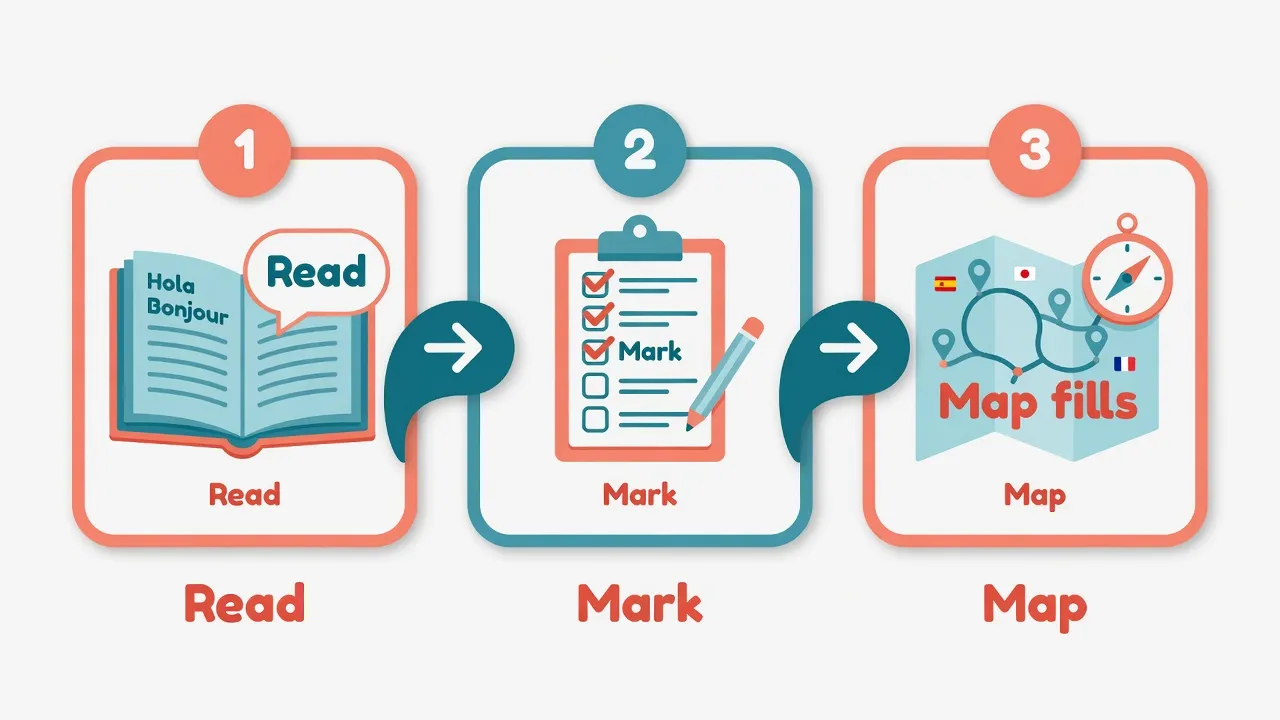
- Read with in-context translation.
- Save useful bits and set learned when a unit sticks.
- Watch catalogue coverage grow on the map.
Library: all articles. Method: B1 by reading. Samples: ES A1 #1127, ES A2 #1209.
Trainers help lock things in. The free plan keeps them limited; full volume is closer to Pro. You do not need Pro to understand the public map.
Grammar tree is a separate grammar roadmap (deeper on Pro). Also not an official CEFR certificate.
Plans and limits
| Plan | Why it matters for the map path |
|---|---|
| Free plan | See the hub, try the loop, limited translations (about 20 word translations/day as a guide) |
| Reader €1/mo | Reading + dictionary volume that actually grows your marks |
| Pro €5/mo | Full trainers, deeper grammar tree, more import - not "buy the green table" |
Soft rule of thumb:
- Only curious about CEFR-scale talk? Stay on the free map.
- Want your %? Sign in, pick EN/ES, mark carefully.
- Hit the free plan's limits on real reading? Check pricing and Reader from €1.
- Bottleneck is drills or grammar structure? Then Pro and trainers.
FAQ
Is this a free CEFR test?
No. Public ranges are orientation. Your percentage is marks vs catalogue. Exams are a different story.
Why don't the card numbers match the catalogue?
Different questions: "what scale do research-style talks use?" vs "how much of our list have you marked?"
Do I need Pro for the map?
Not to understand the public layer. Personal % needs an account and marks. For practice volume, Reader from €1 is often the right fit.
Can I track Ukrainian as a learning language?
No. UI - yes. Learning targets in the product are English and Spanish.
Do phrases count?
Yes. Words and phrases are normal progress units.
High % = ready for DELE / IELTS?
No. High % means strong coverage of this catalogue. Exams test skills in other conditions.
What to do next
- Open the map calmly, like a compass.
- For number context: A1-C2 pillar and B2.
- For personal progress: register → EN or ES → e.g. B1 or B2.
- Feed the map with reading: how to use, articles.
The map works best when you read, mark honestly, and remember: green progress is your path inside MovaReader - not an exam stamp.
Keep reading with translations inside the text
With a free account, an unknown word translates with one tap, and the words you are learning wait for you in the trainer.
Free account: 7 days of Pro, then 20 word translations a day or a paid plan.