Vocabulary
Words vs expressions: why CEFR needs chunks too
You know the words, freeze on the phrase. CEFR progress needs single words and ready-made chunks. Here is how to notice both and track them while you read.
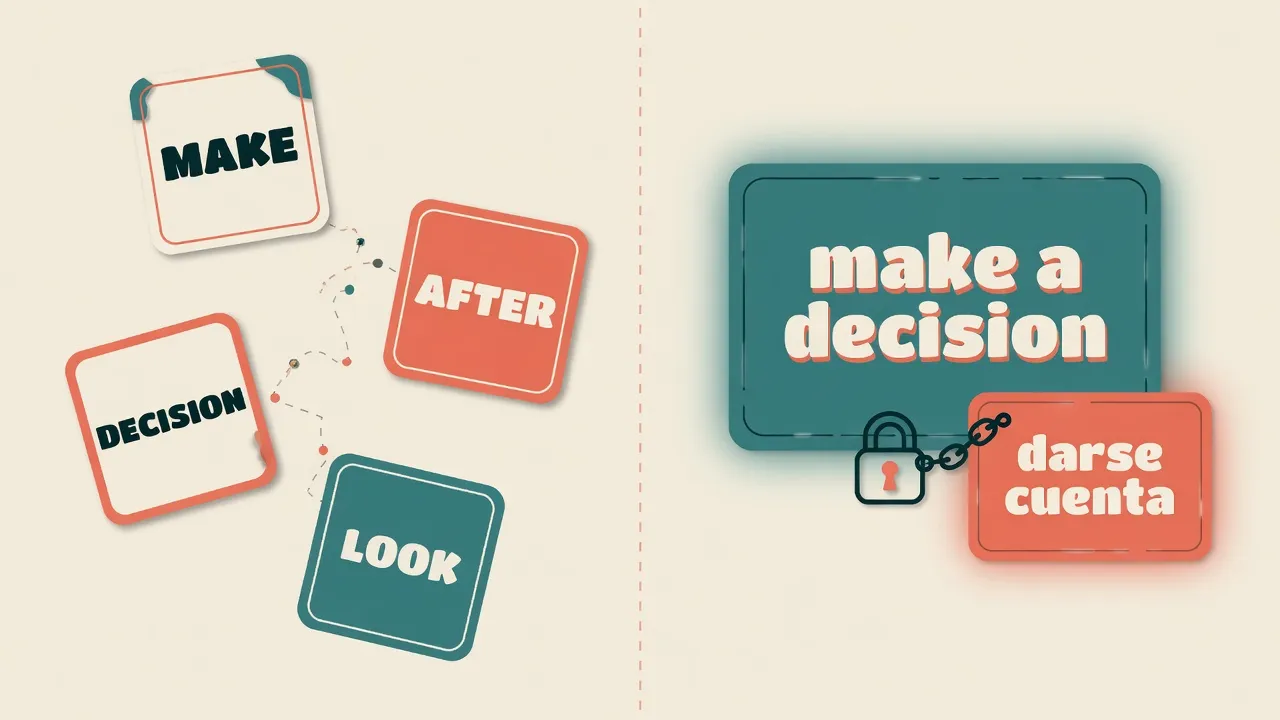
You open a page in English or Spanish. Every separate word looks familiar. Then the sentence freezes you: make a decision, look after, by the way - or tener que, darse cuenta, por si acaso. You "know" make and decision. You still cannot pull the unit out cleanly when you speak or write.
That freeze is the topic of this article. The missing piece is often not another headword. It is a multiword expression that behaves as one item in memory.
If you only count single words, CEFR progress looks better than it feels. Collocations, phrasal verbs, and ready-made formulas often behave as one unit in memory - so a lemma counter undercounts usable vocabulary. CEFR does not publish an official phrase quota; higher bands still talk about idiomatic range and flexible formulas. Treat multiword expressions as first-class units, and track words and phrases when your map allows.
Below: a simple filter for what is worth saving, realistic CEFR ranges, a practice loop while reading, and how a map can show words and phrases by level. Learning targets here are English and Spanish.
Why does knowing the words still leave you stuck?
A word list answers: "Which dictionary headwords have you met?" Real communication also needs: "Which pieces travel together?"
You can name the parts and still freeze when they travel together:
| You can list | You still may not own | Why it hurts |
|---|---|---|
| make, decision | make a decision (not do a decision) | Collocation: wrong partner sounds foreign |
| look, after | look after (care for) | Phrasal meaning is not sum of parts |
| way | by the way, on the way | Fixed routines with different jobs |
| tener, que | tener que + infinitive | High-frequency obligation chunk |
| dar, cuenta | darse cuenta | Reflexive multiword unit with one meaning |
| por, si, acaso | por si acaso | Formula you cannot invent piece by piece |
At A1-A2, many chunks are short and frequent (thank you, how much, me gusta, a veces). From B1 upward, semi-fixed phrases thicken in news, workplace talk, and fiction dialogue. A pure word counter can climb while your ear still hears correct words, wrong music.
Which pairs are real units - and which are free noise?
Not every pair of words is a learning unit. Eat bread is usually free: you combine known pieces. Strong tea, heavy rain, and tomar una decisión are tighter: natives prefer one partner.
Treating every free combination as a "phrase trophy" is noise. Treating high-frequency fixed and semi-fixed patterns as optional bonus is the opposite error.
Save a multiword item when:
- Meaning is not obvious from the parts (opaque unit: look after, darse cuenta).
- The partner is strongly preferred (collocation: make a decision, not do a decision).
- The whole unit is a speech routine you need ready-made (by the way, por si acaso, politeness frames).
Prefer opaque or high-value chunks. Opaque look after still deserves its own mark even if look and after are known lemmas. Fifty free make + noun combos do not.
What does CEFR actually care about - quotas or can-do?
CEFR describes what learners can do. It does not publish a mandatory word count or an official phrase quota. Public charts and product maps borrow orientation bands for frequent lemmas so you have a navigation ladder - not a diploma.
Here is the simple version we use on the map (frequent lemmas as a guide):
| Level | Orientation (frequent lemmas) |
|---|---|
| A1 | up to ~1,500 |
| A2 | ~1,500-2,500 |
| B1 | ~2,500-3,250 |
| B2 | ~3,250-3,750 |
| C1 | ~3,750-4,500 |
| C2 | ~4,500-5,000+ |
Those bands are not certificates, and they do not mean "only count single headwords forever." They scale high-frequency vocabulary. Expressions live beside that scale: they are how vocabulary becomes usable on a real page.
Higher bands talk about idiomatic range and flexible formulas in can-do language. They do not invent a fixed "phrases per level" number. Frequency lists also under-represent multiword units, because charts prefer countable list items. Spanish teaching inventories such as Plan Curricular organize content and themes; they are not one mandatory lemma quota either. More on that path: Spanish vocabulary, CEFR, and Plan Curricular. For size bands, see how many words for CEFR. Browse free orientation on the language map.
Why my 3,000 words still feel B1-stuck
Word size still matters - including for B2 (how many words for B2). Size alone does not fix the freeze. A few common practice patterns:
- Flashcards alone - you recognize words in lists, then slow down in sentences. You need collocations and chunks.
- Grammar only - forms look correct on tests; speech stays stiff. You need formulaic sequences.
- Lots of reading with zero saves - gist is fine; precise reuse is shaky. You need marked items for review.
- Phrase lists with no reading - you can recite slogans; transfer fails. You need context from real pages.
In practice: listable pieces build inventory. Owned chunks build usable range. Intermediate learners often have plenty of the first and too little of the second - which is why the page still freezes.
What types of expressions are worth tracking?
You do not need academic labels every day. You need a rule of thumb: if it behaves as one item when you listen or speak, store it as one item.
Useful shapes for English and Spanish:
| Type | English examples | Spanish examples | Learning job |
|---|---|---|---|
| Collocation | make a decision, heavy traffic | tomar una decisión, fuertes lluvias | Prefer native partners |
| Phrasal / multiword verb | look after, run out of | darse cuenta, llevar a cabo | Store as one meaning unit |
| Discourse routine | by the way, as far as I know | por cierto, por si acaso | Fluency glue |
| Functional formula | Would you mind...? | ¿Te importa si...? | Ready social moves |
| Light-verb patterns | have a look, take a break | dar un paseo, hacer una pregunta | High frequency, easy to misuse |
Form, lemma, and chunk - three different jobs
Think of three layers, not three trophies for the same thing:
- Word form: surface spelling (goes, went). Useful for morphology; noisy for "how big is my vocabulary?"
- Lemma: headword (go). Good for CEFR-style orientation bands.
- Expression / chunk: multiword unit (go on, go for it). Often undercounted if you only mark go.
Lemma vs chunk in one picture - one headword, several multiword lives:
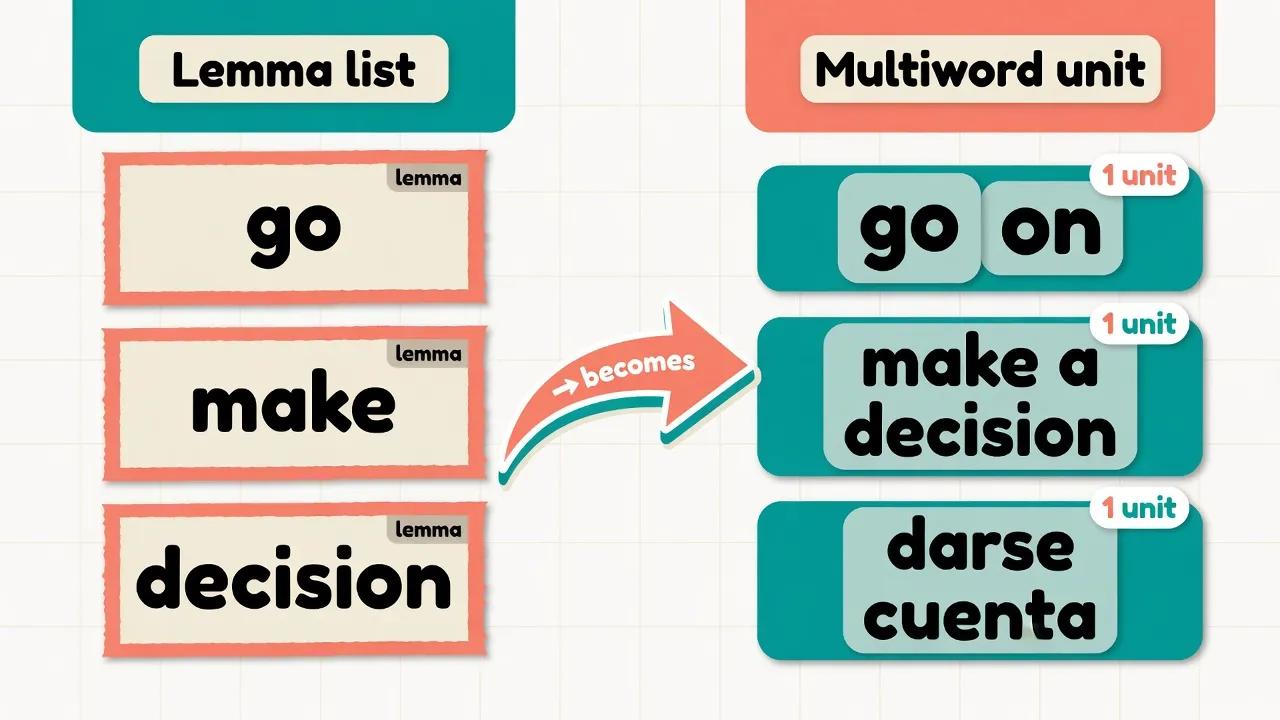
One headword can sit under several chunks. That is why pure lemma maps undercount usable vocabulary when multiword units never get their own mark. Deep dive: lemma vs word form. If someone sells "5,000 words = C2," check does 5000 words mean C2?.
Do not double-count everything
Opaque look after yes - even if look and after are already known. Fifty free make + noun combos no. High-value or opaque units earn a mark; free noise does not.
How do you practice chunks while reading?
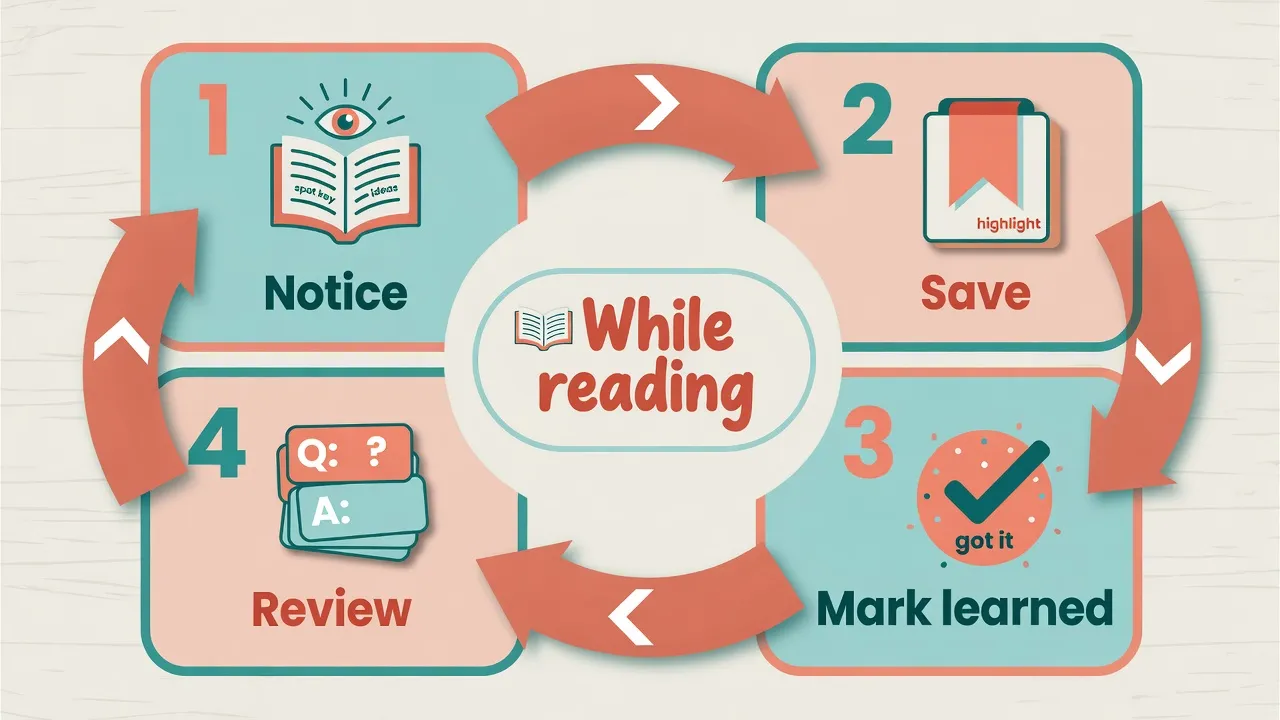
A lightweight loop beats a perfect system you abandon:
- Read graded or slightly hard text in English or Spanish.
- Look up when the sentence stalls. Prefer whole useful phrases over every tiny function word.
- Save opaque multiword units and high-value collocations when you can.
- Mark learned when the item is truly yours (recognition plus light reuse), not after one glance.
- Review with trainers when you need spaced practice.
- Re-meet the same chunk in new pages. Context beats pure list completion.
The same loop as a simple path - notice, save, mark, review:
What to notice on the page
Short signals to watch for:
- Verb + particle with a new meaning (give up, seguir adelante) - save as one unit.
- Light verb + noun (take a break, hacer una pregunta) - check the preferred partner.
- Discourse marker (on the other hand, sin embargo) - learn as glue, not three random words.
- Politeness frame (Would you mind..., ¿Podrías...?) - practice as a template.
- False friends (actually vs actualmente) - separate lemmas; also note fixed uses.
Method companion for intermediate growth: build B1 vocabulary by reading. For controlled density, try Spanish A1 (article 1127), Spanish A2 (article 1209), or browse all articles. Difficulty should leave room to notice chunks, not only survive unknown nouns.
English vs Spanish - same idea, different shapes
- English: phrasal verbs and preposition habits hide difficulty inside common short words.
- Spanish: multiword verbs (darse cuenta), se constructions, and high-frequency functional phrases (hay que, tener ganas de) do similar work.
Do not copy-paste a "phrase count" between languages. Keep separate progress for English and Spanish.
How can a map show words and phrases by level?
Think of the map as more than a single-word trophy case. Guests can open free orientation ranges. After you sign in, pick English or Spanish, then mark catalogue items you actually know. Useful progress is roughly marked items vs catalogue size on that path - learning analytics, not a lab score and not an official certificate.
Words and phrases as two layers on the same level path:
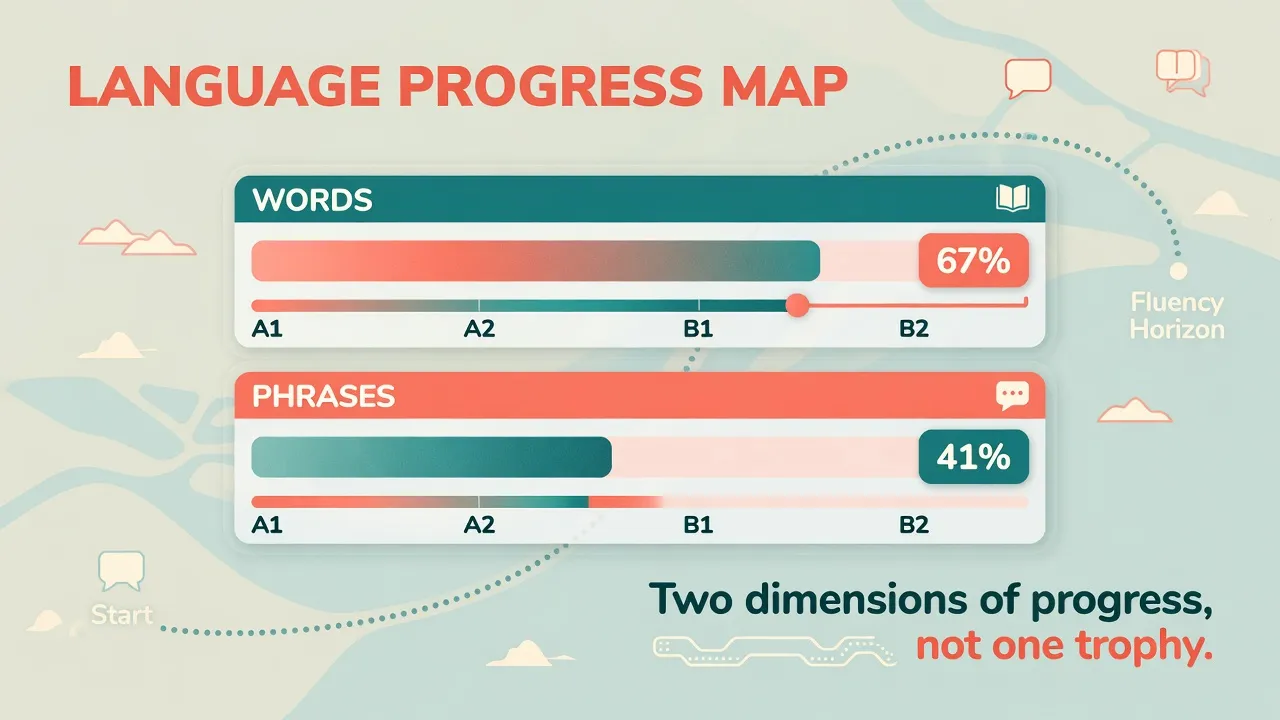
- Public ranges at the language map - research-informed orientation by level, free to browse.
- Catalogue progress after sign-in - marks on items you own.
- Words and phrases - multiword catalogue entries so chunks are not forever invisible "bonus content."
- Level vocabulary views such as B1 vocabulary or B2 vocabulary - focus on one band.
- Phrase library at phrases for thematic multiword sets.
- Trainers at trainers when review needs structure.
Filling marks at real volume still depends on reading and review. Freemium can try the loop (about 20 word translations per day). Unlimited reading translations and personal dictionary volume that feed marks sit on Reader from €1/mo. Unlimited full word and phrase trainers are more Pro (€5/mo). Details: pricing and how to use.
| Need | Realistic plan |
|---|---|
| Peek at orientation ranges | Free map |
| High volume of in-context translations + dictionary marks that feed progress | Reader from €1/mo |
| Unlimited full trainers for words/phrases | Pro €5/mo |
| Occasional try | Freemium (~20 word translations/day) |
How to track without lying to yourself: track vocabulary progress.
FAQ
Are multiword expressions "extra" after I finish the word list?
No. For real intermediate work they are part of the main path. Word lists without chunks produce stiff, literal language - correct pieces, wrong music.
Should every collocation get its own catalogue mark?
Only high-value or opaque ones. Free combinations of words you already own do not need a trophy each. Use the three-rule save filter: opaque meaning, preferred partner, or ready speech routine.
Does CEFR require a fixed number of phrases per level?
No. There is no official CEFR phrase quota the way viral charts invent word quotas. Orientation bands for frequent lemmas are navigation aids. Expressions still matter for can-do performance - idiomatic range and flexible formulas at higher bands. See how many words for CEFR.
Words first or phrases first?
Both, at different jobs. Lemmas build the skeleton of size; chunks supply the joints. Early A1 needs many short frequent chunks (thank you, me gusta) alongside basic headwords. From B1, deliberately save multiword units you meet in reading - do not wait until a pure word list is "finished." More on units: lemma vs word form.
Is English multiword learning the same shape as Spanish?
Same idea, different shapes. English hides difficulty in phrasal verbs and preposition habits. Spanish does similar work with multiword verbs (darse cuenta), se constructions, and high-frequency functional phrases (hay que, tener ganas de). Keep separate progress for English and Spanish.
Is the language map a free CEFR level test?
No. The map is orientation ranges plus optional personal catalogue analytics after sign-in (English or Spanish). Practical volume of lookups and dictionary work that feed marks usually needs Reader from €1/mo; freemium (~20 word translations/day) is for trying the loop. Unlimited full word/phrase trainers are more Pro (€5/mo).
Next steps
- Open the free language map and treat ranges as orientation, not a diploma.
- While reading English or Spanish, save opaque chunks and mark both words and multiword catalogue items when they are truly learned.
- Browse phrases when you want thematic multiword sets; use trainers when review needs structure (unlimited path: Pro).
- When freemium translation limits block volume, choose Reader from €1/mo for practical reading and dictionary use.
- Keep units consistent with lemma vs word form and how many words for CEFR.
Single lemmas build the skeleton of vocabulary size. Multiword expressions supply the joints. Count both - and practice both in context - if you want CEFR-style progress that still works on a real page.
Keep reading with translations inside the text
With a free account, an unknown word translates with one tap, and the words you are learning wait for you in the trainer.
Free account: 7 days of Pro, then 20 word translations a day or a paid plan.