Language Learning Psychology
Impostor Syndrome in Languages: Why Your Real Level Often Beats the Fear
You can read the news and still feel like a fraud. Impostor syndrome in languages is a real feeling, not a measure of skill. How to separate the inner critic from real evidence.
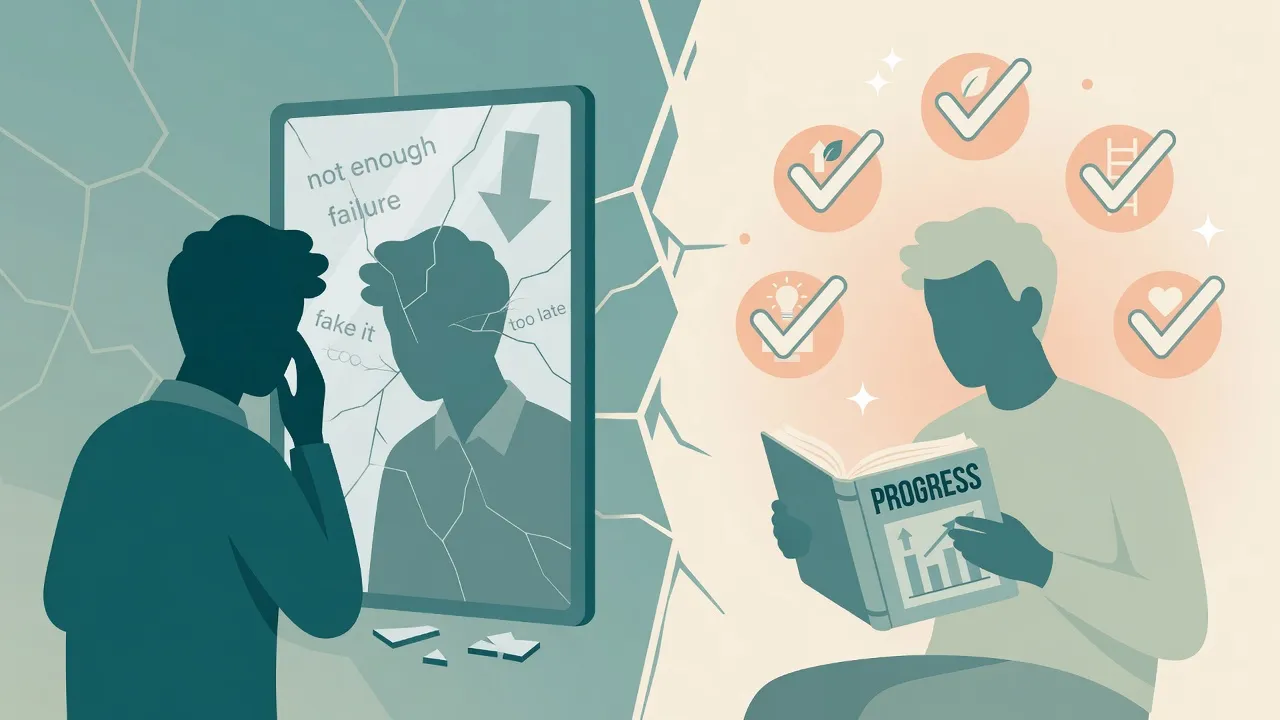
You have studied for years. You watch series without subtitles most of the time. You open BBC or El País and follow the story. Then one hard sentence lands, or you freeze mid-chat for three seconds, and the voice is instant: You know nothing. Years of work - and this is all you have?
If that loop is familiar, you are meeting language impostor syndrome: the stubborn sense that you are faking a level you already use in real life, and that someone will "find you out." The feeling is common and uncomfortable. It is not a lab measurement of CEFR. It is not proof that you are actually A2. And one unknown word, or one awkward pause, does not erase years of contact with the language.
Better antidotes look quiet: private reading, finished passages, short paraphrase checks, and tracked vocabulary marks - not motivational slogans alone.
What language impostor syndrome is (and is not)
Impostor feelings in general mean you treat success as luck and wait to be exposed as a fraud. With languages the pattern gets specific.
You can finish a full article and still fixate on the five percent you did not know. You can hold a twenty-minute work chat and then replay the one phrase where you stalled. You can pass a class or use English daily at work and still whisper "I am not a real speaker."
Useful truths:
- The feeling is real. The score it gives you is not reliable.
- Feeling worse after progress can mean you now see gaps that beginners cannot see.
- One freeze is activation lag or social pressure - not a full wipe of long-term knowledge.
- CEFR labels, exam days, and social media "perfect natives" are noisy signals. Private can-do evidence is quieter and often fairer.
What this is not: a medical diagnosis you must claim, a guarantee that everyone is "actually C1," or proof that exams are meaningless. If anxiety is severe or constant, talk to a professional. Apps and blogs do not replace that.
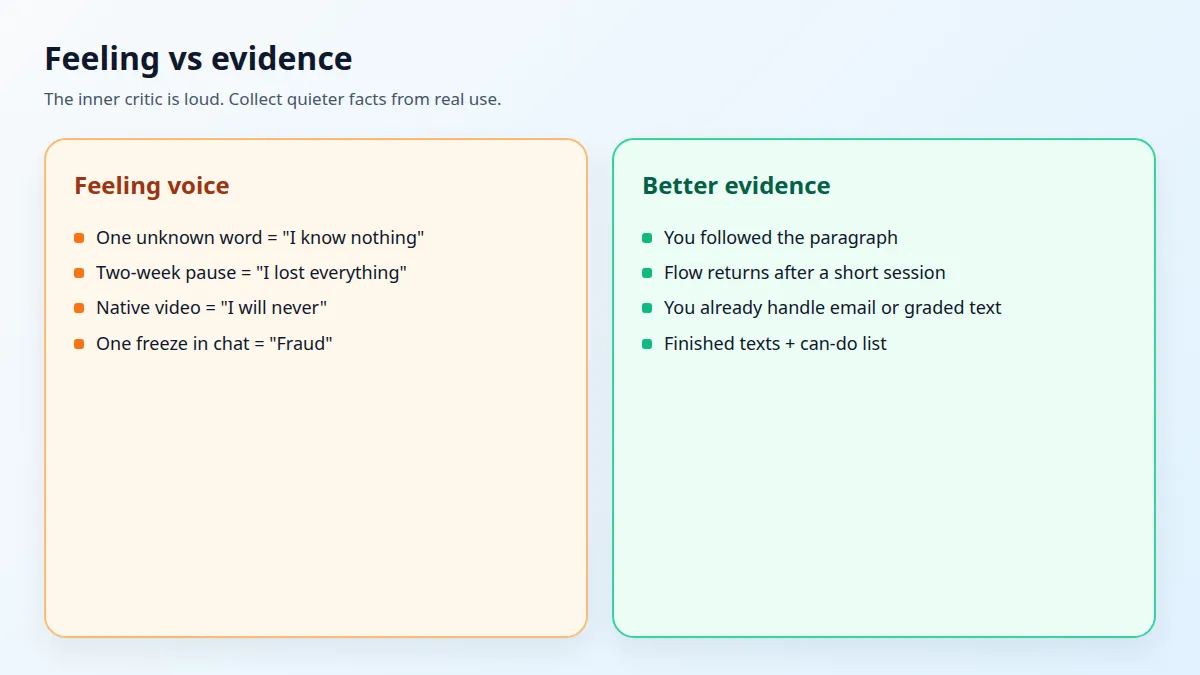
The practical move is simple: stop treating the loudest moment of shame as your level. Collect quieter facts from real use.
| Signal | Feeling voice | Better evidence |
|---|---|---|
| One unknown word | "I know nothing" | You followed the paragraph |
| Two-week pause | "I lost everything" | Reactivation after a short session |
| Native video | "I will never" | You already handle work email or a graded novel |
| Exam anxiety | "Fraud" | Can-do list + finished texts |
Three main triggers
Most language impostor loops run on a few familiar triggers. Naming them does not cure the feeling overnight. It does stop you from treating the feeling as destiny.
1. Blank page after a pause
You skip practice for two weeks. You open a book. The first page feels like fog. Panic: I lost everything.
Usually you did not. Language knowledge sits in long-term memory. What stalled is activation - the speed at which words come online. Fifteen to twenty minutes of gentle input (easy reading, a familiar podcast, a page you have seen before) often restarts the flow. The damage is not the two-week gap. The damage is believing those first panicked minutes are your "true" level.
2. The ideal native speaker myth
Social media sells a fake standard: perfect accent, zero unknown words, effortless jokes in every dialect. Real natives also look things up. They mishear lyrics. They skip dense legal prose. They do not know every rare adjective on the internet.
Comparing your B2 Tuesday to a highlight reel of "native perfection" is not assessment. It is a rigged contest. Your job is not to be invisible as a foreign speaker. Your job is to do what you need: read the brief, order the coffee, follow the meeting, enjoy the novel.
3. Error focus (negativity bias)
Brains evolved to notice threats. In language practice that often becomes: ignore fifty good sentences, store the one wrong article. In reading: skip two hundred known words, freeze on one idiom.
That is not an objective audit of your skill. It is a bias with a survival backstory that happens to be terrible at scoring vocabulary.
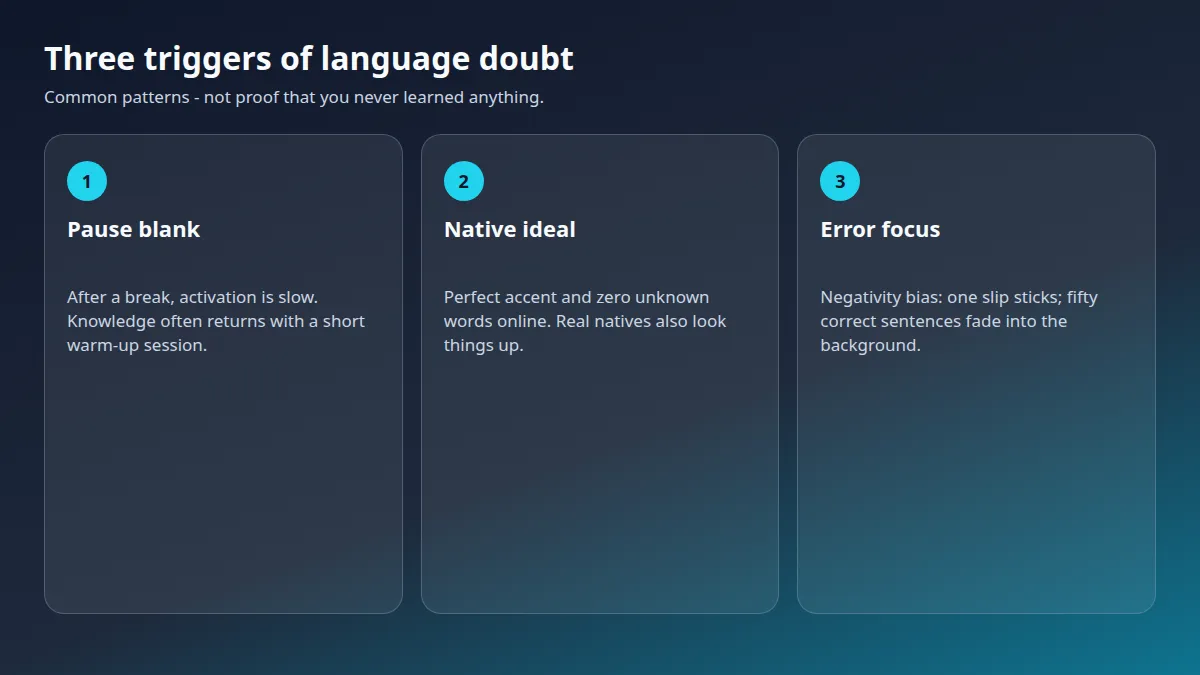
When all three fire together - a pause, a native video, one public mistake - the inner critic sounds almost rational. It is still not a full measurement.
Why "I understand nothing" is often a focus trick
Here is the coverage idea.
Extensive-reading research and classroom tradition often treat high known-word rates as helpful for comfortable reading. Teachers and researchers discuss roughly the mid-to-high 90%s for easy unassisted reading; lower rates mean more decoding and more friction. Use that as a guide for text choice, not as a branded "88% mathematical fact" about you and any random Times article.
What the guide is for:
- If almost every line needs a lookup, the text is too hard for flow reading right now.
- If you mostly ride the meaning and only tap a few blockers, comprehension is doing real work - even if the unknown items feel huge.
- Context still carries a lot of the load. Topic words, cognates, and sentence shape help more than the panic admits.
The subjective trap is focus. Unknown items are rare, bright, and sticky. Known items are frequent and invisible. So the whole page feels impossible while you are still following the argument.
A fairer check is not "Did I know every word?" It is "Can I state the main idea?" or "Could I answer one question about what happened?" That is reading competence. Dictionary perfection is a different hobby.
For a calm, level-fit start, browse free graded articles or try a concrete sample like this Spanish article. Match difficulty to the day you are having, not to the shame you feel after one hard paragraph.
Four strategies to stop undervaluing progress
Strategies will not delete every anxious thought. They change what you feed the thought.
1. Swap the question
Drop "Am I good enough?" for one session. Ask: What can I already do with this page?
Examples: I got the headline. I followed who did what. I only needed three lookups. I could paraphrase the last paragraph. Those answers are boring and powerful. Impostor feelings starve on boring evidence.
2. Keep a tiny win journal
Each day, write three language wins. Keep them small on purpose:
- Understood a meme without translating the punchline
- Got the gist of a news headline in one pass
- Answered a work email without pasting the whole thing into a translator
- Finished two pages of a graded story
After a month, reread the list. The point is not Instagram. The point is a record your mood cannot edit in real time.
3. Read with light support - do not avoid all hard text forever
Avoidance confirms the story "I am not enough." Unlimited struggle confirms the story "I am failing." The middle path is light support on blockers: tap the word that stops meaning, keep going, do not turn every sentence into a grammar exam.
Looking up a blocker is not cheating. Native readers do it with hard books. Skilled reading includes repair moves. If the free plan's limits bite (about 20 word translations a day), choose easier texts that day, or use pricing when volume reading is the goal. Listening stays available as a second channel when your eyes are tired.
4. Redefine "know a language"
Knowing a language is not zero accent. It is not every dictionary entry. It is not perfect essays on the first try.
Knowing a language is using it to reach your goals: understand a medicine leaflet, follow a contract outline, write a client email, order coffee in London, enjoy a chapter of a novel. Everything else is refinement. Refinement is allowed to take years without cancelling the goals you already hit.
If you want structure for practice after reading, try the typing demo or phrase typing demo - small loops that reuse what you marked, not a public performance stage.
Why B2+ often suffers most (reverse Dunning-Kruger style)
Here is the irony: many people feel more fraudulent as they get better.
At A1-A2, the map of the language is small. Every new tense or word batch feels like visible progress. You do not yet see how deep the ocean is.
As level rises, awareness rises with it. You notice idioms you miss, shades of meaning, cultural jokes, regional accents, politeness layers. The more you know, the more you can name what you do not know. That pattern is often called a reverse Dunning-Kruger style effect in learning talk: competence grows, self-rating drops, because the blind spots become visible.
Reframe the noticing. Spotting that run has many senses, or that a joke depends on shared TV culture, is not proof you are a fraud. Beginners often do not even see those layers. Noticing complexity is a side effect of growth - awkward, but informative.
This does not mean "everyone who feels bad is secretly C1." Some people really need more hours, clearer goals, or easier texts. It means feeling fraudulent is a weak signal for ranking yourself against CEFR. Use can-do examples instead.
Five-minute self-check exercise
A short exercise beats a long argument with your inner critic.
- Open a short authentic or graded text (news paragraph, blog, free library piece).
- Read one paragraph carefully.
- Close it (or look away) and paraphrase the idea in your first language - two or three sentences is enough.
If you can state the idea, comprehension is not zero - whatever the critic says.
Optional fourth step: mark one or two words you want to keep. Over weeks, those marks become a personal trail. In MovaReader, after sign-in, the language map fills from your marks over catalogue units. That is personal progress volume, not a DELE, IELTS, or CEFR certificate.
Do the exercise on a good day and on a bad day. Compare the paraphrase quality, not the mood. Mood is weather. Finished meaning is climate.
Why reading is a safer lab than judged speaking
Speaking fear is real. There is a live person, turn-taking pressure, and the sense of being scored in real time. For many learners that freezes retrieval even when the knowledge exists offline.
Reading is a different lab:
- No audience waiting for your next word
- You control pace, re-reads, and pauses
- You can repair with a lookup and continue
- Every finished article or chapter is a quiet artifact of competence
Reading alone will not automatically fix stage fright in meetings. Speaking fear may still need low-stakes speaking practice on its own track. What reading does well is rebuild trust: "I can follow real messages without collapsing." That trust often softens the impostor volume even when speaking still needs separate work.
If the method itself has started to feel toxic, you may also be dealing with learning burnout or fear of mistakes and perfectionism. Different problems, overlapping symptoms. Reading interesting text at a fit level helps several of them for the same reason: low social threat, high meaning.
For a practical tour of the reader workflow, see how to use MovaReader.
Where MovaReader fits
MovaReader is a reading tool, not therapy and not a fluency certificate.
What it can do, without theatre:
- Private reading - no live judge in the room
- Free graded library - rebuild confidence with level-fit text via all articles
- Tap unknown words - the free plan is limited (~20 word translations per day); keep meaning moving instead of panic-stopping
- Listening - useful when you want a second pass without social pressure
- Marks + language map - after sign-in, personal % coverage of the catalogue grows from what you mark; see language map. This is not an exam result.
- Trainers - on Pro, reuse saved items in focused drills when you want active recall, not only passive reading
Pricing in plain terms:
- Free plan: limited word translations (~20/day) + listening where offered
- Reader (~€1/month): higher translation capacity for real reading volume
- Pro (~€5/month): trainers + private import features as shipped
Details and current limits: pricing. Own files and higher volume belong on paid tiers as applicable. Full commercial novels are not included for free.
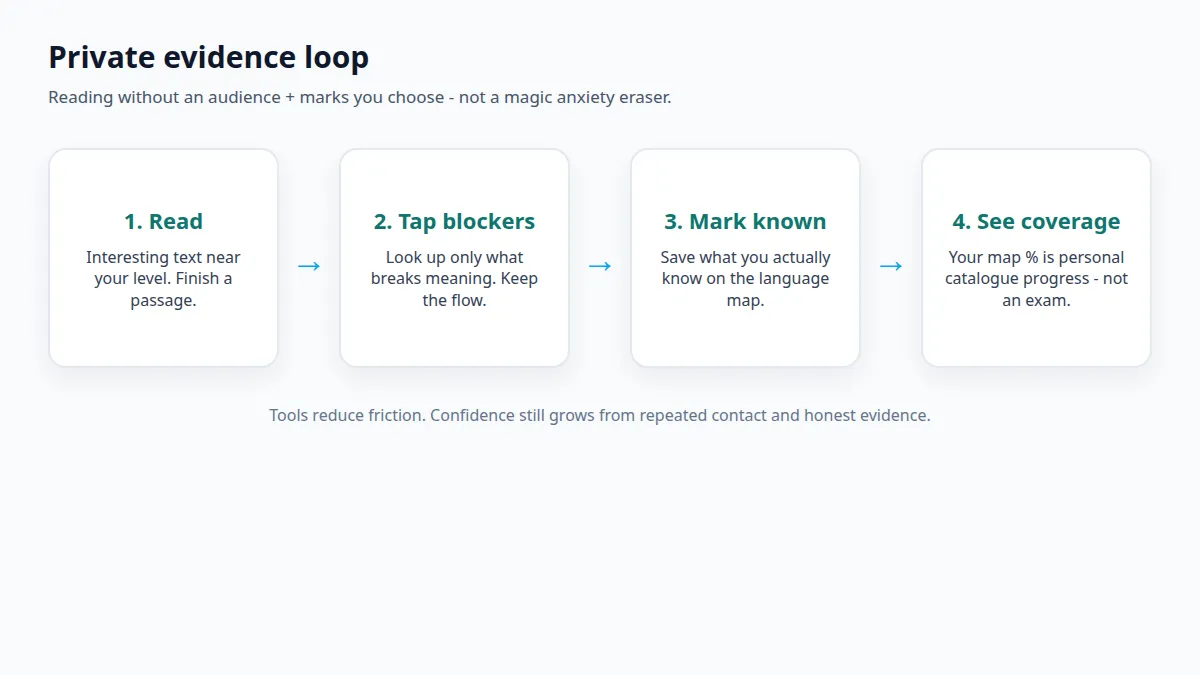
A sane loop looks like this: read a fit text → tap only true blockers → mark a few keepers → watch the map fill over time → optionally train marked items. Evidence accumulates in private. The critic still talks. It just has more competition.
FAQ
Is language impostor syndrome a real diagnosis?
It is a popular name for a common pattern of self-doubt, not a medical label you must claim. If anxiety is severe, talk to a professional - apps do not replace that.
Does a higher level always feel more confident?
Not always. Many people feel more fraudulent as they notice idioms, accents, and cultural layers they missed before. Noticing gaps can be a sign of growth, not proof of failure.
Can reading alone fix impostor feelings?
Reading is a low-audience space to collect evidence. It helps many people. Speaking fear may still need low-stakes speaking practice separately.
Should I trust CEFR labels or my gut?
Neither alone. Labels are useful maps. Gut is noisy. Mix can-do examples, finished texts, and (if you use it) marked vocabulary progress on something like a language map.
Is tap-translate "cheating"?
No. Looking up blockers to keep meaning flowing is normal skilled reading behavior - native readers do it with hard books too.
How does MovaReader help?
Private reading, tap for blockers, free graded samples, optional listening, demos for words and phrases, and a language map that fills from your marks after sign-in. It does not certify exams or make anxiety disappear.
What if I really am stuck at a lower level?
Then collect evidence the same way - just choose easier texts. Choosing the right level is kindness, not defeat. Graded material and short daily contact beat shame-driven leaps into densest news every morning.
Short close
Your real level is not the volume of the inner critic after one hard sentence. It is closer to what you can already do when nobody is scoring you: follow a paragraph, finish a page, write the email, restate the idea.
Stop treating freeze moments as a final exam. Start a small pile of private evidence. Open one fit article, try the five-minute paraphrase, mark what you want to keep, and let the map catch up later if you use it.
You do not need a slogan. You need quieter facts - and a reading space calm enough to notice them.
Keep reading with translations inside the text
With a free account, an unknown word translates with one tap, and the words you are learning wait for you in the trainer.
Free account: 7 days of Pro, then 20 word translations a day or a paid plan.