Tips & Methods
How to Memorize English Words Faster
You cram a bare list at night and most of it is gone next week. A practical loop: meet words in real text, save useful phrases, review briefly and re-meet them as you read.
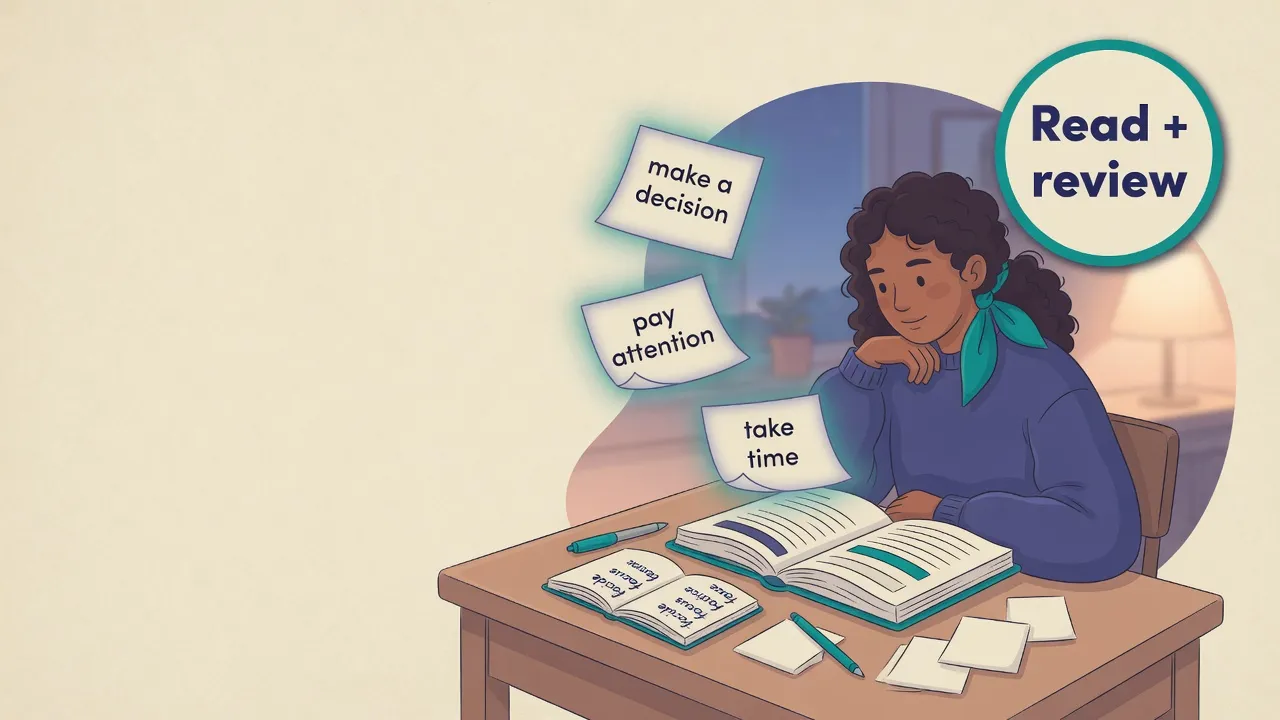
You cram a bare word list at night. By next week most of it is gone - and you blame your "bad memory."
That pattern is normal. It is not proof that your brain is broken. Isolated lists give the brain weak hooks: no scene, no partners, no reason to care. One meeting is not durable storage.
What actually sticks faster
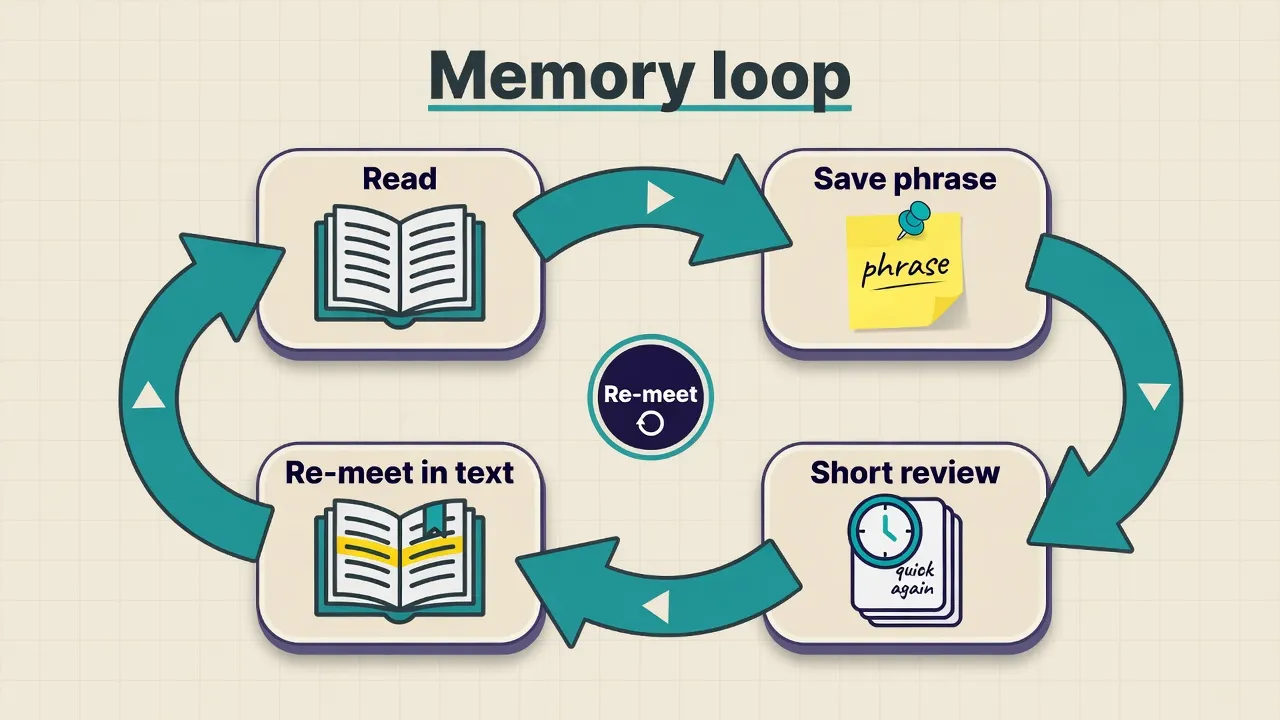
Here's the simple version. Isolated word lists fade fast because the brain gets weak hooks without scene, emotion, or use. Faster retention is better first encoding plus smarter re-meet - not a permanent memory chip. What works: meet words in real text → save useful phrases → short spaced review → re-meet them in the next reading (and use lightly when you want active vocab). A handful of sticky phrases from level-fit text beats fifty bare translations forgotten tomorrow.
"Fast" here does not mean athletic memory-palace claims or "30 seconds flat." It means less waste: a stronger first meeting, timed re-meet, and fewer orphan lemmas that never return.
Bare list cram: fifty headwords, one night, no story.
Context loop: a few phrases from a page you can almost read, re-seen on purpose.
The second path is slower at the counter and stronger in real life.
Why bare word lists fail
A lemma on a page - decision, attention, get - has almost no glue. You do not see who makes the decision, what you pay attention to, or which sense of get you need. Collocations, emotion, and use sit outside the row.
One meeting is not durable passive knowledge either. You glance, nod, move on. The next morning the page is empty. That early fade is ordinary biology after an unused encounter, not a character flaw.
Paper notebooks can feel serious and still fail the same way if you never re-meet items in real text. If lists without re-meet are your main habit, the sister post on why paper vocabulary notebooks kill motivation goes deeper.
The reading-first memory loop
This is the spine. Methods later are layers inside the loop - not five siloed tip dumps.
| Step | Name | What you do | Loop role |
|---|---|---|---|
| 1 | Meet | See the word or phrase in graded or level-fit text | First encoding with scene |
| 2 | Save | Keep a useful phrase/chunk (not every unknown) | Selectivity |
| 3 | Short review | SRS or a 15-minute habit window | Timed re-meet |
| 4 | Re-meet | Next reading or listening | Story glue again |
| 5 | Use lightly | One written or spoken line when aiming active | Optional activate layer |
In plain order:
meet in text
  → save phrase (selective)
  → short spaced review
  → re-meet in next reading
  → optional light use
How many unknowns to save per page
Leave the page readable. If you click every line, the text is too hard - level down.
| Signal | Action |
|---|---|
| Blocks meaning of the sentence | Candidate to save |
| Keeps reappearing on the page | Strong save |
| Rare one-off you will not need soon | Skip or ignore |
| Already half-known from context | Maybe mark for re-meet, not full save |
Rule of thumb: 3-7 useful phrases from one near-level session is a solid day. Vanity unique-lemma counters are not.
Product path sketch
In practice inside a reader: open a graded article → click-translate blockers → save phrases → short trainer or same-day re-look → re-read later. Free library path: all articles.
Method layers inside the loop
Many guides love "5 ways." Treat each as a job inside the same spine.
Context reading (meet)
Dictionary marches train you to collect orphans. Graded or level-fit text trains you to meet language with a scene.
Parallel reading and click-to-translate help when the story still makes sense. Useful items often reappear across pages; you do not need a strict "must meet 5-7 times" rule - frequency still helps when it is real.
Browse the graded gym: all articles. Start near your comfort zone, not three CEFR steps above it. For a longer reading method path, see build B1 vocabulary by reading when you want that sibling depth.
Phrases and chunks, not bare lemmas (save)
Prefer the chunk you actually met:
| Weaker (bare list) | Stronger (phrase in a sentence) |
|---|---|
decision |
make a decision |
attention |
pay attention |
get (which sense?) |
get the idea / get home / get better |
Examples that carry partners:
She had to make a decision before Friday.
Please pay attention to the last paragraph.
I finally got the idea after the second example.
Chunks travel into speech as units. Multi-sense lemmas like get need context; lists hide which sense you need. Prefer high-frequency phrases over a long orphan counter.
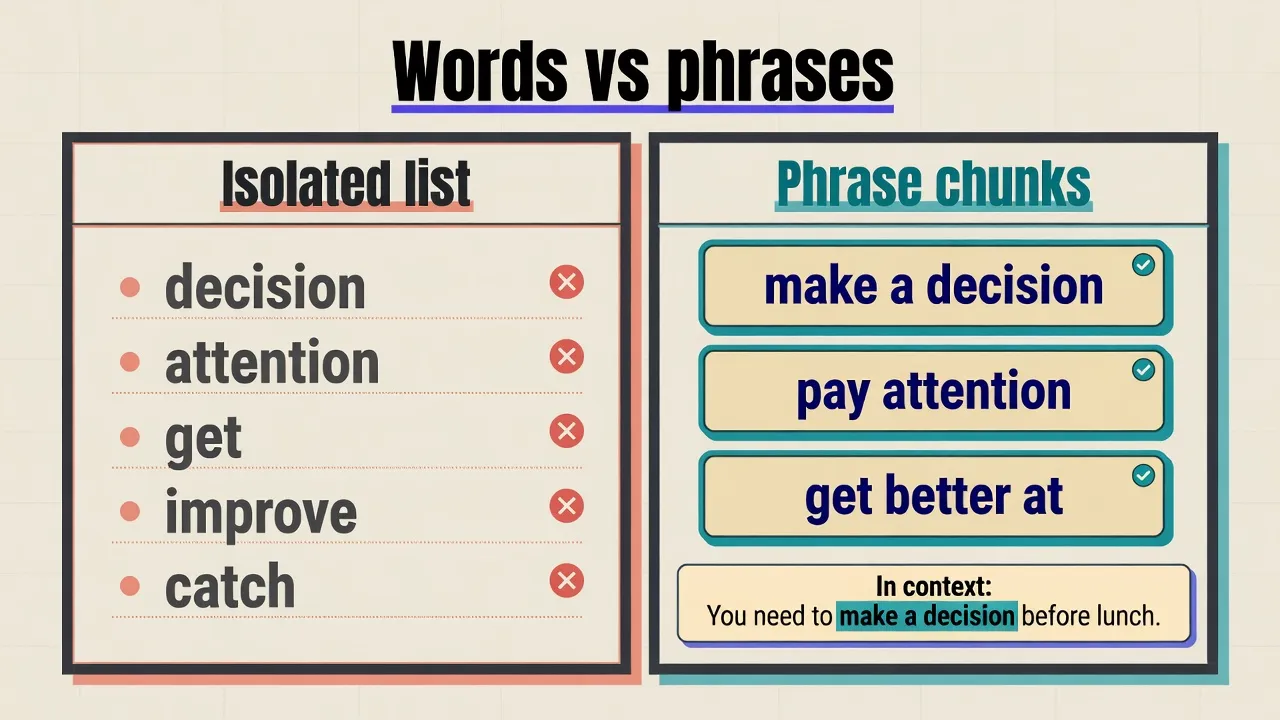
Save and revisit phrases in the product hub: phrases. For why expressions beat bare words at CEFR-style coverage, words vs expressions is a natural next read.
Light spaced review (review)
Spacing is a rough guide, not a medical schedule and not an exact percentage law.
| When | Purpose | What to do |
|---|---|---|
| Same day | Catch early fade after one meeting | Quick re-see of today's saved phrases |
| Next day | First consolidation | Try to recall before you peek; 5-10 min is fine |
| Few days (~3) | Strengthen | Prefer phrase form over orphan lemma |
| About a week | Stretch interval | Re-meet in text or short phrase drill |
| Longer (weeks+) | Long-term check | Light review; re-read a short piece if fuzzy |
same day → next day → few days → ~1 week → longer
(early fade risk)              (stretch if easy / shorten if hard)
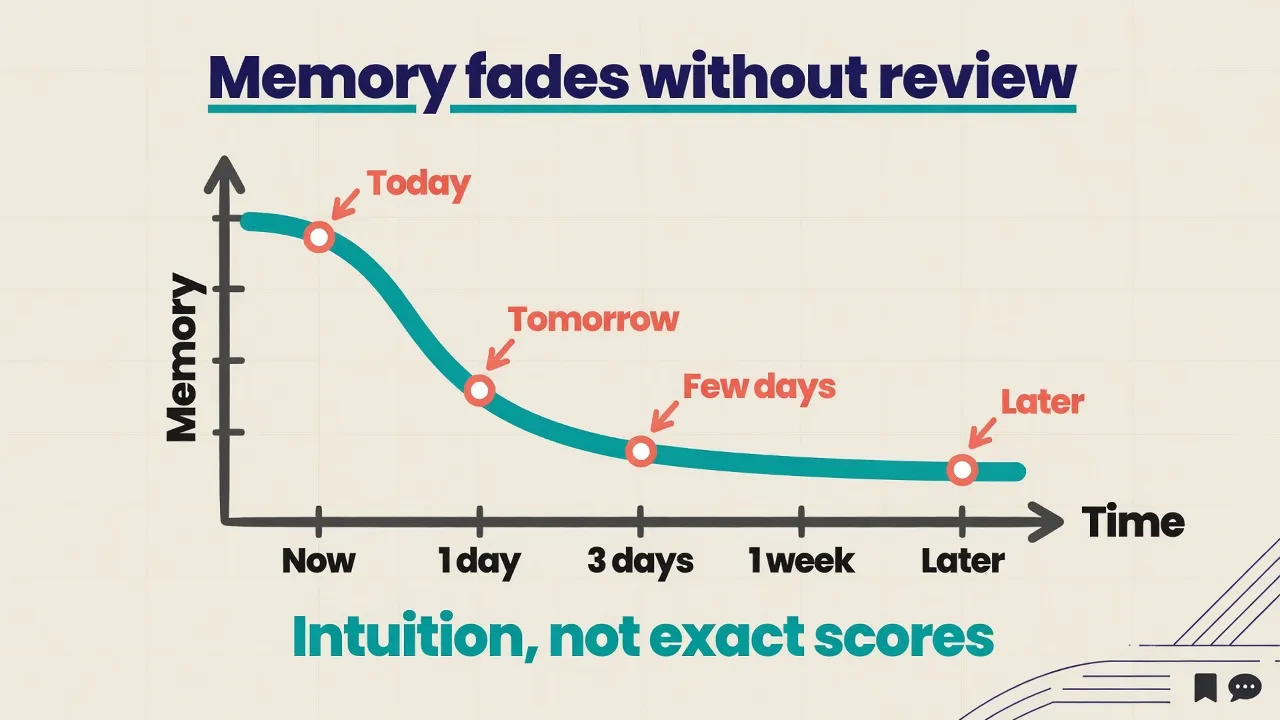
Forgetting after a single unused meeting is normal. Classic curve sketches come largely from old nonsense-syllable work - use the shape (steep early drop, then slower fade), not invented exact "80% gone" as a universal learner law. Full depth lives in the sister post on the Ebbinghaus forgetting curve for vocabulary (the method works for any language, though that post uses Spanish examples).
Anki is fine for phrases from your reading. Bare translation decks without context burn out. A simple daily container for review and read time is the 15-minute rule for daily vocabulary.
In-app trainers and demos like type training and phrase typing reduce friction on saved items. They are helpers.
Optional mnemonics (hard words only)
Keep this short. A fun sound-alike or silly image can hook a stubborn rare word once. Example flavor: a word that sounds like something visual in your L1 gets a one-second mental movie. Then put it back into a phrase and a page.
This is not a memory-palace course. Reading-first still wins for most everyday vocabulary.
Light use: use it or lose it (activate)
When you want active vocab, not only recognition:
- One sentence in a diary or notes app using today's phrase.
- One short social or chat comment with a chunk you saved.
- Speak one line to yourself while walking (no audience required).
Depth on the passive-to-active jump lives in passive to active vocabulary and the language barrier.
Realistic daily limits
Cap daily new units. Lifestyle variance is real.
| Do | Don't |
|---|---|
| Soft ranges: a handful of phrases that reappear (often ~3-8 sticky units on a normal day) | Aim for thousands of new words per month |
| Prefer sticky units from real text | Vanity unique-lemma counters |
| Busy week = fewer new saves; protect re-meet | Believe "memory multiplied" percentage ads |
| Measure finished pages + usable phrases | Night-before cram as "method" |
Huge monthly word targets are mostly marketing. For the full volume myth and realistic ranges, read how to learn 3000 English words a month.
For rough orientation on how many words show up by CEFR band, open the language map.
What not to do
A short list:
- Cramming 50 bare pairs the night before a test and calling it vocabulary growth.
- Saving every unknown with no filter until review debt kills reading.
- Letting review eat all reading time so you never meet new language in a story.
- Waiting for a perfect "forever memory" method - no such method exists; aim for faster retention and re-meet.
- Paper list romance without re-meeting words in real text - lists without context fade (again: paper notebooks).
How MovaReader fits (reading + review)
MovaReader is built for reading + save + light review.
A free path:
- Open a free graded English article (or a legal EPUB you own).
- Read for meaning; the free plan includes about 20 word translations per day - tap blockers and repeating items only.
- Save useful phrases, not every bare lemma.
- Same-day / next-day short re-look; re-meet in the next graded piece.
- Optional: phrase trainers when you want active recall (Pro if you need full trainers).
- Optional: language map for rough CEFR-style orientation.
| Plan | In one line |
|---|---|
| Free plan | Graded library + ~20 word translations/day + unlimited listen |
| Reader ~€1 | Heavier daily reading without the free plan's translation cap |
| Pro ~€5 | Full trainers for active phrase practice |
Own legal EPUB/files are OK. We do not host licensed commercial novels free by default.
Useful links: all articles · phrases · trainers · pricing · how to use.
Soft try: open a near-level English article, save 3-7 phrases, re-read later. Same-day + next-day re-look of those phrases beats a 50-word dump you never review. Upgrade only if you want heavier reading (Reader ~€1) or full phrase trainers (Pro ~€5).
FAQ
How many English words should I learn per day?
There is no universal daily quota that works for every lifestyle. A practical default: a handful of sticky phrases from level-fit reading (often roughly 3-8 units you will actually re-meet), not fifty bare translations. Busy weeks mean fewer new saves; protect re-meeting what you already saved. Quality and reuse beat vanity counters. For volume myths and realistic ranges, see how to learn 3000 English words a month.
Is it possible to memorize vocabulary forever?
Short answer: no permanent "set and forget" for unused words. Memory fades without re-meet and light review; that is normal biology, not a character flaw. What you can aim for is faster retention and less fade - better first encoding in context, phrases instead of orphan lemmas, and spaced re-meets so items stick better over time. Skip any method that sells "never forget" as a guarantee.
Do I need Anki, or is reading enough?
You do not need Anki to start. Reading in context builds meaning, collocations, and story glue. Spaced review (Anki, paper schedule, or in-app trainers) helps timing for phrases you already met in text. Bare translation decks without reading often burn out. Hybrid that works for many people: meet in graded text → save a phrase → short review → re-meet in the next page. Anki is optional tooling, not a religion.
Why do I forget words the next day?
Because one meeting is weak storage - especially from a bare list with no scene or use. Early fade after a single unused encounter is expected; classic forgetting-curve sketches are a rough intuition (steep early drop, then slower fade), not an exact personal percentage law. Fix: same-day re-see, next-day recall, then re-meet in real text. Shame does not help; the loop does. Deeper curve science: Ebbinghaus forgetting curve.
Should I learn words or whole phrases?
Prefer phrases and chunks when you can: make a decision, pay attention, multi-sense get in a real sentence. Chunks carry partners, grammar, and usable speech rhythm. Bare lemmas are fine as a start for rare hard items, weak as the only diet. Save the line you actually met, not only the dictionary headword. Product home for chunks: phrases.
What can I do free in MovaReader (20 translations/day)?
On the free plan you get the graded library, unlimited listening, and about 20 word translations per day - so pick clicks that matter. Reader is about €1 for unlimited translations when you read more. Pro is about €5 for full trainers. Own legal EPUB/files are OK to use; we do not host licensed commercial novels free by default. The product is built for reading + save + light review. Details: pricing.
Today in 15-20 minutes
- One near-level English text from all articles.
- Save 3-7 useful phrases.
- One short review pass (same day).
- Re-read later or tomorrow.
If you want a habit container for that block, use the 15-minute daily vocabulary rule.
Read next
- Soft science depth: Ebbinghaus forgetting curve
- Realistic volume: 3000 English words a month?
- Daily time-box: 15-minute rule
- Activate what you know: passive to active vocabulary
- Why lists stall: paper vocabulary notebooks
You do not need a permanent memory chip. You need better first meetings, selective phrases, and re-meets that keep the language alive on the page.
Learning English?
The English version of MovaReader teaches Spanish and Ukrainian. To read English with a translation for every word, open the reader in Ukrainian or Spanish:
Книги англійськоюЦя стаття українськоюLibros en inglésEste artículo en español