Tips & Methods
Why Reading Helps You Learn English (Science + a 30-Day Plan)
Reading helps English - for vocab, patterns, and confidence with real text - but it is not automatic speaking practice. Science in plain words, a level ladder, and a 30-day loop you can actually keep.
You read a lot of English "for study" and still freeze when you need one clean sentence out loud. Or you open a book full of hope, and every line becomes a dictionary session until the plot dies.
That is rarely a talent problem. It is usually a method plus level problem: the text is too hard, the lookup habit is too heavy, or reading is doing work that only speaking practice can finish.
Reading helps you learn English when the text is mostly clear and a little above your level: you meet words in context, absorb grammar patterns, and get faster at real pages. It does not replace speaking practice, guarantee native pronunciation, or make you fluent in thirty days by itself. Extensive reading works best as a daily habit with selective lookup - not as a dictionary workout and not as the only skill you ever train.
Below: what reading does and does not do, short science (i+1 and why lists fade), a CEFR pick table, a dictionary rule, a realistic 30-day loop, tools, and FAQ. Free graded warm-ups exist if you want a gentle start later.
What does reading do for English - and what does it not?
Reading helps English a lot - and it is still not a full stack by itself.
What it does well
- Context vocabulary. Words stick when they ride a story, a hobby topic, or a real scene - not only a list.
- Pattern feel. You see how English actually builds sentences, without only drilling isolated rules.
- Reading fluency. Suitable text makes pages feel faster over time.
- Motivation and topic knowledge. Interest keeps you coming back; that matters more than prestige titles.
- Support for other skills over time. Extensive reading research often finds small to medium positive effects across domains. Treat those as gradual, not a magic multiplier.
What it does not do
- It does not replace speaking or conversation practice.
- It does not guarantee native-like pronunciation.
- It is not "fluency in 30 days."
- It does not replace all deliberate study for every learner (exams, job writing, hard grammar still need intentional work sometimes).
If your goal is spoken confidence, keep reading and add output: talk, write, shadow short clips. Reading alone is strong input. It is not a full skill stack.
Here is the simple loop that reading actually feeds - stay in text, notice a little, review lightly, read again - versus list-only study that fades fast:
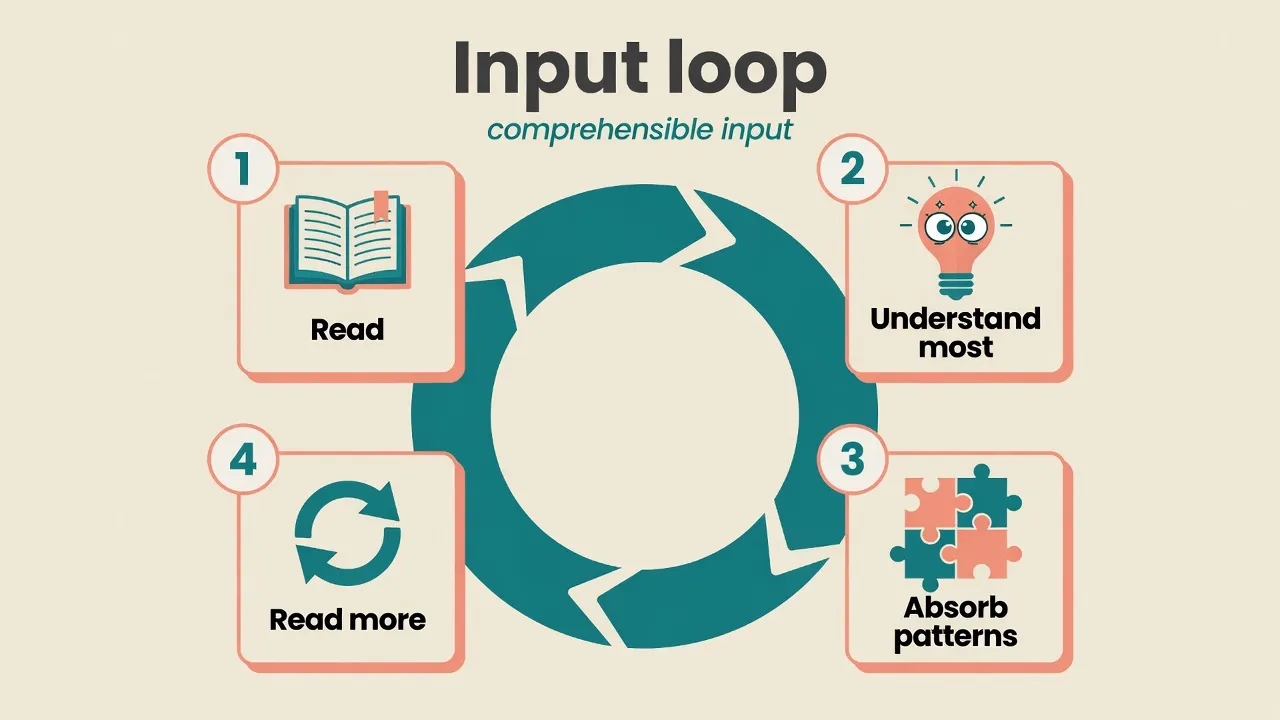
Read something you mostly understand → notice a few patterns or sticky words → optional light review → read more. That loop beats a pure list cycle for most learners.
Why does the science say this works?
You do not need a second textbook of theory. Two ideas are enough for daily practice: comprehensible input (i+1) and why word lists alone fade.
Comprehensible input and i+1 (plain words)
Stephen Krashen's idea in one breath: you grow when messages are mostly understandable and a little new. That stretch band is often called i+1 - your current level plus a small step.
- Too easy: comfortable, little growth.
- i+1 fit: you follow the story; a few new words make sense from context.
- Too hard: every line is a lookup. Call that the dictionary tax. Growth stalls because attention goes to survival, not language.
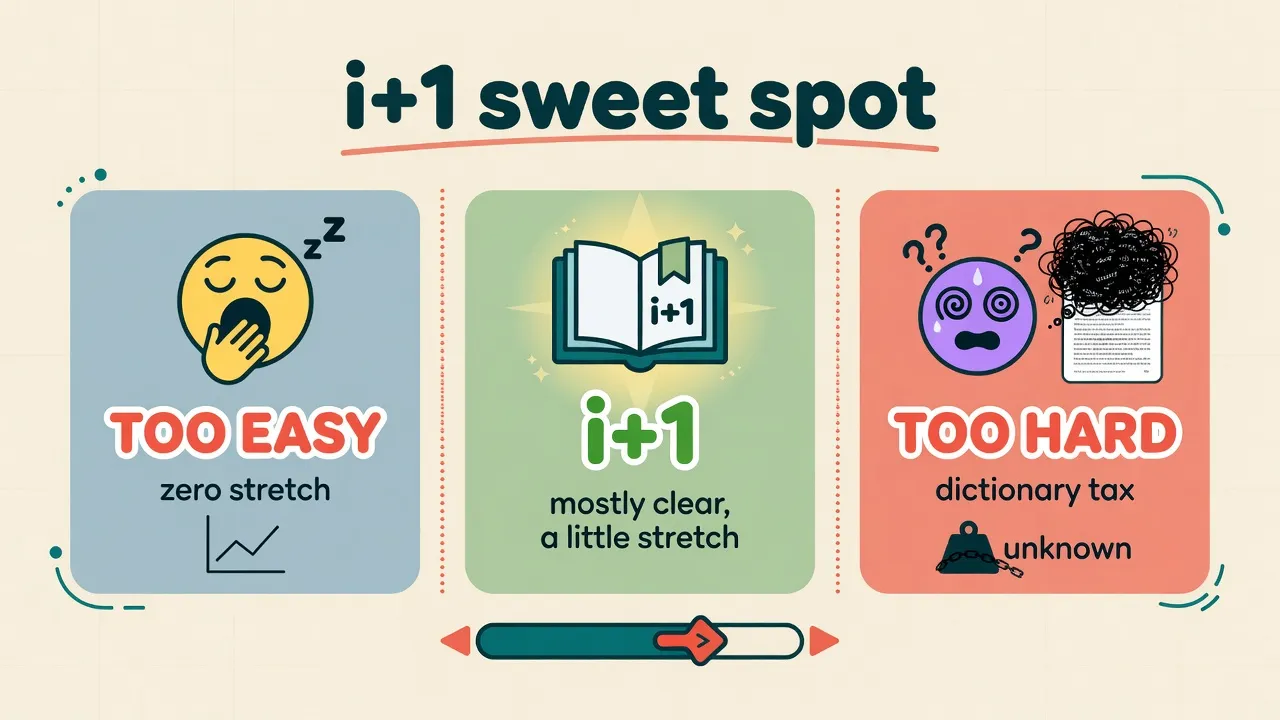
Three bands: too easy (little new language), i+1 fit (story holds with a light stretch), too hard (dictionary tax kills the page).
For the full theory handoff - hypotheses, limits, classroom myths - see Krashen's comprehensible input hypothesis. This article stays practical: pick texts you can finish.
Why word lists alone fade
Isolated lists without use or context fade. That is the plain reading of the forgetting curve idea (Ebbinghaus): unused material decays unless you meet it again.
Reading re-meets words in new sentences. Context is the glue. A word for "run a business" lands differently than "run" on a flashcard alone.
No need for invented exact percentages. The practical takeaway is enough: lists help as a supplement; reading puts words back into living use. For more on review and forgetting, see the Ebbinghaus forgetting curve for vocabulary (the memory idea travels across languages).
Extensive vs intensive reading
Two useful modes. Most "improve English by reading" progress needs enough extensive hours, with selective intensive moments.
| Mode | Focus | Good for |
|---|---|---|
| Extensive | Volume, pleasure, overall meaning | Vocab breadth, fluency, habit |
| Intensive | Short text, deep study, many lookups | Hard structures, exam detail |
Translating every page is intensive by accident. That can work for a short exam passage. It is a weak default for a daily reading habit.
What should you read at your CEFR level?
Match the text to the level you can finish. Interest beats prestige. A famous classic you abandon teaches less than a graded short you complete with a smile.
| Level | What to read | Session rule |
|---|---|---|
| A1-A2 | Graded shorts, learner news, free MovaReader articles | 10-15 min; high known-word ratio |
| B1-B2 | YA, hobby blogs, graded → lighter originals | 15-20 min; selective lookup |
| C1-C2 | Originals, field blogs, non-fiction you care about | Volume + interest; note hard jargon only |
A few practical notes:
- Finishable beats impressive. If you quit by page five, the book was the wrong tool for this month - not proof you "cannot learn."
- Legal path for commercial books: free graded library for warm-ups, plus your own / buy / library EPUB for titles you care about. We do not host free commercial bestsellers.
- Warm-up shelf: browse all articles for free level-matched English. For a first finish plan, see how to read your first book in English. If a page feels wrong, try the five-finger rule for book level.
Should you look up every word?
Looking up every word turns reading into a tax. Stay in the story when you can.
| Rule | Do this |
|---|---|
| 1. Guess first | Context first when the plot still moves |
| 2. Lookup blockers only | Recurring blockers and sentence-breakers |
| 3. Cap saves | About 5-10 high-value items per session - not every unknown |
| 4. Stay in text | In-place help beats tab-switching when possible |
Optional color of the sky can wait. If the same word blocks you three times and the sentence dies without it, look it up. Save the ones you will actually reuse.
Two paths look very different on a tired evening:
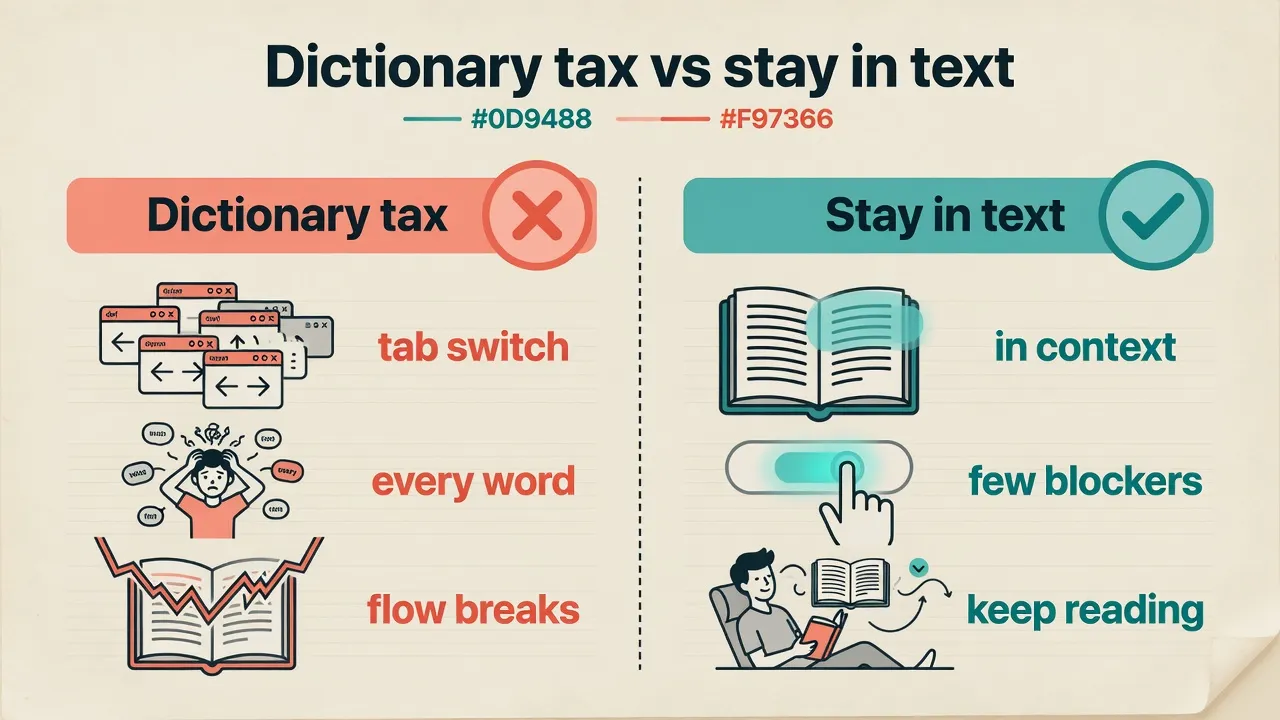
Left path: stop → switch app → re-read → plot lost. Right path: hard stop → short in-context help → keep reading. Same unknown word, different energy cost.
If the whole book feels like a wall, the level may be wrong - not your willpower. Re-check with the five-finger rule or step down to a graded warm-up on all articles.
What does a realistic 30-day reading plan look like?
A realistic month builds habit and comprehension comfort.
| Days | Focus |
|---|---|
| 1-7 | Pick level-fit text; 10-15 min daily; learn the dictionary rule |
| 8-21 | Same band or slight stretch; note 5-10 words/session; optional light review 2-3 times a week |
| 22-30 | Slight volume bump if easy; re-read a favorite short; check "can I finish pages without panic?" |
Rules of the plan:
- Timer over marathons. Ten honest minutes most days beat one heroic Sunday that burns you out.
- Log casually. Minutes or pages noted in a note app is enough. No guilt scoreboard.
- Interest filter. If boredom kills the habit, switch topic. That is strategy, not failure.
- Success metric: habit + comfort with real pages - not "I am C2" and not "I speak like a native."
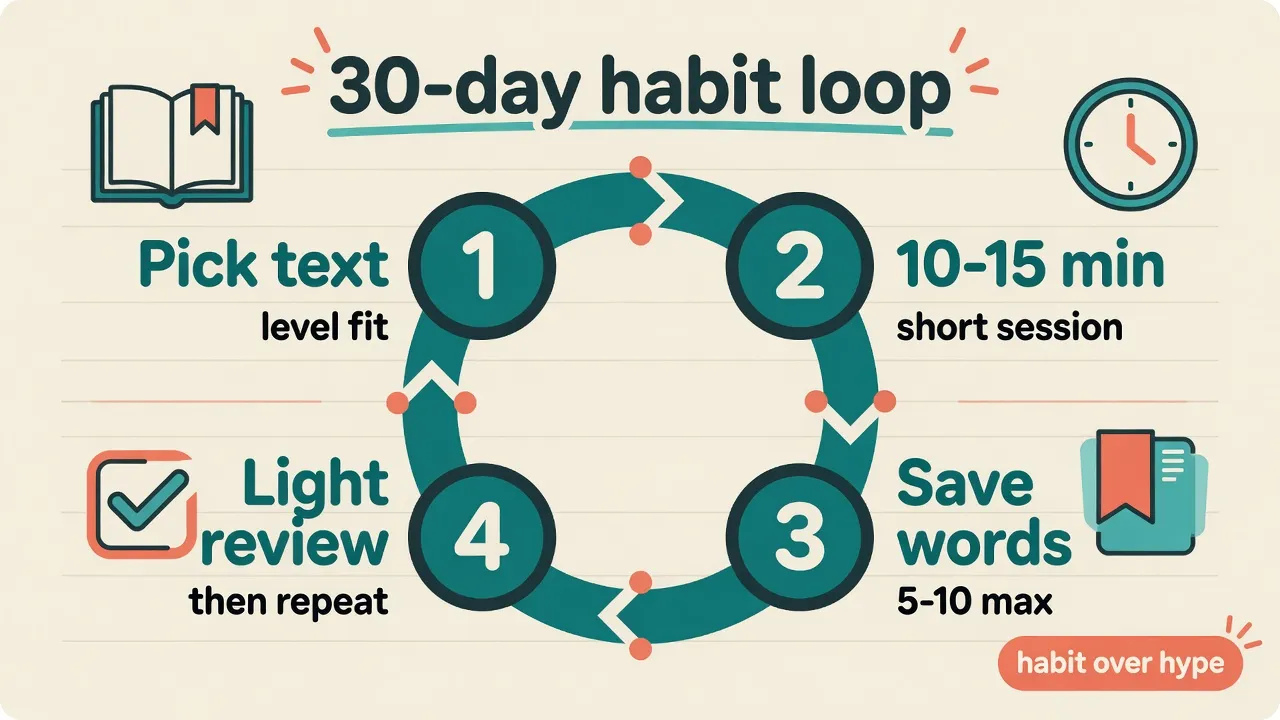
Pick level-fit text → short session → selective lookup → light review → repeat. Small loop, many days.
Default daily range most learners can keep: about 10-20 minutes. Shorter at A1-A2. Stop while you still want the next page.
How can tools reduce reading friction?
Tools help as friction reduction for the same loop.
In one breath: MovaReader is a reader with click translation in sentence context, a free graded library, upload of your legal EPUB, and a language-map for known marks. Click a word → see translation in context → keep reading.
A practical path:
- Warm up on free graded texts: all articles.
- Practice i+1 pick + the dictionary rule + a short timer.
- When volume needs more than free plan lookups, Reader for real reading.
- Optional Pro trainers when save-and-drill is the bottleneck (phrases, trainers).
- Own legal EPUB for commercial books; use the language map to see known coverage.
- Plans on pricing. Upload help on how to use if you bring your own files.
| Plan | What it is for |
|---|---|
| Free | Graded library; about 20 word translations/day; enough for a short daily habit. Listening is often unlimited on free. |
| Reader €1/mo | Volume reading when dictionary tax would outgrow the free plan |
| Pro €5/mo | Trainers / deeper review when drill is the bottleneck |
| Always | Own legal EPUB is fine; no free commercial bestsellers host |
What it is not: a free warehouse of full commercial bestsellers. The free plan limits are real - a short daily habit still works inside them.
FAQ
Does reading really help you learn English?
Yes - especially vocabulary in context, a feel for grammar patterns, and reading fluency when texts are mostly understandable (i+1). Effects are real and gradual, not a magic "3 times faster" switch. Pair reading with other practice if you want a full skill stack.
Is reading enough if I want to speak well?
No. Reading builds input and confidence with text; speaking needs practice (conversation, shadowing, writing output). Use both if spoken fluency is the goal. Reading alone is not automatic speaking practice.
Should I look up every unknown word?
No. Guess when the story still moves; look up recurring blockers and sentence-breakers; save about 5-10 high-value items per session. A full dictionary workout kills the page.
What should an A2 learner read first?
Short graded texts, learner news, and free level-matched articles. Keep a high known-word ratio and about 10-15 minutes a day. Stretch to light YA only when pages feel finishable - interest beats prestige. Start on all articles if you want a gentle shelf.
How long should I read each day?
About 10-20 minutes most days beats rare marathons. Match session length to level (shorter at A1-A2). Stop while you still want the next page.
What free limits apply if I try MovaReader?
Free path: graded library plus about 20 word translations/day. Listening is often unlimited on free. Reader ~€1/mo for full translation volume; Pro ~€5/mo for trainers. Commercial bestsellers are not an unlimited free library - upload legal EPUBs you own. Details on pricing.
Next steps this week
Reading speeds useful progress when level, habit, and selective lookup align.
This week:
- Pick one i+1 text (graded free or a level-fit book you own).
- Run 10-15 minutes.
- Look up breakers only; save about 5-10 items.
- If speaking is the goal, add a little output the same week.
Warm up free on all articles. Check level fit with the five-finger rule or a first English book plan. Theory depth lives in Krashen on comprehensible input. Track known marks on the language map when you are ready. Stay on the free plan while testing; move to Reader on pricing only when the daily translation cap stops real pages.
The tool reduces friction. Limits are real. Commercial pages still come from books you legally own. Steady pages beat perfect plans.
Learning English?
The English version of MovaReader teaches Spanish and Ukrainian. To read English with a translation for every word, open the reader in Ukrainian or Spanish:
Книги англійськоюЦя стаття українськоюLibros en inglésEste artículo en español