Reading Strategies
Five-Finger Rule for Book Level: A Rough Compass
Open a page and count unknown words on your fingers. Learn what each band means, where the rule fails, how it relates to 95-98% coverage and what to do next.
You open a novel full of hope. By page five, every line is dictionary work. The plot dissolves. You blame your talent - but the usual culprit is simpler: the book is too hard for where you are right now.
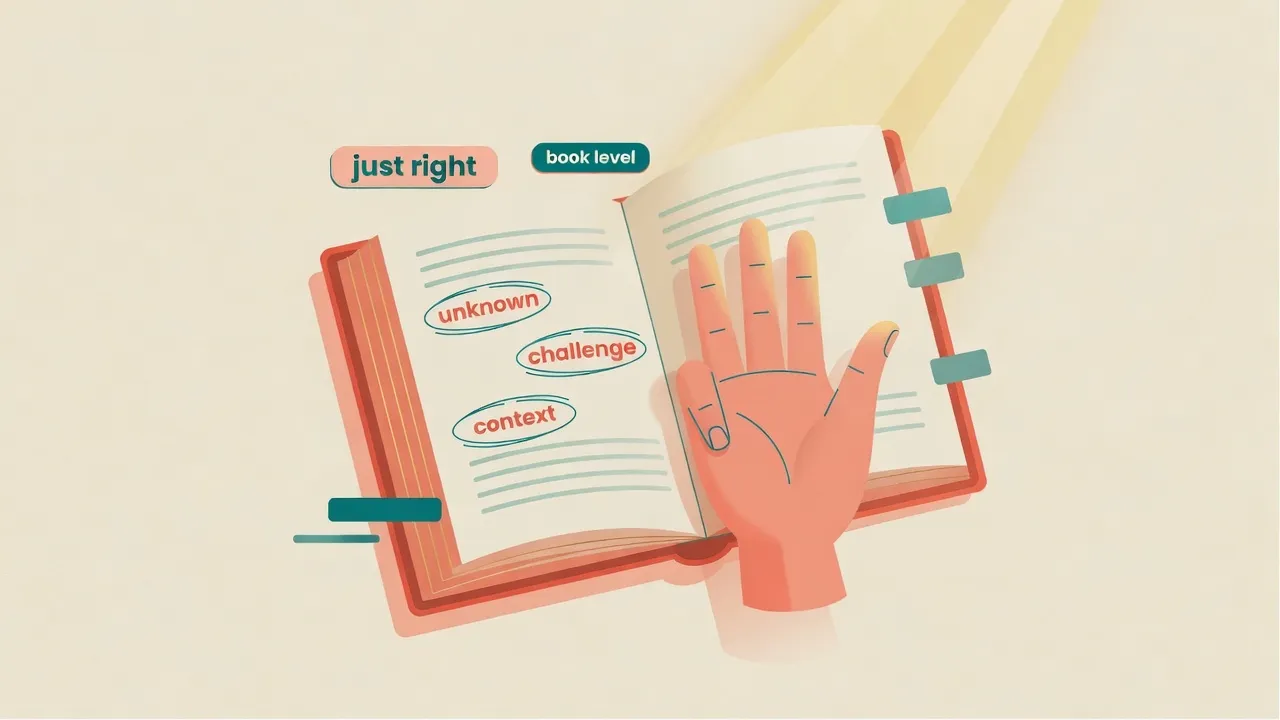
Here is the simple version. The five-finger rule is a quick library check: open a page of a book you might enjoy, hold up one finger for each unknown word, then read the band. Zero or one finger: too easy. Two or three: often just right. Four: hard. Five or more: too hard for independent reading. Treat it as a rough compass, not a precise score. If you can, test two or three pages.
For language learning, that unknown density roughly echoes extensive-reading comfort near ~95-98% known words. Then use a what-to-do table, not a purity test.
Below: how the rule works, where it fails, how it ties to coverage, what to do next, and how to pick a first English book at A2-B1. Offline fingers still win in a shop. Tools can help flow later.
How does the five-finger rule work?
Parents and teachers use this check for early L1 readers. You can reuse the same rough test for English as a second language - in a bookstore or library, with no app.
Here are the steps.
- Pick a book you might actually enjoy. Interest helps.
- Open a page. Prefer not only the first page of front matter; a middle page or a second page is fine.
- Read the page. Raise one finger per unknown word - words that stop you, or that you cannot get from context enough to keep going.
- Check the band on your hand.
- If you are borderline, test two or three pages in different spots when you can.
Count unknowns on one page (words that stop you). Your hand is a rough band chart - not a lab grade.
| Fingers (unknowns on the page) | Band | What it usually means |
|---|---|---|
| 0-1 | Too easy | Little new language; fine for fun, weak for growth |
| 2-3 | Just right | Story holds; a few new words without drowning |
| 4 | Hard / challenging | Possible with help or short sessions; dictionary risk rises |
| 5+ | Too hard (independent) | Save for later, buddy read, or easier text |
Some kids sources split 2 versus 3 (2 good, 3 need help). For adult L2, treat 2-3 as the just-right zone and re-check another page if you are unsure.
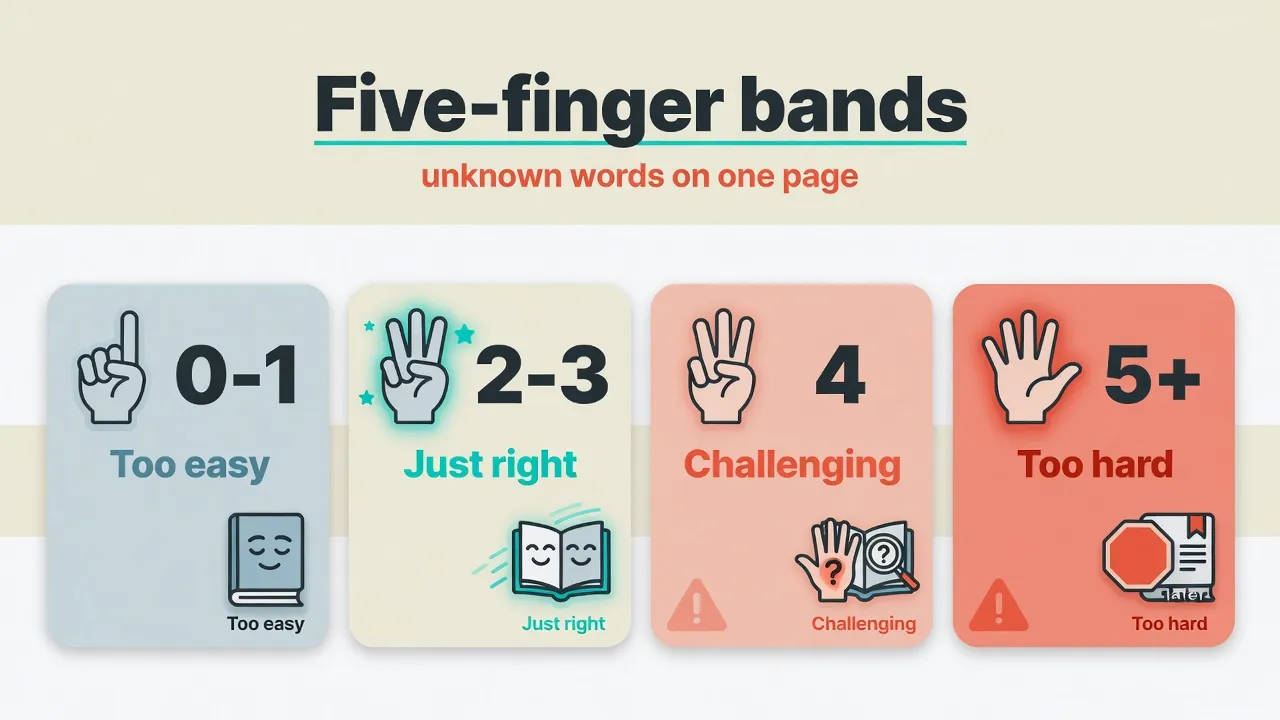
The five-finger scale in one glance: 0-1 too easy, 2-3 just right, 4 hard, 5+ too hard for independent reading.
Where does the five-finger rule fail?
The rule is useful offline. Its limits make it a compass, not a calculator.
One random page is noisy
A dialogue page can look easy. The next chapter may be dense castle vocabulary. Front matter and prologues mislead too. Fix: sample two or three pages in different chapters when you can.
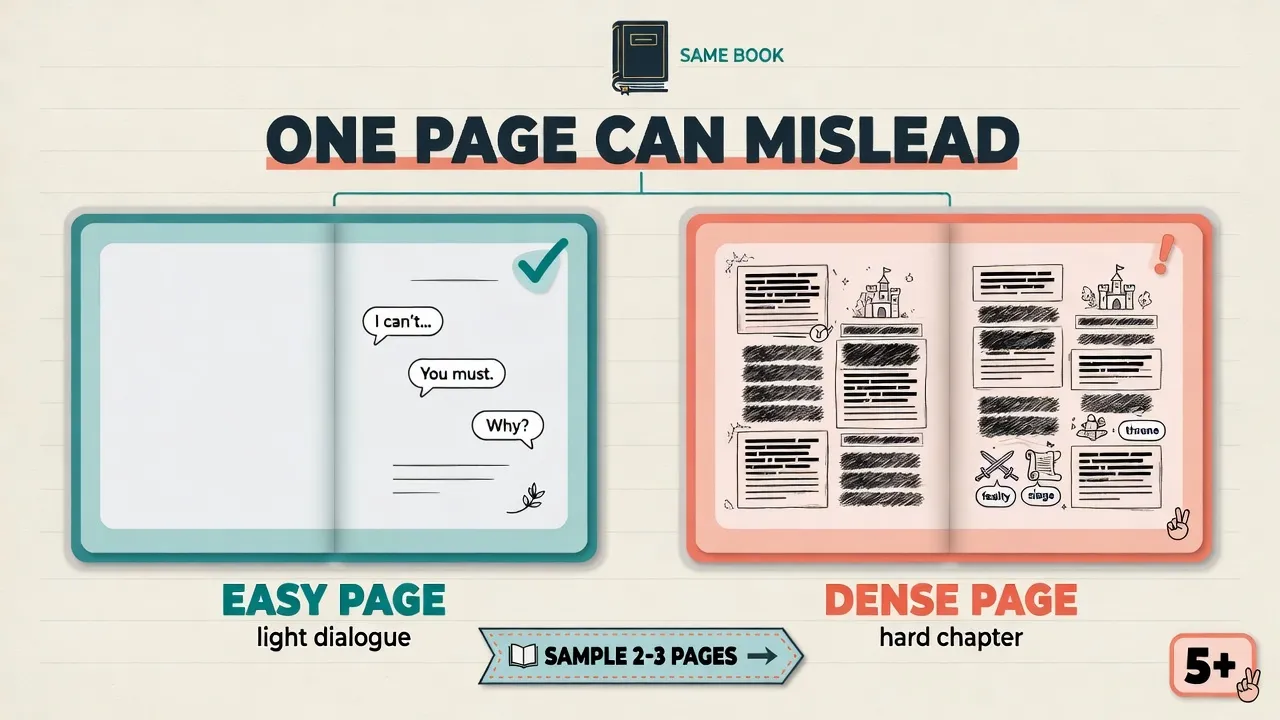
One easy dialogue page and one dense prose page can live in the same book. Sample more than once.
Page length and density
Five unknowns on about 200 words is not the same as five on about 400. Small type, footnotes, and poetry layout change density. Finger count is a proxy for "too many stops," not a lab percentage.
What counts as "unknown"?
Polysemy trips people up: you "know" book as a novel, then miss book a table. Multi-word units, phrasal verbs, names, and cultural allusions all matter. If you guess from context and keep moving, that still counts as flow - do not finger every optional stretch word.
Interest can override the score
High motivation (a favorite series, a known plot) lowers effective difficulty. Still: if every sentence breaks, interest alone rarely saves a full novel.
How does this relate to 95-98% known words?
Finger count is a fast proxy for stop density. It is not a certified coverage test. Extensive-reading research (Nation-style, Hu and Nation, Laufer-style discussion) talks about rough comfort zones as rules of thumb.
For comfortable extensive reading, learners often need about ~95% known running words as a lower comfort area, with ~98% feeling smoother. About ~90% or less often feels like decoding: short-term memory holds translations, and the plot evaporates.
| Rough coverage feel | Reading mode | Typical learner experience |
|---|---|---|
| ~90% or less | Intensive / decode | Dictionary heavy; plot slips |
| ~95% | Workable extensive | Some lookups; story still moves |
| ~98% | Smooth extensive | Flow; new words from context more often |
Fingers do not equal exact percent. They ask a simpler question: am I stopping too often on this page?
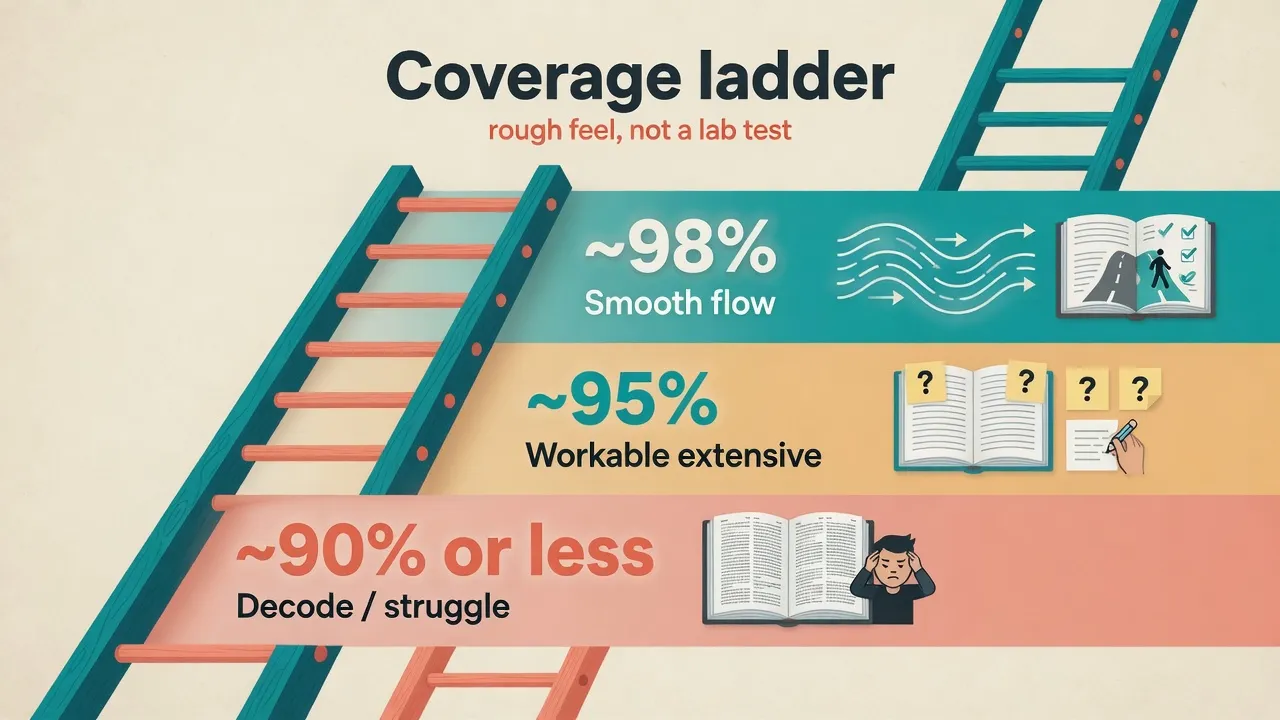
A coverage ladder for feel: ~90% decode, ~95% workable extensive, ~98% smoother flow.
If you want more on lookups and word growth from reading, see vocabulary for reading comprehension and build B1 vocabulary by reading.
What should you do after the finger count?
The count is not a verdict on your talent. It is a next-step signal.
| Fingers | Next step (practical) |
|---|---|
| 0-1 | Keep for easy fun or pick a slightly richer book if your goal is growth |
| 2-3 | Good independent read; start short sessions; look up only sentence-breakers |
| 4 | Try another 1-2 pages; if still 4, use graded start, known-plot easier title, or read with in-context help and shorter sessions |
| 5+ | Too hard for now: easier book, graded reader ladder, or save the title for later - prestige can wait |
Prefer books you finish over books that look impressive. Graded readers versus originals is a real fork for A2 - we cover the trade-offs in adapted vs original books for A2. Intensive reading (study every word) is valid for short texts. Do not force intensive mode on a 400-page novel.
First-book tips for A2-B1
After the bands and next steps, pick something finishable - not prestige in week one.
Known plot helps. Context carries unknowns. Long modern series (for example Harry Potter) are often not easy A2 for many learners - length, invented names, school slang. Treat them as a high-motivation stretch later, not a default week-one book.
Avoid dense 19th-century classics as first English originals. Dickens- or Austen-era density and archaisms punish early flow unless you love them enough to go slow on purpose.
Non-fiction and popular science can be more direct than stacks of literary metaphor. Still sample a page: topic jargon can spike your finger count.
Start finishable: short books, graded readers, or light YA with support. For a ready ladder of titles, see top 10 easiest English books for A2-B1. Optional warm-ups for phrases that stick: type training demo and phrase typing demo.
Offline fingers, online flow
The compass still works offline. Online, a short trial with in-context help can keep flow when a book is near your edge.
MovaReader is a reader with click translation and sentence help, a free graded library path, and upload of your EPUB. The point here is flow - not replacing the five-finger rule in a shop or library.
Practical path:
- Still use five fingers in a shop or library - free, no account.
- Warm up with free samples from all articles if you want a graded start.
- Upload a legal copy of a book you own when ready (how to use).
- Tap blockers only; protect the story.
- Optional demos and trainers when phrases stick.
- Visible marks on the language map if you use them.
- Plans and limits on pricing.
| Need | Realistic plan |
|---|---|
| Try a trial page / free graded path | Freemium (~20 word translations/day) |
| Real reading volume with click translation | Reader €1/mo |
| Trainers beyond reading | Pro €5/mo |
| Commercial novel you own | Your legal EPUB or file - not an unlimited hosted catalog |
FAQ
Is the five-finger rule only for kids?
It comes from early L1 literacy tips, but adults learning English can reuse the same rough page check in a library or shop. The bands still ask: am I stopping too often? Treat it as a compass for L2 reading level, not a kids-only game.
How many unknown words is "too hard"?
On one typical page, 5+ hard stops usually means save it or get support. 2-3 is often comfortable for independent reading. 4 is a challenge zone - retest. Retest 2-3 pages if borderline; one page can lie (dialogue versus dense prose).
Does 95% known words match the finger rule exactly?
No exact match. Fingers are a fast proxy for stop density on a page. Extensive-reading research talks about roughly ~95-98% known words as comfort zones - a ladder of feel, not a lab percentage. About ~90% or less often feels like decoding.
Is Harry Potter a good first English book at A2?
High motivation and known plot help, but many A2 readers still hit length, invented names, and dense unknowns. Prefer a shorter finishable book first; use Harry Potter as a stretch later if you love it. Prestige can wait.
Should I use an app instead of counting fingers?
Offline, fingers still win - free, no account, bookstore-ready. Online, a short trial with in-context help (click translation) can keep flow when a book is near your edge. The rule does not become useless because apps exist.
What free limits apply if I try MovaReader for a trial page?
Free path: graded library plus about 20 word translations/day. Reader ~€1/mo for more translation volume; Pro ~€5/mo for trainers. Upload legal EPUBs you own for commercial titles - we do not host unlimited bestsellers by default. Helps flow; does not replace the five-finger check offline.
A rough compass, this week
The five-finger rule is a rough compass for book level - still useful offline. Limits are real: sample more pages; watch density and word senses. The coverage ladder reminds you to aim for flow near a ~95-98% feel, not prestige pain.
This week: test one candidate book on two or three pages, pick something finishable, and look up only sentence-breakers. A tool can reduce friction; fingers still count when you are offline.
Next steps: free graded samples on all articles, progress marks on the language map, plans on pricing, and sister guides on easiest English books A2-B1 and adapted versus original for A2.
Keep reading with translations inside the text
With a free account, an unknown word translates with one tap, and the words you are learning wait for you in the trainer.
Free account: 7 days of Pro, then 20 word translations a day or a paid plan.