Reading Strategies
The 95% Rule: Reading or Just Decoding?
Five unknown words in a hundred is a comfort floor, not a score. Count 100 words tonight, mark the holes, and see if the plot still holds.
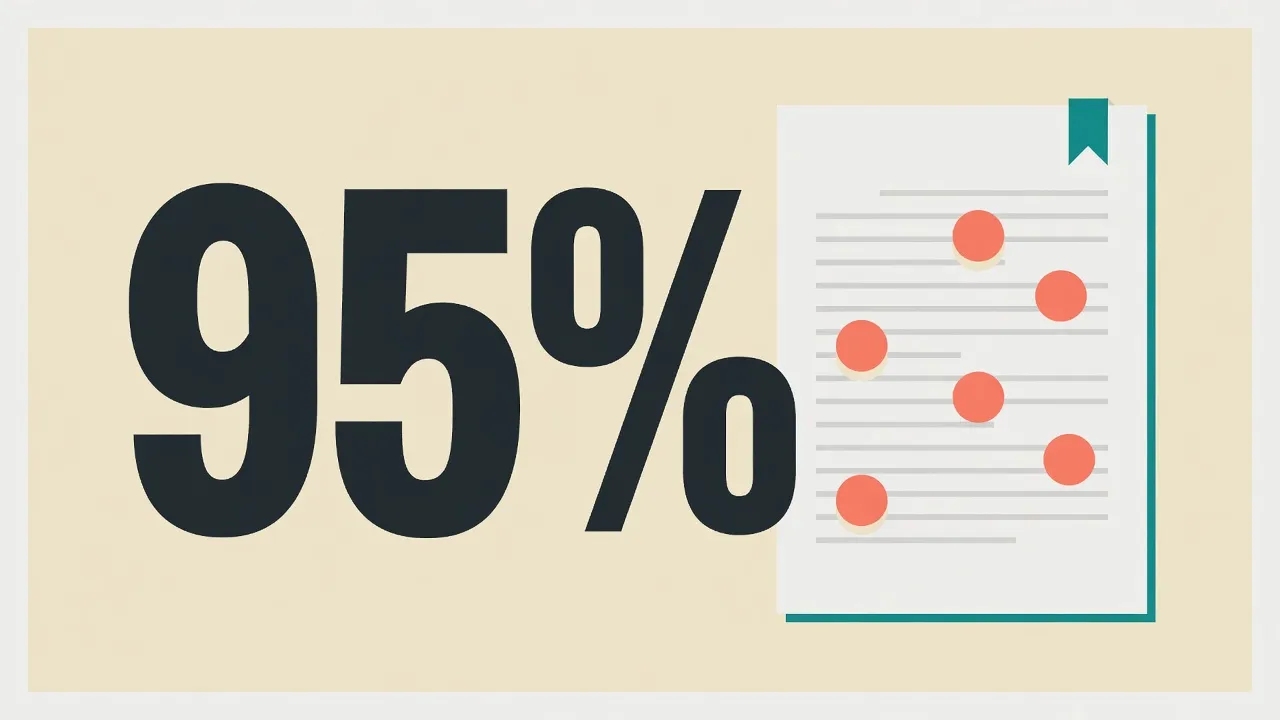
You open a chapter. You tap three times. The thread is gone. A closed office. Fog over a river. You cannot say who is waiting where.
How many unknown words when you read still leave the story standing? About five unknown running words per 100 (~95% known) is a common floor: the plot often holds, but you work. About two per 100 (~98%) usually feels smoother. About ten or more per 100 (~90% or less) is often decoding: the story slips and the dictionary takes over. Treat 95% as a comfort floor, not a lab grade or a CEFR law. Count 100 words tonight, not five holes on a page. Pages often run 200-350 words.
Below is a 100-word count you can do tonight, with a marked sample, then what 90, 95, and 98 feel like. A tap can lower the cost of a hole. It does not turn 85-90% into easy reading.
Are you reading or just decoding?
The useful question is not "did I look something up?" It is "do I still have the story?"
You are reading when you can follow who did what. A hole in the fog does not kill the scene. Mara is still looking for her cousin. The platform is still empty. You can keep going.
You are decoding when you rebuild every clause. You tap. You forget the line. You start again. The dictionary is the book. The station is just a word list with a plot taped on.
Picture a bus station at night. Thin fog over the river. If you still know who is waiting on which street, you are reading. If you only have a pile of definitions, you are decoding.
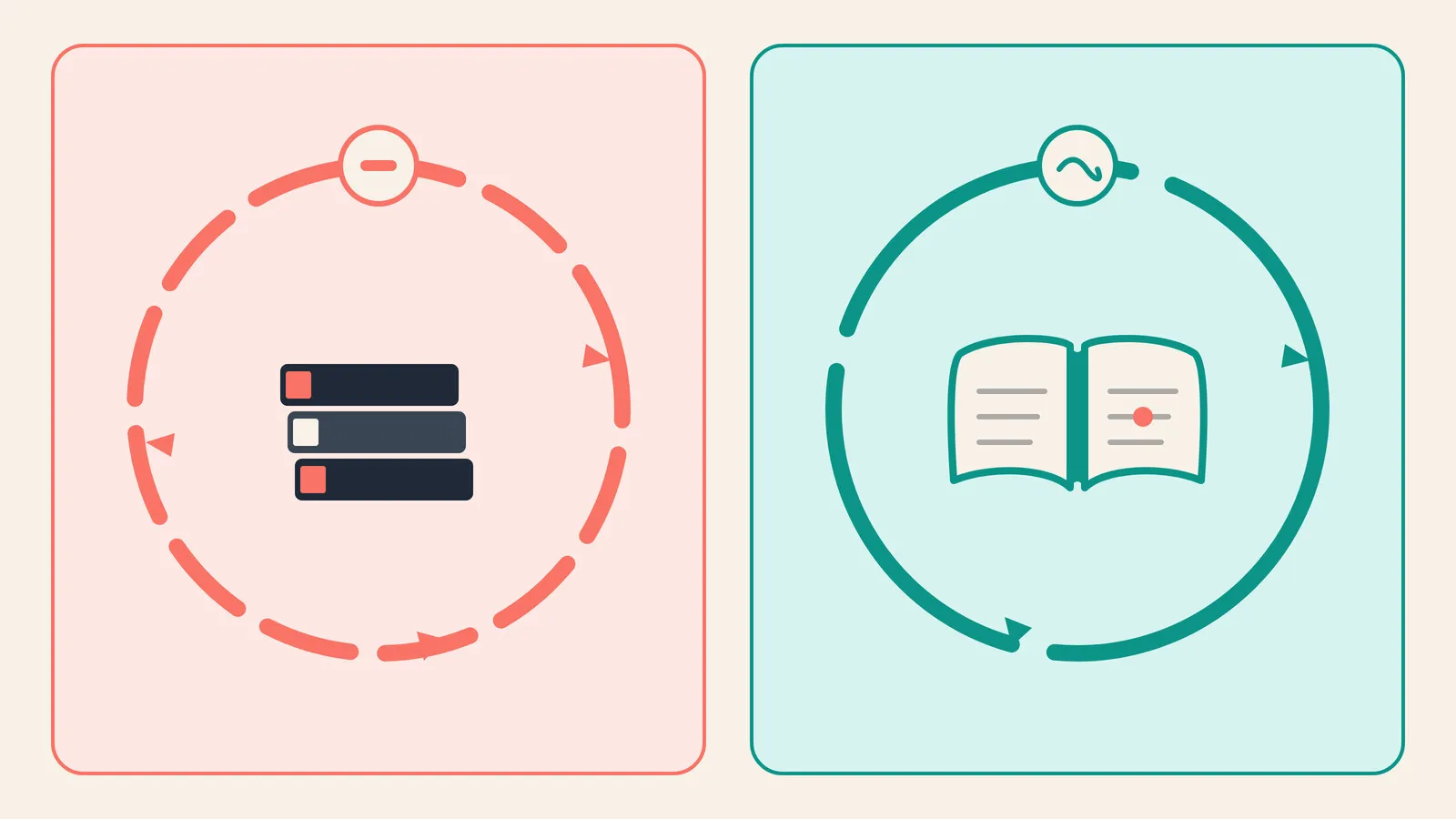
Two loops, same page: one keeps the story, one rebuilds every clause.
In a shop, a five-finger check flags stop density on a page. This page is about what those stops mean once you sit down.
How do you count unknown words in 100?
If you want a number you can use tonight, count running words. Not "unknowns per page."
Why not "per page"?
Pages are not equal. A paperback page often runs about 200-350 words. Five holes on a short page is not five holes on a long one. Some advice treats "three to six unknowns on a page" as if that were already 98% known. The math only works if you know how long the page is, and even then it is sloppy. Five unknowns per hundred words is about 95%. Five on a 250-word page is closer to 98%. Same five stops. Different band.
Five holes is not one number. It depends how long the page is.
| Sample | 5 unknowns means about... |
|---|---|
| 100 running words | ~95% known (~1 in 20) |
| ~250-word paperback page | ~98% known |
| Typical paperback page | often ~200-350 words |
Count running words, not "I kind of knew it." If you stop, it counts.
A 100-word sample with five holes
Thirty seconds. Pick a mid-chapter stretch. Skip the title page. Count 100 running words. Mark every stop. Then do the plot check.
Here is an original station scene, not a novel quote. Five words are in bold. Those are the holes.
Mara stepped off the last bus and checked the crumpled timetable on the wall. The platform was almost empty, except for a man folding a newspaper and a girl feeding crumbs to a pigeon. A thin fog sat over the river. The ticket office had already closed. She still needed to find the side street with the blue awning, where her cousin had promised to wait. The suitcase wheel caught on a cracked tile. For a moment she thought she had missed the last connection, then a lamp flickered above the exit and she saw the sign for the old ferry landing.
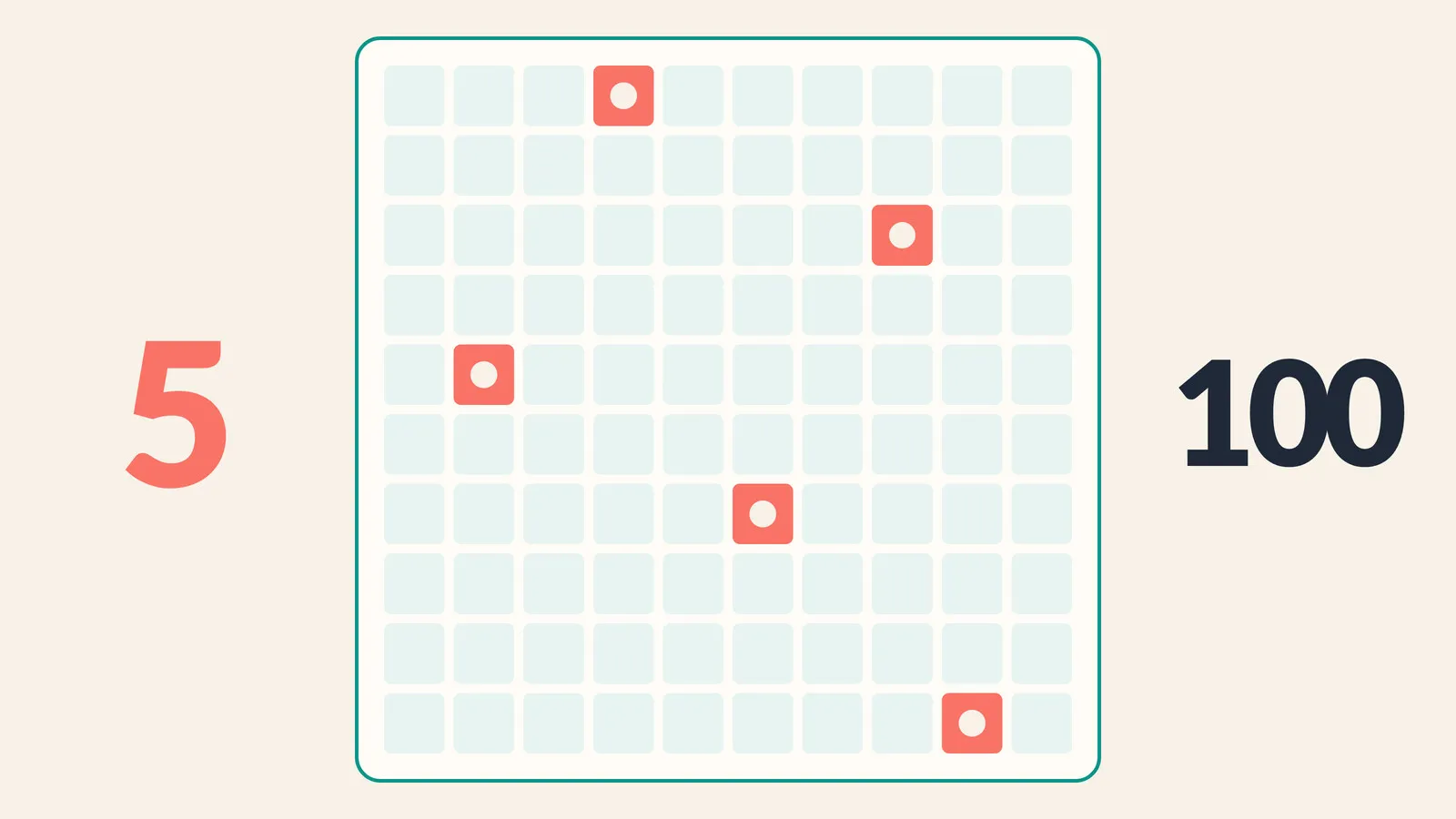
That is 102 running words. Five stops: crumpled, awning, tile, flickered, landing. About 95% known.
The same idea as a page of 100 cells with five marks:
Plot check, even if those five are fog:
- Who: Mara, looking for her cousin.
- Where: a nearly empty bus platform by a river. Ticket office closed. She needs a side street.
- What next: she heads for the exit and a ferry sign, hoping the cousin is still waiting.
If you can answer those three after the holes, you are closer to reading than decoding.
The five marks, in plain words: crumpled is crushed or folded badly. An awning is the cloth roof over a shop door. A tile is a flat floor square. Flickered means the lamp blinked. A landing is where boats and ferries stop. Nice to know. Not required to keep the scene.
This is a feel check, not a scan of the whole book. Chapter two can be denser than chapter twelve.
What do 90, 95, and 98 feel like?
Same 100 running words. Different density. Different night.
| Rough known share | Unknowns per 100 | Everyday feel (not a score) |
|---|---|---|
| ~90% or less | ~10+ per 100 (~1 in 10) | Often decoding; plot slips |
| ~95% | ~5 per 100 (~1 in 20) | Still reading for many; still tiring |
| ~98% | ~2 per 100 (~1 in 50) | Smoother; more room to infer |
Three rungs, number first: 90, 95, and 98, with 10, 5, and 2 holes.
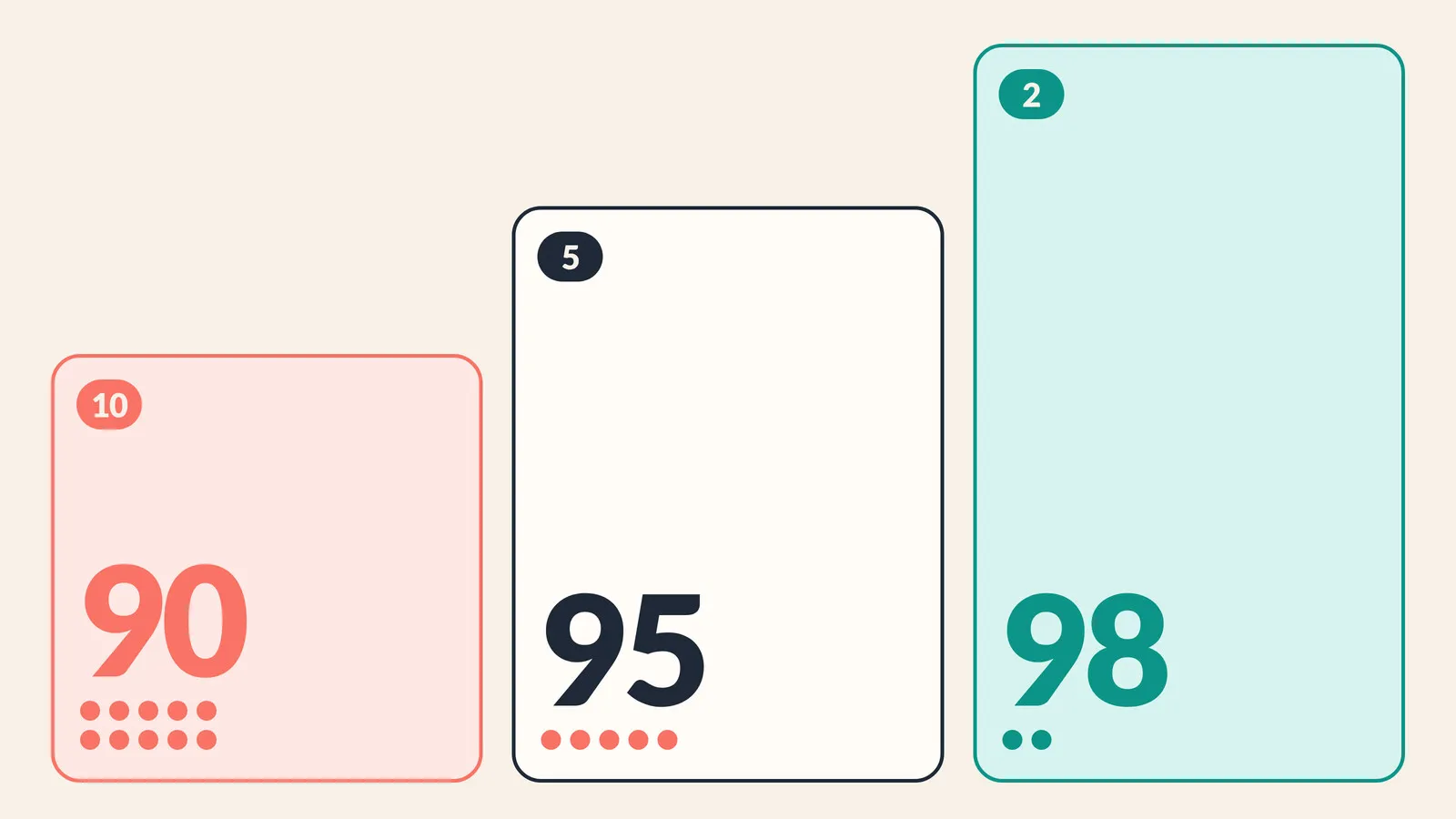
Think of 95% as the comfort floor: the density where the story still holds for many readers. It is a floor, not a guarantee. 98% often feels kinder. There is no sudden cliff. More known words usually help. And 95% coverage is not 95% comprehension. Those are different numbers.
How many word families that takes is another question. See which words you need to read and how many words per CEFR level. No size table here.
Is 95% a lab grade?
Short version: no. Researchers did not hand you a school mark.
Laufer (1989) treated about 95% coverage as a possible floor for adequate comprehension, not as "you understood 95% of the message." Hu and Nation (2000) found 95% still hard for many. They argued about 98% for unassisted pleasure reading. They did not test 98%, so they did not prove it.
Later work is messier, not neater. More known words usually help, with no magic cliff (Schmitt, Jiang and Grabe 2011). One later design found no statistically significant gap among 90, 95, and 98, and coverage explained about 11% of score variance (Webb, Pellicer-Sánchez and Wang 2025). Use the 100-word count for feel, not as a certified lab grade.
The comfort floor is a rule of thumb you can check tonight.
What if a tap dictionary makes harder books fine?
Some teachers, including people around Steve Kaufmann, point out that a tap dictionary changes the cost of a hard page. That part is fair. A tap can make 10% unknown survivable. You lose less time. You stay on the line. You may still finish the chapter.
Tools lower the cost of a hole. They do not turn 85-90% known into a night you finish with ease. You can finish a page and still not have read it. The station never became a scene.
The goal is flow you finish, not a purity test. It is also not "push to 10-15% unknown" as default advice for a novel you wanted to enjoy. Use tools to keep the story. Do not use them as a reason to stay in fog on purpose.
What should you do tonight?
The count is not a verdict on your talent. It is a next-step signal.
| If your 100-word count is... | Do this |
|---|---|
| ~10+ unknowns (~90% or less) | Easier text, or slow intensive on a short piece. Do not force the prestige novel as extensive reading. |
| ~5 unknowns (~95%) | Reasonable reading for many. Finish the chapter. Tap a few. Do not hunt every word. |
| ~2 unknowns (~98%) | Smoother night. Infer more. Keep going. |
| You only survive with constant taps | That is a tool-cost win, not proof the book is in the comfort floor. |
If the sample is already about 10 or more per 100, drop a rung or study a short piece. Adapted versus original books is the fork when you need an easier book. Intensive versus extensive reading is the split if you want to study a paragraph on purpose.
Want a density demo you can finish? Try a Spanish A2 sample. If that still feels heavy, start with the Spanish A1 warm-up. Or browse texts by level. English readers can use those pages just to feel the band, then pick an English text nearer 95-98%.
Need a rough range first? The language map is orientation, not an exam. If you have not picked a first book yet, start with how to start reading in English.
What MovaReader can (and cannot) do
MovaReader helps you keep reading: tap a hole in the sentence, mark words on the language map, try articles by level, or open your own EPUB. It does not compute exact book coverage. The map is orientation, not an exam. The free side is about 20 translations a day; Reader is €1 a month for more volume; Pro is €5 a month for trainers (pricing). Count the 100 words yourself, then use the app for flow, not as a scanner that grades the novel. If you want a lighter page tonight, try the Spanish A2 sample or the A1 warm-up.
FAQ
Is 95% known words enough to read?
For many people, yes as a floor. About five unknowns per 100 often leave the plot standing, but you still work. About two per 100 (~98%) usually feels smoother. If 95% already feels like decoding, drop a rung. Feel, not a score.
How many unknown words per 100 is too many?
About 10 or more per 100 (~90% known or less) is often decoding: the story slips and the dictionary takes over. Count 100 running words, then ask if the plot held. About 5 per 100 is a common floor. About 2 per 100 is usually kinder.
Do five unknowns on a page mean 95% coverage?
No. Pages vary (often about 200-350 words). Five unknowns per hundred words is about 95%. Five on a 300-word page is closer to 98%. Count 100 words, not "five on a page." The five-finger check in a shop is a density flag, not this math.
Does MovaReader score my book's coverage?
No. You count. The app does not compute exact book coverage. It helps you keep reading: tap a hole, mark the map, try articles, open your EPUB. The free side is about 20 translations a day. Reader is €1. Pro is €5. See pricing.
Is the 95% rule an official CEFR law?
No. Not a CEFR law, not "95% coverage = 95% comprehension." The studies are rules of thumb. The language map is orientation, not a test.
Tonight: mark 100 words, count the holes, ask if the plot held. Then pick easier, stay, or go intensive. If the plot already slipped, start with an easier book rung, not a purity fight with the prestige novel.
Keep reading with translations inside the text
With a free account, an unknown word translates with one tap, and the words you are learning wait for you in the trainer.
Free account: 7 days of Pro, then 20 word translations a day or a paid plan.