Reading Strategies
Latin American vs Spain Spanish: What to Read First
Spain and Latin America share one Spanish. Choose the variety you will read this year, or start Latin American if nothing pulls you. First books by region and which Harry Potter edition to buy.

You freeze at the dialect fight. Spain or Mexico? "Castilian for literature"? A forum swears one vosotros book will ruin the Latin American Spanish you actually need. The novel stays closed. A month later you still have two tabs and zero pages.
That fight is a second course you never signed up for. You need a first book, not a passport.
Spain Spanish and Latin American Spanish are one language, not two courses. Pick a first reading accent for this year (travel, family, the shows you already watch), not a forever identity. If nothing pulls you, start Latin American-leaning books and media: more YA, news, and Netflix in that flavor, and treat vosotros and leísmo as patterns later. Open a finishable book at your level, not Cien años de soledad or La casa de los espíritus.
Here is what actually changes on the page:
| On the page | Typical Spain | Typical LatAm-leaning | What to do |
|---|---|---|---|
| Informal "you all" | vosotros | ustedes | Notice it; keep the plot |
| vos | rare | Rioplatense / parts of Central America | Same: a pattern, not a new course |
| Spoken past | pretérito perfecto more often | indefinido more often | Both appear in books |
| Sound (reading still works) | distinción common in north-central Spain; Andalusia / Canaries often seseo | seseo | Spelling is shared; do not call all Spain ceceo |
| Object pronouns | some leísmo | generally lo / la | Save the sentence if it blocks you |
| A little vocab | piso, ordenador, coger (watch the false friend) | departamento / depto, computadora, agarrar | One or two examples only |
| Media this year | RTVE, Spain series, Almodóvar | Mexican / Colombian news, telenovelas, Netflix LatAm audio | Support, not the spine |
The board is the whole fight, shrunk to a page. Vosotros vs ustedes is the line you will notice first. The rest is texture.
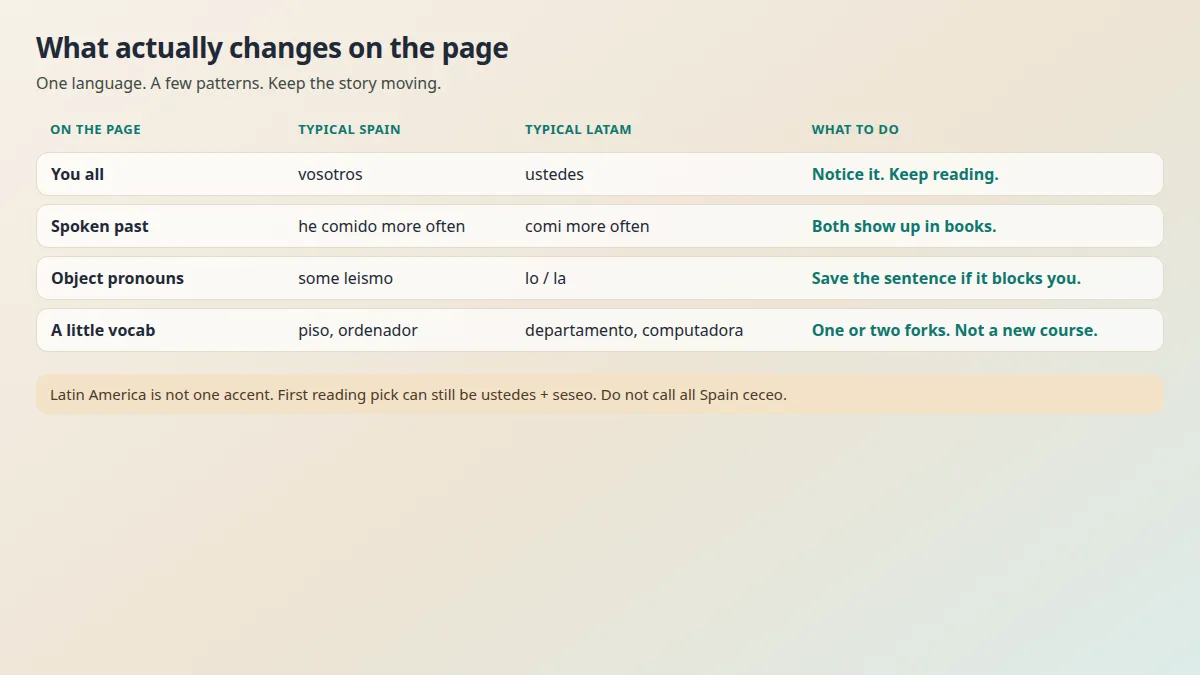
Latin America is not one accent. Mexican Spanish, Caribbean Spanish, and Rioplatense vos do not write the informal "you" the same way. A first reading accent can still be a useful bucket: LatAm-leaning ustedes plus seseo. That is the flavor many US learners already hear. Inside Spain, the Canary Islands and western Andalusia often use ustedes and seseo too. Spelling is shared. Do not call all of Spain ceceo. That is a different sound pattern, and it is not the default of north-central Spain.
One vocab fork is enough to notice. Do not turn this page into a coger vs agarrar list. Coger is a false friend in much of Latin America; agarrar is the safe verb there. Save the sentence if it blocks you. Then keep the plot.
Below: how to pick this year's accent, first-reads for Latin America, first-reads for Spain, which edition to pick (including Harry Potter), a reading loop that is not grammar class, and FAQ.
Should you learn Spain Spanish or Latin American Spanish first?
Ask it as a reading question, not as a second syllabus.
Neither variety is more correct or more pure. Latin American Spanish is not slang-only. Spain is not required for literature. Isabel Allende, Gabriel García Márquez, Laura Esquivel, and Mario Vargas Llosa all wrote on the American side of the ocean. Márquez is Colombian, not Mexican. You can read serious books without moving to Madrid.
The useful question is smaller. Which Spanish will you actually hear and read this year?
How do you pick this year's reading accent?
Match the people, travel, and media you will meet. Then open a finishable book in that flavor.
| If this year you... | Start here | First-read direction |
|---|---|---|
| Live, study, or talk with people in Spain; watch Spain media | Peninsular | Manolito Gafotas or Spain YA (below) |
| Family, work, travel, or US / Mexico / Colombia media | LatAm-leaning ustedes | Cajas de cartón or Allende YA / Crónica (below) |
| No travel, no family, no strong show habit | LatAm default | Wider YA / news / Netflix supply; Peninsular features later |
| A2 still shaky, or the dialect fight already ate last week's plot | Texts adapted by level first | Free adapted Spanish; return to novels |
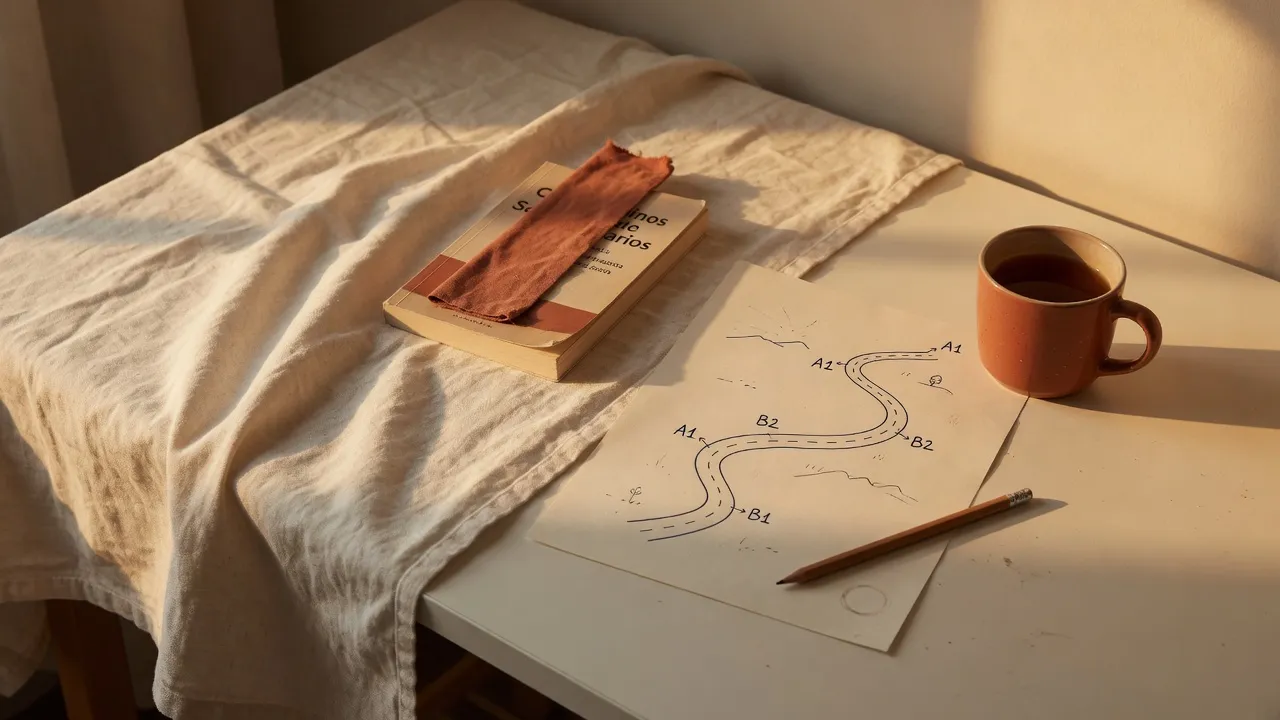
If you like the decision as a picture:
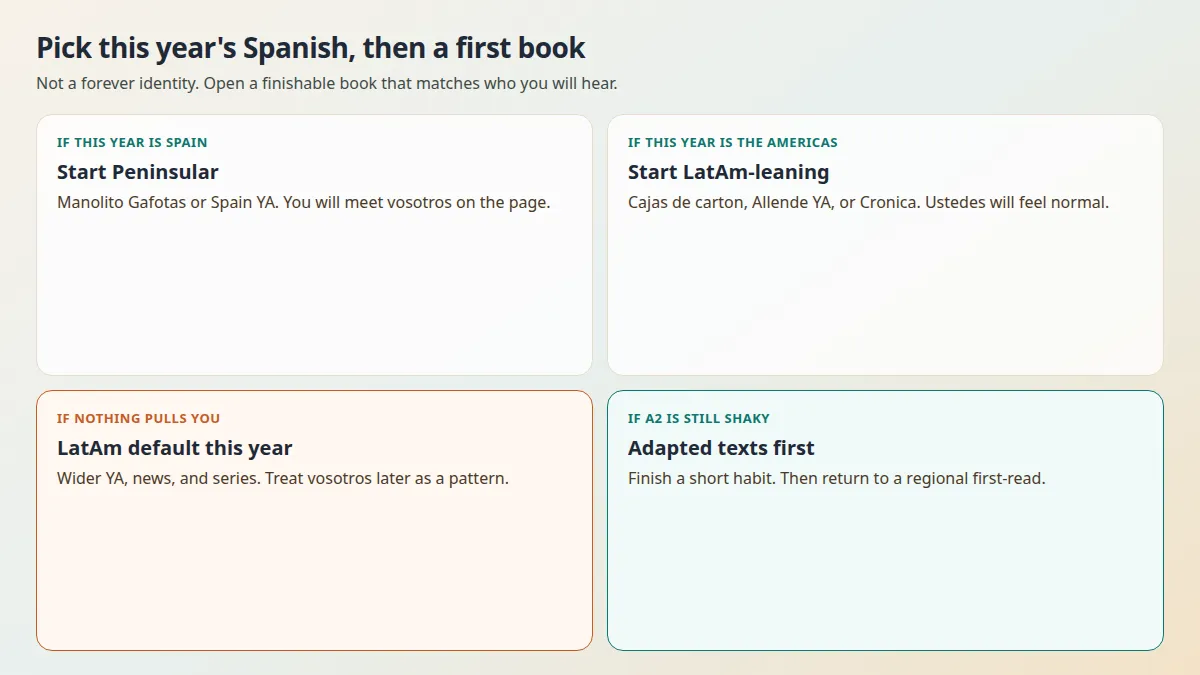
Say the default out loud if you need it. No travel, no family, no strong show habit? Use the LatAm default this year. Not because it is "easier Spanish" as a language. Because the supply of YA, news, and Netflix in that flavor is wider, and ustedes matches more of the Spanish you will hear online and in the Americas. You can read a Spain translation later without ruining anything.
What if you have no travel pull?
Then this year's reading accent is LatAm-leaning ustedes. Mexican-leaning media is a common US default. That is still a first accent, not a forever identity. When the people or shows in your life change, you can switch. The language does not split.
If A2 still feels shaky, or last week's dialect fight already ate the plot, do not "solve" it with a harder novel. Start with texts adapted by level. Finish a habit. Then return to a named book in the same region.
What should you read first if you start with Latin America?
Open a finishable book in the flavor you chose, not a prestige dump. The bands below are practical comfort ranges (can you follow the scene?). They are not official CEFR exam labels for dialects or novels.
| Title | Origin / edition | Practical band | Why |
|---|---|---|---|
| Texts adapted by level first (Lola Lago / Juan Fernández / Paco Ardit; free adapted articles) | Often written for class in Spain; still fine | A2 | Finish a habit before a variety fight |
| Cajas de cartón (Francisco Jiménez) | Mexican-American memoir | A2 | Concrete Spanish many US learners already hear |
| Diario de Greg (Spanish ed.) | Translation; check wording | A2-B1 | High finish; dialect is light |
| El Principito / El alquimista (Spanish) | Translation; edition-dependent | A2-B1 | Confidence books; not "a dialect" |
| Cuentos de la selva (Horacio Quiroga) | Rioplatense / jungle stories | A2-B1 (short) | Short sessions |
| Papelucho (Marcela Paz) | Chile, diary | high A2 / B1 | Journal vibe |
| La casa en Mango Street (Sandra Cisneros) | US-Mexican Spanish, vignettes | B1-ish | Short sessions |
| Como agua para chocolate (Laura Esquivel) | Mexico | high B1 | Stretch; food + family spine |
| La ciudad de las bestias (Isabel Allende) | Chile / LatAm YA | B1-B2 | Allende YA start; not La casa de los espíritus |
| Crónica de una muerte anunciada (García Márquez) | Colombia (not Mexico) | solid B1-low B2 | Márquez start; not Cien años |
| Cuentos de Eva Luna | Chile / LatAm | B1-B2 | Short literary if YA is a no |
Cajas de cartón is the concrete start many US learners need: work, school, family, Mexican-American Spanish on the page. Diario de Greg and El Principito are confidence books. Check the wording; a translation is not "a dialect," but the edition still leans Spain or LatAm. Quiroga and Papelucho give short sessions. Cisneros gives vignettes you can finish in a sitting.
Do not first-read Cien años de soledad, La casa de los espíritus, La fiesta del Chivo, or La sombra del viento as a habit test. Famous is not the same as first.
If you want Allende, start with La ciudad de las bestias, not the family saga. The which Allende book to read first guide covers that in detail. If you want Márquez, start with Crónica de una muerte anunciada (Colombia), not Cien años. The which Márquez book to read first guide covers that in detail.
For more finishable titles without a region fight, see the easiest Spanish books at A2-B1 and a wider B1 Spanish book list.
What should you read first if this year's Spanish is Spain?
Same rule: finishable voice beats prestige. You want vosotros and a Madrid or Castile ear on the page, not a museum.
| Title | Why | Practical band |
|---|---|---|
| Gloria Fuertes (verse / stories) | Short Spain beginner pages | A2 |
| Manolito Gafotas (Elvira Lindo) | Madrid kid voice, vosotros, colloquial Spain | high A2 / solid B1 |
| Laura Gallego (La misión de Rox, Memorias de Idhún) | Spain YA | B1 |
| El camino (Miguel Delibes) | Castile, classroom classic | B1-B2 |
| La buena letra (Rafael Chirbes) | Short Spain novel | B2-ish |
| El tiempo entre costuras (María Dueñas) / La sombra del viento (Zafón) | Spain bestsellers; later | B2+ / B2-C1 |
Manolito Gafotas is the Spain twin of a concrete first book: a kid in Madrid, colloquial vosotros, scenes you can hold. Gloria Fuertes is even shorter if A2 still wobbles. Laura Gallego is the YA path. Delibes is the classroom classic once B1 can carry Castile. Save El tiempo entre costuras and La sombra del viento until B2 can carry a long Spain bestseller. Zafón is not a first habit test.
Does the edition matter? Harry Potter and Spain translations in LatAm shops
Sometimes. Not as a purity test. As a match to this year's accent.
Which Harry Potter Spanish edition should you buy?
Publisher: Salamandra. There are three adaptations: Europe, Latin America, and Southern Cone.
The tell is informal "you all." ¿Vosotros lo sabíais? is Europe. ¿Ustedes sabían? is Latin America or Southern Cone. Southern Cone also carries vos flavor if that is your pull this year.
| Edition | Informal "you all" tell | Match if this year you... |
|---|---|---|
| Europe | vosotros | Live with Spain Spanish |
| Latin America | ustedes | LatAm-leaning ustedes default |
| Southern Cone | ustedes (plus vos flavor in that region) | Argentina / Uruguay / nearby pull |
Do not start the dialect decision on Harry Potter if you have never read the series. A new plot plus a new language is enough. If you already love it, pick the edition that matches this year's reading accent. Book-by-book difficulty lives on the Harry Potter Spanish CEFR guide.
Will a Spain translation ruin Latin American Spanish?
No. Many translations exist only in Spain Spanish and still sit on Mexican and other LatAm shelves. Vosotros and some leísmo are patterns. Notice them. Keep the plot. Wrong edition is not wrong Spanish.
If a sentence blocks the scene, save it. Do not close the book to start a second course.
How do you read a new variety without turning it into grammar class?
Reading is kinder than grammar-first. The forms show up as patterns if you let the story stay in charge.
- Notice the variant (vosotros, vos, a vocab fork such as ordenador vs computadora).
- Keep going if the scene is still clear.
- After the session, save up to five phrases. Not a conjugation drill.
- Return tomorrow while the plot is warm.
The loop looks like this:
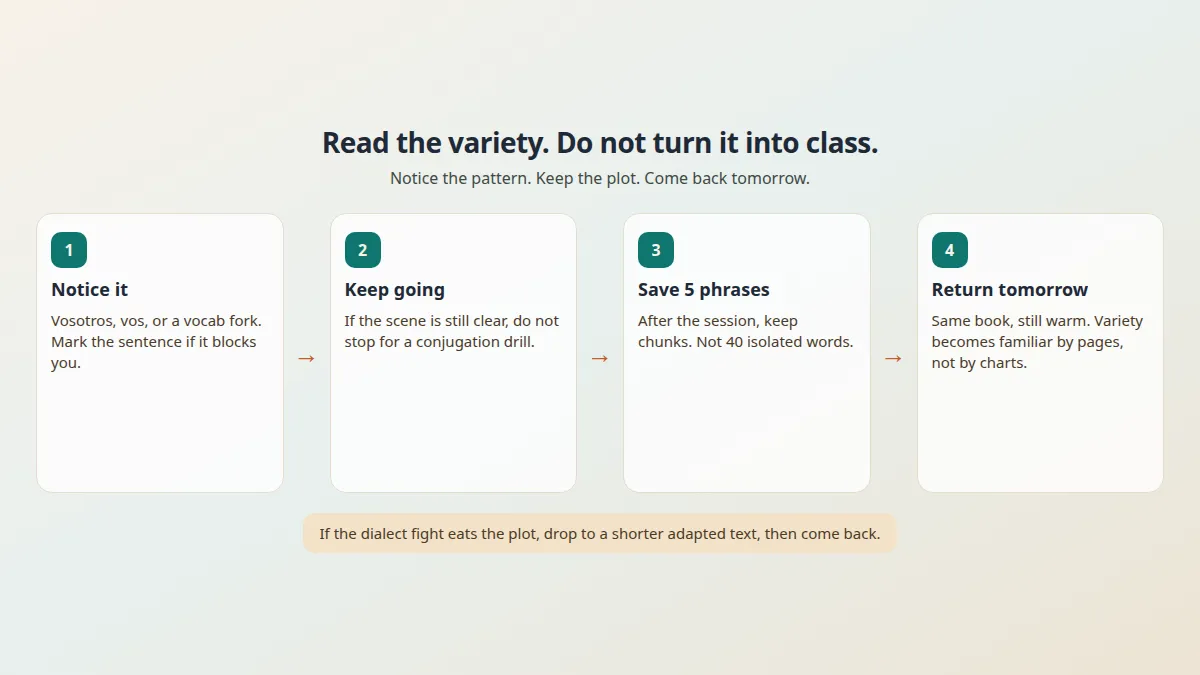
If you use a tool, tap the sentence that blocks the scene and return to the story fast.
Check the level with the 5-finger rule. If A2 should not jump to originals yet, read the note on adapted vs original books. The full habit lives in how to learn Spanish by reading.
If even the "easy" regional book is too hard
If the dialect fight is eating the plot, step down. Do not switch continents because page 3 hurt.
- Open the free library of Spanish texts adapted by level.
- Retry the same region. Cajas de cartón if you chose LatAm. Manolito or Gloria Fuertes if you chose Spain. Diario de Greg if you only need a finish.
- Use the reading loop. Notice the variant. Keep the plot. Save five phrases.
- When you are ready for a full novel, upload a legal EPUB you own.
MovaReader is built for tap-translate on the page you are actually reading. The free plan gives about 20 word translations per day. Reader is 1 EUR/mo for more translation volume. Pro is 5 EUR/mo when you want the full practice trainers. We do not host licensed commercial novels for free. Borrow or buy the book; then read the file you own.
The language map shows orientation ranges.
FAQ
Is Spain Spanish more correct for reading?
No. One language. Neither variety is more correct or more pure. Latin American Spanish is not slang-only. Literature lives on both sides: Allende, Márquez, Esquivel, Vargas Llosa. Spain is not required for "real" books. Pick the Spanish you will actually read this year.
Will a Spain translation ruin my Latin American Spanish?
No. Vosotros and leísmo are patterns on the page, not a second course. Many LatAm shops sell Spain-only translations unchanged. Read it. Wrong edition is not wrong Spanish. Save a sentence if it blocks you; keep the plot.
Should I skip books with vosotros if I only need ustedes?
No. Read them. Notice vosotros, save a few forms after the session, keep going. Skipping every vosotros book shrinks the shelf for no gain. The same is true the other way: an ustedes book will not erase Spain Spanish.
Which Harry Potter Spanish edition should I get?
If you already love the series, match this year's accent. Salamandra has three adaptations: Europe (vosotros, ¿Vosotros lo sabíais?), Latin America, and Southern Cone (ustedes, ¿Ustedes sabían?). If you have never read Harry Potter, do not start the dialect decision there. Book-by-book difficulty is on the HP by-book guide.
What if I have no travel or family pull?
Use the LatAm-leaning default this year: wider YA, news, and Netflix supply, and ustedes matches more of what you will hear online and in the Americas. Not because it is easier Spanish as a language. Treat Peninsular features (vosotros, some leísmo) as patterns later. You can switch when this year's people or media change.
Can an A2 learner start original novels? When do I switch varieties?
If A2 is shaky, start with texts adapted by level, then retry a finishable regional book (Cajas de cartón, Gloria Fuertes, Diario de Greg). Originals are a stretch, not a first habit test. Switch varieties when this year's people or media change, or after you can finish books in the first accent. Not a forever lock.
Pick this year's reading accent. If nothing pulls you, start LatAm-leaning. Open one named book from the matching table, not Cien años or La casa de los espíritus. Notice the variant, keep the plot, save five phrases.
- Warm-up: free adapted Spanish
- Related: Allende first · Márquez first · HP editions and levels
- Level check: 5-finger rule
- If A2 is shaky: adapted vs original
- Full method: how to learn Spanish by reading
- Plans and levels: pricing · language map
Free plan about 20 translations a day. Reader 1 EUR/mo. Pro 5 EUR/mo.
Keep reading with translations inside the text
With a free account, an unknown word translates with one tap, and the words you are learning wait for you in the trainer.
Free account: 7 days of Pro, then 20 word translations a day or a paid plan.