Curated Resources
Spanish Books for B1 Level: What to Read When Graded Texts Feel Too Easy
At solid B1 you need more than A2 easy lists. Here are Spanish books that fit independent reading, which titles are still a stretch, and how to keep finishing chapters.
You are solid B1 in Spanish. Short graded texts feel thin. You can follow everyday stories and simple dialogue. Then a prestige blog hands you La sombra del viento or Cien años de soledad as "intermediate," and you bounce hard off dense literary Spanish.
That gap is normal. Solid B1 is the bridge beyond graded readers into real novels: not baby Spanish, and not every classic on a shelf.
If you are solid B1 in Spanish, A2 "easy books" lists start to feel thin. You can follow everyday stories, but you still bounce off dense literary Spanish and long prestige novels. This guide is for that middle zone: realistic Spanish books and novellas for independent reading, a short stretch list many blogs push too early (La sombra del viento, Cien años de soledad, long Allende), and one rule - open a random middle page; stay when you understand about 80-90%. Warm up on free graded samples when you need recovery; long commercial novels are copies you own or borrow. MovaReader does not host them by default.
Below: quick picks, what B1 should feel like, seven realistic finishes, three stretch warnings, A2 vs B1, method, paths, notes on MovaReader, and FAQ.
Still fragile after A2, or hunting easiest page-turners? Start with the finishable A2-B1 ladder. Absolute beginner? Use easy Spanish books for A1. This post is about independent reading at solid B1.
Quick picks for solid B1
Match your situation, not a prestige wishlist. If a random middle page is under about 70% clear, drop one rung or stay on recovery graded texts for a few days.
| Your situation | Start with | Why it works |
|---|---|---|
| Just left A2, still fragile | Free A2 graded texts + short narrative bridge books | Protect speed and confidence |
| Solid B1, want a real novel | Cajas de cartón, El alquimista, Como agua para chocolate (careful) | Clear plot pull, manageable structure |
| Strong B1, ready for literary short form | Crónica de una muerte anunciada | Short length, higher density |
| Want modern habit reading | Spanish editions of familiar YA / diary-style books | Motivation and informal language |
| Not yet for comfort | La casa de los espíritus, La sombra del viento, Cien años de soledad | Excellent later; high quit risk now |
Think of solid B1 as a ladder: free A2 recovery, bridge YA or memoir, a real novel, a literary short, then "not yet" prestige titles as goals.
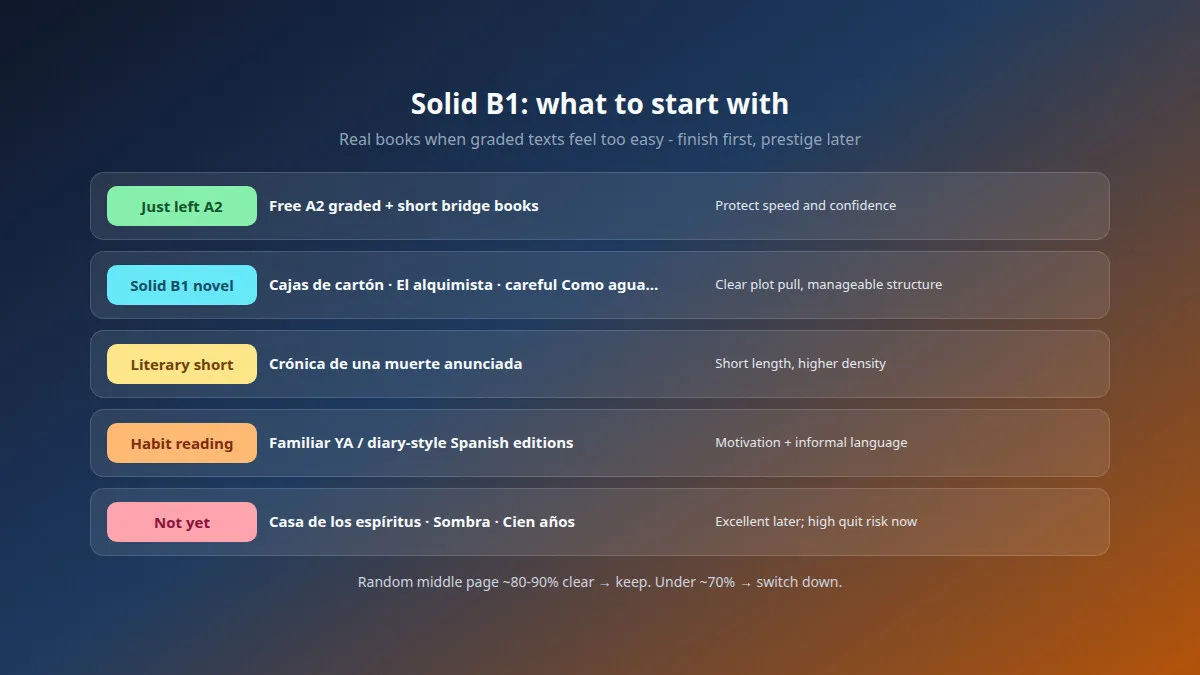
The only rule that matters: open a random middle page. If you understand about 80-90% without help, keep going. Under about 70% is stretch, not daily reading.
Calibrate first with free samples:
- Spanish A2: Aprendiendo a reciclar en casa (should feel easy at solid B1)
- Spanish A1: Mi día en el parque (warm-up only)
- Browse free graded texts
If A2 free texts feel automatic, you are ready for the B1 book zone below.
What solid B1 reading should feel like
At solid B1, good material usually has:
- clear narrative or documentary structure
- dialogue you can follow with occasional lookup
- concrete or semi-concrete settings (family, travel, school, work, crime, food)
- chapters or scenes you can finish in 15-30 minutes
- enough plot pull to survive unknown words
B1 still struggles with:
- multi-generation timelines
- heavy political history without context
- long gothic description
- poetic compression
- constant regional slang without support
B1 is where many learners can start real books and still need to choose carefully. "I am B1" does not mean every Spanish novel is fair game. Choose finish rate first; prestige later.
Part 1: Realistic Spanish books for solid B1
Seven finishable rungs for solid B1. Each card has a soft level, why it helps now, what trips people up, and a start tip.
1. Cajas de cartón - Francisco Jiménez
Realistic level: high A2 to B1
Why it helps at B1: Clear autobiographical scenes, concrete vocabulary, short sections. You can read for meaning instead of decoding every line.
Watch out for: Emotional weight. The language is simpler than the life story.
Start tip: Excellent confidence memoir if you want adult content without B2 density.
2. Diario de Greg (Spanish edition) - Jeff Kinney
Realistic level: A2-B1 (easy win at solid B1)
Why it helps: Short diary chunks, informal school Spanish, high finish rate.
Watch out for: Jokes and cultural punchlines. Skip a joke; keep the plot.
Start tip: Use it for speed training and habit days, not as your only literary diet.
3. El Principito - Antoine de Saint-Exupéry (Spanish)
Realistic level: A2-B1 for most of the book; some lines feel higher
Why it helps: Short chapters, familiar story, dialogue-heavy stretches.
Watch out for: Abstract philosophy packed into short sentences.
Start tip: One-week confidence project, then move to longer narrative Spanish.
4. El alquimista - Paulo Coelho (Spanish edition)
Realistic level: A2-B1 to low B2 depending on edition comfort
Why it helps: Quest structure, repeated key ideas, short chapters.
Watch out for: Repetitive philosophy. Fine for language practice; not everyone's taste.
Start tip: Strong bridge when graded readers feel too easy but literary Spanish still feels heavy.
5. Las aventuras de Tom Sawyer (Spanish translation)
Realistic level: B1
Why it helps: Adventure plot, dialogue, past narration in motion.
Watch out for: Older settings, name lists, and a translation style that may feel less modern than YA.
Start tip: Great for narrative past forms in context. Do not stop for every verb form if the scene is clear.
6. Como agua para chocolate - Laura Esquivel
Realistic level: high B1 (stretch for weak B1)
Why it helps: Strong plot, food vocabulary, chapter structure mixing recipe and story.
Watch out for: Sensory description piles. If food words block you, skim the recipe block and return to the plot.
Start tip: Motivating "real novel" step after one easier finish.
7. Crónica de una muerte anunciada - Gabriel García Márquez
Realistic level: solid B1 to low B2
Why it helps: Short length, intense plot, repeated events from different angles.
Watch out for: Local references, many names, denser sentences than YA.
Start tip: Better first serious literary novella than starting with Cien años de soledad. Short still does not mean easy.
Want pure comfort YA only? The A2-B1 easiest list is the better fit. Part 1 here is the next step when those lists feel thin.
Part 2: Stretch books (popular, often pushed too early)
These are excellent books. They are not comfortable daily B1 for most independent readers. Many "intermediate" posts lead with them because they are famous, not because they match B1 finish rates. Treat them as goal books, not week-one proof.
La casa de los espíritus - Isabel Allende
Realistic comfort level: B2+ for many independent readers
Why people recommend it at B1: Famous, emotionally strong, "should be readable."
Why it breaks plans: Length, multi-generation family timeline, historical and political load.
Rule: Project book only after two shorter narrative wins from Part 1.
La sombra del viento - Carlos Ruiz Zafón
Realistic comfort level: B2-C1
Why people love it: Atmosphere and mystery.
Why it is a B1 trap: 500+ pages plus denser descriptive style. Motivation helps; daily lookup load is still high.
Rule: Keep as a goal book. Do not use a long gothic mystery to test whether reading works for you.
Cien años de soledad - Gabriel García Márquez
Realistic comfort level: high B2-C1 for most learners
Why it is hard: Generations of the same family, repeating names, magical realism density, long narrative arcs.
Better path: Read Crónica de una muerte anunciada first if you want Márquez in Spanish.
Rule: Do not soften this title to chase prestige lists. Judge a random middle page, not fame.
| Book | Realistic band | Why too early as daily B1 |
|---|---|---|
| La casa de los espíritus | B2+ | Length + multi-gen timeline + history load |
| La sombra del viento | B2-C1 | 500+ pages + dense description |
| Cien años de soledad | high B2-C1 | Generations, names, magical realism density |
How B1 reading differs from A2 reading
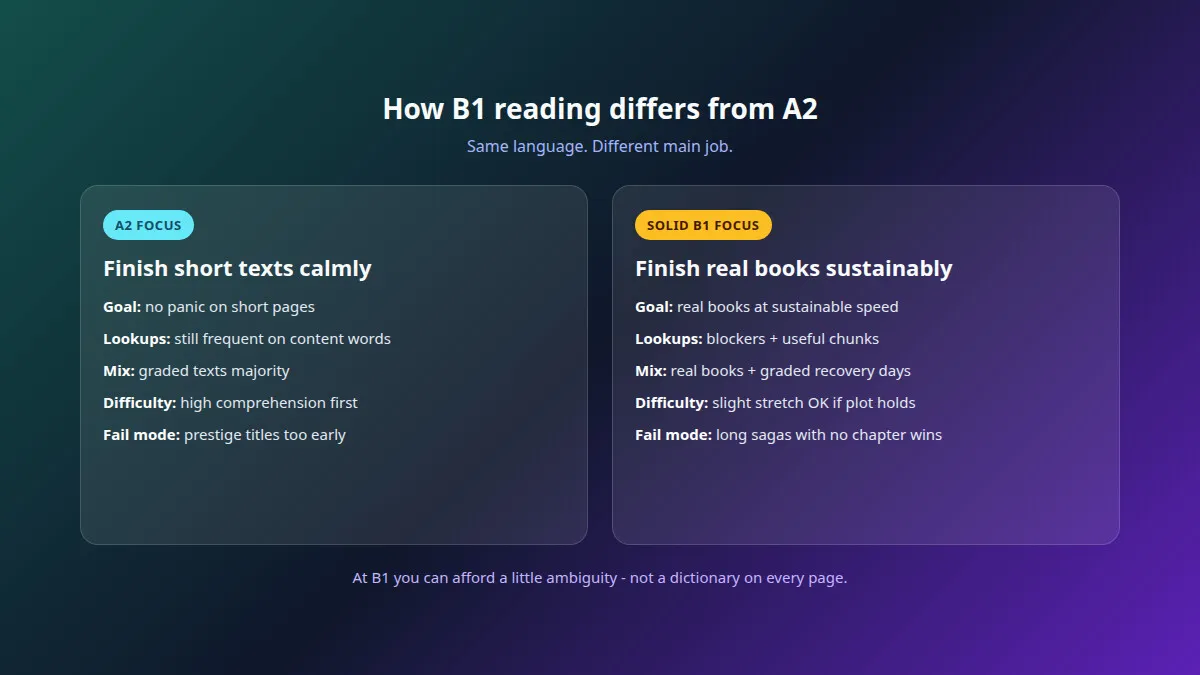
At A2 you protect confidence and finish short texts. At solid B1 you build a real-book habit: more ambiguity is fine; a dictionary session on every page is not.
| Dimension | A2 focus | Solid B1 focus |
|---|---|---|
| Main goal | Finish short texts without panic | Finish real books at sustainable speed |
| Lookup style | Still frequent on content words | Mostly blockers and useful chunks |
| Text mix | Graded texts majority | Real books majority + graded for recovery days |
| Difficulty target | High comprehension first | Slight stretch is OK if plot holds |
| Common failure | Prestige titles too early | Long sagas with no chapter wins |
Still want A2 majority graded work or easiest finishes? Stay on the A2-B1 top-10 easiest list. Still building first sentences? Use easy Spanish books for A1.
A B1 method that keeps you finishing
Books fail at B1 less from "talent" and more from session design: too hard a main book, no recovery track, and endless lookups.
One main book, one recovery track
- Main book: your chosen B1 novel or novella (paper or EPUB you own)
- Recovery track: free graded texts when you are tired or after a hard chapter
Session design
- Read 15-25 minutes without stopping for non-blockers.
- Mark only words that kill sentence meaning.
- Check those, then reread the hard paragraph.
- Save 5-12 phrases max.
- Stop mid-chapter if energy drops; stopping is better than quitting the book.
Weekly pattern for solid B1
- 4 days: main book
- 2 days: free graded or slightly easier Spanish (speed and morale)
- 1 day: phrase review or light speaking from saved lines
Free recovery options:
Stretch warnings checklist
Before you commit to a hard title, check:
- Can you finish 5 pages in one sitting without heavy lookup?
- Do you care about the plot enough to survive boring descriptive stretches?
- Do you have a shorter win book as backup?
If two answers are no, pick an easier main book from Part 1.
Suggested reading paths
If you feel lost, pick one path and stay until pages feel green. Path A is safer. Path B skips comfort YA when you already finished that band.
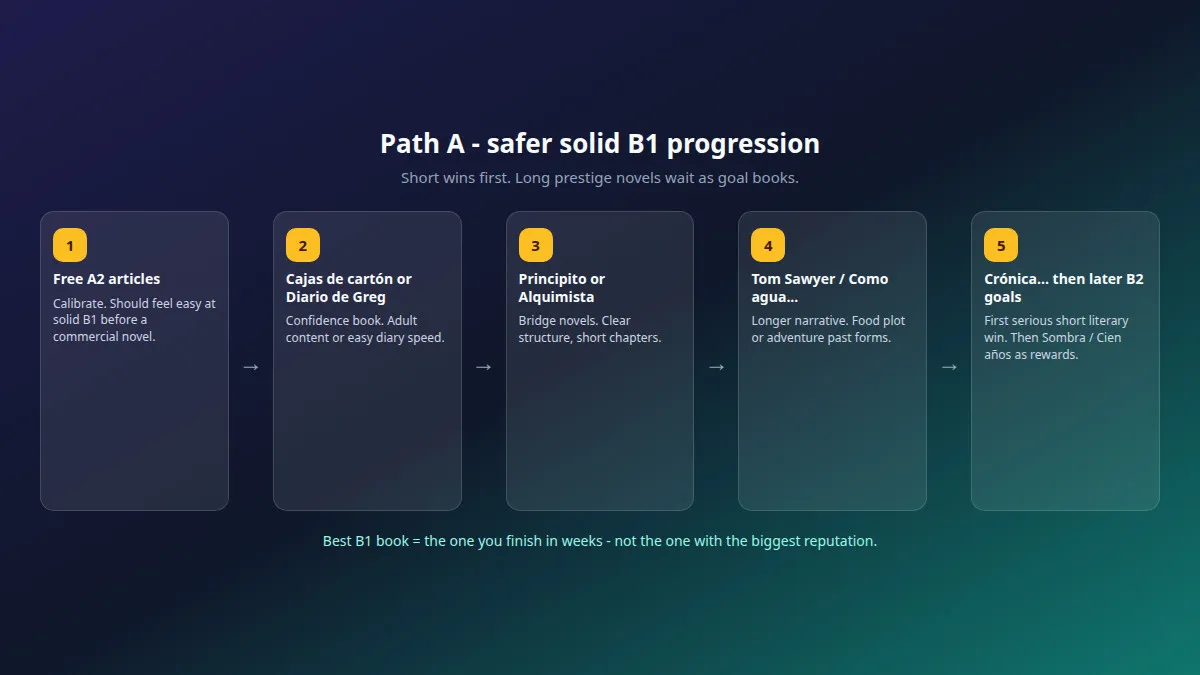
Path A (safer B1 progression):
- Free A2 articles for calibration (A2 sample, all articles)
- Cajas de cartón or Diario de Greg
- El Principito or El alquimista
- Tom Sawyer (Spanish) or Como agua para chocolate
- Crónica de una muerte anunciada
- Later: one long B2 goal book (La sombra del viento, La casa de los espíritus, or Cien años de soledad)
Path B (if you already finished A2 easy books):
- Skip pure comfort YA if it bores you
- Start with El alquimista or Como agua para chocolate
- Add Crónica de una muerte anunciada as literary short form
- Keep La sombra del viento as a future reward, not week-one proof
Either path works. Switching every two days because a title is famous is how finish rate dies.
How to use MovaReader at B1
MovaReader helps with supported reading and turning unknown language into practice. Free graded texts warm you up and cover recovery days. Long commercial novels from this list stay your legal EPUB or paper copy. The app does not host full commercial bestsellers such as La sombra del viento, La casa de los espíritus, or Cien años de soledad by default. It does host a small catalog of public-domain books, including B2 stretch titles such as Unamuno's Niebla and Quiroga's Cuentos de amor de locura y de muerte, where you tap a word to see its translation.
A practical B1 flow:
- Warm up on a free graded text so click-to-translate feels automatic: All Articles.
- Upload a book file you own when you start a commercial title. See How to use.
- Tap blockers only in dense paragraphs.
- Train phrases with the everyday Spanish phrases practice or free Spanish vocabulary trainer after saving useful chunks.
- Plans: freemium includes listening and 20 word translations/day. Reader (€1) unlocks unlimited translations. Pro (€5/mo) unlocks full trainers. See Pricing.
Free path today:
- Spanish A2 sample
- Word training demo
- Phrase training demo
- Upload one realistic B1 title you own and start Part 1 above
Tools reduce friction. They do not turn a hard book into comfort material.
FAQ: Spanish books for B1
What Spanish book should I read at B1 first?
Pick a book you can finish in weeks, not months. Cajas de cartón, El alquimista, or Crónica de una muerte anunciada beat 500-page mysteries as first targets. If A2 free samples still feel hard, stay on graded recovery longer before any novel.
Is B1 enough for Spanish novels?
Yes for many narrative novels with clear plots. No for every classic, every long literary saga, or dense poetry as a main project. "I am B1" does not mean every Spanish novel is fair game. Use a random middle page, not reputation.
Should I still use graded readers at B1?
Yes, as recovery and speed work. They should not be your only diet if the goal is independent real books. Useful mix: real books most days, graded texts on tired days. Free Spanish A2 sample: Aprendiendo a reciclar en casa.
How many unknown words per page is OK?
There is no magic number. If unknowns keep blocking whole sentences, the book is too hard for daily reading. If you can follow the plot and only stop for key phrases, you are in a useful zone. Under about 70% on a random page is stretch, not habit.
Can I read Márquez at B1?
You can try short Márquez (Crónica de una muerte anunciada). Long Márquez (Cien años de soledad) is usually later (high B2-C1 comfort). Judge by a random middle page, not by reputation.
Do I need translations for every unknown word?
No. Guess first, check blockers, save useful chunks. Unlimited lookups feel productive and often destroy flow. Tap only words that kill sentence meaning.
Final takeaway
Solid B1 is where Spanish books become real, not only possible.
Choose for finish rate. Keep a recovery track of easier graded texts. Treat long prestige novels as goals, not entrance exams. You do not need Cien años de soledad to prove you are intermediate.
Today: open a free Spanish A2 text to warm up, pick one realistic title from Part 1, and protect 15-25 minutes a day.
Lower than solid B1? Start with easy Spanish books for A1 or the easiest A2-B1 ladder. When graded feels too easy and you want real novels with clear stretch warnings, you are in the right place.
Keep reading with translations inside the text
With a free account, an unknown word translates with one tap, and the words you are learning wait for you in the trainer.
Free account: 7 days of Pro, then 20 word translations a day or a paid plan.