Curated Resources
Easy Spanish Books for A1 Beginners: What to Read First
True A1 Spanish books are mostly short graded texts you can finish, not El Principito on week one. Here is a starter list, free samples and a finish-first method.
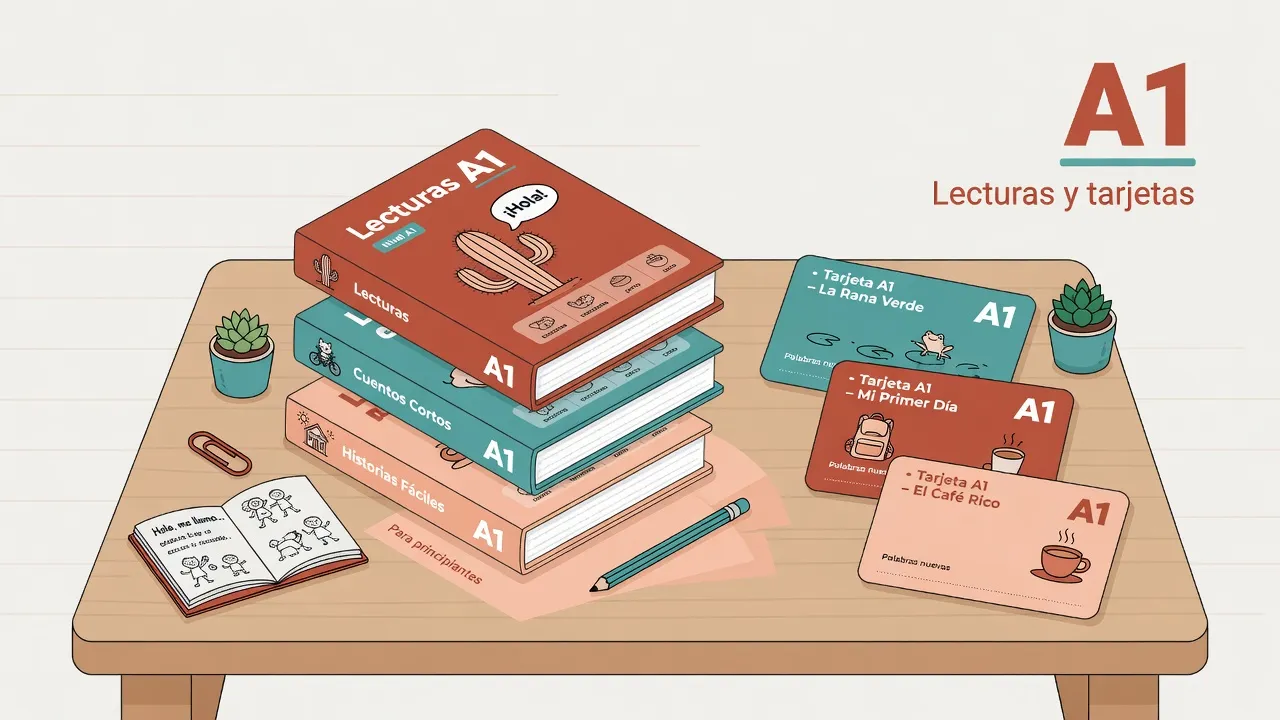
You type "easy Spanish books A1" and half the results hand you El Principito, a YA novel, or a "short classic" that still assumes grammar you do not have. You open page one, look up every other word, and decide you are bad at Spanish. You are not. The list was bad.
This guide is for true early stage: greetings, present tense, everyday nouns. A full chapter of unadapted prose still feels like noise. You need materials you can finish this week, not prestige titles for later.
Here's the simple version. True A1 Spanish "books" are mostly short graded texts and beginner readers you can finish, not El Principito on week one. Start with free A1 graded stories (park, airport, shopping), keep about 80-90% comprehension, and look up blockers only. Famous short classics wait until A2+.
Below: a quick picks table, free A1 finishes with real samples, publisher readers / kids books / comics, a postpone list, a weekly method, A2 readiness signals, Path A/B order, and FAQ.
About MovaReader: the library has no full commercial novels. You read free graded articles, or you upload a book file you own (for example EPUB). There is also a small catalog of public-domain fairy tales retold in simple A1 Spanish, such as Los tres cerditos and El gato con botas, where you tap a word to see its translation. The links below go to real free samples.
Quick picks for true A1
| Where you are | Start with | Why it works |
|---|---|---|
| Absolute beginner (A0-A1) | Free A1 graded articles | Short, controlled vocabulary, clear scenes |
| A1 with some school Spanish | Very short graded readers (A1) | Chapters you can finish in one sitting |
| High A1 / entering A2 | Picture-supported readers or Diario de Greg later | Still concrete; not literary yet |
| Not yet | El Principito, El alquimista, any "short classic" | Short length does not mean A1 difficulty |
The only rule that matters: open a page. If you understand about 80-90% without help, keep going. If you are under ~70%, drop one level. At A1, pride is expensive.
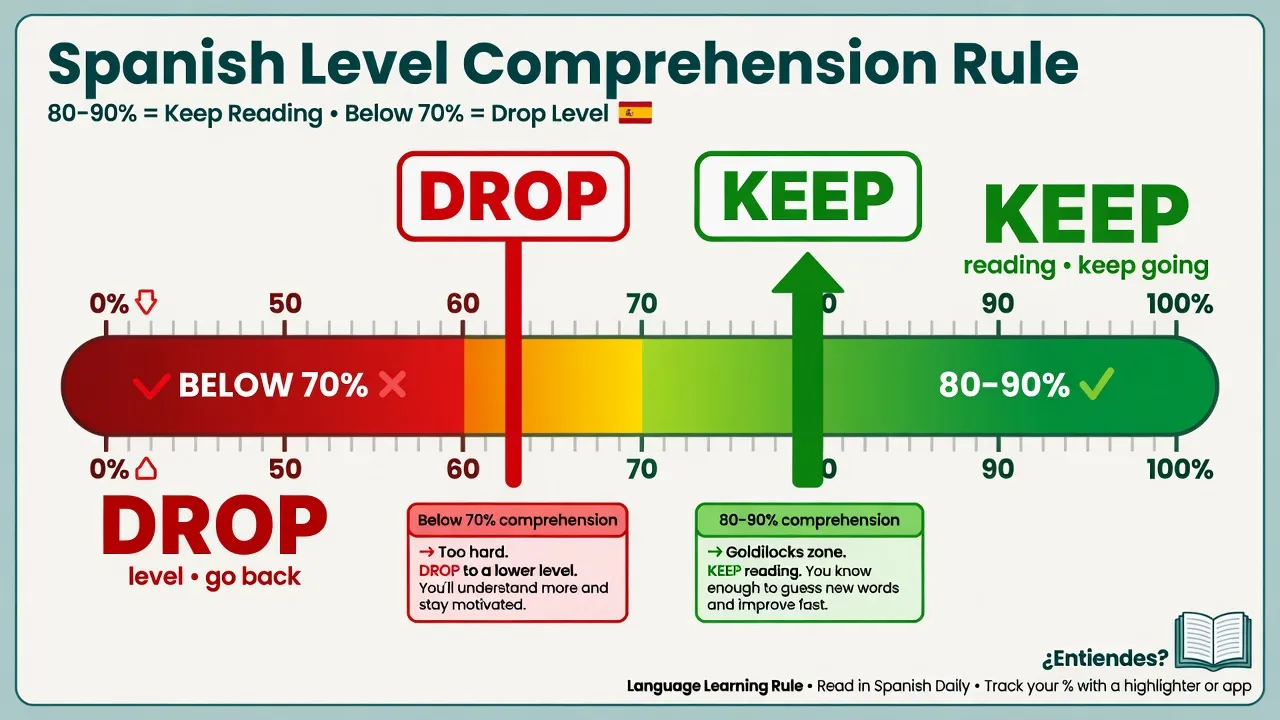
Try this free sample first (no book purchase needed): Spanish A1: Mi día en el parque. If that page feels mostly readable with a few lookups, you are in the right zone for the list below. For a wider free ladder across levels, see Spanish graded reading stories by CEFR. For legal external sources beyond the app, use free graded Spanish readers online.
What "A1 Spanish book" actually means
At A1, "book" often means short graded text, not a 200-page novel. That is not a failure. It is how reading skill is built.
A1-friendly material usually has:
- present tense as the main engine
- short sentences and clear subject-verb-object order
- concrete topics: home, food, school, city, family, weather
- heavy repetition of high-frequency words
- limited character casts and simple plots
A1 material usually does not have:
- long descriptive paragraphs
- subjunctive-heavy dialogue
- multi-timeline plots
- dense humor that depends on culture
- poetry or abstract philosophy as the main text
Many blogs label anything "short" as beginner. Length and CEFR level are different things. A short poem can be harder than a longer graded story.
Think of your materials as a ladder: free graded articles first, short beginner readers next, longer books only when the lower rungs feel easy.
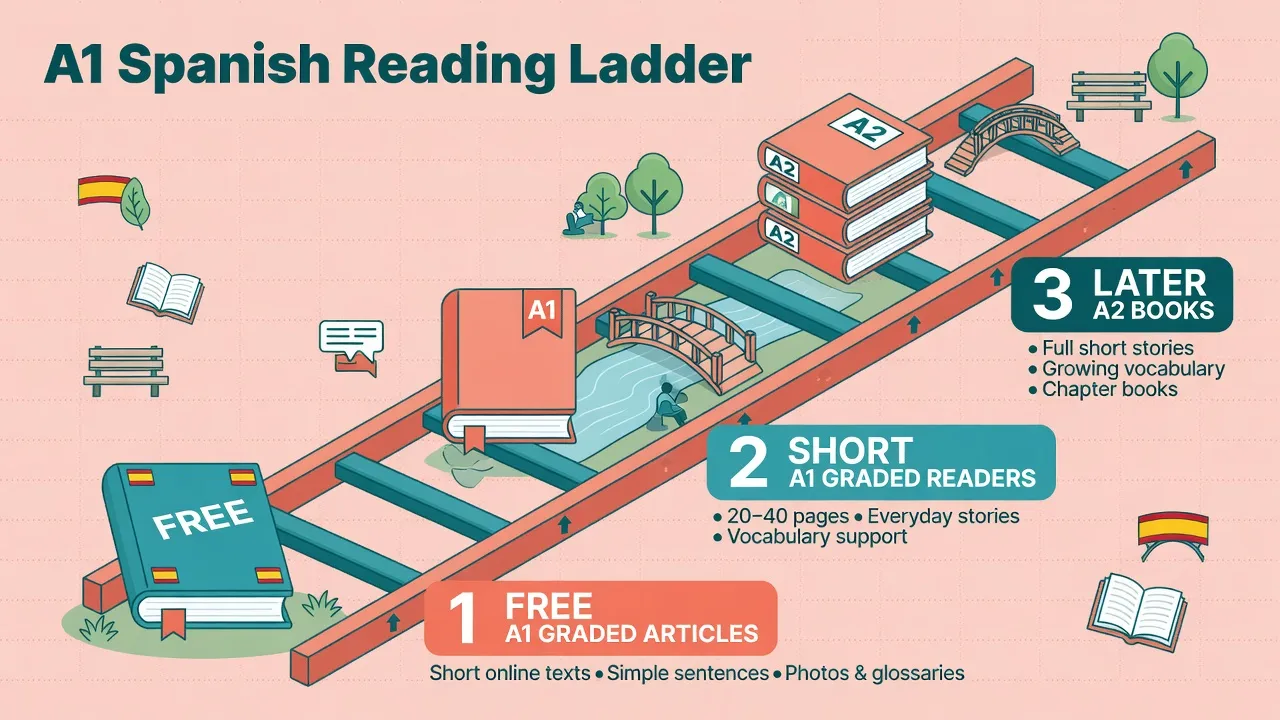
Free articles build the habit. Short readers give you "book" confidence. Famous novels wait.
Free A1 graded finishes you can open today
These are real free Spanish A1 samples in the library. Each one is short enough to finish in one calm session. Use them as your main daily reader for the first weeks. Longer books come after you can finish a short A1 text without melting down.
| Start with | Why it helps at A1 |
|---|---|
| Mi día en el parque | Everyday park scene, present tense, clear who/where/what |
| El lápiz mágico de Sofía | Simple story arc with concrete objects and short sentences |
| Jugar al fútbol | Sport vocabulary you can picture; high repetition |
| En el aeropuerto | Travel basics in plain language |
| Ir de compras con mamá | Shopping dialogue and familiar routine language |
| La comida española | Food and culture at concrete noun level |
| La Merienda | Snack-time scene; short and friendly |
| El juego del escondite | Hide-and-seek plot kids and adults both follow easily |
How to use the list: pick one. Read for 10-15 minutes. Look up only words that block the whole sentence. Finish the page. Tomorrow, pick the next one or reread the same text for speed.
Browse more free leveled Spanish in all articles. When A1 feels automatic, try an A2 warm-up: Aprendiendo a reciclar en casa. If you want micro-story formats rather than a book ladder, pair this with 7 short Spanish stories beginners can read day one.
Publisher A1 readers, kids books, comics, and high-A1 bridges
Publisher A1 graded readers (short chapter books)
Realistic level: A1 to low A2
Why it helps: Designed for learners: glossaries, short chapters, limited vocabulary range.
Watch out for: Series labels. "A1" from one publisher may feel harder than another. Trust your 80% rule more than the cover.
Look for:
- readers marked A1 or beginner with about 500-1,000 headwords (or similar)
- stories under ~40-60 pages if possible
- plots about travel, school, simple mysteries, or daily life
You buy or borrow these as files or paper. Then, if you use an app, upload the EPUB you own rather than expecting a free full commercial novel inside a learning tool. How-to: how to use.
Children's early readers in Spanish (careful selection)
Realistic level: A1 for some titles; others jump
Why it helps: Simple syntax, pictures that support meaning, concrete nouns.
Watch out for: "Kids books" that are still culturally dense, idiomatic, or full of made-up names.
Good early-reader traits:
- one idea per page or short paragraph
- present tense narration
- familiar routines (morning, park, food)
Skip for now:
- fairy tales with archaic language
- long chapter books aimed at fluent native 8-year-olds (those are often A2-B1 for adult learners)
Dual-support picture stories and comic-style beginners
Realistic level: A1-A2
Why it helps: Visual context reduces dictionary load.
Watch out for: Relying only on pictures and never reading the words carefully.
Comics and illustrated stories can keep motivation high. Treat them as training wheels: useful, not the only diet.
Diario de Greg (Spanish) - only at high A1 / early A2
Realistic level: closer to A2 than pure A1
Why people put it on beginner lists: Short diary entries, humor, modern school life.
Note: Many absolute beginners still drown in colloquial lines. Keep it as a bridge book after graded A1 texts feel easy.
If you already know the story in English, you can try a few pages earlier. Still: if lookup rate stays high, return to graded A1 material.
Popular "beginner" books to postpone
These titles appear on endless beginner lists. They are fine books. They are usually not true A1 finish projects.
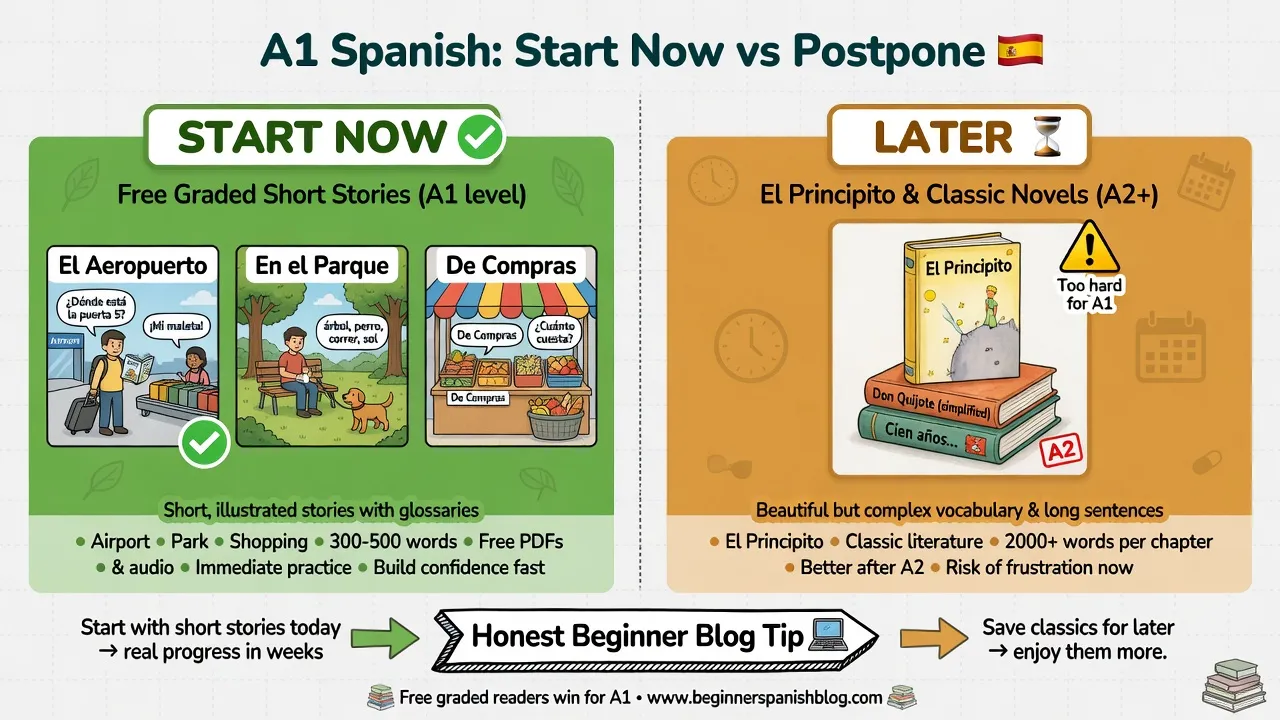
Start now with free A1 stories. Save the prestige titles for when concrete narrative already feels calm.
El Principito (Spanish)
More realistic level: A2-B1 for comfortable reading
Short chapters help. Abstract lines about "what is essential" do not. Save it until you can read concrete A2 narrative without constant stops.
El alquimista (Spanish)
More realistic level: A2-B1
Repetition helps intermediate readers. Philosophy plus narrative still overshoots many A1 learners.
Cajas de cartón - Francisco Jiménez
More realistic level: solid A2
Clear and concrete, but emotional and denser than A1 graded text. Excellent next step after A1, not week-one material for most absolute beginners.
Any "short classic" or poetry collection
Short does not equal easy. Poetry compresses meaning. Classics often keep older vocabulary and complex style.
A1 reading method that does not burn you out
1) Build a finish habit before a prestige habit
Your first goal is not "read real literature." Your first goal is finish small texts often. Ten finished A1 pages beat one abandoned novel.
2) Look up blockers only
Practical workflow:
- Read a short paragraph without stopping.
- Mark only words that block the whole sentence.
- Check those words.
- Reread once.
- Save 3-8 useful phrases max per session.
If you look up every adjective, you train dictionary use, not reading.
3) Keep sessions short
10-15 minutes daily beats a weekend guilt marathon. Stop mid-text if needed. Consistency is the skill.
4) Weekly pattern for A1
- 5 days: free graded A1 texts from the list above
- 1 day: optional short graded reader chapter (publisher A1 or kids early reader)
- 1 day: review saved phrases (typing or speaking aloud)
Free samples to start the week: Mi día en el parque, then rotate through the free A1 table. When ready: A2 sample. Full library: all articles.
5) Use audio after text, not instead of text
If audio exists for a text, listen after you can follow the written page. Audio on a page you do not understand yet usually adds noise.
Want a rough sense of vocabulary bands while you read? Open the free language map as a compass.
How to know you are ready for A2 books
You are probably ready to move up when:
- A1 graded pages feel mostly automatic
- you finish short texts in one sitting without dread
- unknown words no longer kill every sentence
- you can retell a short text in simple Spanish or in English with most events intact
Then try high-A1 / low-A2 graded readers, then easier narrative titles people often recommend at A2 (Cajas de cartón, Diario de Greg, later El Principito).
How to use MovaReader
MovaReader is useful for early reading with support, then turning unknown words into practice. Use it like this:
- Warm up on free graded articles in all articles so you learn click-to-translate.
- Stay on A1-A2 library texts until daily reading feels stable.
- Upload a book file you own (for example EPUB) only when you pick a real graded reader or beginner book. See how to use.
- Tap only blockers, not every unknown word.
- Train a small phrase set in the Spanish phrases practice or full trainers after you save items.
- Respect freemium limits: free use includes listening and a daily word-translation budget (20/day). Unlimited translations are on Reader (€1). Full trainers are on Pro (€5/mo). Details: pricing.
If you want to start for free today:
- Read Spanish A1 sample
- Try Spanish typing practice
- Try phrase training demo
- Only later upload a short reader you own
Sister guides (same Spanish reading path, different job)
- Spanish graded reading stories by CEFR - free in-app ladder across levels
- Free graded Spanish readers online - legal external sources map
- 7 short Spanish stories beginners can read day one - story types for A1-A2 finishability
This post owns the A1 book/material decision: what counts as a book at A1, what to postpone, and how to finish first.
Suggested order if you feel lost
Path A (safest for absolute beginners):
- Free A1 articles in MovaReader for 1-2 weeks (start with the free table above)
- More free A1-A2 graded texts in all articles
- One short publisher A1 graded reader (file you buy or borrow)
- High A1 / early A2: simple diary-style or illustrated reader
- Later (A2): Cajas de cartón or Diario de Greg
- Later still: El Principito as a confidence book, not as your first proof
Path B (if you already know basic school Spanish):
- Free A1 sample to calibrate: Mi día en el parque
- Free A2 sample when A1 feels easy: Aprendiendo a reciclar en casa
- Short A1-A2 graded reader
- One slightly harder bridge book only if comprehension stays high (~80-90%)
FAQ: easy Spanish books for A1 beginners
What is the easiest Spanish book for absolute beginners?
For most true A1 learners, the easiest "book" is a short graded A1 reader or a free A1 article series, not a famous novel. Start with controlled text before prestige titles. The free table above is a practical starting pack.
Can A1 beginners read El Principito?
Some try and survive with heavy support. Most will enjoy it more at A2-B1. If your goal is finishing and building confidence, postpone it.
Should I use dual-language books?
They can help at the very start, but many learners over-rely on the English side. Prefer level-matched Spanish text with selective lookup over constant parallel reading.
How many pages should A1 learners read per day?
Start with 1-3 short pages or 10-15 minutes. Increase only when lookup rate drops. Finishing small units matters more than page count.
Are children's books always easy for adults at A1?
No. Some are perfect. Others are idiomatic, culture-heavy, or long. Use the 80% comprehension rule, not the age label on the cover.
Do I need a paid app to start reading Spanish?
No. You can start with free graded samples and paper or library readers. Tools help with friction (lookup, review). They do not replace choosing the right difficulty. Freemium is enough to try (~20 word translations/day); Reader (€1) and Pro (€5/mo) are optional when volume or trainers become the real wall. See pricing.
How do I know a text is too hard?
If you understand under ~70% without help, drop one level. Stay where about 80-90% is clear. Below that zone, you train frustration, not reading fluency.
Final takeaway
The best easy Spanish book for A1 is the one you can finish this week.
Choose controlled texts first, protect a short daily habit, and treat famous novels as later rewards. If you want a clean start today, open the free Spanish A1 sample, rotate through the free A1 finishes above, then move to more leveled texts in all articles before you buy or borrow a longer title.
Keep reading with translations inside the text
With a free account, an unknown word translates with one tap, and the words you are learning wait for you in the trainer.
Free account: 7 days of Pro, then 20 word translations a day or a paid plan.