
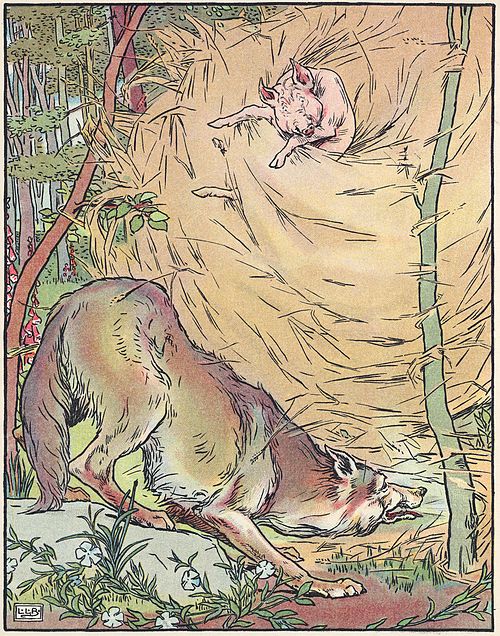
I. La vieja cerda
, .
« , », . « ».
«¿ , ?», .
« », . « ».
«¿? ¿ ?», .
« . , ».
«¿ ?», .
« , . . ».
A fairy tale adapted for A1
Joseph Jacobs
This is a retelling in simple Spanish, not the original text: MovaReader adapted “The Story of the Three Little Pigs” from Joseph Jacobs’s English Fairy Tales (1890) for level A1. In the catalog it is about 3,300 words, 6 words per sentence on average, all in the present tense. 8 short chapters about three little pigs who leave home to seek their fortune, and a hungry wolf who knocks at each of their doors.
This text
You can manage it at A1: sentences are short, 6 words on average, everything is in the present tense and the wolf’s lines repeat, so the tale reads well one chapter at a time, translating single words.
Check this passageWith room to spare
At A2 the tale reads with room to spare and almost without translation; only rare words like tojo or mantequera may stop you.
Start readingThe average sentence has 6 words, less than half as many as in Unamuno’s Mist (13): Mist has the shortest sentences among the catalog’s complete Spanish texts and sits at B2. A word of 9 letters or more comes up about once in 180 words here, against one in fourteen in Mist, and there are only three such words in the whole text: ladrillos, mantequera and mantequilla. Everything is in the present tense, a quarter of the words are the characters’ lines and thoughts in quotation marks, and set phrases like Cerdito, cerdito, déjame entrar keep coming back. The difficulty is even: each of the 8 chapters runs at 6-7 words per sentence. Hence A1. This is the catalog’s assessment, not a certificate.
MovaReader. Project Gutenberg
An old sow is too poor to feed her three sons, so she sends the little pigs out into the world to seek their fortune. Each takes his own road and builds a house: the first of straw, the second of prickly furze, the third of bricks. A hungry wolf comes to each of them and asks to be let in. The third little pig turns out to be the cleverest: the wolf invites him to pick turnips, then apples, then to the fair at Shanklin, and each time the pig leaves home before the wolf arrives. How their game ends is not revealed here.
I. La vieja cerda
, .
« , », . « ».
«¿ , ?», .
« », . « ».
«¿? ¿ ?», .
« . , ».
«¿ ?», .
« , . . ».
VII. La feria de Shanklin
. . , . , . .
. .
, , .
«¿ ?», .
« », . « ».
«¡ ! . ¿ ?».
« ».
Choose an underlined word.
The mother explains the word fortuna herself: Una vida buena. Una casa, comida y un poco de suerte, “a good life: a house, food and a bit of luck”. Buscar su fortuna means “to seek your fortune”. Tener que with an infinitive expresses duty: tiene que buscar, “has to look for”; es hora de salir, “it is time to set out”. Every verb here is in the present tense: dice, pregunta, está.
Hay means “there is” or “there are”: Hay mucha gente, “there are lots of people”. A woman explains what a mantequera is: Sirve para hacer mantequilla, “it is for making butter”; sirve para with an infinitive says what a thing is used for. ¿Cuánto cuesta? asks the price, “how much is it?”. In La quiero the pronoun la, “it”, meaning the churn, comes before the verb.
The book stays free on every plan. Reader, €1 a month, removes the daily limit on words and sentences.
€1 a month
At A1 many words are new: Reader lifts the daily limit on translating them and translates whole sentences, like the pigs’ answer to the wolf, which does not translate word by word.
ReaderIt is a MovaReader adaptation, not the original text. The source is “The Story of the Three Little Pigs” from Joseph Jacobs’s English Fairy Tales, 1890. The language has changed: the tale is retold in Spanish in the present tense, with short sentences and the most common words. It is several times longer than Jacobs’s tale: dialogue and scenes that grow out of the story were added, such as the farewell to the mother and a walk around the fair, and Jacobs’s rhyming opening is retold in prose. All of Jacobs’s episodes are kept, in the same order: the three houses, the turnips from Mr. Smith’s field, the apple tree at Merry-garden and the fair at Shanklin.
No, this adaptation has no audio version on MovaReader: the tale is read here. An unfamiliar word translates with a tap, and most often it will be the name of a thing, such as olla, paja or ladrillo.
Yes, with the Reader plan. Sentences here are short, 6 words on average, so a whole-sentence translation helps not with length but with set phrases that do not translate word by word: por los pelos de mi barbilla or Es hora de salir al mundo. On the free plan you can still translate single words, up to a daily limit.
The whole tale takes about an hour, reading with translation of new words rather than at a native speaker’s pace. Each of the 8 chapters has roughly 340-500 words, so a chapter takes a few minutes.
It does not get easier because it never gets harder: the difficulty is even, with 6-7 words per sentence on average in each of the 8 chapters. Chapter VII, at the fair, has the most long words, mantequera and mantequilla, but its sentences are just as short.
Yes. Once you sign in, the reader remembers where you stopped and the words you opened, so you can finish the tale another day from the same spot. Each of the 8 chapters also opens from the contents on this page, for example chapter V, about the turnips from Mr. Smith’s field.

