Curated Resources
7 Short Spanish Stories Beginners Can Finish Day One
Short Spanish stories work for beginners when they are finishable. Here are seven A1-A2 types, a simple reading method, and free samples to start today.
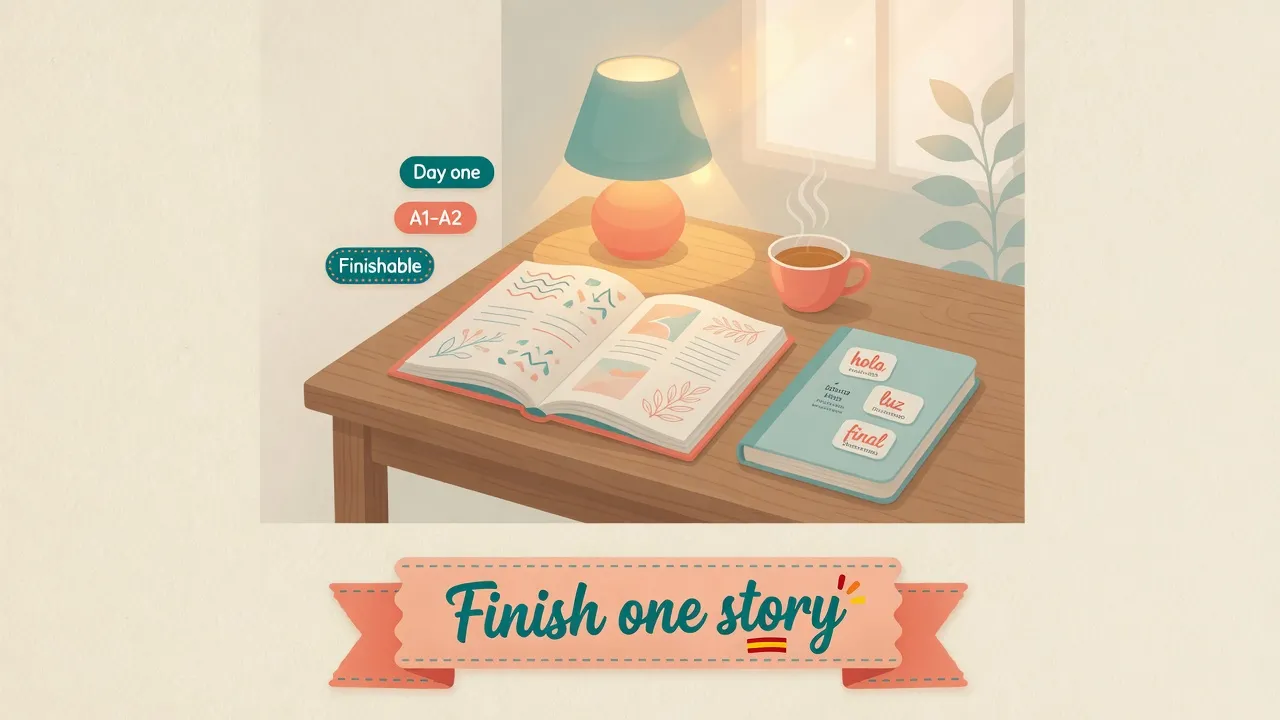
You can already say Hola, ¿cómo estás? and you want something more alive than a hotel dialogue. Motivation is rarely the problem. Material is.
A 300-page novel feels like a mountain. A dry textbook scene often dies mid-page. You need a bridge that feels like real Spanish and still ends before your patience does.
Short stories can be that bridge - but only if the difficulty is right. Plenty of lists drop a beginner into dense literary Spanish on day one. That does not help you finish anything this week.
This page is for A1-A2, with a light note for B1 stretch. You will leave with a level map, seven finishable story types, a too-early list, a two-pass reading method, and two clear paths when you do not know where to begin.
Short answer
The best short Spanish stories for beginners are short, concrete, repetitive, and finishable. On A1-A2 prefer daily-life scenes (family, shop, city, birthday), very simple fables with clear conflict, free graded texts about school, food, home, or weekend, and plots you already know in another language - not a dense literary novella just because it is short.
Stay if you understand roughly 80-90% of a page without help. Below about 70% is stretch, not a daily habit. Warm up free on Spanish A1 and Spanish A2, then use the seven types below.
If you want named titles by level A1-B2, use the CEFR short-story guide. This page is only finishable story types for day one - not a buy ladder.
Length is only a container. Hard syntax and rare vocabulary still apply. Pick finishable types, not prestige shorts, on day one.
What you will use next:
- a level roadmap for "what to read now"
- seven finishable types with a skip-if line on each
- a too-early list so you do not blame yourself for the wrong text
- a two-pass method and Path A / Path B
Why short stories help at the start (and when short ≠ easy)
On A1-A2, a short story earns its place for simple reasons:
- you can see the finish line - huge for confidence
- vocabulary repeats inside one small world
- one plot is easier to hold than fifteen characters
- you can complete a text in 1-3 short sessions
Here is the catch: "short" is not the same as "easy."
A two-page piece with unexpected tenses, wordplay, and idioms can be harder than a longer, plain supermarket scene. Prestige titles look impressive in a list. They do not help if you quit on paragraph two.
That is why this guide favors finishability over famous names. You want a text you can close with a small win - not a bookmark of guilt.
If you want books rather than micro-stories, pair this post later with easy Spanish books for A1 beginners and top easy Spanish books for A2-B1. For free graded sources in general, see free graded Spanish readers online.
Level roadmap: what to read now
Use this table as a compass, not a certificate. Match text length and type to the level you can actually finish this week.
| Level now | Story type | Best start | Goal |
|---|---|---|---|
| Low A1 | Micro-scenes 80-200 words | Free graded A1 + cat/mouse, family, shop | Who / where / what happens |
| A1-A2 | Daily stories 200-600 words | Day in city, lost dog, birthday | Finish one full text |
| Solid A2 | Longer scenes / simple fables | Trip, school, familiar fairy tale (plain language) | Read with few lookups |
| A2-B1 | Adapted classic short stories | Known plots, simplified | Follow tension, not every word |
| B1 stretch | Real short literary prose | Short literary with support | Style + plot - not day one |
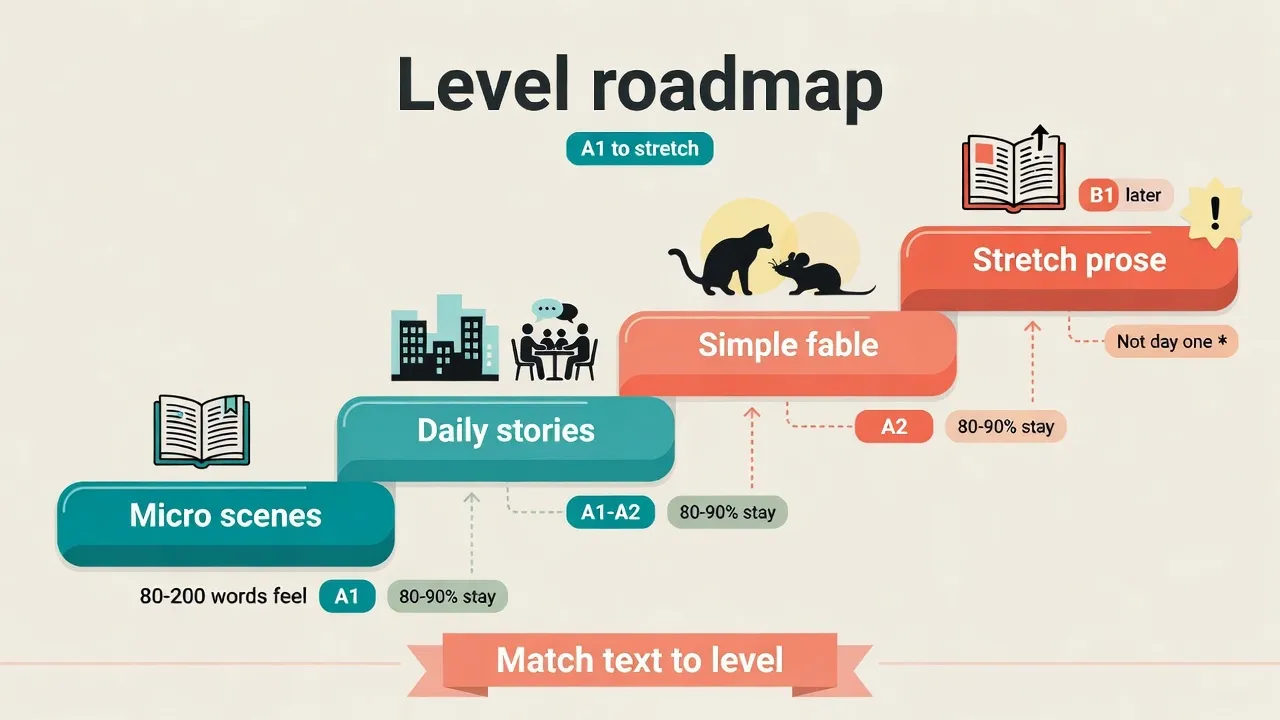
Understanding rule again: 80-90% comfort = stay. Below about 70% = step down or switch to a graded text. Do not "power through" fog every day. That trains quitting, not steady progress.
Free start today:
- Spanish A1: Mi día en el parque - calibrate the habit
- Spanish A2: Aprendiendo a reciclar en casa - stretch comfort
- All articles - daily volume when you want more free pages
Optional overview of free library levels: Spanish graded reading by CEFR.
7 story types beginners can actually finish
These are working formats. You will find versions as learner texts, simple retellings, public-domain style fables, or files you already own legally.
Warm up on free graded pages first. Then pick a type that matches your week - travel energy, home life, a small emotional plot, or pure thematic practice. Not every type fits every mood.
1. «El gato y el ratón» - a very simple fable scene
Realistic level: A1
Why it works: Concrete nouns, repeats, and a clear conflict (cat hunts / mouse tricks). You always know who wants what.
Skip if: you only want travel and daily phrases this week - fable animals will not stick to your café life.
Watch out: Even "children's" Spanish sometimes sneaks in unexpected verbs. Clarity beats a fancy edition.
Vocabulary you lock in: animals, size (grande/pequeño), core verbs (vivir, buscar, correr).
Session tip: 8-12 minutes. Finish the whole scene. Do not autopsy every adjective.
2. «La familia García» - family, work, weekend
Realistic level: A1
Why it works: High-frequency words (family, jobs, days of the week) and a predictable structure. You can almost feel the next sentence before you read it.
Skip if: these texts bore you cold - swap the names for your own family, or jump to the lost-dog type.
Watch out: Can feel dry. Dry is fine for vocabulary; bad for quitting. Personalize if needed.
Vocabulary you lock in: madre/padre/hijo, trabajar, cocinar, los domingos.
Session tip: After the text, say or write 3-5 sentences about your real family. Passive becomes a tiny bit of active use.
3. «Un día en Madrid» (or any city) - a tourist day
Realistic level: A1-A2
Why it works: Practical travel language - cafe, street, shop, park. Useful the same week you visit a city or plan one.
Skip if: you hate travel framing and only want home or school scenes.
Watch out: You do not need to memorize every place name. Keep the skeleton of actions: morning / later / evening.
Vocabulary you lock in: food, movement (caminar, ver, ir), times of day.
Session tip: Add audio after the text already makes sense. Listening on a page you do not understand mostly adds noise.
4. «El perro perdido» - a short emotional story
Realistic level: A1-A2
Why it works: Emotion holds attention. The plot is linear. You get questions and simple dialogue without a fifteen-character cast.
Skip if: you need pure phrase drills only - the emotion pack can feel messy for list-learners.
Watch out: Feelings and needs (hambre, frío, miedo) may arrive as a pack. Take only blockers.
Vocabulary you lock in: ¿Dónde está...?, tener hambre, simple help dialogues.
Session tip: Practice not translating every word. The plot is often clear at 70-80% of the lexicon - and that is enough to finish.
5. «La fiesta de cumpleaños» - party, gifts, friends
Realistic level: A1-A2
Why it works: A concrete scene, repeated greetings, age, and numbers. You leave with lines you can actually use.
Skip if: the party noun deck overwhelms you and you need shopping or work vocab more this week.
Watch out: Food and party nouns balloon fast (pastel, velas, globos). If the cake is not needed for the plot, skip the full menu deck.
Vocabulary you lock in: Feliz cumpleaños, age, regalo, amigo, basic numbers.
Session tip: Practical bonus - after the text you can wish someone a happy birthday in Spanish without a separate "holiday unit."
6. «En el supermercado» - shopping list and dialogue
Realistic level: A1-A2
Why it works: Everyday vocabulary you can use the same week. Lists and polite requests show up in real life constantly.
Skip if: product lists become endless flashcards and you need plot-first motivation instead.
Watch out: Cap 5-10 new items per session. The aisle is infinite. Your memory is not.
Vocabulary you lock in: food items, necesitar, ¿Podemos...?, polite requests.
Session tip: Read one or two sentences aloud after you understand them - not instead of understanding.
7. «Las estaciones del año» - seasons and weather
Realistic level: A2 (description)
Why it works: Clear structure (four blocks), thematic vocabulary nests, easy comparison across seasons.
Skip if: you need a plot with conflict today - this is thematic training, not a twist ending.
Watch out: Descriptive language is sometimes harder than dialogue. If it drags, one season per day is fine.
Vocabulary you lock in: primavera/verano/otoño/invierno, weather, nature, colors.
Session tip: Alternate with stories that have conflict and an ending so your week is not only weather labels.
Find plain learner versions, free graded pages in the same world, or a legal file you already have. The format is what matters on day one.
Too early for most A1-A2 readers
Good materials. Bad first targets:
- unadapted literary short stories "because they are short"
- poetry as the main reading plan
- news from week one
- long novel chapters framed as "I'll just look"
- unadapted fairy tales when the language is not plain (a children's classic is not automatic A1)
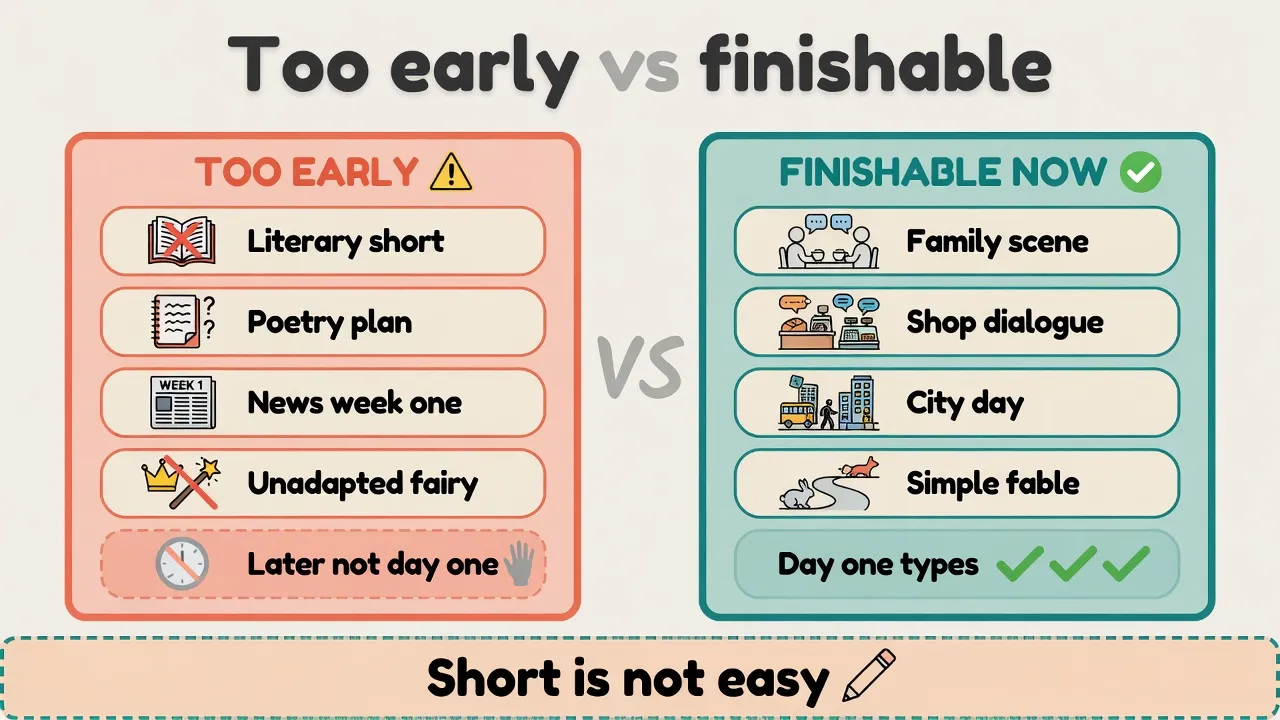
Short form is only a container. Difficulty lives in vocabulary, grammar, cultural context, and how familiar the plot already is. Famous names can wait until you finish simpler texts without constant dictionary work.
When you are ready for legal free files at a later stage, see free legal EPUB libraries (English and Spanish). For a named climb by band later - not today - return to the CEFR short-story guide.
How to read without quitting on paragraph two
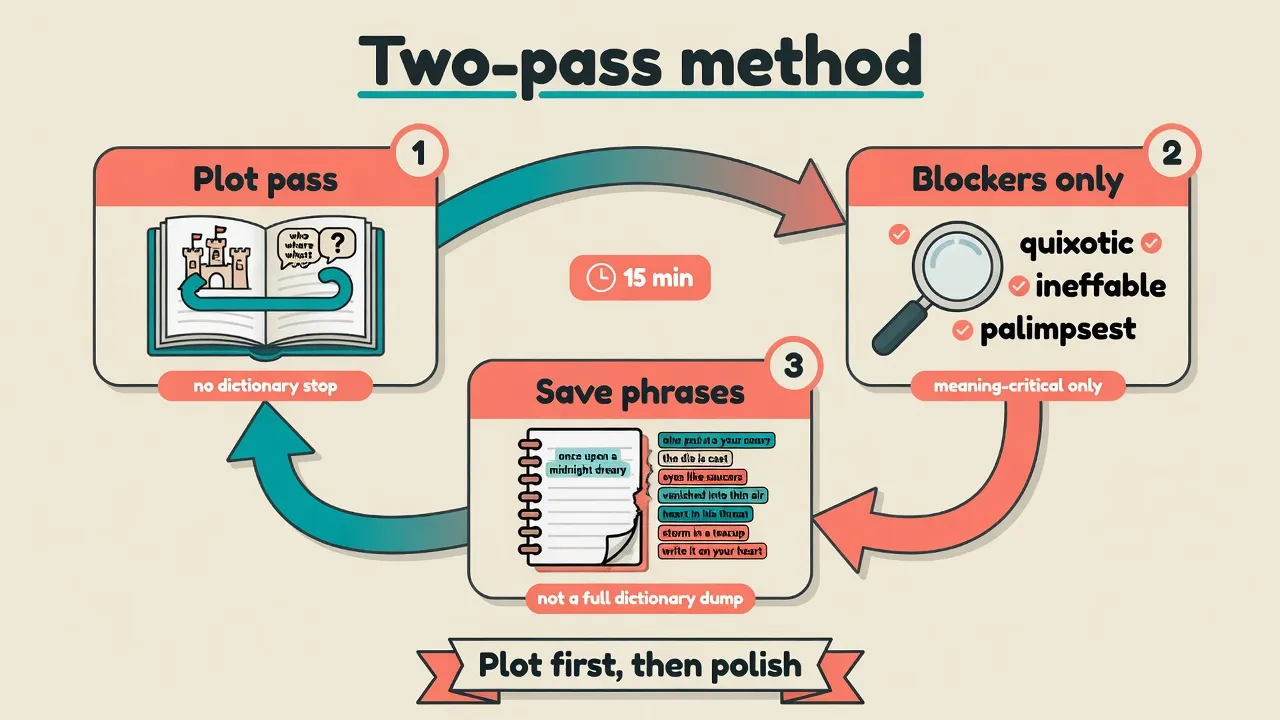
Finish the page before you rebuild the dictionary. That is the whole method in one line.
1) First pass = plot only
Who? Where? What happened? Do not stop on every unknown word. Circle the fog if you must - then keep moving.
2) Second pass = blockers only
Look up words without which the sentence loses meaning. Decorative unknowns can wait. Azul vs rojo on a dress rarely decides the plot.
3) Save chunks, not infinite lists
3-10 useful phrases per session: tener hambre, por la mañana, ¿dónde está?, vamos al parque. A short list you revisit beats a graveyard of 80 words.
4) Audio after basic understanding
Sound links spelling and speech. On a page you do not follow, audio usually adds load, not magic.
5) Short daily sessions
Fifteen minutes every day beats a heroic weekend and two weeks of silence. Protect the finish line, not the drama of a long session.
A stable week:
- 4 days: free graded texts
- 2 days: one chosen short story (paper, EPUB, or simple learner text)
- 1 day: light review of saved phrases
Free start today:
For the wider method (not only short stories), see how to learn Spanish by reading. If you prefer a Ukrainian-language start guide, there is also how to read Spanish for Ukrainian speakers. More free graded options: free graded Spanish readers online.
Two paths if you do not know where to begin
If you freeze at the seven types, pick a lane. Both finish small texts before prestige.
Path A - safer finishability ladder
- Free A1-A2 graded articles
- Family / supermarket / day in the city
- Lost dog or birthday
- Simple fable scene
- Seasons as a thematic add-on
- Later: one adapted short story
Path B - plot-first
Use this if story grips you more than "useful for travel":
- Free A2 articles
- Emotional short story (dog / friendship / small adventure)
- A familiar fairy tale in plain language
- One adapted literary piece only after 2-3 texts read without constant dictionary use
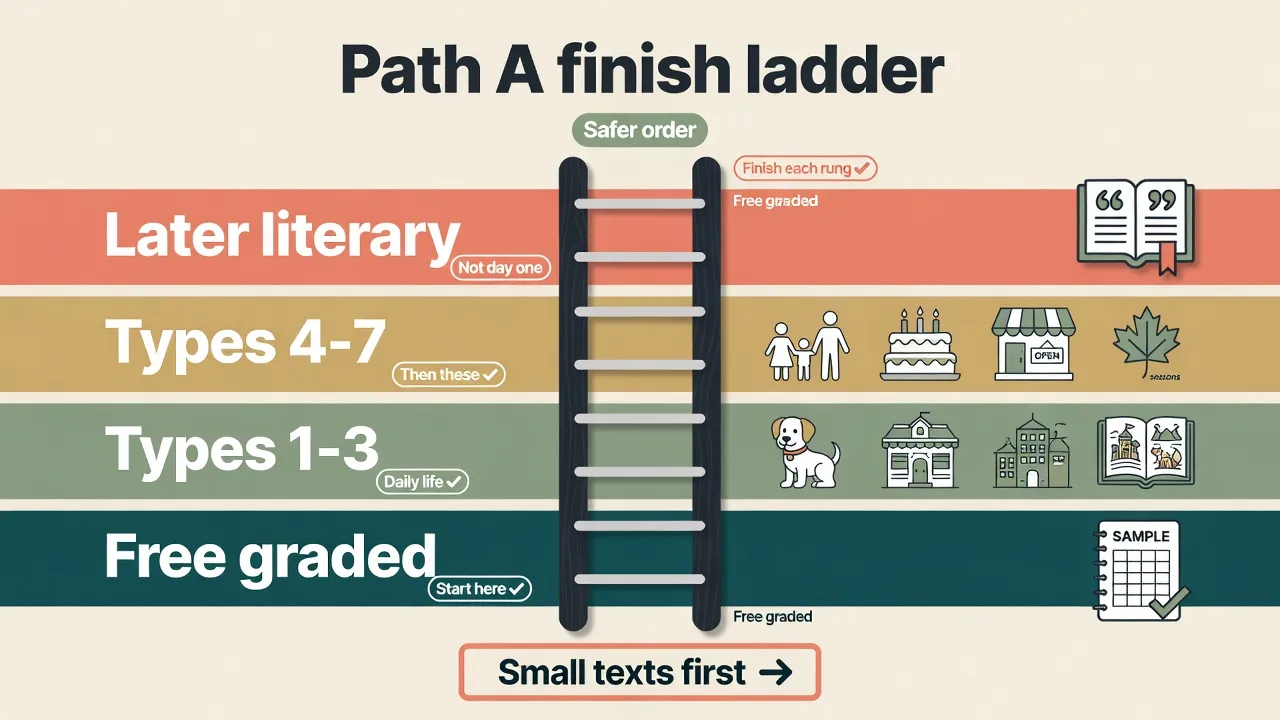
Both paths share the same rule: finish small texts before you chase prestige. Day-one literary novels are not "easy because short."
When you want named free and buy titles by band, hand off to the sister post: best Spanish short stories by CEFR level. That guide climbs A1-B2 with real titles. This page stays on types and day-one finishability.
How to use MovaReader
MovaReader helps you read with support and turn unknown words into light practice. You get free graded articles with click translation and listening, plus the option to upload legal files of your own (EPUB and similar). For a familiar fairy tale in plain Spanish, the book catalog also has A1 retellings such as Caperucita Roja and Los tres cerditos, where you tap any word to see its translation; more on the Spanish A1 shelf.
- Warm up on free graded articles in All Articles.
- Open real samples: Spanish A1, Spanish A2.
- Upload a file you legally have when you want a specific story. See How to use.
- Tap only blockers, not every new adjective.
- Train a small phrase set in everyday Spanish phrases practice or full trainers. Word demo: free Spanish vocabulary trainer.
- See your vocabulary shape on the language map after a few sessions.
- Know the free plan limits: free includes listening and about 20 word translations per day. Unlimited translations: Reader (€1). Full trainers: Pro (€5/month). Details: Pricing.
What MovaReader does not do:
- replace legal buying or borrowing of commercial books
- turn B1 literature into "A1 easy"
- cancel the need to choose the right difficulty
A clear path for today:
- Read the Spanish A1 sample
- Read the Spanish A2 sample
- Try the word training demo
- Try the phrase training demo
- Then either another graded text or one daily-life story type (family, city, shop)
Small finished texts beat big unfinished ambitions.
FAQ: short Spanish stories for beginners
Where should absolute beginners start?
Graded A1 plus a daily scene (family, shop, park). A simple fable is fine if the language is very plain. Skip a famous literary short story until you can finish easy texts without panic. Warm up free on Mi día en el parque, then try one type from this guide - family, shop, or lost dog are strong first picks. For named titles by level later, use the CEFR short-story guide.
Are short stories better than novels at A1-A2?
Usually yes for confidence and finishing. A short text shows a finish line you can reach in 1-3 sessions. Novels motivate some people, but many quit on length and lookup load. When you want longer books at an easy level, pair this post with easy Spanish books for A1 beginners and later the top easy Spanish books for A2-B1.
How many stories per week?
One to three fully finished stories beats seven half-started ones. Quality of finish plus light phrase review matters more than a long "to read" list. A stable week: about four days free graded texts, two days on one chosen short story type, one light review day for saved phrases.
Must I know all verb tenses first?
No. Recognize presente and frequent forms. Pull in other tenses in context when they block meaning - not as a gate before any reading. If a tense wall makes a page collapse under about 70% understanding, switch to a graded A1-A2 text rather than quitting Spanish reading.
Should I read aloud?
Yes, briefly, after you understand. One or two minutes of clear speech on sentences you already follow beats twenty minutes of opaque text out loud. Same rule for audio: listen after the written page makes sense, so sound links spelling to speech instead of adding noise.
Can I learn only from fables? Where do I find free graded Spanish reading?
Fables are fine as a start. Then add daily-life scenes so your vocabulary is not only castles and princesses - you still need trabajo, tienda, autobús. Free graded path: free graded Spanish readers online, stories by CEFR level for a named climb, in-app samples 1127 and 1209, and the full free library at all articles.
Next steps
The best short Spanish story for a beginner is the one you finish this week.
Pick by understanding. Protect a small daily habit. Use tools to reduce friction - not to pretend you are reading literature from day one.
- Open Spanish A1, then Spanish A2
- Choose one type from the seven above (family, shop, or lost dog are strong first picks)
- Use the two-pass method and save only a handful of phrases
- When you want more structure: free graded readers, short stories by CEFR, easy A1 books
- Product help when ready: how to use, language map, trainers, pricing
Finish one small text. Then another. That is the whole game at A1-A2.
Keep reading with translations inside the text
With a free account, an unknown word translates with one tap, and the words you are learning wait for you in the trainer.
Free account: 7 days of Pro, then 20 word translations a day or a paid plan.