Curated Resources
Best Spanish Short Stories by CEFR Level (A1-B2)
Short Spanish fiction works when the type of text matches your level. An A1-B2 ladder with named free and paid picks, famous stories that are harder than they look, and a simple 4-pass method.
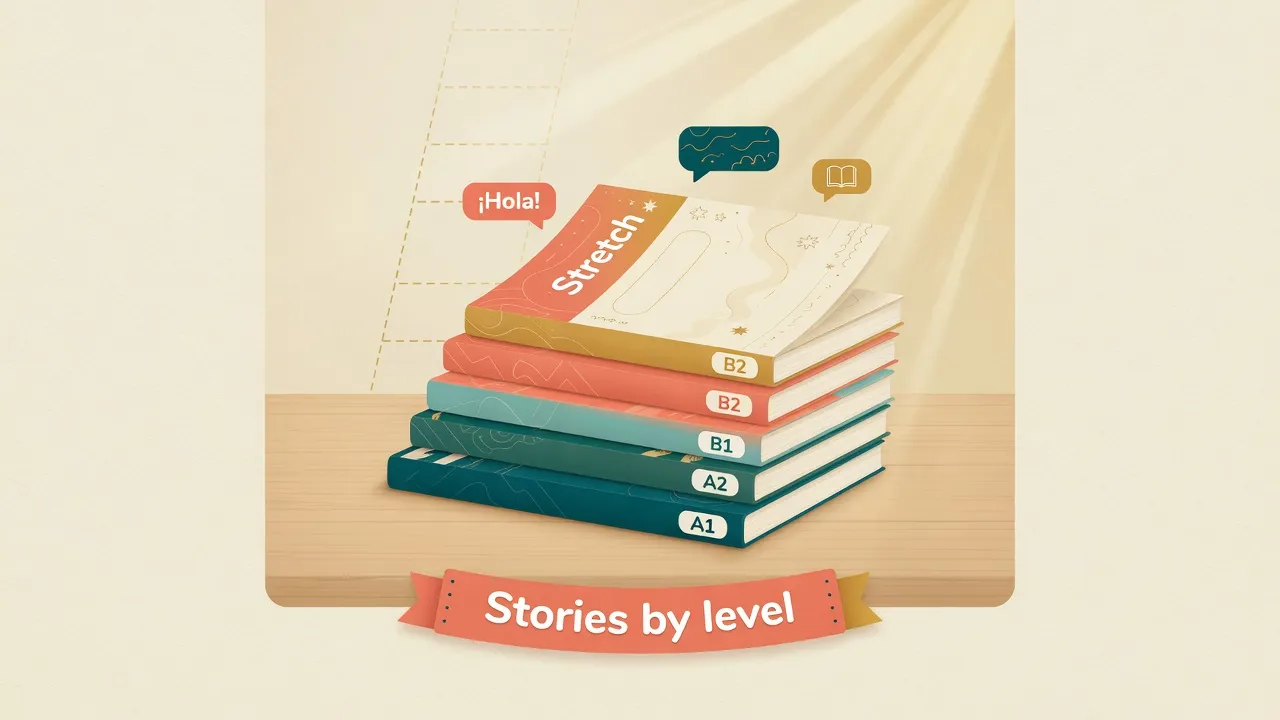
You want short Spanish fiction you can finish. Most lists dump kids' tales, graded micro-texts, and Borges under one "short stories" label - as if length alone made hard Spanish easy.
It does not. A five-page literary story can crush a beginner. A five-page graded micro-text can rebuild confidence in fifteen minutes.
Match the type of short story to your CEFR rung. At A1, use free graded micro-texts you finish in minutes. At A2, longer graded stories and simple learner collections. At B1, intermediate anthologies and clear modern plots. At B2, one literary story at a time (not a dense weekend binge). If you understand about 80-90% of a page, stay; under ~70%, step down. Start free with an A1 sample, then climb the named rungs below - buy or borrow commercial titles; do not expect free full modern anthologies.
If you only need finishable A1-A2 story types for today (animal, family, city), see our day-one beginners guide. This post is the full level ladder with named free and buy picks.
You will get:
- A CEFR map of short-story types (not prestige titles only)
- Named free graded, ELE, buy, and stretch options for A1 through B2
- Famous "short" titles that are harder than they look
- A 4-pass method and two simple ladders
- A map of free graded texts vs anthologies to buy
Quick map - short stories by CEFR
Think of short Spanish fiction as a ladder. Each rung is a type of text, not just a shorter page count.
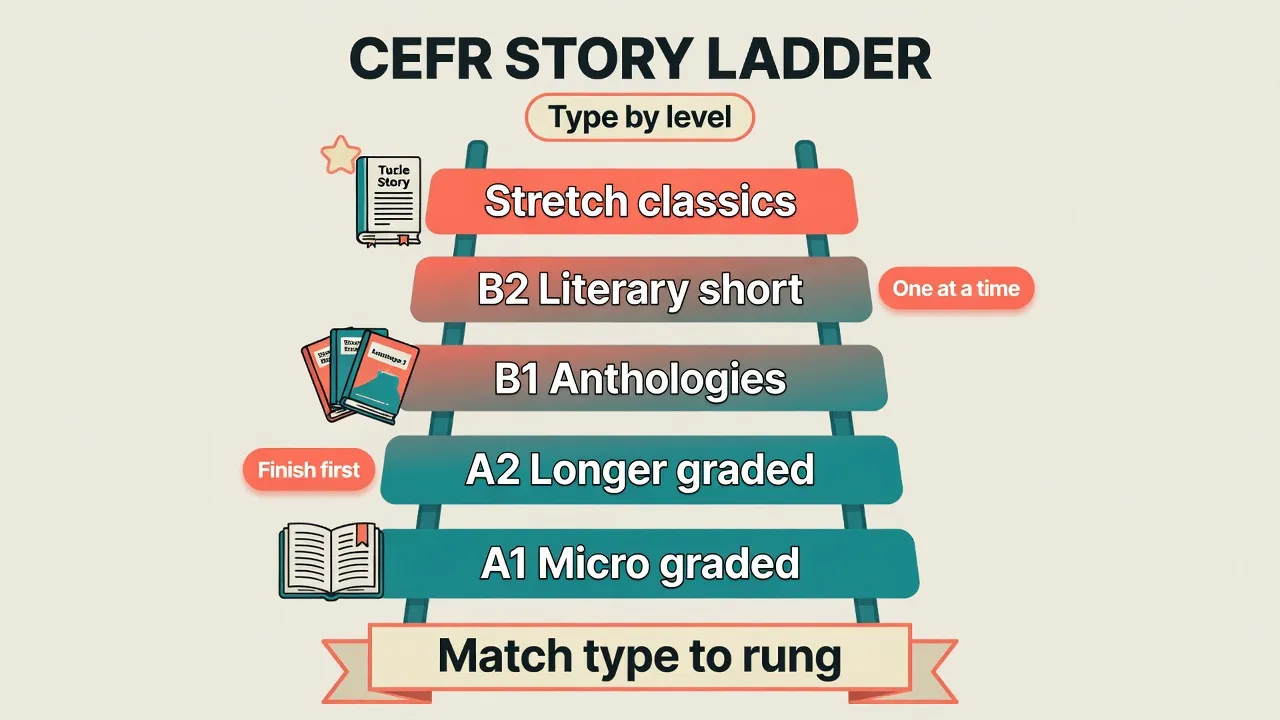
| Level | Best short-story type | Goal this month | Access style |
|---|---|---|---|
| A1 | Free graded micro-texts + A1 readers | Finish many tiny stories | Free samples + cheap ELE |
| A2 | Longer graded stories + simple narrative | Speed + past-tense comfort | Free A2 + buy beginners collections |
| B1 | Learner anthologies + selected modern stories | Finish complete stories with light support | Buy/borrow; upload own EPUB |
| B2 | Literary short stories, one at a time | Style, implication, denser prose | Own books |
| Stretch | Famous "short" classics / compressed prose | One careful story, not a binge | Often harder than the length suggests |
Comprehension rule: if you understand about 80-90% of a page, stay. Under ~70%, drop a level. Short length does not rescue hard style.
Start free:
Why short stories beat novels early
At A1-B1, novels fail for boring reasons: too many characters, too many pages before a payoff, description walls between dialogue, and one hard week that becomes permanent abandonment.
Short stories fix most of that. You get one main conflict, a faster payoff, and an "I finished something" loop that fits a 15-minute session.
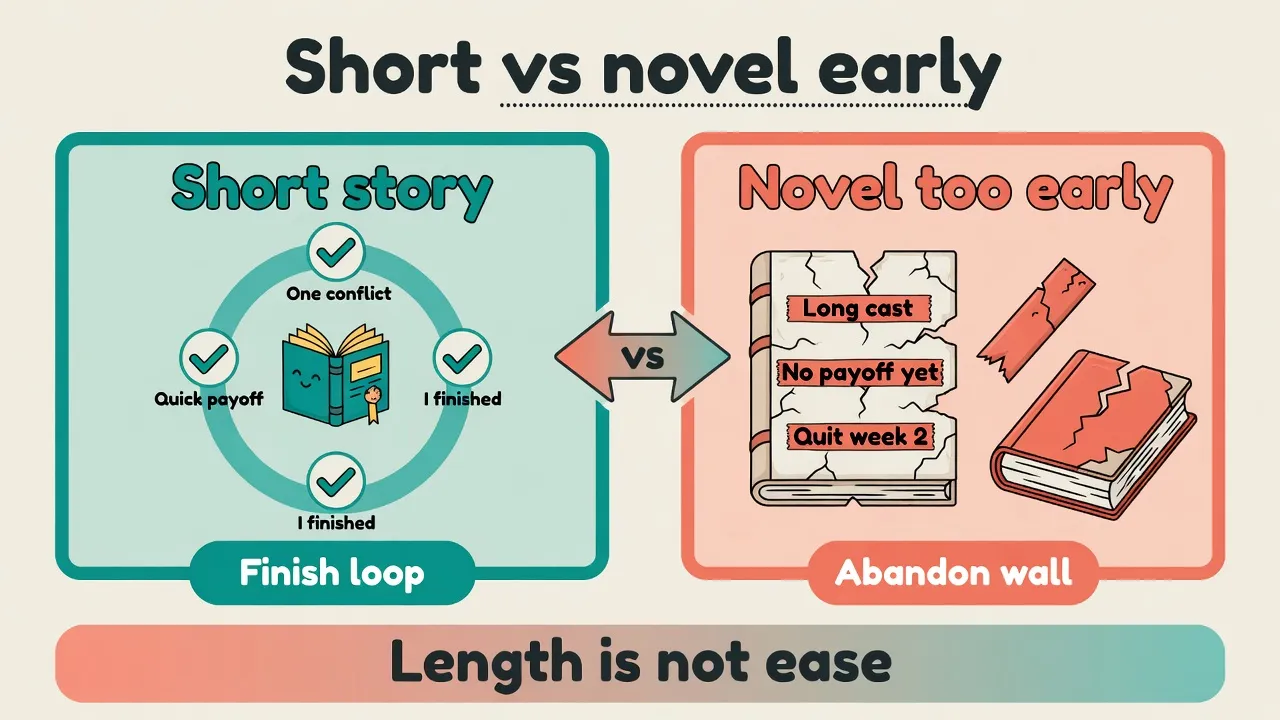
That does not mean every short text is easy. Literary compression, poetry micro-pieces, and famous classics can still block you. Length is not difficulty.
Use novels later for endurance. Use short stories to build the habit of finishing Spanish. For a day-one type menu (not this full ladder), the beginners short-story guide is the soft handoff.
A1 - micro-stories and controlled free texts
What works at A1
You want 1-3 screen stories with concrete actions: park, home, food, school. Present-tense routines and high-frequency words help. Almost no subjunctive maze. Session goal: finish one full micro-text per day, even if it is short.
Free named starting points
| Pick | Access | Note |
|---|---|---|
| MovaReader Mi día en el parque | Free graded - /en/article/1127 | Calibrate A1 habit |
| More free A1-tagged texts | Free graded - /en/all-articles | Daily volume |
| External free graded banks (Lingua.com Spanish reading, learner story banks) | Free graded on their sites | Practice type only - we do not host their catalogs |
Buy / borrow named options at A1
| Title / series | Access | Hedge |
|---|---|---|
| Pobre Ana (Blaine Ray style graded) | Buy / borrow | Classic beginner reader; not free host |
| Ana, estudiante (Paco Ardit) | Buy / borrow | A1 learner narrative |
| Spanish Short Stories for Beginners (Lingo Mastery) | Buy anthology | Buy; later upload an EPUB you own |
| Lola Lago y asociados (Difusión, often A1-A2) | ELE / buy | Prefer glossary + headword labels |
| Un día en… series (A1) | ELE / buy | Concrete place-day stories |
| Los Fernández (A1-A2) | ELE / buy | Family series |
| Para que leas / Pepe Rey (multi-level) | ELE / buy | Detective graded; check band on cover |
A1 watch-outs
Native kids' stories still use idioms. Fairy tales hide archaic or poetic lines. Bilingual pages help only if you do not live on the English side.
A2 - longer graded stories and simple narrative
What works at A2
Clear past narration (pretérito / imperfecto in context). Short mystery, travel, school, or family plots. Dialogue you can follow with occasional lookup. Stories you can finish in one or two sittings.
Free calibration
If A1 free texts feel automatic, move to:
- A2 Aprendiendo a reciclar en casa
- More free A2 library texts in All Articles
Named A2 sources
| Pick | Access | Hedge |
|---|---|---|
| Free A2 MovaReader texts | Free graded | Habit + past-tense comfort |
| Short Stories in Spanish for Beginners (Olly Richards) | Buy / borrow | Often sold A2-B1; not free full text here |
| Laura no está (Paco Ardit) | Buy / borrow | Clear plot learner narrative |
| Gael (Difusión A2) | ELE / buy | Publisher CEFR label |
| Lola Lago band (A1-A2) | ELE / buy | Continue the series if A1 felt easy |
| Edinumen Enigma y misterio (often A2-B1) | ELE / buy | Mystery pull; check edition band |
| Cuentos de la selva (Horacio Quiroga) | PD often + graded ELE editions | PD ≠ easy Spanish; prefer a graded edition first at A2 |
A2 method tip
Read the whole story once for plot. On the second pass, save only 5-10 useful phrases. Do not rebuild the dictionary after every paragraph.
When you are ready for longer easy books, our easiest Spanish books A2-B1 list is a natural next cluster.
B1 - real short stories with support
At solid B1, short stories bridge graded Spanish and authentic style. You can finish complete stories with light support - notes, a glossary, or a careful second pass.
What works at B1
Modern learner anthologies labeled B1 or intermediate. Selected contemporary shorts with clear plots and a limited cast. One literary short at a time (not a dense collection in a weekend).
Named realistic B1 choices
| Pick | Access | Hedge |
|---|---|---|
| Intermediate / B1-labeled learner anthologies (Olly-style intermediate packs; Penguin Short Stories in Spanish parallel) | Buy / borrow | Parallel mixes levels - prefer glossary editions |
| Crimen en Barcelona (Paco Ardit) | Buy / borrow | Short mystery graded pull |
| El Principito (Saint-Exupéry) | Buy / borrow | Familiar plot stretch - not automatic easy |
| Crónica de una muerte anunciada (García Márquez) | Buy / borrow | Short-novella stretch, often B1-B2; plot-strong; edition-dependent |
| Free graded recovery days | Free graded (MovaReader) | Keep speed on easy days |
B1 watch-outs
Regional speech without notes. Stories that are "short" but mostly interior monologue. Jumping into complete works of literary giants because one story is famous.
B2 - literary short stories and style work
At B2, short stories are excellent for implication, denser description, varied registers, and author style without a full novel commitment.
What works at B2
Single stories from major authors, one at a time. Themed anthologies you own (crime, love, migration, city life). A reread after a week for style, not only plot.
Named B2 / stretch
| Pick | Access | Hedge |
|---|---|---|
| Sin noticias de Gurb (Eduardo Mendoza) | Buy / borrow | Often recommended intermediate-advanced humor; edition-dependent |
| Single stories from Cortázar (Bestiario, Final del juego collections) | Buy / borrow | B2+ stretch - one story, not a binge |
| Single Borges stories (El Aleph collections and similar) | Buy / borrow | Compressed literary; not free full-host; not B1 homework |
| Learner-written B2 graded banks | Free graded on their sites | Practice style without claiming literary equivalence |
| Own themed commercial anthologies | Buy + upload EPUB you own | Authentic voice |
Rule: one hard literary story per week is enough if you also keep easier reading for speed.
Famous "short" Spanish reading that is harder than it looks
Fame and short chapter counts can lie. Use prestige as spice, not as your daily rung.
| Title / type | Why it looks easy | Why it often is not |
|---|---|---|
| El Principito | Short chapters | Abstract lines, philosophical density |
| Poetry "micro" pieces | Few words | High figurative load |
| Famous classic short stories | Cultural prestige | Older style, implication, less scaffolding |
| Viral "easy PDF" dumps | Free and short | No level control, messy OCR, random difficulty |
| Borges / Cortázar single famous story | "Just one short story" | Density + cultural load; treat as stretch |
Build habit on level-matched stories. Sprinkle hard titles when you have support and time.
A short-story method that scales from A1 to B2
The 4-pass mini method (10-25 minutes)
Use the same loop at every level. Only the text difficulty changes.
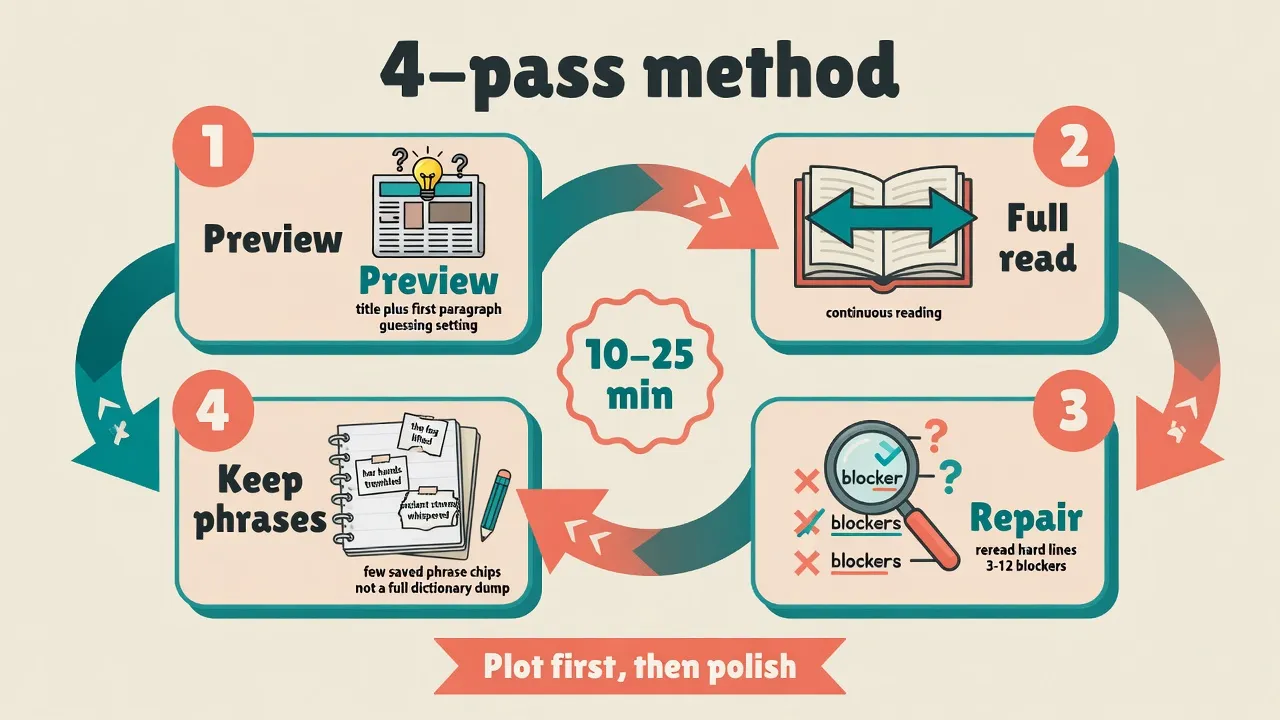
- Pass 0 - title + first paragraph: guess setting and characters
- Pass 1 - full read: no stopping except total blockers
- Pass 2 - repair: check 3-12 blockers, reread hard lines
- Pass 3 - keep: save phrases you might reuse (not every unknown noun)
Weekly plan by level
| Level | Cadence |
|---|---|
| A1 | 5-6 micro-texts + 1 review day of saved phrases |
| A2 | 3-4 graded shorts + 1 slightly harder attempt + 1 review day |
| B1 | 2-3 intermediate + 1 literary short or novella cluster + 1 recovery free graded day |
| B2 | 1-2 literary + 1 easier speed text; optional reread of one hard story |
What to save from stories
Prefer discourse markers (de repente, sin embargo, al final), reusable verb frames, emotional reaction phrases, and scene connectors. Avoid saving 40 isolated adjectives from one page.
Free graded short texts vs anthologies you buy
You need both habit fuel and, later, real author voice. They are not the same bucket.
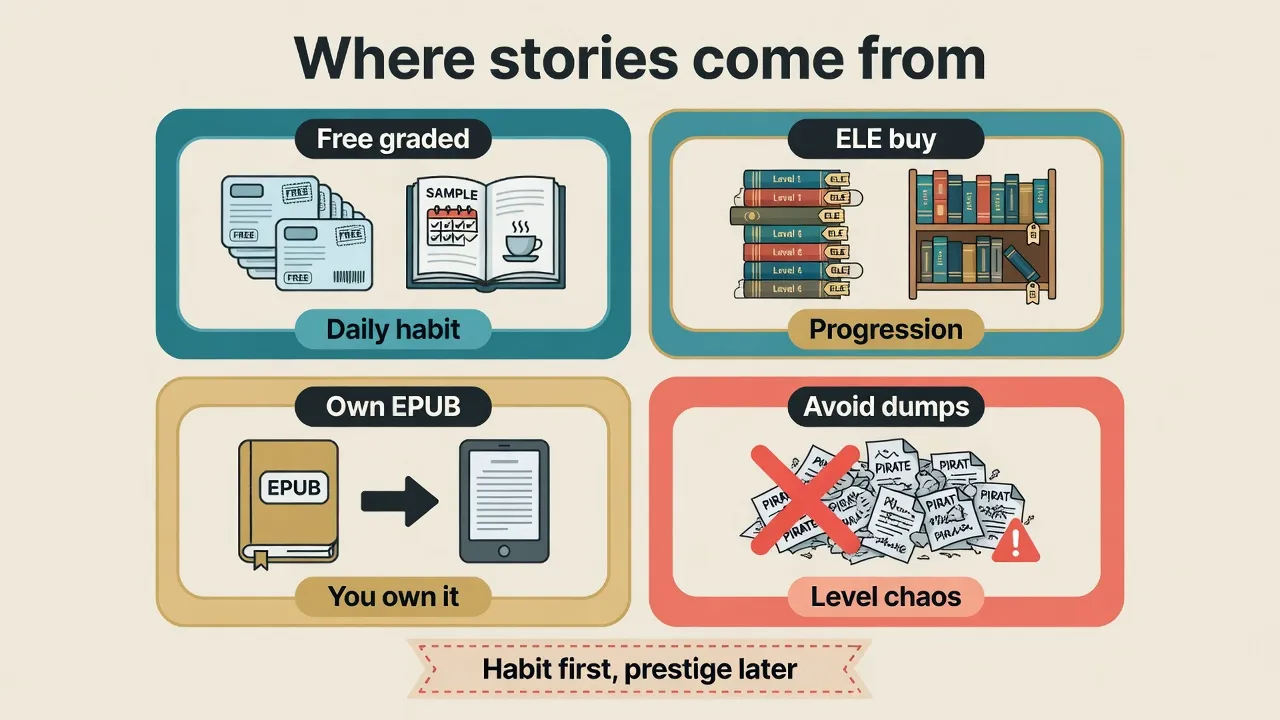
| Source | Best for | Limit |
|---|---|---|
| Free graded library texts (MovaReader + external banks) | Daily habit, level control, low friction | Not a full literary anthology replacement |
| Graded story books / ELE series | Structured progression A1-B1 | Can feel thin if you stay forever |
| Commercial anthologies you own | Authentic style and author voice | Harder; careful selection; buy/borrow/upload |
| Public domain classics | Legal free files sometimes | Difficulty ≠ beginner |
| Random free web dumps | Occasional extra practice | Quality and level vary wildly |
Healthy mix: most days, level-matched shorts; some days, one real story from a book you own; always finish rate over prestige.
For a wider free graded map, see free graded Spanish readers online. For legal PD and library files (with the usual difficulty hedge), see free legal EPUB libraries.
How to use MovaReader for short-story practice
Use MovaReader for supported reading and phrase practice, not as a piracy library. Free graded Spanish texts build the daily rung. Commercial short-story anthologies stay on the buy/borrow path. When you are ready for denser stories, upload an EPUB you legally own. For a B2 stretch, the book catalog also has Horacio Quiroga's collection Cuentos de amor de locura y de muerte, and at A1 you can start with retold tales such as Caperucita Roja; tap a word to see its translation.
- Read free graded Spanish texts in All Articles.
- Start with real samples: A1 Mi día en el parque and A2 Aprendiendo a reciclar en casa.
- Upload a short-story EPUB you own when you move to anthologies - see How to use.
- Click only blockers, then train a small phrase set in the Spanish phrases practice (word training: demo).
- Plans: free includes listening and 20 word translations/day. Reader (€1) is unlimited translations. Pro (€5/mo) is full trainers. Details: Pricing.
What MovaReader does not do:
- host licensed commercial short-story collections by default (no free full Olly, Lingo Mastery, modern Cortázar-Borges packs, or commercial El Principito inside the app)
- auto-label every web PDF with a perfect CEFR score
- replace choosing easier stories when comprehension collapses
Free path today: A1 sample → A2 sample → word demo → phrase demo → later, upload one anthology file you own.
Suggested ladders
Ladder A (A1 to B1, safest)
- Free A1 texts (1127 + library)
- Free A2 texts (1209 + library)
- A2 graded short-story reader (ELE / Olly / Ardit - buy or borrow)
- B1 learner anthology (buy or borrow)
- One short literary novella or dense short story (buy - stretch)
Ladder B (already A2-B1)
- Free A2 calibration
- Intermediate anthology stories (buy or borrow)
- One stretch literary short per week (buy)
- Keep free graded texts for low-energy days
FAQ - Spanish short stories by level
Are short stories better than novels for beginners?
Usually yes for finish rate and motivation. A short story gives you a full beginning-middle-end in one or two sessions, which novels rarely do at A1-B1. Novels become more useful later for endurance, once you can sit longer without constant lookup. Use shorts to build the habit of finishing Spanish; use novels when that habit is solid.
What is the best Spanish short story type for A1?
Graded micro-texts written for learners, not famous literature. Look for 1-3 screen stories with concrete actions, present-tense routines, and high-frequency words. Start free with an A1 sample such as Mi día en el parque, then more free A1 library texts. Buy or borrow A1 ELE readers (Pobre Ana, Ana, estudiante, Lola Lago, Un día en…) when you want a paper or commercial progression. Skip Borges, dense classics, and unadapted fairy tales as daily A1 work.
Can I read Borges or Cortázar at B1?
Only as stretch, not as your baseline. Some motivated B1 learners sample one story with heavy support (glossary, notes, slow rereads). Many enjoy them more at B2+. Compressed style, implication, and cultural load make a "short" Borges or Cortázar story harder than its page count suggests. Do not binge a whole collection in a weekend. Keep easier graded or intermediate stories for speed and confidence.
How do I know a story is too hard?
After one careful read, you still cannot summarize the basic plot, or almost every sentence needs a translation click. That is under the ~70% comfort zone - step down a rung. Understanding about 80-90% of a page without help means stay. Short length does not fix hard style: abstract lines, older vocabulary, and dense monologue can crush a "short" text. Drop to a free graded recovery day rather than forcing prestige.
Should I use bilingual / parallel Spanish short stories?
Yes, if Spanish stays primary and the level roughly matches. Parallel texts (for example Penguin-style Spanish short story collections) reduce plot panic and help when a hard line blocks meaning. The trap is living only on the English column and never finishing the Spanish side. Use the translation as a repair tool after a full Spanish pass, not as the main reading track. Prefer editions with notes or glossaries over random dual-language dumps.
Free graded texts or buy anthologies - which first?
Free graded texts first for daily habit at A1-A2 (MovaReader free library + external practice banks on their sites). Buy or borrow named learner collections at A2-B1 when you can finish graded stories without collapse - Olly Richards-style packs, Paco Ardit titles, ELE series, intermediate anthologies. Upload an EPUB you own for supported reading later. Public-domain classics can be legal free files, but PD is not the same as beginner Spanish. Never expect free full modern commercial anthologies hosted by default.
Final takeaway
The best Spanish short story is the one you can finish today and still want tomorrow.
Match type to CEFR: free graded micro-texts for A1 habit, longer graded and ELE readers at A2, learner anthologies at B1, and one literary story at a time at B2. Buy or borrow commercial packs; upload files you own; keep prestige titles as stretch, not as your daily rung.
Start now with a free Spanish A1 sample or an A2 sample, then climb one level at a time. For more free graded sources, see free graded Spanish readers. For day-one story types only, the beginners guide is waiting.
Keep reading with translations inside the text
With a free account, an unknown word translates with one tap, and the words you are learning wait for you in the trainer.
Free account: 7 days of Pro, then 20 word translations a day or a paid plan.