Tips & Methods
How to Learn Spanish by Reading: A Method You Can Start Today
A practical method to learn Spanish through reading: right difficulty, short daily sessions, smart lookups, weekly plans by level and free samples to start.
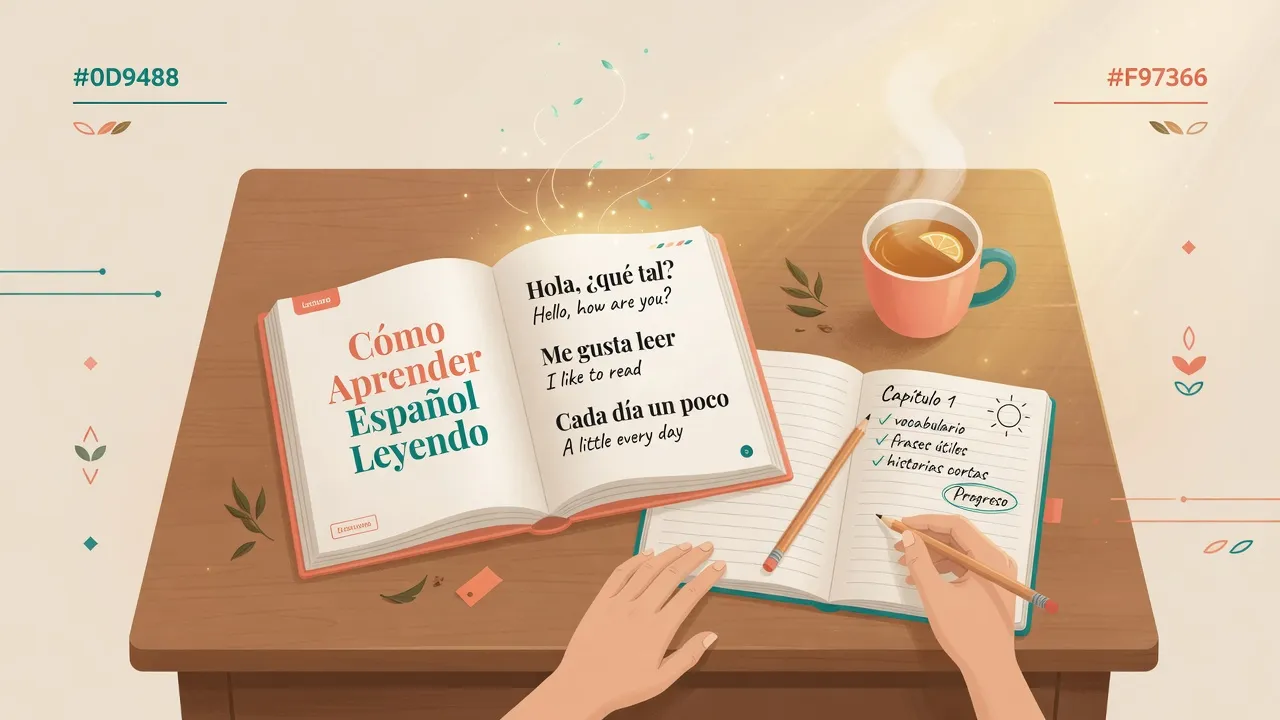
You buy a "serious" Spanish novel with pride. Page one feels impressive. By page twelve you are living inside a dictionary. Twenty lookups per paragraph. Zero story left in your head. You close the book and tell yourself you will come back "when you are ready."
Or maybe you never open the hard novel. You open an app, save fifty isolated words, and still freeze on a simple graded page the next day. Same pain, different costume: pride lookups, no finishes.
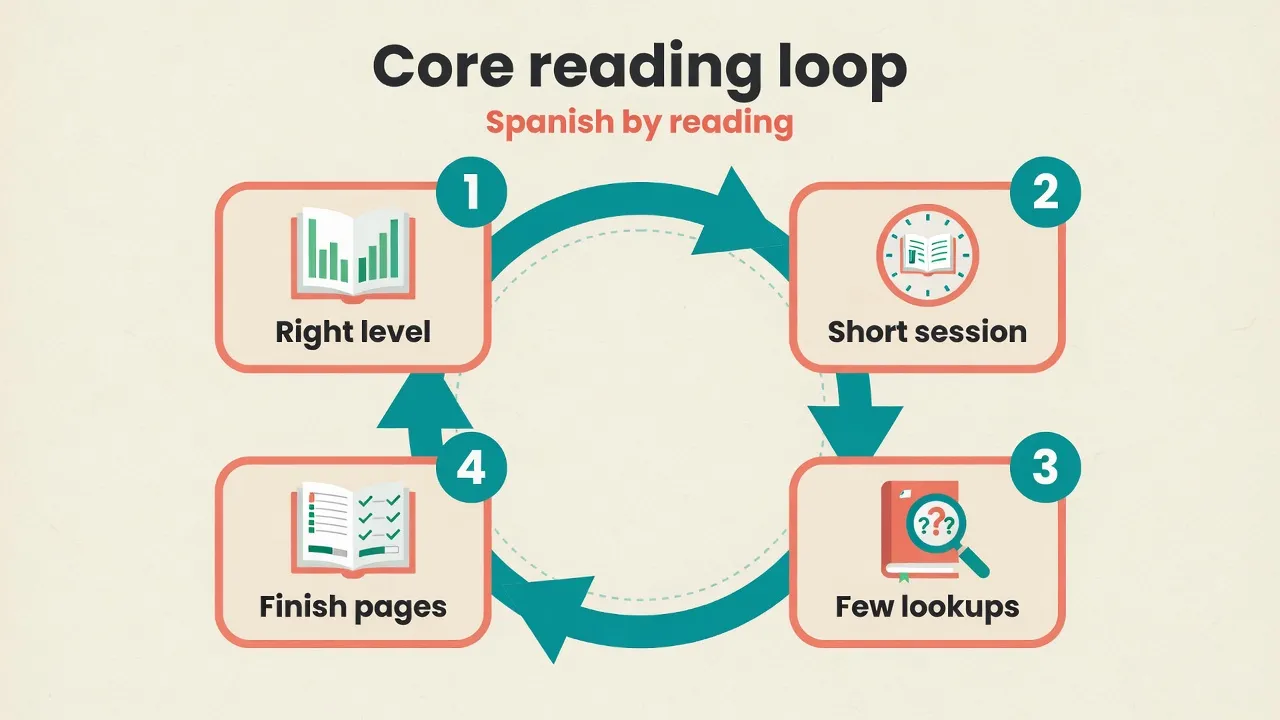
Here is the calm version. Learning Spanish by reading works when three things line up: the text is the right difficulty, you look up less than pride wants, and you get enough daily reps. Aim for roughly 80-90% sense on a random page, 15-25 minutes most days, blockers only, and save phrases not giant word lists. Reading is a strong input engine for vocab and patterns; it does not auto-deliver fluent speaking or perfect pronunciation.
If you only remember one line: finish easy pages more often than you abandon hard pages.
That finish metric is the spine of this whole method. Everything below exists to protect it.
The core idea in one screen
Here is the method at a glance - the rules you can pin above your desk:
| Piece | Rule of thumb |
|---|---|
| Difficulty | Understand ~80-90% of a random page |
| Session length | 15-25 minutes most days |
| Lookups | Only blockers that kill sentence meaning |
| Output | Save phrases, not giant word lists |
| Mix | Graded texts for control + real books for motivation |
| Goal metric | Finished texts per week, not "hours studied" |
What you will get from the rest of this guide:
- Why reading works for Spanish (and what it does not replace)
- A quick level test you can run today
- A three-track text stack so you stop hopping between random PDFs
- A 15-25 minute daily script
- Weekly plans for A1, A2, and B1
- Lookup rules, progress signals, common traps, and a 14-day starter
Soft start if you want something free right now: browse all free graded articles, or jump to the A1 sample or A2 sample. Tools come later. Habit first.
Why reading is a strong way to learn Spanish
Reading gives you things flashcards alone rarely deliver:
- vocabulary in context (not only isolated pairs)
- grammar patterns attached to meaning
- reusable chunks you can later speak or type
- a habit you can run alone, almost anywhere
Reading does not automatically give you fluent spontaneous speaking, perfect pronunciation, or native writing style overnight. Treat it as the input engine. Add short phrase practice and, when you can, speaking. A novel alone will not magic you into conversation.
A soft note on input (without a theory wall)
Two ideas show up again and again in serious language learning, and both pair well with this method.
First, comprehensible input: messages you mostly understand, with a bit of stretch. In practice that feels like the 80-90% page band below - not a fog of unknown words. For a longer walk through the idea, see Krashen's comprehensible input hypothesis.
Second, many polyglots lean on mass interesting input rather than endless grammar charts. The spirit is simple: interesting pages at a doable level beat prestige titles you abandon. Related read: Steve Kaufman's method - polyglots read, not only grammar.
Intensive vs extensive (two modes, one week)
Intensive reading = short text, more lookups, notice forms.
Extensive reading = longer easy-enough text, story first, volume.
Most people over-intensify. They treat every page like a grammar exam and burn out. Prefer volume at the right difficulty, plus short intensive bursts on phrases you actually saved. Full contrast: intensive vs extensive reading for Spanish.
Step 1 - Find your real reading level (not your hoped level)
Your hoped level is Cien años de soledad on day three. Your real level is the page you can still follow after two minutes without a dictionary.
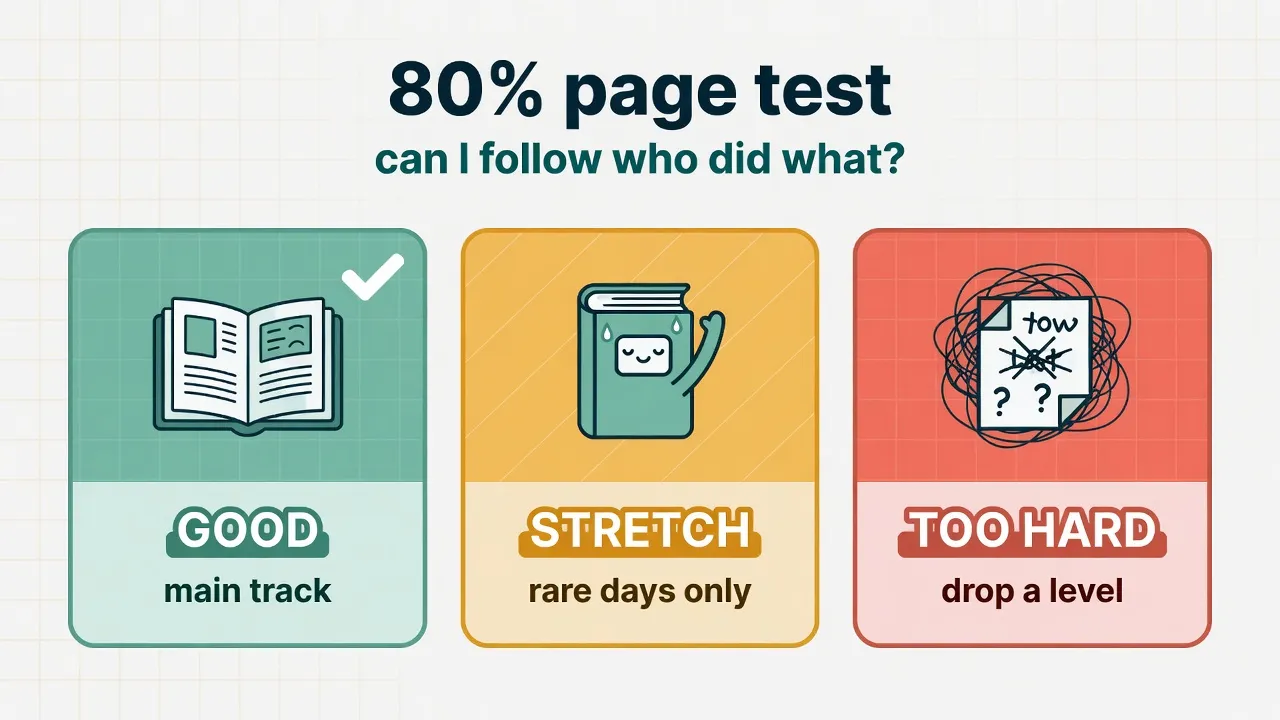
The 80% page test
- Open a random middle page (or a full short free text).
- Read without a dictionary for 2-3 minutes.
- Ask: can I follow who did what, and what happens next?
| Result | Band | Next step |
|---|---|---|
| Yes, few fuzzy words | Good daily level | Main track |
| Sort of, many stops | Stretch | Rare days only |
| Mostly lost | Too hard | Drop a level |
Treat 80-90% as a practical comfort band, not a lab measurement. If you cannot retell the scene in plain words, the page is not your daily main track yet.
Another quick check some learners like: the 5-finger rule for choosing book level. For why coverage matters at all, see vocabulary for reading comprehension.
Start free (no purchase needed)
- Absolute / low beginner: Spanish A1 sample - Mi día en el parque
- High beginner / low intermediate: Spanish A2 sample - Aprendiendo a reciclar en casa
- More texts: All Articles
If A1 feels hard, stay on A1 graded texts. If A2 feels easy, move toward longer graded stories and then real books you actually want to finish.
CEFR reading targets (practical, not exam theory)
These are daily habits, not exam scores. Use them as a compass:
| Level | Daily reading target | Main text type |
|---|---|---|
| A1 | 10-15 min | Free graded micro-texts, A1 readers |
| A2 | 15-20 min | Graded stories + easy narrative books |
| B1 | 15-25 min | Real books/short stories with support |
| B2 | 20-30 min | Longer authentic texts; keep recovery days |
For a progress compass, open the language map.
Step 2 - Build a text stack (not a random pile)
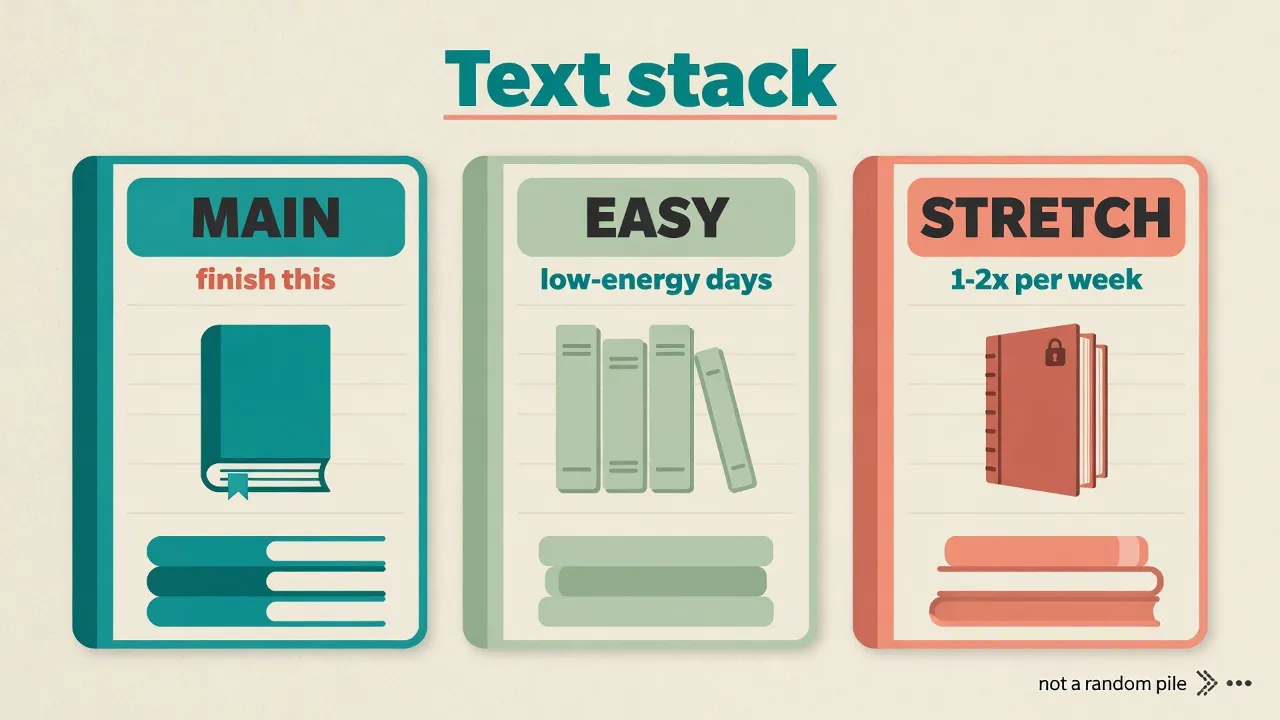
Random PDFs on your desktop are not a plan. Keep three tracks:
| Track | Role | Cadence |
|---|---|---|
| Main | One book or story series you want to finish | Most reading days |
| Easy | Free graded texts for low-energy days | Recovery / fatigue |
| Stretch | Optional harder pages | Max 1-2 times per week |
Example stacks by level
A1 stack
- Main: A1 graded reader
- Easy: free A1 articles
- Stretch: none, or one short page of A2
A2 stack
- Main: easy narrative book (diary-style or short chapters)
- Easy: free A2 articles
- Stretch: one harder chapter on a weekend
B1 stack
- Main: realistic novel or novella you own
- Easy: free graded recovery texts
- Stretch: one literary short story
A note on books: A2 is not La sombra del viento. B1 is not automatic Cien años de soledad. Choose finishable titles first. When you want lists instead of method, start with Spanish graded reading stories by CEFR, then adapted vs original books for A2 learners and vocabulary size to read Spanish novels.
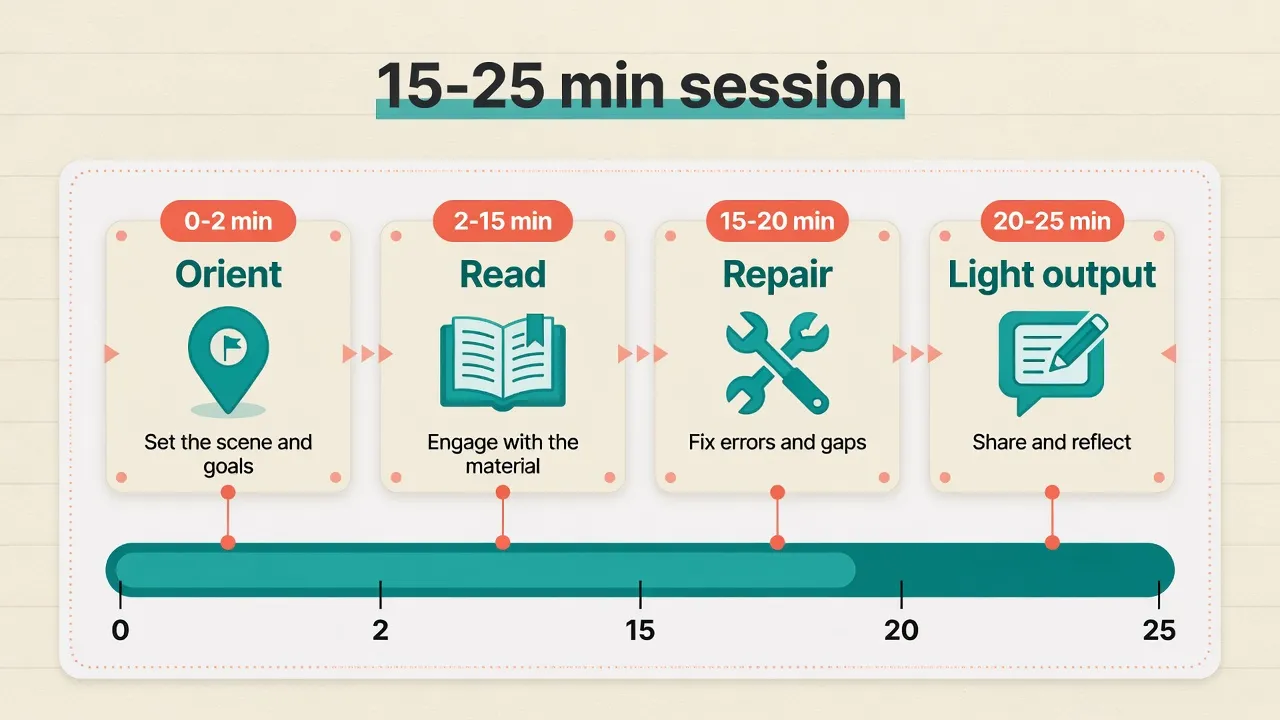
Step 3 - The daily reading session (15-25 minutes)
Use the same script so sessions do not turn into chaos. Ordinary repeated sessions beat perfect rare ones.
| Block | Minutes | Focus |
|---|---|---|
| Orient | 0-2 | Where am I? Who is on stage? What next? |
| Read for meaning | 2-15 | No every-word translate; mark blockers only; keep events moving |
| Repair | 15-20 | Check blockers; reread hard paragraph once; save 3-12 phrases max |
| Light output (optional) | 20-25 | Say/type 3 phrases or retell 3 plot points (Spanish or L1 if needed) |
Minutes 0-2: orient
- Where am I in the story?
- Who is on stage?
- What do I expect next?
Minutes 2-15: read for meaning
- Do not translate every unknown word.
- Mark only words or phrases that block the sentence.
- Keep moving when you understand the event.
Minutes 15-20: repair
- Check the blockers.
- Reread the hard paragraph once.
- Save 3-12 useful phrases max.
Minutes 20-25 (optional): light output
- Say or type 3 saved phrases.
- Or retell 3 plot points in simple Spanish (or English if needed).
This is enough. A perfect session is less valuable than a repeated ordinary session. If you like a related micro-habit frame, see the 15-minute rule for daily vocabulary - just do not let Anki swallow the reading.
Step 4 - What to look up (and what to ignore)
Pride wants every word. Flow wants only the ones that kill meaning.
Look up when
- the unknown item hides the whole sentence meaning
- it is a high-frequency word you keep seeing
- it is a phrase you want to reuse later
Skip or postpone when
- it is a rare proper name
- the scene is already clear
- it is the fifth synonym for "said" and the plot is fine
Save phrases, not only words
Better saves:
- de repente
- no tenía ni idea
- al día siguiente
- me di cuenta de que...
Weaker saves:
- long lists of isolated adjectives
- every verb conjugation variant from one page
Phrases travel better into speech and typing. For building usable stock at intermediate level, see build B1 vocabulary by reading. If paper notebooks keep stalling you, why paper vocabulary notebooks kill motivation may sound familiar. Light review still matters; for the forgetting side, see Ebbinghaus curve for Spanish vocabulary.
Step 5 - Weekly plan by level
A weekly skeleton beats "I will read when I feel inspired."
A1 weekly plan
| Day | Plan |
|---|---|
| Mon-Fri | 1 free A1 text or short reader section (10-15 min) |
| Sat | Reread 2 easy texts for speed |
| Sun | Review saved phrases (typing/speaking) |
Start: A1 sample
A2 weekly plan
| Day | Plan |
|---|---|
| 4 days | Main easy book / graded story |
| 2 days | Free A2 graded texts |
| 1 day | Phrase review + optional audio after reading |
Start: A2 sample
B1 weekly plan
| Day | Plan |
|---|---|
| 4 days | Main real book (EPUB you own or paper) |
| 2 days | Easy recovery texts |
| 1 day | Phrase review / short retell |
Keep stretch literary pages optional, not mandatory.
If you are already B2-ish, aim for 20-30 minutes of authentic text on most days, with recovery days of easier graded material so you still finish things.
Step 6 - Add audio and phrase training without wrecking flow
Audio
- Best after you can follow the written page
- Useful for rhythm and pronunciation
- Weak as a first pass on a text you do not understand
Listen to enjoy the sound of Spanish you already half-know. Do not use audio as a second dictionary marathon on fog.
Phrase training
After you save chunks from reading:
- Practice a small set (not 100 new items).
- Prefer typing or saying full phrases.
- Recycle phrases that reappear in new texts.
Demos if you want to try the mechanics free:
Step 7 - Progress signals
You are improving when:
- the same level feels faster
- you finish more pages with fewer stops
- you recognize old phrases in new texts
- you can retell more of the plot without translating every line in your head
You are stuck when:
- every session is a new hard book and zero finishes
- lookup rate stays extreme for weeks
- you only collect words and never reread or reuse them
- you wait for motivation instead of a calendar slot
Fix stuckness by dropping difficulty for 1-2 weeks and maximizing finish count. Revisit the language map as a compass, not as a judgment day.
Common traps (and clean fixes)
| Trap | Fix |
|---|---|
| Prestige first (Quixote / 500-page literary first project) | Finish short graded + one easy book first |
| Dictionary addiction (20 lookups per paragraph) | Blockers only; protect flow |
| Only parallel text forever | Dual support briefly, then Spanish-first pages |
| No review | One short review day per week |
| Tool shopping instead of reading | One free text today; tools second |
If your eyes move but nothing lands, you may be in blind reading syndrome. If apps keep winning the evening and books lose, the dopamine trap of language apps is a useful mirror. Perfectionism that freezes every sentence also has a sister: fear of mistakes in language learning.
14-day starter plan (copy this)
Protect the habit before you shop for tools.
| Days | Focus |
|---|---|
| 1-3 | Free A1/A2 sample at your level; 15 min daily; blockers only; max ~8 phrases/day |
| 4-7 | Continue graded; mid-week short review; optional phrase demo |
| 8-10 | Choose one main easy book/reader you own or borrow; free texts as recovery |
| 11-14 | Protect habit (same time slot); measure finishes; only then consider unlimited translation if free plan limits block daily |
Concrete starts: A1, A2, more in all articles. Also browse Spanish graded stories by CEFR level.
How MovaReader fits this method
If the method is clear and you want less friction day to day, MovaReader can help. It is not a miracle button.
- Warm up on free graded Spanish in All Articles.
- Use real samples: A1 - Mi día en el parque and A2 - Aprendiendo a reciclar en casa.
- Upload a book file you own when you start a longer title. Guide: How to use.
- Click-to-translate blockers only (freemium: 20 translations/day). Listening stays unlimited on freemium.
- Unlimited translations when that daily limit blocks habit: Reader plan, €1.
- Full trainers if you want them: Pro plan, €5/mo.
- Try mechanics free: word demo, phrase demo.
- Soft compass: language map. Create an account only when you need progress saved: register.
What MovaReader does not do:
- host licensed commercial novels by default
- replace choosing the right level
Other reading tools exist. Pick one free text today; compare apps later.
FAQ: learn Spanish by reading
Can I learn Spanish only by reading?
You can build strong comprehension and vocabulary mainly by reading. Speaking and listening still need their own practice. Reading is a powerful main engine, not a complete replacement for all skills.
How long until reading feels comfortable?
It depends on starting level and consistency. Many learners feel a clear jump after a few weeks of daily short sessions at the right difficulty. There is no universal day count.
Should beginners read books or only graded texts?
Beginners should prefer graded texts and short controlled stories first. Jump to famous novels later, when comprehension is stable. Free starts: A1 sample, A2 sample, all articles.
Is translation cheating? Should I look up every word?
Selective translation is a tool. Looking up every word kills flow. Full-sentence machine translation of every page can become a crutch. Check blockers only, then return to Spanish.
How many new words should I learn per day?
Ignore vanity targets. Save a small set of useful phrases and meet them again in new texts. Volume without reuse fades fast. Skip the fantasy of huge monthly word quotas.
Do I need a paid app?
No to start. Free graded samples and library or paper books are enough for the method. Paid helps if daily translation limits or trainers become the bottleneck. Freemium path here: 20 translations/day, unlimited listen; Reader €1 for unlimited translations; Pro €5/mo for full trainers. Not required to begin.
Final takeaway
Learning Spanish by reading is not about finding the perfect book list. It is a repeatable system: right difficulty, short sessions, few smart lookups, and weekly finishes.
Start today with one free text - A1 or A2 - then run the daily script for two weeks before you change tools, methods, or ambitious novels. When you want a compass for where your vocabulary sits, open the language map.
Finish easy pages. Protect the habit. Let hard prestige books wait until you can stay in the story.
Keep reading with translations inside the text
With a free account, an unknown word translates with one tap, and the words you are learning wait for you in the trainer.
Free account: 7 days of Pro, then 20 word translations a day or a paid plan.