Vocabulary
Paper Vocab Notebooks: When They Break Reading Flow
Full notebook, blank mind when you speak? Paper still helps for deliberate lists. Mid-story stop-and-copy often stalls reading. Three frictions, a fair comparison, and a reading-first capture loop.
You sit down with a book, a pen, and a clean vocabulary notebook. A good evening plan. Two pages in, a word you do not know appears. You stop. Dictionary open. Line written carefully. By the time you look up, the scene has gone cold - and tomorrow the neat line is just ink.
That is the classic vocabulary notebook method many of us learned in school. It is not always wrong. It often hurts when you use it: mid-story, for every unknown, with no plan to review. Motivation drops not because paper is evil, but because the story reward dies and the list never becomes real practice.
Below: when paper still helps, three frictions that break reading, a fair comparison of notebook vs flashcards vs reading capture, a reading-first loop that keeps the book open, and an optional product path if you want the loop in one place. Learning targets here are English and Spanish.
Short answer
A paper vocabulary notebook still helps for slow deliberate study and exam word lists. It often stalls motivation when you stop mid-story to look up and copy every unknown word, then never schedule a real review. A better loop for extensive reading: choose interesting text near your level, mark only a few high-value words or phrases, keep the sentence context, and do a short review later (SRS app or phrase practice). Copying is not the same as owning a word.
If you scroll for one thing, take this: tool to job. Paper for study blocks. Lighter capture while you read for pleasure. The rest of the article unpacks the illusion of productivity, the three frictions, the comparison table, and a simple loop you can try this week.
The illusion of productivity: copying is not ownership
You know the complaint. "I have a whole notebook of English words. When I try to speak, my mind goes blank." That is not a rare personality flaw. It is what write-and-forget looks like from the inside.
Writing can help. Slow handwriting can prime attention when the task is word study. You look longer. You notice the form. Fair. Priming is not the same as retrieval practice. Ownership shows up when you meet the word again in a new sentence, pull it under light pressure, or use a short phrase that still feels like the book you read.
What feels productive:
- neat columns
- pretty pages
- a thick notebook that "proves" you studied
What sticks more often:
- reuse in real context
- recall on a schedule (even a tiny one)
- phrases, not only bare L1 pairs
So the notebook is not a liar by nature. The illusion starts when volume of ink replaces re-meeting and recall. For the gap between words you recognize and words you can use, see passive to active vocabulary.
The stall during reading is easier to fix when you name the frictions. Paper is not "dead." Mid-reading full-copy often is.
Three frictions that break reading
The notebook problem is often when you use it, not that handwriting exists. Three patterns show up again and again.
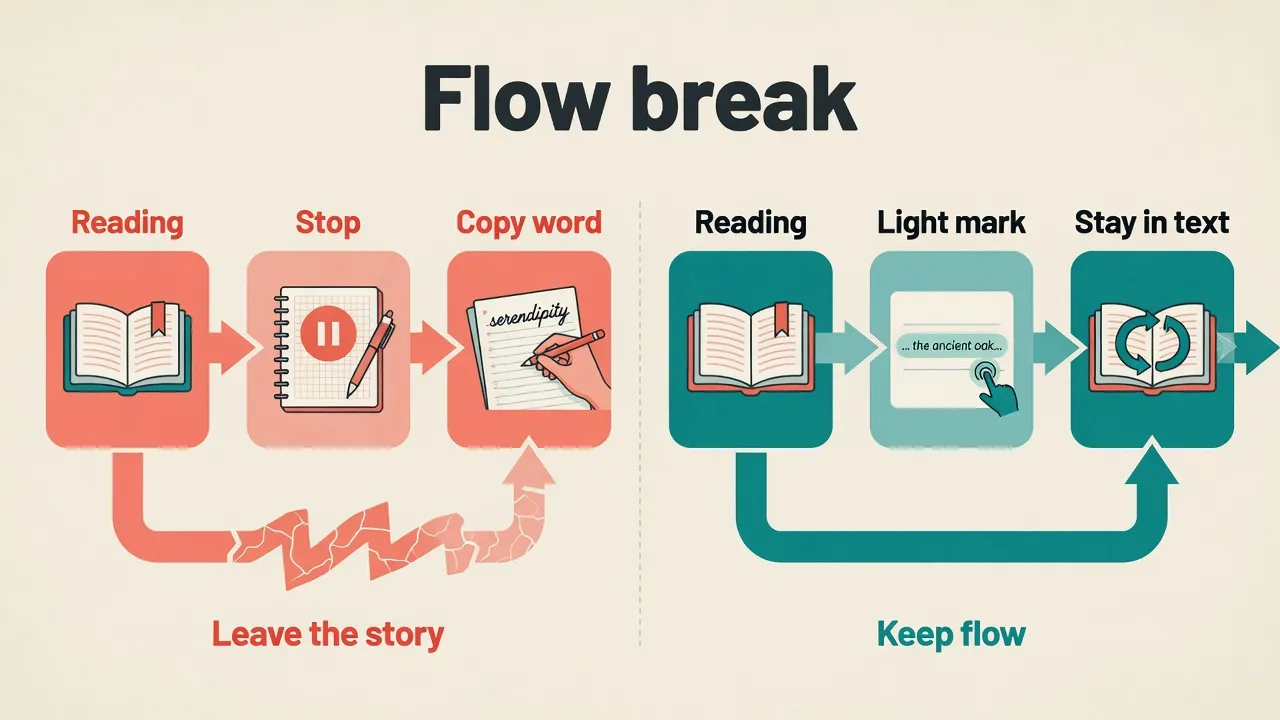
1. Context and flow break
You stop the story to open a dictionary and write a line. Plot and emotional pay-off slip away. Flow is the reward that keeps many self-learners opening the next page. Break it often and the evening starts to feel like clerical work, not reading.
One hard stop is fine. A stop every third sentence is a different hobby.
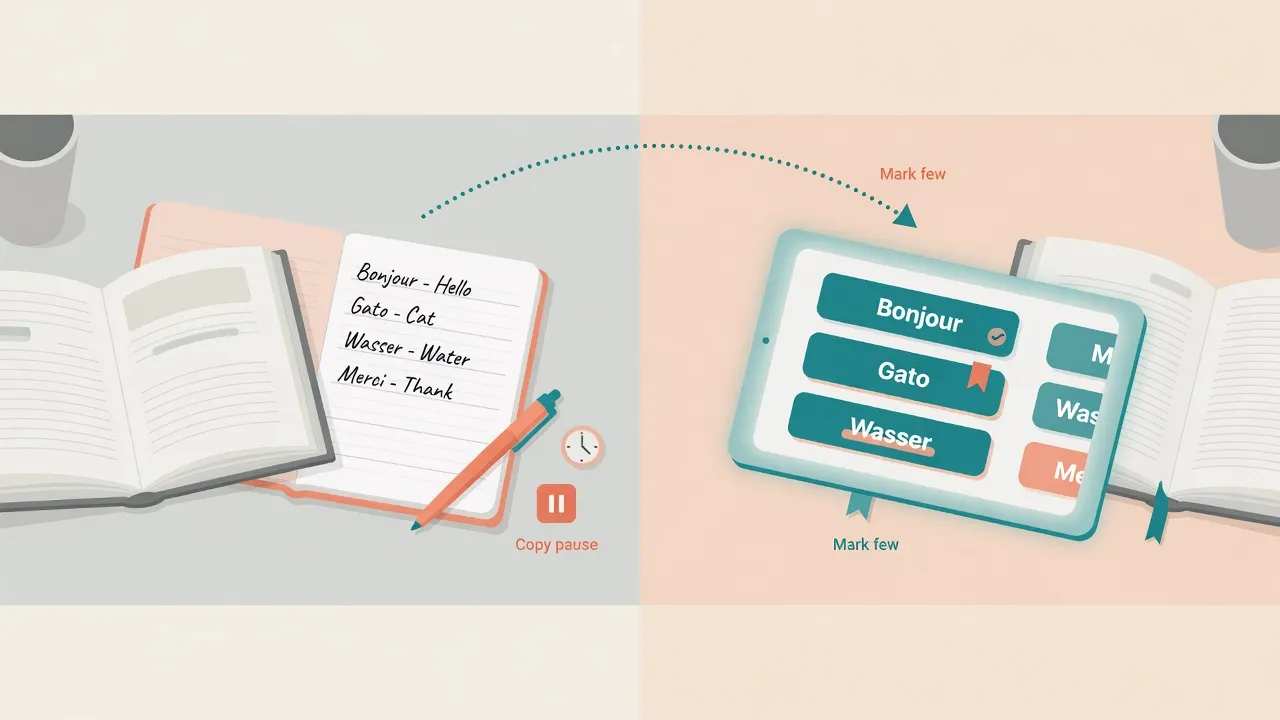
Here is the fork in one picture: leave the story for pen and notebook, or stay in the text with a light mark.
2. Time cost mid-text
Lookup plus copy plus optional transcription can eat minutes per stop. Twenty stops can swallow a whole session. That is a soft picture, not a universal law - use it as a feel check, not a stopwatch religion.
If your "reading night" becomes a transcription job, you did not fail discipline. You chose a method that fights the activity you came for. Extensive reading wants pace; intensive study wants depth. Mixing them on every page is how both feel bad. Related: intensive vs extensive reading.
3. Archive without spaced review
A notebook rarely schedules tomorrow's recall. Write-and-forget becomes the default. Neat pages without a revisit plan are storage, not practice - an archive without a schedule, a friendly graveyard for words you meant to learn.
High-frequency words often return through more reading. Rare words need intentional re-meeting. Forgetting is the normal path when nothing calls a word back - that is the plain idea behind the Ebbinghaus forgetting curve, not a scary formula you must memorize.
The three frictions together:
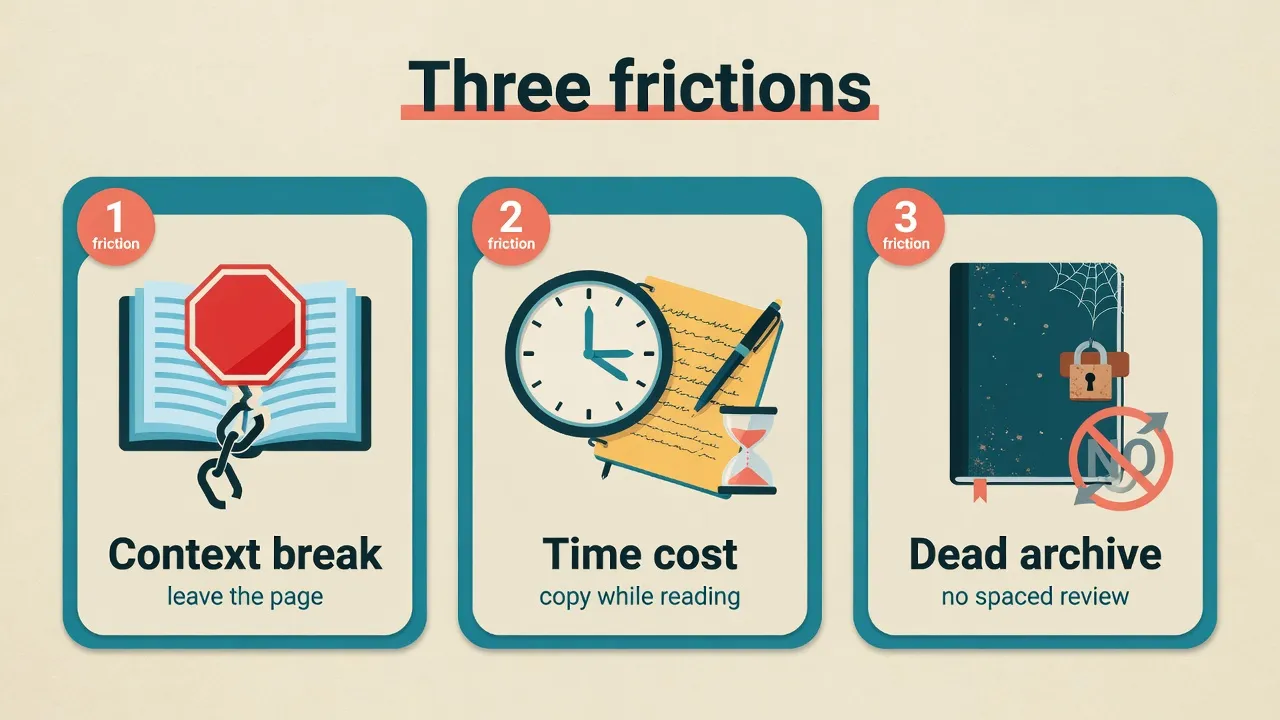
Name them when a session feels heavy. Often the fix is fewer mid-text stops, not "throw the pen forever."
When is a paper vocabulary notebook still a good idea?
Paper is not the villain. Mid-reading full-copy is the usual culprit.
Paper still helps when:
- you run slow deliberate study sessions (not mid-chapter)
- you work through exam or course lists you will actually review on paper
- you prefer handwriting for encoding when the task is word study (medium can matter; it is not a free pass without review)
- you want offline focus, a screen break, or a journal that feels motivating
- you will revisit and self-test, not only decorate pages
| Job | Prefer |
|---|---|
| Deliberate study blocks, exam units | Paper notebook (or paper + later SRS) |
| Extensive reading for pleasure / volume | Lighter capture (mark few, keep flow) |
Rule of thumb: paper for study blocks; lighter capture tools for extensive reading. Hybrid is normal. A paper list for unit seven and selective capture in a novel you love can live in the same week without drama.
Paper notebook vs flashcards vs reading + capture
Tools match jobs. Here is a plain three-way view - not a ranking of moral worth.
| Dimension | Paper notebook | Flashcard app (Anki etc.) | Reading + on-demand capture |
|---|---|---|---|
| Flow while reading | Often breaks | Capture friction if manual | Lowest if in-reader click |
| Context (sentence) | If learner writes it | Depends on card design | Easy to keep source sentence |
| Spaced review | Manual / rare | Strong | Needs product or habit |
| Best use | Deliberate lists, exams | Volume of active recall | Extensive reading + selective vocab |
Takeaway: copying lists is not retrieval. SRS is strong for recall but still needs good input. Reading + selective capture keeps the story alive; pair it with a short review later. Many learners hybrid: capture from text, review in Anki or phrase practice.
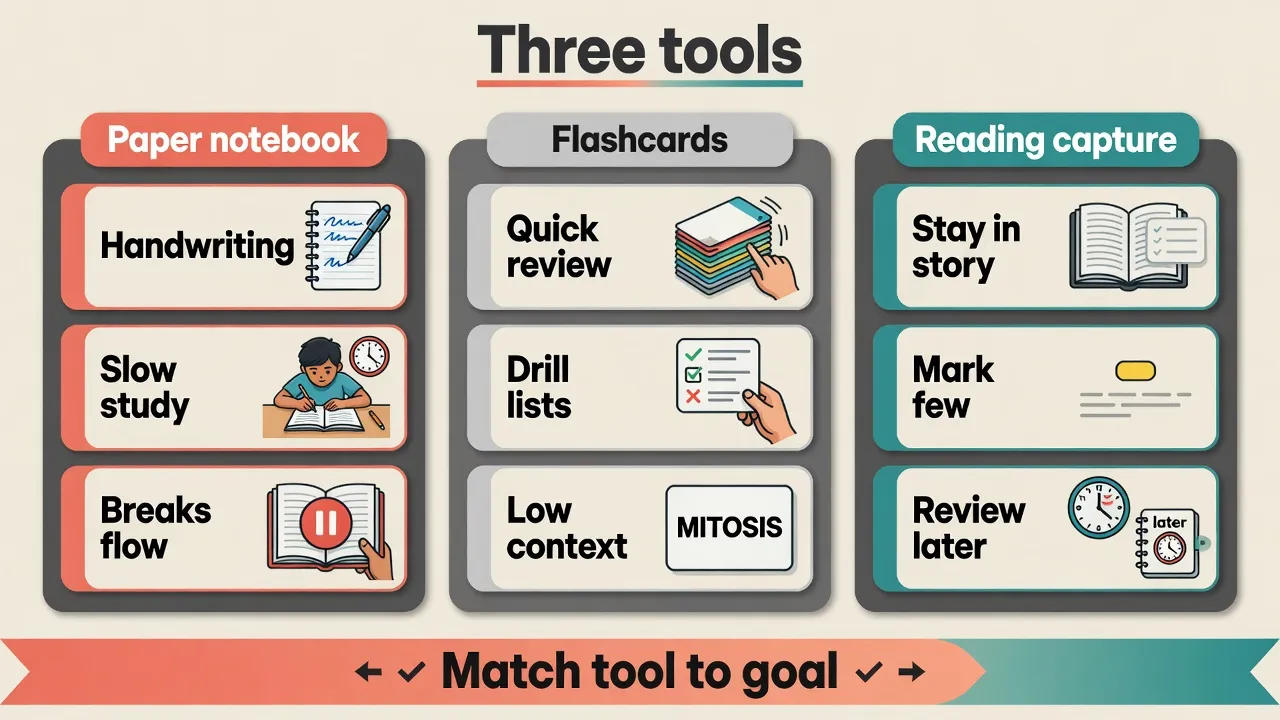
If one column feels "correct" for every hour of learning, you will force the wrong tool into the wrong job. Match tool to goal, then stop arguing with yourself.
A reading-first vocabulary loop that keeps motivation
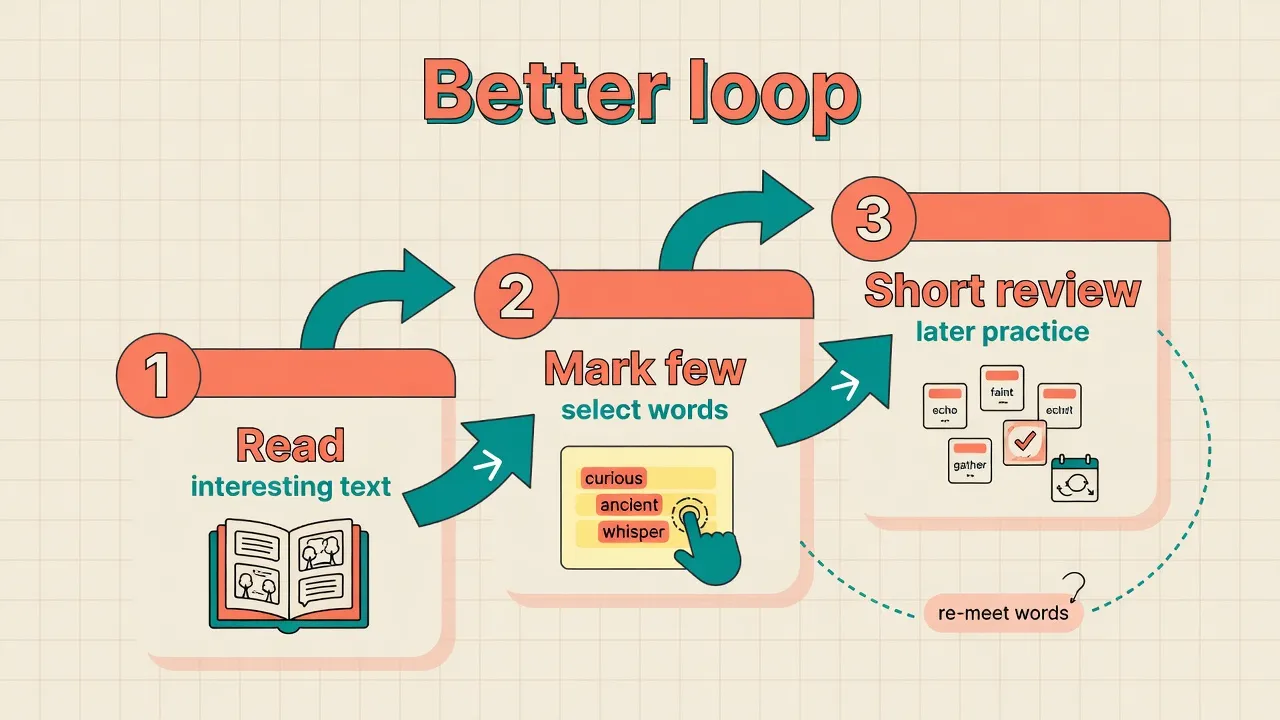
Motivation stays when reading stays enjoyable. Try this loop for pleasure pages and graded articles.
- Read interesting text at roughly the right level (i+1 feel: you can finish the page).
- Mark few high-value words or phrases - not every unknown.
- Keep context (source sentence or phrase), not bare L1 pairs only.
- Short review later: SRS deck or phrase practice; reading itself re-spaces frequent items.
How many words should you mark?
A handful of high-value items beats a wall of ink. Prefer words that block meaning or keep repeating. Skip proper names once recognized, one-off jargon outside your goals, and rare ornaments that never carry the plot.
If the review pile grows every day, cut new marks for a week. Quality over scoreboard.
Click-translate while reading is one way to mark without leaving the page - details in the next section if you want that path in one app.
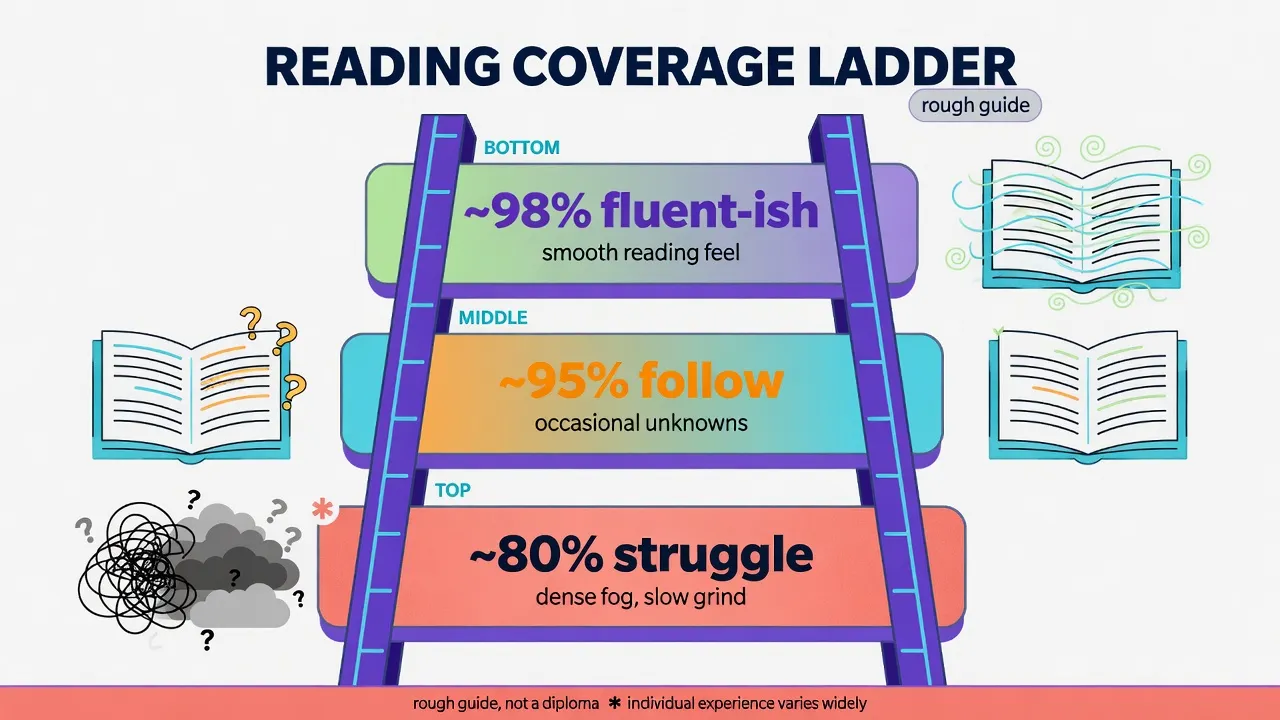
The loop as a ladder:
Want ready material? Browse the free graded library, try a Spanish A2 sample, and skim how to use once for capture habits. For building a wider reading bank at B1, see build B1 vocabulary by reading. For short daily contact without waiting for a free Saturday, the 15-minute rule pairs well with this loop. Progress tracking without fantasy dashboards: track vocabulary progress. Density while reading: vocabulary for reading comprehension.
Optional product path (if you want the loop in one place)
You can run the whole method with a paper list for study and any dictionary for reading. A reading app only helps if it cuts friction: stay in the text, mark a few words, keep context, listen when you want sound, and optionally practice phrases later.
MovaReader is an optional tool for that loop, not a miracle brain. Open graded text or your own legal file, click-translate while you read, keep the sentence around the word, listen when useful, and use short phrase trainers when available. Study languages for the product: English and Spanish (UI language can be separate).
| Need | Realistic plan |
|---|---|
| Test click-translate + free graded text | Free plan - about 20 word translations/day; listen often unlimited |
| Daily volume without hitting the free cap mid-page | Reader ~€1 unlimited translations; free graded library continues; own legal EPUB |
| Phrase trainers as the main bottleneck | Pro ~€5 trainers when available |
What it is not: one-click auto-save of every word into a perfect brain, guaranteed English-English gloss for every item, an AI accent coach, free commercial novels you do not own rights to, or a fluency certificate. Upload books you already own legally.
Path for a week: pick easy interesting text on all articles → read for story → mark few high-value items → optional short review on trainers or your own SRS. Setup notes: how to use. Plans: pricing. Account if you want progress saved: register. Soft orientation of known words (not an official CEFR exam): language map. Optional demos: phrase typing, type training.
Stay on the free plan while you test whether selective capture sticks. Move to Reader when daily limits block real pages. Pro only if trainers are the bottleneck - not because a badge yelled at you.
FAQ
Is a vocabulary notebook worth it?
Yes for deliberate study and exam lists you will actually review. It is a weak only-tool for mid-reading: stop-and-copy every word often breaks flow and becomes a write-and-forget archive. Use paper for study blocks; use lighter capture while you read for pleasure.
Is handwriting better for remembering words?
It can help for slow study (encoding when the task is word work). It is not a free pass if you never recall the item later, and it does not prove paper wins mid-story. Medium matters less than selection plus a review schedule.
Should I write down every unknown word while reading?
No. That often stalls pace and the story reward. Mark a few high-value words or phrases that block meaning or keep repeating. Keep sentence context when you can.
Is Anki (or any flashcard app) enough without a notebook?
Flashcards are strong for active recall if cards are good. You still need input and context from reading (or listening). Many learners hybrid: capture from text, review in SRS or phrase practice. Pure decks without real input often feel empty.
How many words should I mark per reading session?
A handful of high-value items beats a wall of ink. Prefer quality and context over "every unknown." If the review pile grows every day, cut new marks for a week.
Do I need a paid plan to try a reading + capture loop?
No. The free plan is enough to test the habit: free graded library, about 20 word translations/day, and listening is often unlimited. Move to Reader ~€1 when daily limits block real volume. Pro ~€5 only if phrase trainers (when available) are the bottleneck. There is no AI accent coach and no guaranteed English-English gloss for every word; upload your own legal EPUB, not pirated novels. Details on pricing.
What to do this week
- Pick one reading session; mark only a small set of words.
- Decide the tool job: paper for a deliberate list, or in-text capture for flow.
- Schedule a 5-10 minute review later - not "someday."
- Try a free graded piece if useful: library, ES sample.
- Optional: click-translate on the free plan; Reader if daily limits bite; Pro only if trainers are the bottleneck.
- For depth: Ebbinghaus and spaced review and passive to active vocabulary.
Motivation stays when the story stays enjoyable. Paper can still help deliberate study. Capture plus a short review keeps reading alive - with or without a paid plan.
Open the book. Mark few. Finish the page. Review later on purpose.
Keep reading with translations inside the text
With a free account, an unknown word translates with one tap, and the words you are learning wait for you in the trainer.
Free account: 7 days of Pro, then 20 word translations a day or a paid plan.