Vocabulary
Passive to Active Vocab: Why You Freeze When Speaking
You follow a series, then blank out in real talk. That gap is usually retrieval and production, not zero knowledge. Here is how to move words from recognition toward use - gently, with sound and phrases.
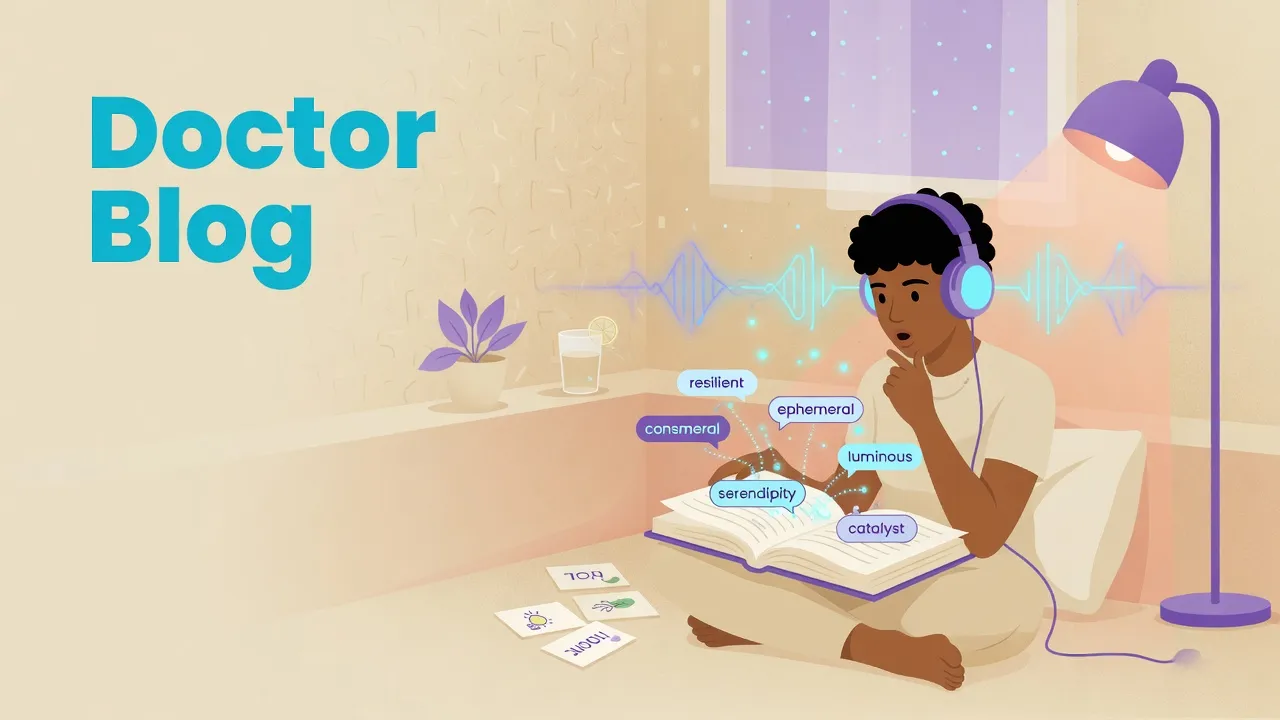
You finish an episode with English subtitles and think, "I got almost everything." You read an article and the plot sticks. Then someone asks a simple question face to face - and your head goes empty. The word you "knew" five minutes ago will not come out.
That freeze is common. It is not proof you studied wrong for years. It is the gap between passive vocabulary (words you recognize) and active vocabulary (words you can pull out under time pressure). This article names the gap, explains why silent reading alone does not close it, and gives a practical activation stack: hear the line, say it, store whole phrases, then use them later.
Short answer
Passive vocabulary is what you recognize when you read or listen. Active vocabulary is what you can produce on demand in speech or writing. Most learners have a much larger passive set - that is normal, not a personal failure.
The language barrier "I understand but freeze" often means retrieval and motor practice are missing, not that you know nothing. Growing passive through reading is useful. Activating words needs sound, mouth practice, full phrases, and real attempts to use them. No tool makes thousands of words active overnight.
Here is the iceberg picture:
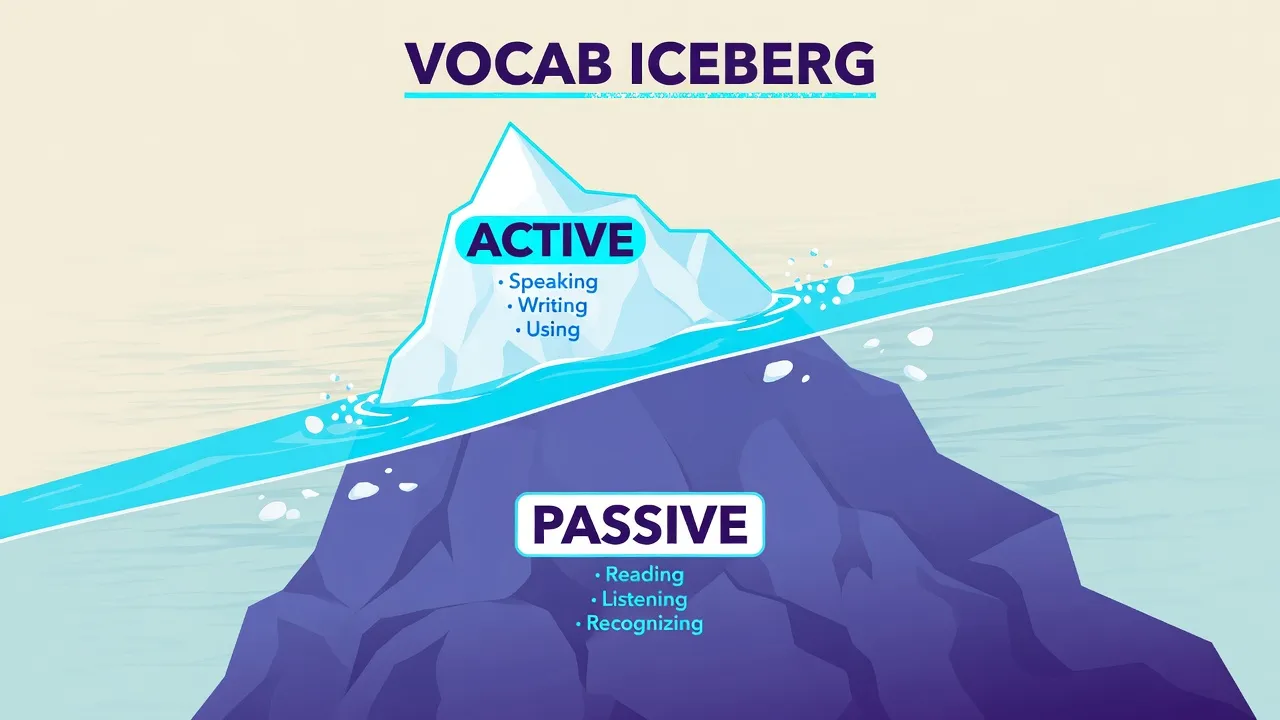
Above the water: the smaller tip you can say fast. Below: the bigger mass you only recognize. Reading grows the underwater mass. Mouth + sound grow the tip. Both matter.
Passive vs active vocabulary (plain definitions)
| Passive | Active | |
|---|---|---|
| Mode | Recognize | Produce |
| Under pressure | Easy when you see or hear the cue | Needs deliberate practice |
| Built by | Reading, listening | Speaking, writing, deliberate recall |
| Size for most learners | Usually larger | Smaller tip of the iceberg |
A soft intuition many people share: passive can feel several times larger than active. Treat "3-5x" as a feeling, not a universal law. Your numbers will vary by topic, stress, and how much you actually speak.
Receptive vs productive is the same split in academic language. Receptive = understand. Productive = produce. You need both. A huge passive bank without production practice is like a full warehouse with no delivery trucks.
Why the freeze feels personal (it is common)
When you blank, shame arrives fast: "Everyone else can talk. I only pretend to know English." That story is unfair.
What usually happens in that moment:
- You recognize the question (passive works).
- You search for words without the page or subtitles (retrieval under pressure).
- Your mouth has rarely said those words in sequence (motor practice gap).
- Stress steals the spare attention you use for translation and self-monitoring.
- You freeze - or reply with tiny safe words that feel "below your level."
So the barrier is often a production and retrieval gap, not empty knowledge. You are not a fraud for understanding Netflix and still stumbling at the cafe. Different skills. Related, but not identical.
Here is the loop many learners live in:
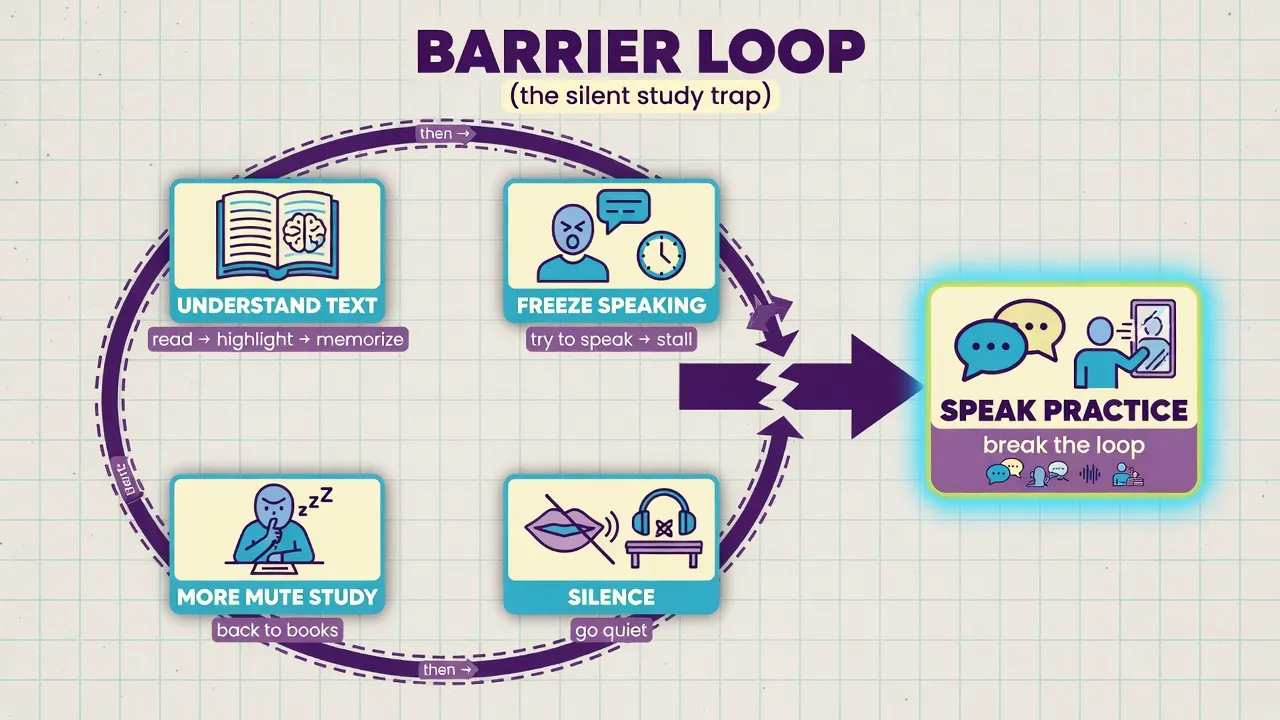
Input feels good. Output never gets enough safe reps. Confidence drops. You return to silent input because it feels safer. The loop tightens.
If mental translation also slows you, that is a sibling problem - covered in how to stop translating in your head. Freezing and inner translation often travel together.
Silent reading builds passive (and that is still good)
"Just read more" is not wrong. It is incomplete for speaking.
When you read with your eyes only:
- your brain decodes meaning
- your lips and tongue rest
- pronunciation of a new word may stay fuzzy
- you may never meet the word again as a phrase
Context still teaches meaning. Meeting daunting inside a real paragraph beats a naked word list. That is why reading remains a core path for vocabulary growth - see intensive vs extensive reading for how deep study and wide volume share the load, and flow-state reading when you want long sessions that still feel human.
The limit is simple: silent decoding does not automatically install fast retrieval or mouth memory. Unknown pronunciation also blocks willingness. If you are not sure how a word sounds, your brain often refuses to risk it in public.
So keep reading. Add sound and speech on purpose. That is the upgrade, not a replacement.
What actually moves words toward active use
Activation is not one magic drill. It is a short stack of ingredients, repeated often enough that a phrase becomes "mine."
- Hear the word or phrase in a full sentence (rhythm and connected speech matter).
- Say it - shadowing with the model, or a delayed echo from memory.
- Store a phrase, not only a bare lemma (Could you say that again? beats again alone).
- Retrieve without the original page (a prompt, a blank card, a trainer, a self-question).
- Use it in self-talk, writing, or a real conversation when you are ready.
Realistically, some phrases start feeling available after a few deliberate uses. Others need weeks of re-meeting them in new texts. "Instant activation of every lookup" is marketing, not how memory usually works.
The path in one glance:
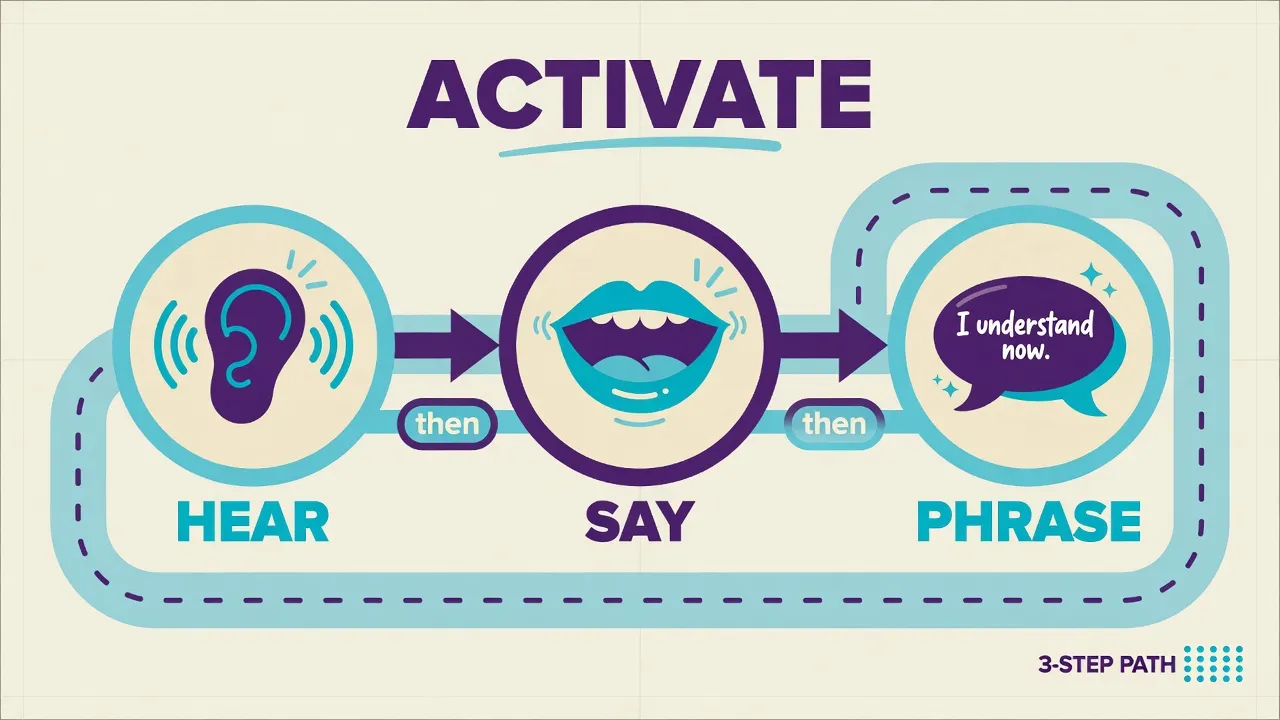
Notice what is missing from that path: shame after one bad conversation, and pure isolated flashcard marathons with no audio and no phrases.
Reading aloud sits next to this stack when pronunciation is the blocker. If you want more on voice while reading, see reading aloud vs silent reading.
A practical 15-20 minute session
You do not need a heroic hour. A focused block beats a vague "study all evening." For habit design, the 15-minute rule for daily vocabulary is a friendly sibling.
Try this shape:
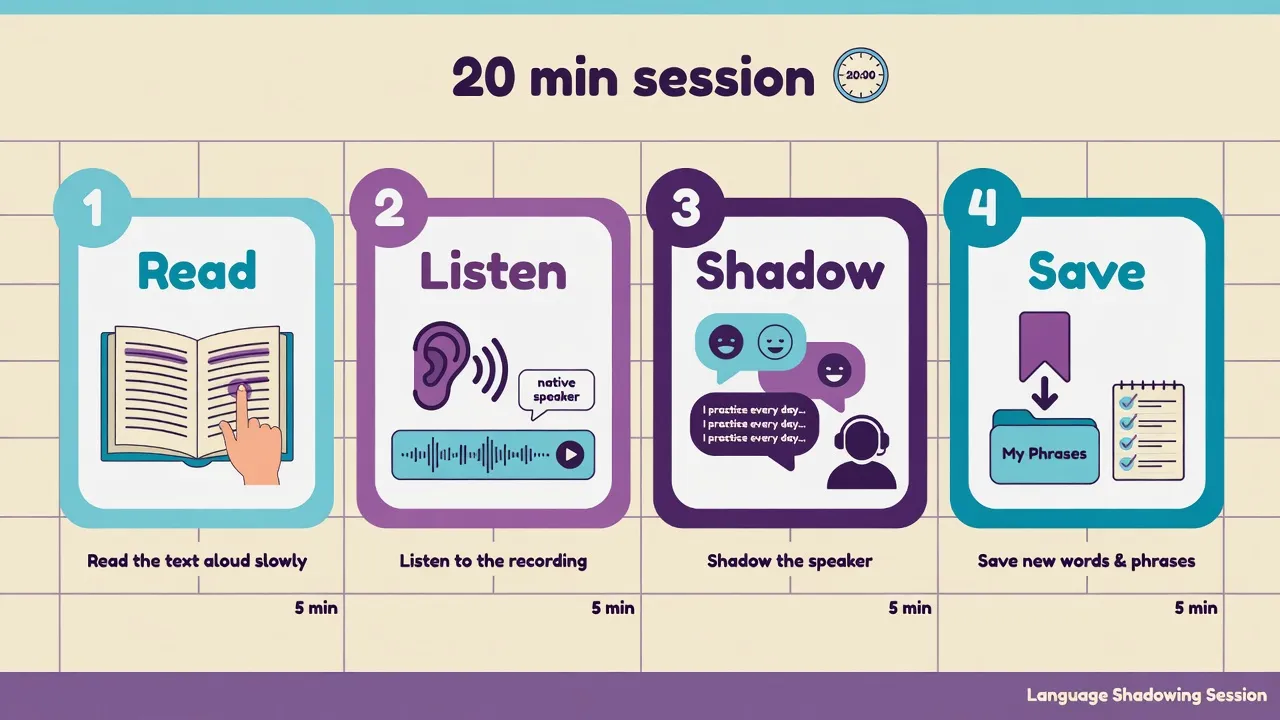
- Read interesting short text for 8-10 minutes. Click only blockers - words that stop meaning - not every fancy adjective.
- Replay 3-5 sentences with audio for 4-5 minutes. Listen for how words glue together.
- Shadow those lines for 3-5 minutes. Copy rhythm and stress, not only single words.
- Optional: save about 3 phrases for a trainer or self-prompt later.
That is enough for one day. Tomorrow, new text or the next paragraphs. Consistency beats intensity theater.
A simple score for the session: can you retell one idea from the text in your own words, even if short and imperfect? If yes, passive and active both got a workout.
Five activation exercises (pick two, not all five)
1. Shadowing after the model
Play a sentence. Speak with it, almost in real time. Goal: mouth memory and intonation, not perfect drama. Keep volume private if that helps you start.
2. Echo (wait, then repeat)
Play the line. Pause two seconds. Repeat from memory. Harder than pure shadowing because retrieval starts earlier.
3. Phrase typing or saying the phrase aloud
Type or speak the full chunk: That makes sense, I'm not sure, Could you repeat that? Whole phrases travel better under pressure than single dictionary entries. Demos: phrase typing and type training. Later, trainers and phrases when you want a fuller loop.
4. Self-prompt without the page
Close the article. Ask: "How would I say X?" If nothing comes, peek once, then try again tomorrow. This is deliberate recall - the muscle speaking needs.
5. Mini write: three sentences with today's phrases
Write three short sentences that reuse the phrases you saved. Writing is slower than talk, but it still forces production. Then read your three lines out loud once.
Two exercises done well beat five half-done.
Mistakes that keep the freeze in place
- Only mute reading forever. Passive grows; the mouth stays unemployed.
- Expecting every looked-up word to go active the same day. Celebrate a few usable phrases, not a perfect dump of the dictionary.
- Isolated word cards only. Lists help recognition. They often fail for natural speech rhythm unless you upgrade to phrases + audio.
- Shame after one freeze conversation. One blank moment is data, not a final exam grade.
- Never speaking because "I'm not ready." Readiness grows from small attempts, not from waiting for a magic level badge. Tools help practice. Real humans still matter eventually.
If you tend to punish yourself for imperfect speech, fear of mistakes and perfectionism is worth a parallel read.
Where MovaReader fits
MovaReader supports the activation loop: read graded text or import what you own, click for translation on blockers, listen to sentence audio, then optional phrase trainers later.
Limits and plans:
| Need | Realistic plan |
|---|---|
| Try the habit without a big commitment | Free plan: free library, about 20 word translations/day, unlimited listening |
| More daily reading volume without constant flow breaks | Reader ~€1/mo |
| Full phrase / type trainers for active chunk practice | Pro ~€5/mo |
Listening is not a premium-only gate. Unlimited listening on the free plan lets you hear lines and shadow without paying first. Translations have a daily cap on the free plan (~20/day). Volume reading without friction usually wants Reader. Trainers sit on Pro.
Practical path:
- Open free graded texts in All Articles - try the ES A2 sample.
- Read for meaning; click blockers only.
- Replay 3-5 sentences with audio; shadow them.
- Save a few full phrases, not only single words.
- Optional light trainer later; details on Pricing and How to use.
- Use a language map as a rough compass for what you are collecting.
Upload a legal EPUB you already own when you want a longer book.
FAQ
Is a huge passive vocabulary enough?
It helps comprehension and confidence a lot. For speaking, you still need production practice. Passive is fuel; output is the engine start. Grow both.
How long until a word becomes active?
It varies. Some phrases feel available after a few deliberate uses. Others need weeks of re-meeting them in new contexts. Avoid "instant" promises. Track usable chunks, not perfect counts.
Are flashcards enough?
Flashcards help recall. Pair them with full phrases, audio, and speaking. Context from reading is gold for meaning. Isolated "word = translation" walls rarely fix the cafe freeze alone.
Is listening free in MovaReader?
Yes. On the free plan, unlimited listening is available. Word translations are about 20/day on the free plan. Reader ~€1 for reading volume; Pro ~€5 for full trainers. Always check current details on Pricing.
Do I need a tutor?
A tutor gives feedback and real dialogue. Self practice (shadowing, phrases, conversation partners, self-talk) still moves words toward active. Different tools. You can start alone and add people when ready.
Does this work for English and Spanish?
Yes. The passive/active split is the same skill problem in both. The product library covers English and Spanish graded material so you can run the same hear-say-phrase loop.
Will reading alone make me fluent?
Reading grows passive stock and often confidence. Fluency in live talk still needs production and, eventually, real conversations. Tools reduce friction; they do not replace people.
Next steps
- Pick one short text you actually want to finish - All Articles.
- Run one 15-20 minute loop: read → listen to a few lines → shadow → save 3 phrases.
- Tomorrow, retrieve those phrases without the page once.
- When you can, say one of them to a human or a voice note. The freeze loosens with reps, not with guilt.
You already understand more than you can say under pressure. That is not failure. It is an iceberg with a tip that still needs mouth practice. Hear it. Say it. Keep the phrase. Speak when you can - imperfectly is fine.
Keep reading with translations inside the text
With a free account, an unknown word translates with one tap, and the words you are learning wait for you in the trainer.
Free account: 7 days of Pro, then 20 word translations a day or a paid plan.