Reading Strategies
Flow State Reading: Enjoy English Longreads
Why some people get lost in English articles while others quit after one paragraph. The secret is flow state - and you can train the conditions that make it show up.

Picture this: you open a long piece from The New York Times about AI, climate, or geopolitics. The first lines pull you in. You catch every other sentence, guess the rest from context, and then notice - an hour has gone. No Instagram. No Google for every word. You just... read. And it felt good.
That state is flow - a concept psychologist Mihaly Csikszentmihalyi made famous. It is also the practical key to loving reading in English, not forcing it.
Here is the plain version. Flow while reading English longreads means full immersion: time fades, you stop tab-hopping for every word, and the article feels like a game you chose. You get there when the text is a bit harder than easy, feedback is instant (each paragraph clicks or you recover), and the page is quiet - no ads, no phone pings, no dictionary detours. Most people fail on environment and level match, not on "talent." Fix those first; vocabulary grows as a side effect of staying in the story.
What flow is and why reading fits it
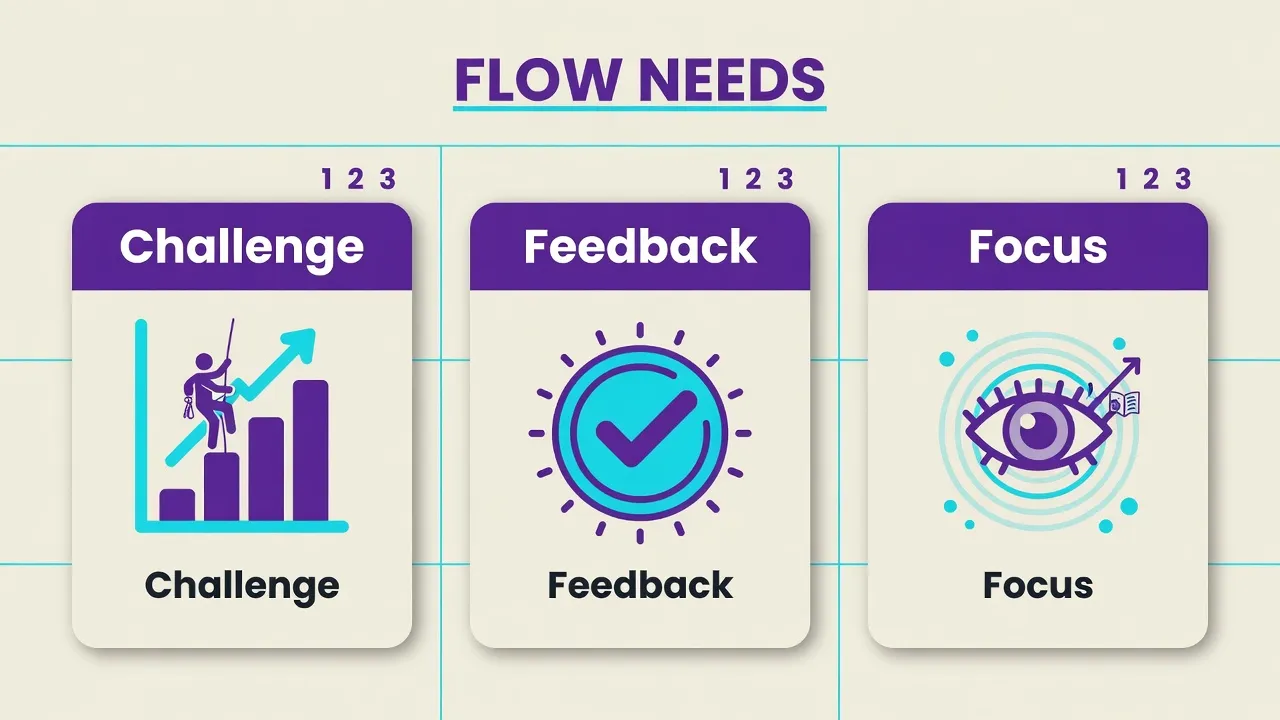
Csikszentmihalyi described flow as deep absorption: effort feels more like play than work, and the clock disappears. Three conditions usually need to line up:
- Challenge slightly above skill - too easy is boring; too hard is stress.
- Clear feedback - you can tell whether you are still "getting it."
- No distractions - one process holds your full attention.
Those conditions look simple on paper. Here is the same idea as a diagram:
English longreads fit this setup well. A strong news or magazine piece is an intellectual challenge: every paragraph confirms or breaks a hypothesis you formed two screens earlier. When the text sits just above your comfort zone, that stretch is where flow likes to live.
"The best moments in our lives are not the passive, receptive, relaxing times… The best moments usually occur if a person's body or mind is stretched to its limits in a voluntary effort to accomplish something difficult and worthwhile."
- Mihaly Csikszentmihalyi, Flow: The Psychology of Optimal Experience
That is why a real B1-B2 or B2-C1 article often beats endless adapted textbook pages. The adapted page is safe. The real piece has just enough friction to feel alive.
Stuck between levels? The language map shows which vocabulary bands already feel solid before denser journalism.
5 enemies of flow when you read English online
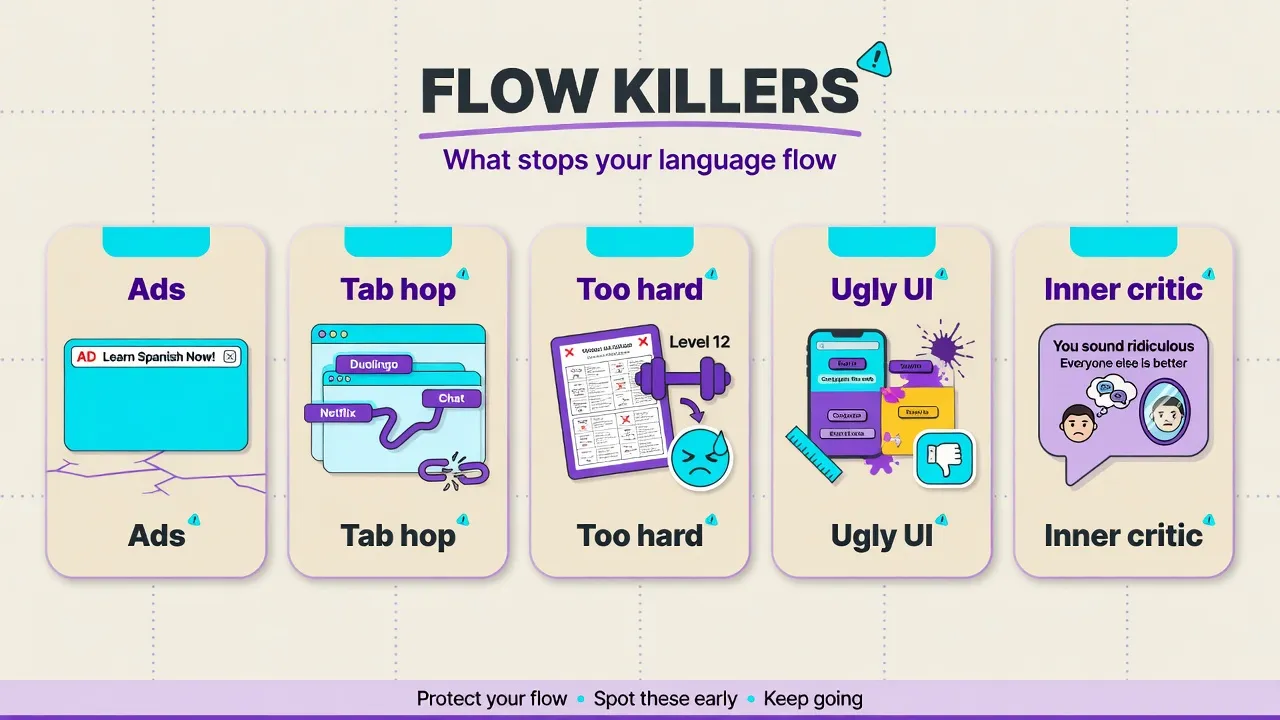
Before the fixes, name the villains. These five break immersion for English web articles more often than a "weak vocabulary" story does:
- Ads and page chrome - banners, sticky bars, "you may also like" modules. Each one is a micro-hit on attention.
- Tab dictionary - unknown word, new tab, Google Translate, email ping, ten minutes gone, plot forgotten.
- Text too hard - when known words drop under roughly 70%, the brain overloads and wants out.
- Ugly UI - tiny type, low contrast, zero paragraph air. Eyes quit before the argument starts.
- Inner critic - "you will never get this" kills start energy before sentence two.
At least three of these enemies live in the reading environment, not in your passport or IQ. Environment is fixable.
The clean room method
Cognitive load is simple: your brain has a limited budget for simultaneous processing. Every extra element on screen spends budget you could use on meaning.
For English reading, every non-essential UI bit steals resources from understanding. So the first practical step toward flow is a "clean room."
Checklist:
- One text on screen - nothing else essential
- Comfortable font size (around 18px or larger if you control the UI)
- Warm or dark theme if eyes tire at night
- Translation in one click, without leaving the page
- Zero ads, popups, or sticky recommendation junk
That is the design idea behind MovaReader: import a page or file, strip the circus, read in a calm UI, tap a word for help without a tab tour. Just less attention bleed before the story grabs you.
New to the product? How to use covers the basics without a lecture.
From NYT to The Guardian: import longreads without the war
Quality English journalism is gold for intermediate and advanced learners. The New York Times, The Atlantic, The Guardian, Wired - dense, but usually logical. Good material for B1 through C1, depending on the piece.
On the original sites it is often a fight: paywalls, banners, autoplay, recommendation sidebars. A calmer path:
- Pick a piece you actually care about - not "useful business content" you hate.
- Import it into a clean reader (URL or a file you already have rights to use).
- Tune the room - font, theme, phone on silent.
- Read in flow mode - when a word blocks the main idea, click it. Confirm. Keep moving.
Legal note, said plainly: use free articles, library access, or subscriptions you already pay for. Import tools should extract readable text where allowed. Do not treat any app as a piracy shortcut.
Main rule once the text is clean: do not stop for every unknown. Three hard words in a row is not a red light. Context often does the work a dictionary cannot.
She felt a frisson of excitement as the implications of the discovery began to unfold.
Even if frisson is new, excitement + discovery + unfold points toward a shiver of thrill. One-click confirmation that you guessed right is a small dopamine hit - and that is how words stick better than a cold flashcard list.
The dopamine loop (why flow can feel addictive in a good way)
When you follow an interesting article and it makes sense, the brain rewards you. Guess a word from context and confirm it: another small spike. Finish a long piece and think "I actually got that": a bigger one.
The loop looks a lot like a well-designed game:
- Challenge - hard sentence or unknown word
- Effort - guess from context
- Reward - confirm meaning + whole paragraph clicks
- Progress - you see how far you have come
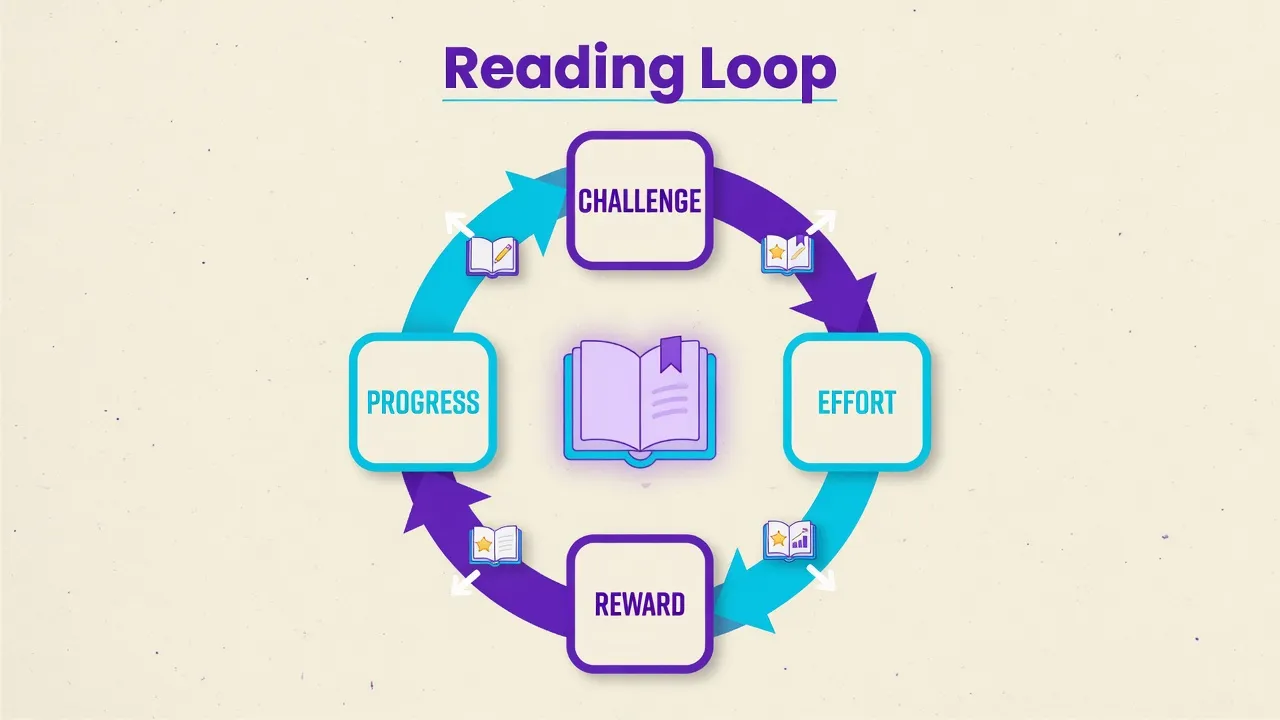
People who find this loop stop forcing reading sessions. They start protecting them. The fragile part is friction. If translation needs a separate app, a wait, or a trip through notifications, the loop snaps. Instant, quiet help keeps the story intact.
How to pick the right longread for flow
Not every article is flow material. Three filters help.
Difficulty (CEFR ladder for sources)
Bands are approximate - topic familiarity can move a piece up or down a notch:
| Band | Example sources | Feel |
|---|---|---|
| B1 | Popular blogs, Vox explainers, lighter Medium, simple news | Shorter sentences, modern vocab |
| B2 | The Guardian, BBC long reads, Wired | More idiom, denser structure |
| C1 | New York Times, The Atlantic, The Economist | Academic-ish lexis, layered argument |
| C2 | The New Yorker, London Review of Books | Literary style, cultural references |
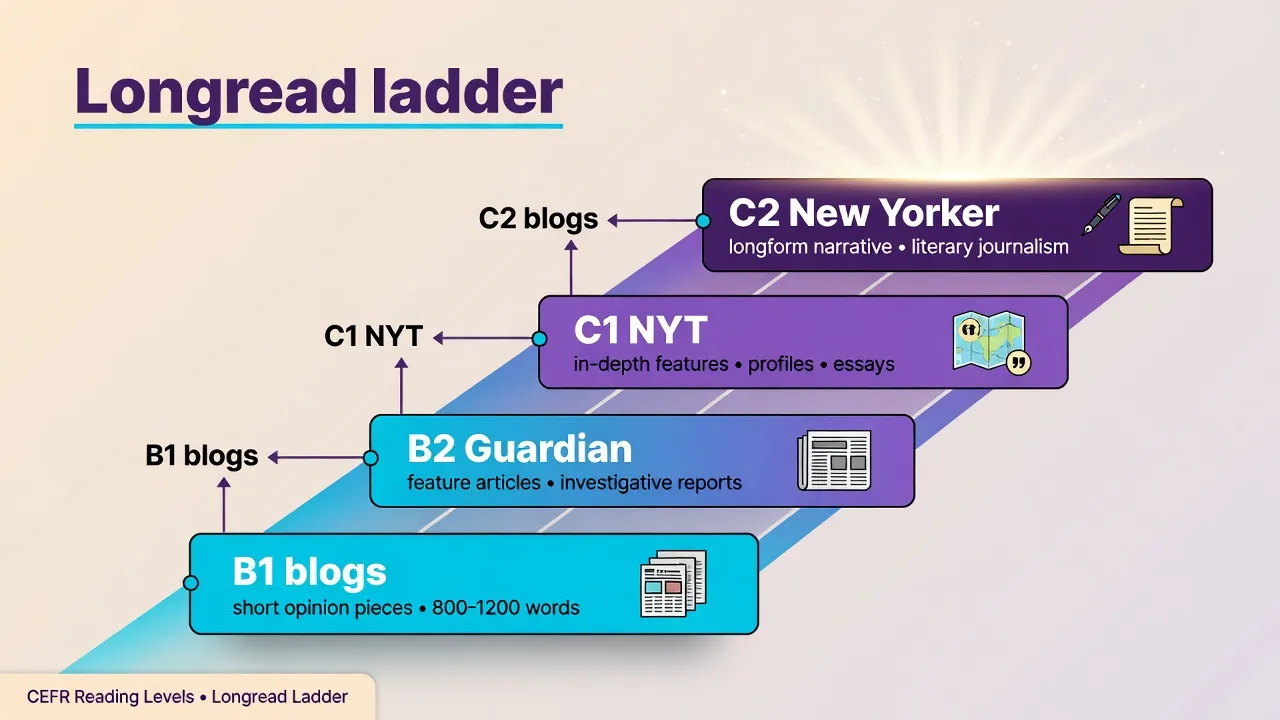
If native longreads still feel brutal, warm up on graded free articles first. That is not cheating - it is matching challenge to skill so flow has a chance.
Topic
Choose what you actually care about. Forced "useful" content kills flow faster than one hard word.
- Tech → Wired, Ars Technica
- Psychology → Psychology Today, Scientific American Mind
- Food → Bon Appétit, Serious Eats
- Film → IndieWire, Sight & Sound
Length
For first flow practice, start around 1,000-2,000 words. When the habit feels natural, longer pieces (3,000+) give deeper immersion after the warm-up.
The 20-minute entry protocol
Many people need roughly 15-20 minutes of uninterrupted focus before time starts to feel different. That is a common pattern, not a lab guarantee for your next Tuesday evening. Treat the steps as a practical ritual:
- Prep (about 2 minutes) - open a clean text, mute the phone, close extra tabs.
- Warm-up (about 5 minutes) - read the first paragraphs slowly. Incomplete understanding is fine. Keep moving.
- Immerse (about 10 minutes) - continue; click only words that block the main idea. Your brain starts filling gaps from context.
- Flow (open-ended) - if the clock fades, stay. If after a solid uninterrupted try nothing clicks, switch topic or drop a difficulty step. Wrong text is information, not a personal failure.
If flow never appears, change the input or the noise level. Do not grind through a piece you hate "for English."
What to do with words you meet while reading
A common panic: "I saw fifty new words and remembered three. Is that normal?"
Yes. Completely normal - and often the right outcome for extensive reading.
In flow, the brain is not running a vocabulary exam. It builds links through context: emotion, argument, story. A word glued to an article you cared about beats a naked "word = translation" line in a notebook.
If you want to lock a few keepers after the session:
- Send sticky lines into the phrases trainer later.
- Practice awkward spellings with phrase typing - motor memory helps.
- Re-read the same piece a week later. "Forgotten" words often resurface without drama.
More on growing a reading lexicon without killing pleasure: vocabulary for reading comprehension.
Textbook habit vs flow approach
| Traditional | Flow approach | |
|---|---|---|
| Material | Graded textbook passage | Real articles you care about |
| Environment | Book + separate dictionary | Clean single UI |
| Translation | Look up everything | Click only critical words |
| Motivation | "I should" | "I want this story" |
| Typical session | 20 minutes and tired | Longer when it clicks |
Neither column is pure villain. Graded texts are great for warm-ups. The point is that staying only in textbook mode rarely produces the pleasure that keeps intermediate learners reading for years. Flow reading turns input into something you protect.
On a B1-B2 plateau, method matters as much as minutes: how to break a B1-B2 language plateau.
Where MovaReader fits
MovaReader is built around the clean-room idea: import a URL or file, read without the usual web noise, tap a word for translation without leaving the text. That keeps the challenge → effort → reward loop intact.
What we are: minimal reading UI, click-translate in context, free graded library when native longreads are still too hard, and optional phrase/typing trainers after reading.
Hard texts still need the right level and a quiet phone.
Pricing:
- Freemium - free library and about 20 word translations per day
- Reader ~€1/month - reading-focused limits for daily longreads
- Pro ~€5/month - current and future trainers
Details on pricing. Start free if you need an on-ramp; import real interest pieces when ready; pay only when freemium caps block a habit you already enjoy.
Suggested path:
- Shaky B1? Warm up on free all-articles; mark what you know on the language map.
- Ready for more? Import one article you would read in your first language.
- Click-translate sparingly. Re-read once later. Optional phrases for lines that stuck.
- Upgrade when the free translation budget fights your reading rhythm.
FAQ
Do I need to understand every word to enter flow?
No. Flow needs enough understanding to follow the story or argument, not a 100% decode. Looking up every word is one of the fastest ways to kill immersion. Guess first; look up words that block the main idea or keep repeating.
What if I understand less than about 70%?
That text is probably above your stretch zone for flow. Drop a level (easier source or a graded article), pick a topic you already know well, or pre-skim headings. Frustration is a signal to change the input, not a moral failure.
How do paywalls and NYT/Guardian ads fit in?
Original sites often mix paywalls, banners, and recommendation widgets. For practice, use clean text you legally have access to: free articles, library access, your own subscriptions, or import tools that extract readable text where allowed. We do not encourage piracy. MovaReader is a calmer surface once you have a URL or file you can use.
How long until flow usually appears?
Many people need roughly 15-20 minutes of uninterrupted focus before time feels different - not a lab guarantee. If nothing clicks after a solid try, the article or the noise level is wrong. Switch text or fix the room.
Is MovaReader free for this?
Yes, partly. Freemium: free graded library and about 20 word translations per day. Reader ~€1/month for heavier reading; Pro ~€5/month for full trainers. Import your own files or URLs within product rules. We do not host licensed commercial novels by default.
Does reading longreads replace speaking practice?
No. Reading builds vocabulary, rhythm, and stamina. Speaking still needs its own practice. Flow reading is a strong engine for input, not a substitute for conversation.
Next step
Find one article that would interest you even in your first language. Open it in a quiet UI. Mute notifications. Give yourself about twenty uninterrupted minutes.
Flow often shows up when the room is clean, the level is right, and the story is yours. Stay long enough for the loop to catch.
Learning English?
The English version of MovaReader teaches Spanish and Ukrainian. To read English with a translation for every word, open the reader in Ukrainian or Spanish:
Книги англійськоюЦя стаття українськоюLibros en inglésEste artículo en español