Reading Strategies
Read Complex English Sentences Faster: 3 Practical Skills
You do not need genius speed reading. You need three structure skills: chunk meaning groups, lock the main clause first, and treat idioms as one unit. Here is how to practice them in 30 days.
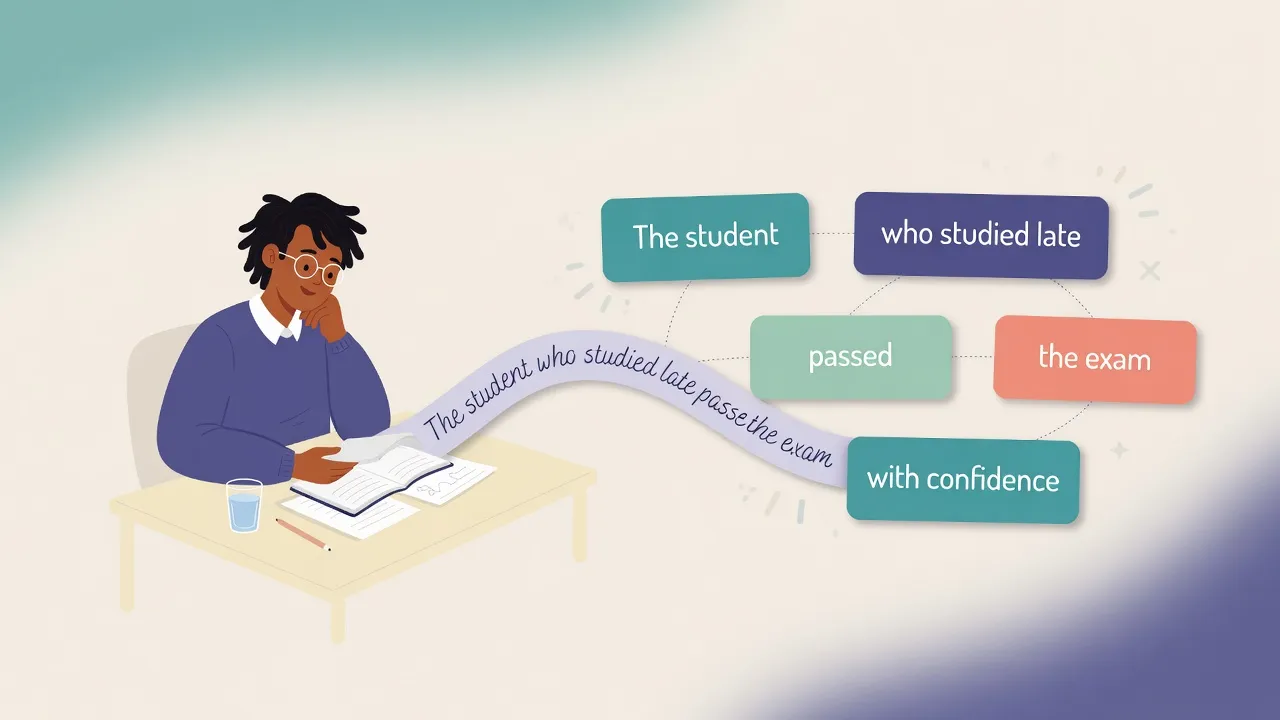
You open a page in English, start a long sentence, and somewhere around the third line you realize you forgot how it began. Your eyes jump back. You re-read. You still lose the thread inside relative clauses. Five minutes later you close the book and think: "Maybe I am not ready yet."
That feeling is common. It is not proof that your level is "too low." It is what happens when foreign syntax meets word-by-word reading.
The short answer
You do not need genius speed reading. You need to stop treating every word as a separate unit.
Train three skills: chunking (read 3-5 word meaning groups), main-clause first (lock subject + verb before decorations), and idiom spotting (treat fixed phrases as one piece). That cuts re-reading more than racing your eyes with a finger.
Classic pacers help a little. Structure skills help more. Expect fewer stuck moments after weeks of practice - not a miracle double overnight.
Here is the spine in one view:
| # | Skill | What you do | Why it helps L2 readers |
|---|---|---|---|
| 1 | Chunking | Group words into 3-5 word meaning units | Fewer items in working memory than 30 single words |
| 2 | Main-clause first | Find who + does what before nested clauses | Keeps the spine when modifiers pile up |
| 3 | Idiom spotting | Read fixed phrases as one chip | Stops dead ends on strings like "break the ice" |
Why foreign complex sentences feel heavy
In your first language, your brain already groups words into ready-made blocks. You do not assemble "despite the fact that" letter by letter. You swallow the whole phrase.
In a second language, those automatic chunks are thinner. Working memory holds more loose words. A relative clause starts, then another modifier, then the verb finally shows up - and the start of the sentence has already slipped away.
So the fix is not "move your eyes faster at any cost." Skilled readers often slow down on purpose when the syntax gets dense, then speed up again on easy stretches. Speed without structure is just expensive re-reading.
Technique 1: Chunking
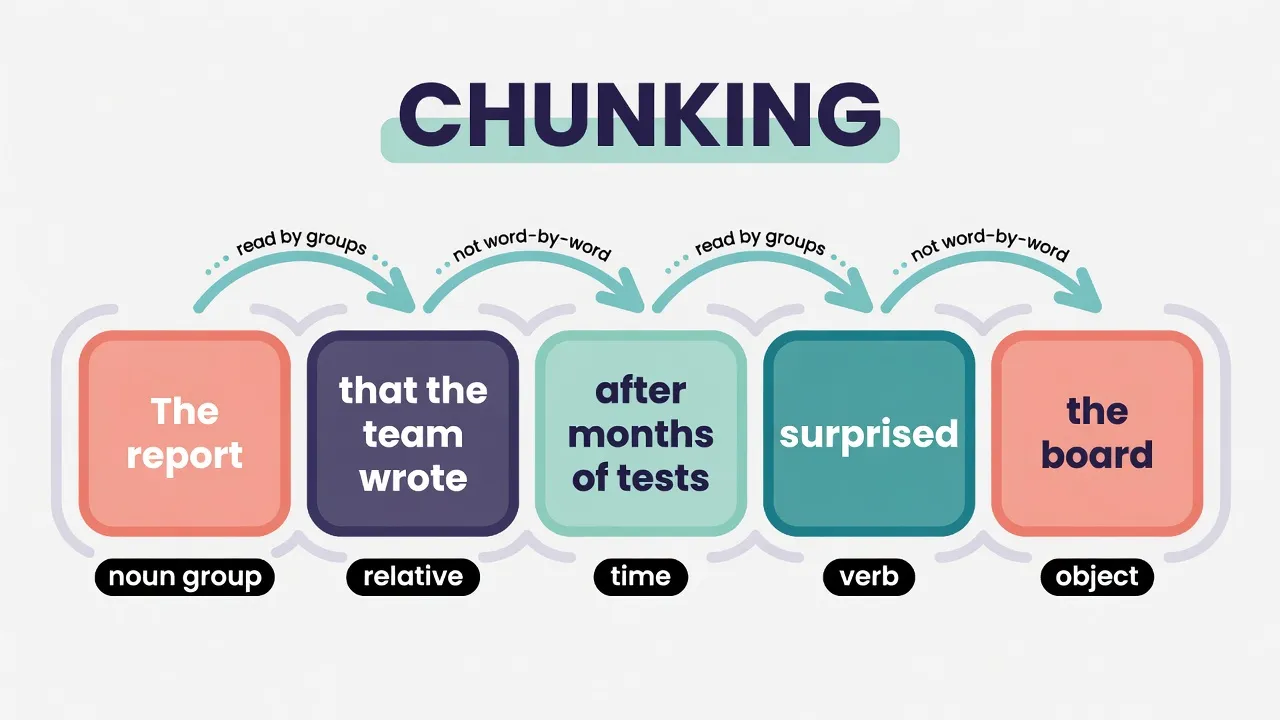
Chunking means you read meaning groups instead of single words. Aim for small units of about three to five words that carry one idea: a noun phrase, a short verb phrase, a prepositional bit.
Take this heavy sentence:
The book that the professor, who had spent decades studying ancient manuscripts in the dusty archives of forgotten libraries, recommended to his most diligent students was, surprisingly, a slim volume of poetry.
Word-by-word, that is a tax on attention. In chunks it looks more like this:
[The book] [that the professor] [who had spent decades] [studying ancient manuscripts] [in the dusty archives] [of forgotten libraries] [recommended to his most diligent students] [was, surprisingly,] [a slim volume of poetry.]
You still read everything. You just load fewer separate items into short-term memory.
How to practice chunking
- Pick a short graded article or a page you already half understand.
- For 15 minutes, mark groups with a pencil or lightly with your finger.
- Read each group as one "bite," then move on.
- Do not stop to translate every unknown word mid-sentence. Mark it and finish the paragraph first.
If you want less friction while you train, use text with click-to-translate on hard words so one unknown lemma does not kill the whole line. Free access is enough to start: the library of adapted articles plus 20 translations a day.
Here is the idea as a simple map - long line becomes groups, not a fog of singles:
Technique 2: Main clause first
Chunking helps memory. Main-clause first helps orientation.
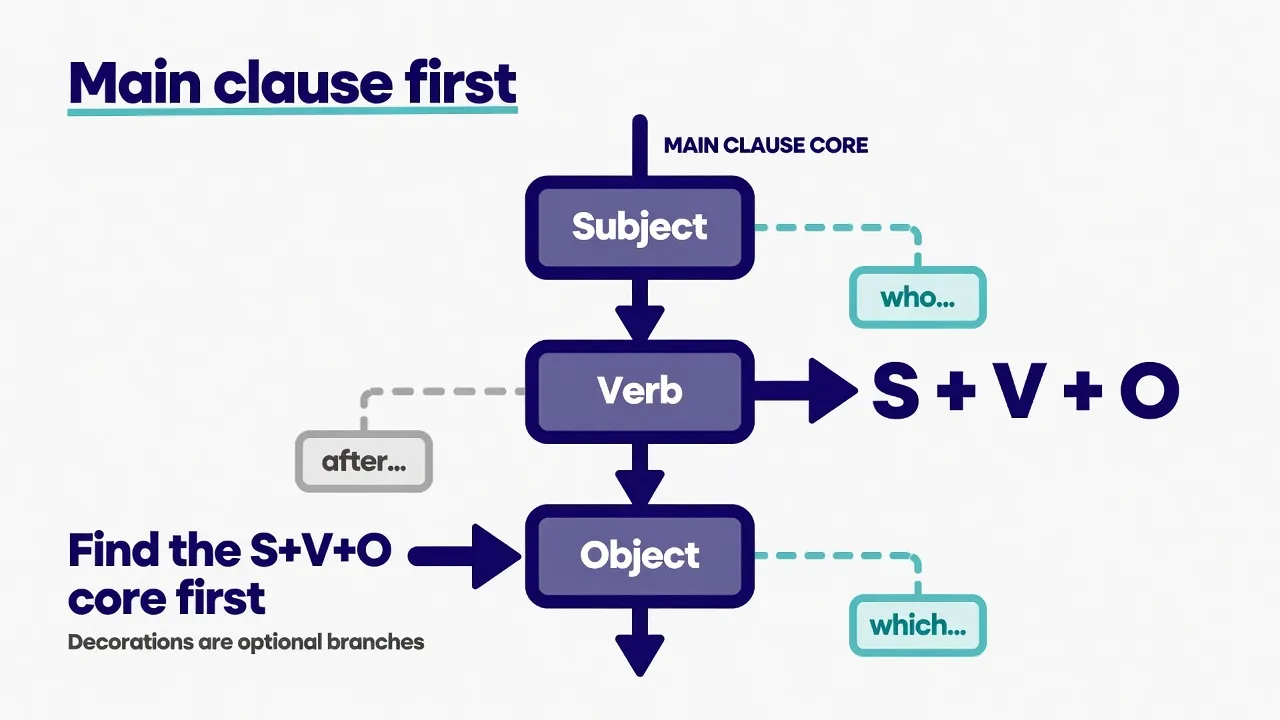
In the same professor sentence, the spine is simple once you strip the decorations:
The book ... was ... a slim volume of poetry.
Everything else is who recommended it, who studied what, and where. Useful - but not the beam that holds the roof up.
Try another one:
The company, despite facing unprecedented challenges during the global pandemic, managed to increase its revenue by fifteen percent.
Core: The company managed to increase its revenue (by 15%, despite pandemic challenges).
When you feel lost mid-sentence, do a two-pass move:
- Pass A (fast): find who + does what (subject + main verb).
- Pass B (once): read the modifiers, relative clauses, and asides around that core.
A tiny drill for wider focus
You do not need special "peripheral vision" training. You need a slightly wider field so you stop staring at one word.
Optional 5-minute warm-up: draw a soft center line down a column of text (or imagine one). Let your eyes rest near the middle of each line and take in the sides as groups. Then read a real paragraph and force yourself to name the main clause before you re-read anything.
Before (word focus): The company, despite facing... (panic, scroll back).
After (clause focus): The company managed to increase its revenue - then fill in the "despite..." detail once.
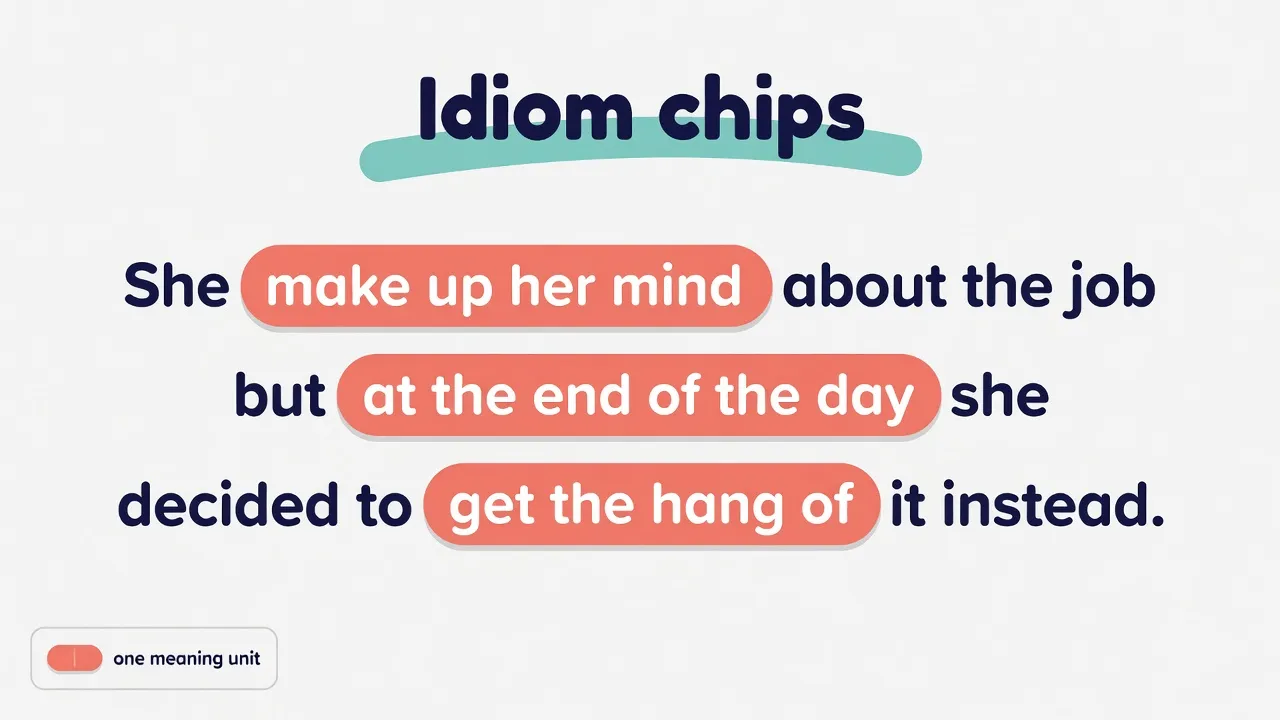
Technique 3: Idiom spotting
Idioms break word-by-word reading on purpose. If you decode "burn," "midnight," and "oil" as three separate dictionary hits, you miss the unit.
Example:
She knew that burning the midnight oil before the exam was a double-edged sword - it could help her pass, but it might also take a toll on her health.
Read these as single chips:
- burning the midnight oil = studying or working late
- double-edged sword = helps and hurts
- take a toll = damage or cost over time
You do not need a giant idiom list on day one. When a phrase does not add up from its parts, mark it as one unit, look it up once, and reread the sentence with that chip already glued together.
Idiom spotting is language-specific. Chunking and main-clause first transfer well to Spanish complex sentences too. The phrase inventory does not.
A 30-day practice plan
You do not need two hours a day. You need a clear weekly focus.
| Weeks | Focus | Daily |
|---|---|---|
| 1-2 | Chunking only | 15 min mark groups; note pages per 15 min with understanding |
| 3 | Add main-clause first | 5 min center-line or core-clause drill + 15 min reading |
| 4 | All three | 20 min; jot idioms you met; compare week 1 comfort, not vanity speed |
Track comfort and re-reads, not only words per minute. If you "finish" faster but understand less, you only trained skimming.
Good practice material: graded text near your level, then slightly harder pages. Sample paths on the site include an English A2 article, and the wider free article library. For structure around words and order, see related guides like English word order and sentence structure when you want grammar without a textbook slog.
Mistakes that kill real speed
A few habits look like "trying hard" and actually create more re-reading:
- Racing the eyes with zero structure - more regression, not more comprehension.
- Translating every word into your first language mid-sentence - you break the English spine before it forms.
- Re-reading every hard sentence three times before finishing the paragraph once - finish the paragraph, then re-read with a question ("Who did what?").
- Treating L1 diagonal-reading tricks as a fix for unknown grammar - if the structure is new, slow down and map it.
- Declaring war on all subvocalization - a light inner voice is normal; full lip-sync of every word is the real drag.
Why classic L1 speed courses miss L2 syntax
Many popular speed-reading lists teach pacers, span expansion, and "stop saying words in your head." Those tools assume you already parse the grammar for free.
As an L2 reader, grammar is not free yet. Relative clauses, long subject delays, and idioms are the load. Finger pacing on top of word-by-word decoding just helps you fail faster.
Use the classic tools as seasoning. Use chunking, main-clause first, and idiom units as the meal.
Tools: pencil is enough; software is optional
You can train all three skills with a pencil and a printed page. Mark brackets. Underline the main verb. Circle idioms.
An app helps when you want less friction: graded articles, phrase practice, click translation, and your own files when you already own the text. On MovaReader, free use includes adapted articles, 20 word translations per day, and listening where available. Reader is €1/month; Pro is €5/month (trainers fully unlocked on Pro). We do not host licensed commercial novels by default - bring texts you have rights to use, or stay with the graded library.
Software removes friction. It does not remove the daily minutes.
If you want to feel the practice style, try a short typing / demo training or phrase demo, then check pricing only if you already know you want higher volume.
FAQ
Is speed reading safe when I am learning a language?
Yes if "speed" means fewer stuck moments and clearer structure - not skipping meaning. For learning, comprehension comes first. Use a faster pace on easy graded text. Slow down on dense original prose on purpose.
Should I stop subvocalizing completely?
No. Total silence in the head is not required. Mouth-sync of every word keeps you near speech rate, so soften that over time. A light inner voice is fine.
What if I still re-read every sentence?
Use the main-clause pass: find subject + verb, then read modifiers once. Finish the paragraph before looping. Re-read with a question ("Who did what?") instead of panic scrolling.
Does chunking work only for English?
No. Chunking and main-clause first help Spanish complex sentences too (and other languages with heavy subordination). Idiom spotting is language-specific: build the phrase inventory for the language you read.
How is this different from skimming?
Skimming drops detail for a rough gist. These techniques still read the sentence - just in smarter units so you keep the argument.
Do I need an app, or is a pencil enough?
Pencil and paper work. An app can show chunks, idioms, and click translations so practice costs less willpower. Freemium is enough to start; pay only if you want more daily volume.
Next step
Pick one page today. For fifteen minutes, only practice chunking - no speed goals. Tomorrow, name the main clause of each long sentence before you re-read. Later in the month, start treating idioms as chips.
If you want material that is hard enough to train structure but not so hard that every line breaks, start with graded English and Spanish articles and grow from there. The skill is not "eyes of steel." It is a calmer way to hold a long sentence in your head until the meaning clicks.
Learning English?
The English version of MovaReader teaches Spanish and Ukrainian. To read English with a translation for every word, open the reader in Ukrainian or Spanish:
Книги англійськоюЦя стаття українськоюLibros en inglésEste artículo en español