Grammar in Context
English word order: SVO sentence structure guide
You know the words, but the sentence still collapses. Learn English SVO as a spine, fix five common mistakes, and train structure on real graded texts.
You open a long English sentence. Half the words look familiar. You still cannot see who does what. You reread it twice, hunt for the main verb, then give up.
That is not a vocabulary failure first. It is often a word-order failure. In many first languages, endings, particles, or freer order carry the roles. In English, position does much of that work.
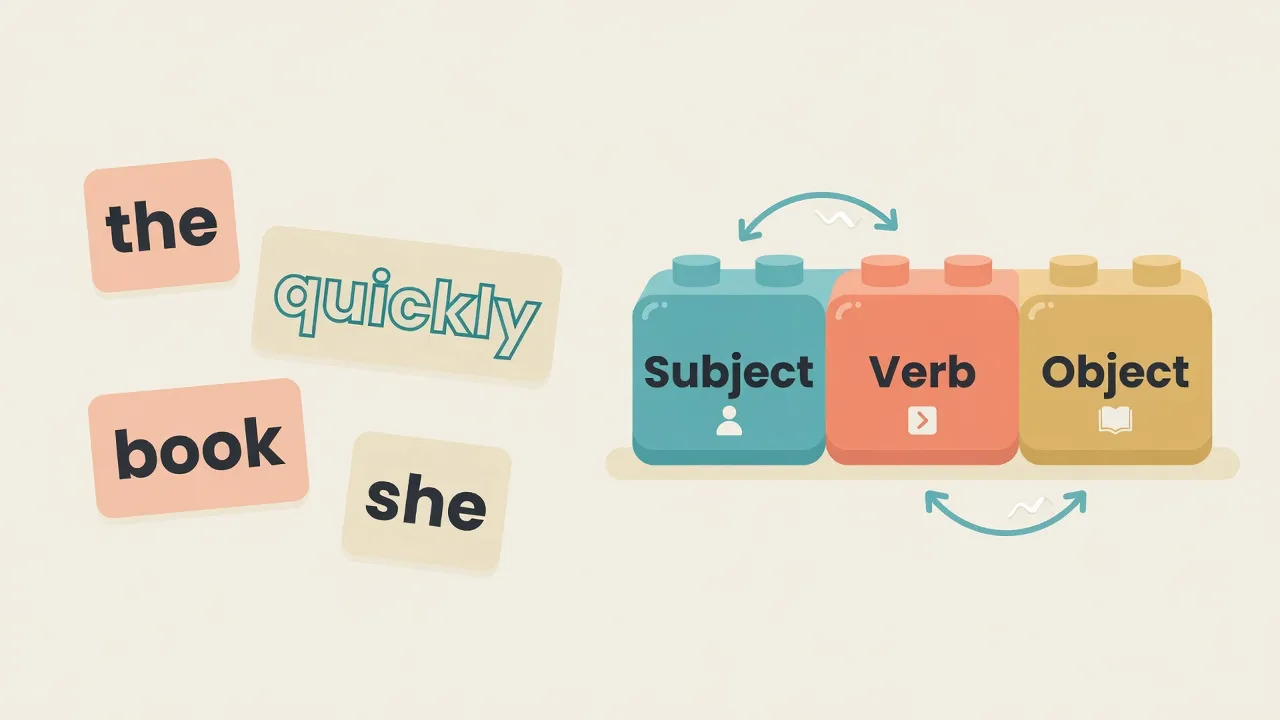
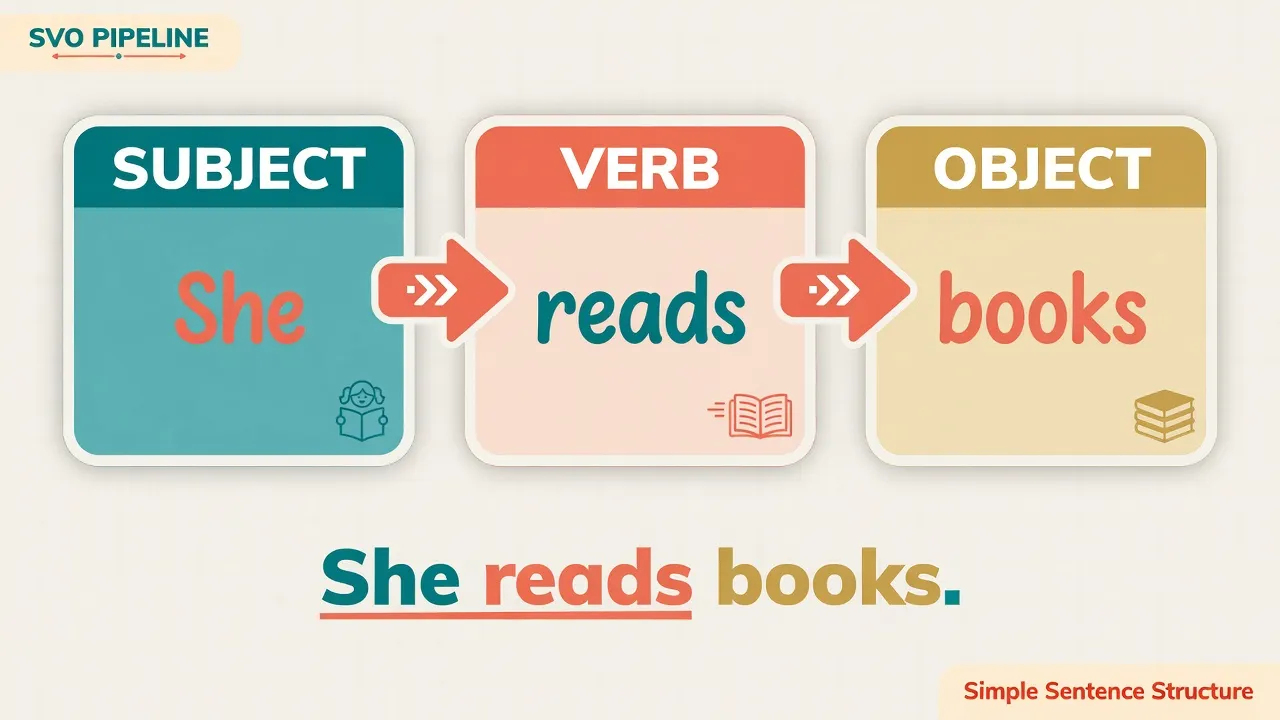
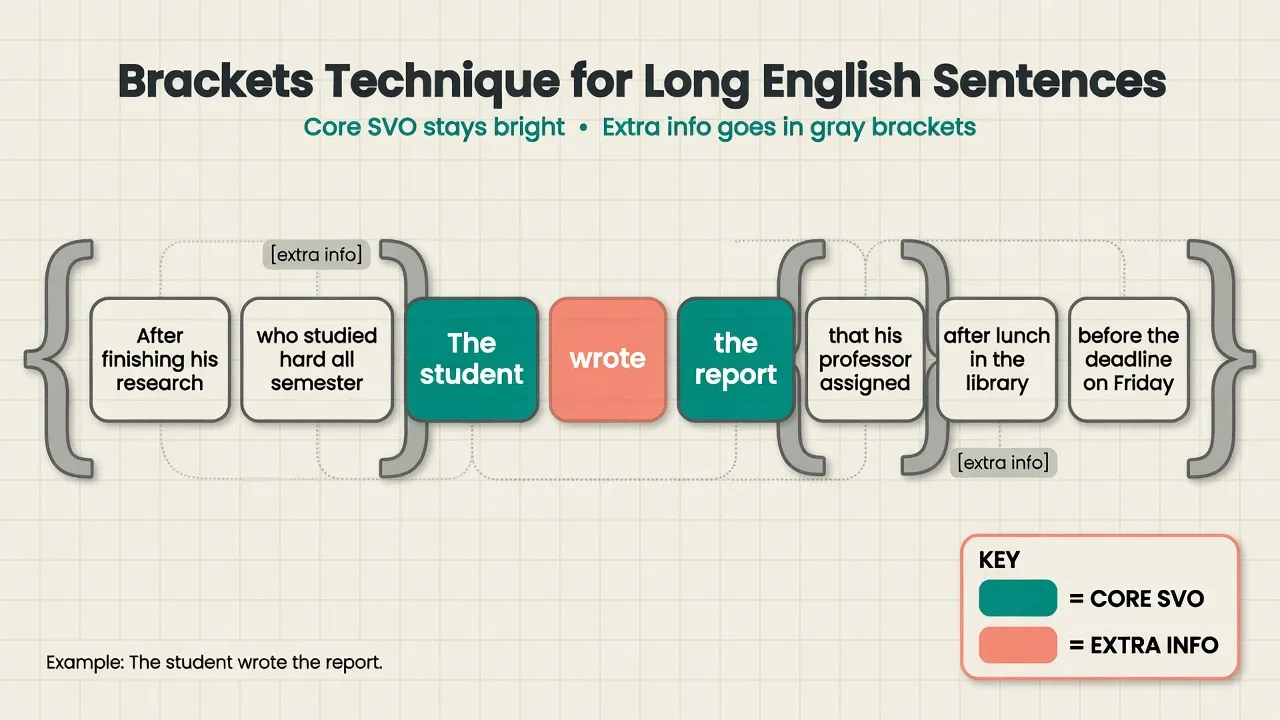
English statements usually run Subject → Verb → Object (SVO). She reads books. Swap the pieces and the story can flip: The cat caught the mouse is not The mouse caught the cat. If your L1 allows freer rearrangements, train yourself to find the English spine first (who, action, object), then add place and time. Long sentences get readable when you put relative clauses and prepositional phrases in mental brackets until SVO remains.
Below: the default map, adverbs, questions, a brackets technique, five transfer mistakes, a light note on there is and clefts, a four-week reading plan, and how to practice with MovaReader.
Why flexible L1 brains struggle with English order
If your first language is Ukrainian, Russian, Spanish, Italian, German, Japanese, or another system with freer order, rich endings, or different default patterns, your ear may "fix" roles without needing a fixed slot for every word.
English is more analytical. Where a word sits often decides its job. That is why Books she reads is not a neutral statement, even if every word is correct in isolation.
You do not need to abandon your L1 instincts forever. You need a default English route you can trust under pressure: reading, writing, speaking.
The core formula: SVO
She (S) reads (V) books (O).
That pattern covers most affirmative statements. Master it before you chase every stylistic exception.
SVO in action: from simple to useful
Simple statements
Tom (S) likes (V) coffee (O).
In a flexible L1 you might front the object for emphasis or start with time and place. Neutral English usually keeps one clear route: who → does what → what/whom.
Where time, place, and manner go
Time often sits at the start or the end:
Yesterday, Tom drank coffee. / Tom drank coffee yesterday.
Place usually comes after the object:
Tom drinks coffee in the park.
Manner often sits before the main verb (with care) or after the object:
Tom slowly drinks his coffee. / Tom drinks his coffee slowly.
A practical default map for statements:
Who → Does what → What/Whom → Where → When
Example: Tom slowly drank coffee in the park yesterday.
Fronting every adverb at once (Yesterday in the park slowly Tom coffee drank) is the classic transfer pile-up. Keep the spine, then hang the extra pieces on the usual hooks.
Questions and careful style inversion
Yes/No questions
She can swim. → Can she swim?
You need an auxiliary and a subject-verb flip. Written English does not rely on rising intonation alone the way some languages do in speech.
Wh- questions
Where does she swim?
Pattern: question word → auxiliary → subject → main verb.
Who as subject (the trap)
Who wrote this book?
No inversion here: who is already the subject.
Who(m) did she call?
Here who/whom is the object, so you get auxiliary + inversion.
Style inversion (later, not first)
Never had he felt so alone.
Everyday version: He had never felt so alone. Starting with never / rarely / seldom can trigger inversion for emphasis. In many flexible L1s, starting with an adverb feels normal. In English, this is a style marker, not the daily default. Learn Yes/No and Wh- first.
Long sentences: the brackets technique
Classic parallelism looks scary until you see the repeating spine:
It was the best of times, it was the worst of times, it was the age of wisdom, it was the age of foolishness...
- Charles Dickens, A Tale of Two Cities
Pattern: It (S) was (V) [phrase] repeated. The length is decoration; the frame is simple.
Four steps
- Find the main verb (or the chain of main clauses).
- Bracket relative clauses (who / which / that...).
- Bracket prepositional chunks (in the park, after dinner, with a smile).
- Read what is left. You usually get clean SVO.
Example:
*The woman (who lives next door) gave me (what I had been looking for).*
Without the brackets: The woman gave me [something]. SVO again.
You can practice this on graded articles, simple news, public-domain prose, or a legal EPUB you own. No app can fully replace the habit of finding the frame yourself.
Five common transfer mistakes (with fixes)
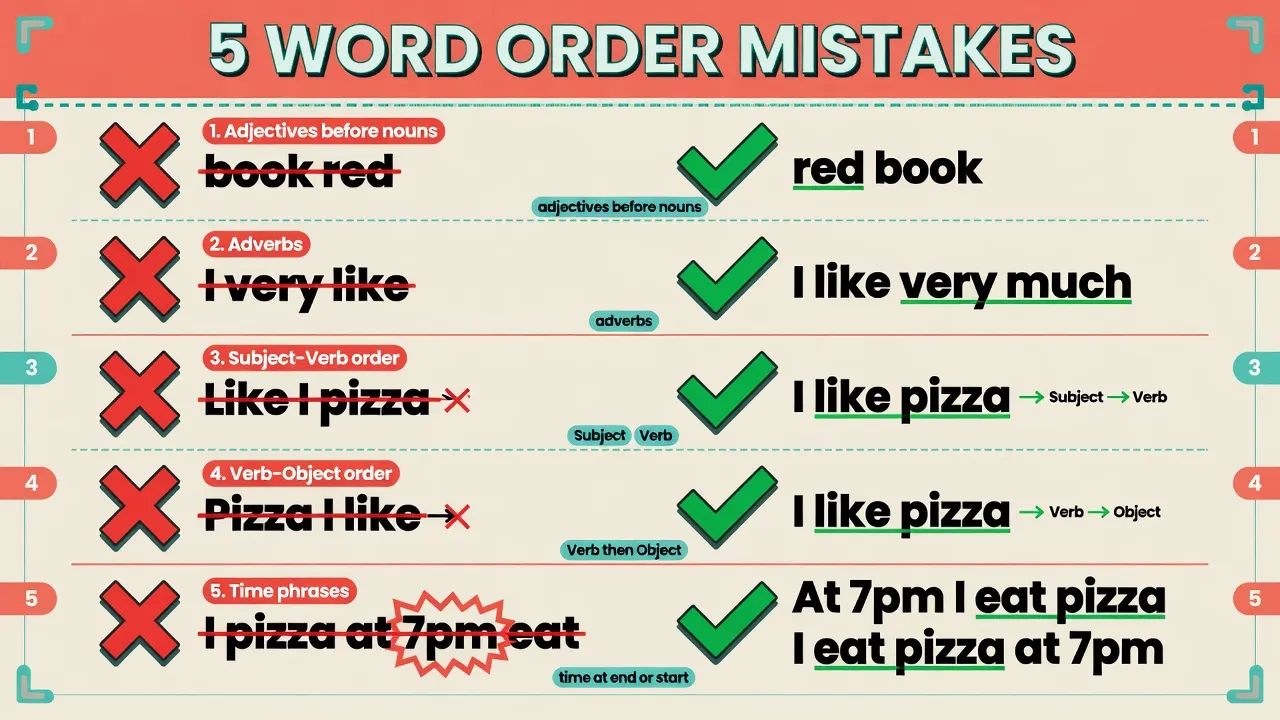
These show up across many L1s that either put adjectives after nouns, park adverbs between verb and object, or keep question inversion inside reported speech.
1. Adjective after the noun
❌ I bought a car new.
✅ I bought a new car.
2. Adverb jammed between verb and object
❌ She speaks well English.
✅ She speaks English well.
3. Emotion or intensity first, English spine second
❌ Very much I like this book.
✅ I like this book very much.
4. Indirect questions with full inversion
❌ He asked where is the station.
✅ He asked where the station was.
Inside the reported question, order is usually direct again (SVO), not is the station.
5. Double negative
❌ I don't know nothing.
✅ I don't know anything. / I know nothing.
There is, it is, and light clefts
There is / There are
There is a book on the table.
There is a formal starter, not always "in that place." Many L1s prefer to start with location ("On the table is a book"). Neutral English often keeps There is... first.
Emphasis clefts
It was John who broke the window.
Plain version: John broke the window. The cleft highlights John.
A famous literary frame:
It is a truth universally acknowledged, that a single man in possession of a good fortune, must be in want of a wife.
- Jane Austen, Pride and Prejudice
With brackets:
- It is - emphasis shell
- a truth universally acknowledged - the noun phrase
- that... - clause explaining truth
This is a study parse. Use classics (paper, legal EPUB, public domain) as material for your own technique.
Flexible L1 order vs stable English default
| Flexible L1 pattern (examples) | Stable English default |
|---|---|
| Rearrange for emphasis without changing morphology | One neutral SVO path for statements |
| Start with time/place/object freely | Time/place usually on the edges; object after verb |
| Question feel without auxiliaries (speech) | Auxiliaries + inversion in standard questions |
| Keep inversion inside "he asked where..." | Indirect questions usually return to SVO |
| Adjective after noun in some structures | Attributive adjective usually before the noun |
Three freer L1 wordings can map to one calm English route, plus special styles you learn later rather than copy on day one.
A 4-week reading plan for word order
- Weeks 1-2: graded A2-B1 texts. In each paragraph, mark S-V-O in notes or lightly on paper.
- Weeks 3-4: simple modern prose or news. Track adverb slots: where yesterday, quickly, in London sit.
- Later: harder texts when ready. Do five bracket sentences a day on long lines.
- Daily 15-20 minutes beats rare two-hour storms.
Mini drill after each session: take three sentences and rebuild them as a Yes/No question, an indirect question, and a version with yesterday at the end.
Browse levelled reading in all articles. Spanish path if you need contrast practice: article 1209. Optional orientation on known words: language map.
How MovaReader helps
MovaReader is reading with support.
What you get:
- free graded library + click-translate on blockers
- freemium about 20 word translations per day; listening is often unlimited
- Reader at €1 for unlimited translations
- Pro at €5/month for full trainers
- upload your own legal EPUB/files when you have the rights
Useful route:
- More texts: all articles
- When a sentence blocks you, translate one or two key words, then mark SVO yourself
- Practice saved phrases in type training and phrase typing
- Plans and how-to: pricing, how to use
Reading builds pattern recognition over time. The app removes lookup friction; you still train the spine.
FAQ
Is SVO always true?
As the default for statements, yes. Questions, headlines, poetry, emphasis (inversion, clefts), and spoken ellipsis can shift. Learn the default first, then the special cases.
Why is I very like wrong?
Very does not modify verbs that way. Use I really like it or I like it very much.
How do I feel word order faster?
Mass correct input from reading plus 5-10 conscious parses a day. No magic button. Short daily reps beat rare theory marathons.
Should I learn inversion early?
Yes/No and Wh- early. Style inversion (Never had he...) later, once basic SVO is stable.
What if a very long sentence still freezes me?
Brackets → main SVO → add pieces back. Translate one or two blockers, then reread the English frame.
Should I machine-translate the whole sentence?
Fine for rough meaning. Weak for training structure. Prefer word or phrase blockers and keep the English spine in your head.
Close: five anchors
- SVO is the default law for statements.
- Adjective usually sits before the noun.
- Indirect questions drop question inversion.
- Dependent chunks go in mental brackets.
- Questions use their own auxiliary + inversion pattern.
Old path: endless "put the words in order" drills with no story. Better path: read real texts at your level and hunt S-V-O every day.
Start with one short graded text today. Mark subject and verb in five sentences. That is already real English word-order practice - not theory about theory.
Learning English?
The English version of MovaReader teaches Spanish and Ukrainian. To read English with a translation for every word, open the reader in Ukrainian or Spanish:
Книги англійськоюЦя стаття українськоюLibros en inglésEste artículo en español