Grammar in Context
All 12 English Tenses: Logic + Story Examples
Twelve tense names feel random until you see the grid: 4 aspects x 3 time frames. One map, twelve magic-school teaching examples, then notice the same patterns while you read.
You open a tense chart. Twelve names. Twelve formulas. You can recite Present Perfect Continuous in a quiz, then freeze on a real page: had been waiting, will have finished, was falling when… Which box is that? Why does this sentence feel different from the one above it?
That freeze is common. Tables alone feel like a shopping list. Reading needs a system.
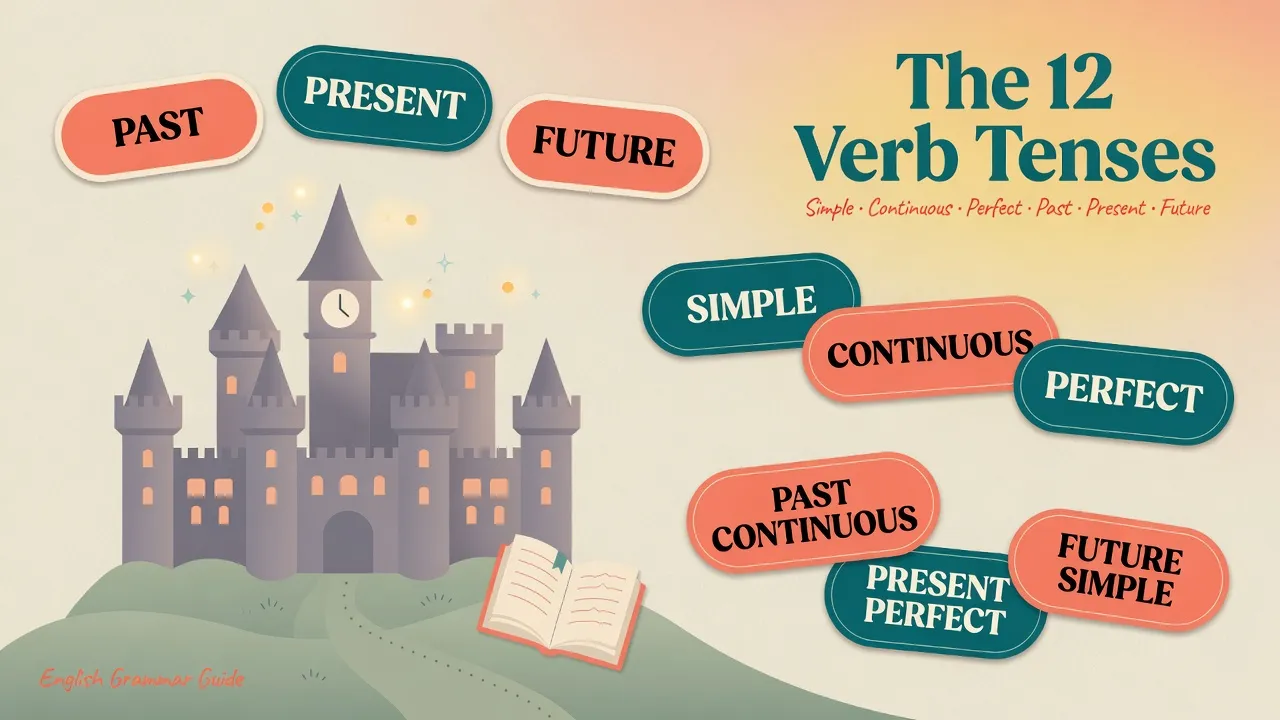
English verb tenses look like a long list until you see one grid: 4 aspects × 3 time frames = 12.
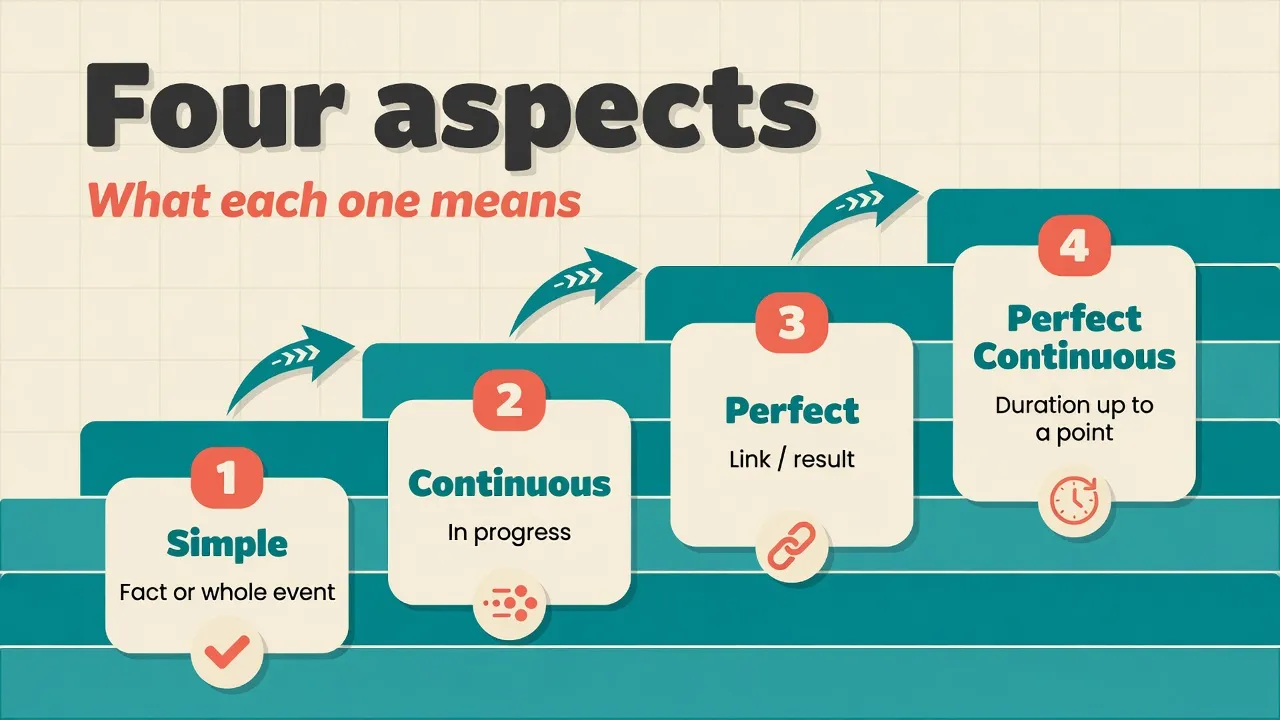
Aspects are Simple (fact or whole event), Continuous (in progress), Perfect (link to another time or result), and Perfect Continuous (duration up to a point). Time frames are Present, Past, and Future - the same four aspects in each.
This guide walks the full grid with original teaching examples set in a familiar magic boarding-school story world, then shows how to spot the same patterns when you read.
One map. Twelve clear examples. A way to notice forms in real text.
About the examples: they are original teaching sentences set in the Harry Potter story world, not quotations from J.K. Rowling's books.
Why tense tables alone fail
Most charts give you twelve isolated recipes: have + been + V-ing, will + have + V3, and so on. Useful for drills. Weak for meaning.
What they often skip:
- Aspect - not only "when," but how the speaker frames the action (whole fact, snapshot in progress, result, duration).
- Story context - fiction leans hard on past narrative clusters; daily chat leans on a few high-frequency forms.
- Near-miss pairs - went vs had gone, has left vs left yesterday - the traps that show up in reading.
You still need a map. The point is to treat the map as one grid, not twelve unrelated laws.
The 4×3 system (four aspects, three times)
Think of a city map. Streets run one way (time). Districts run the other (aspect). Every tense is a crossing, not a random street name you memorize alone.
The four aspects in plain words
| Aspect | One-line meaning |
|---|---|
| Simple | Fact, habit, or whole event as a unit |
| Continuous | Action in progress at a moment |
| Perfect | Link to another time; result or "before then" |
| Perfect Continuous | Duration up to a point (how long so far) |
The three time frames
Present - now, habits, life so far.
Past - finished story time, backgrounds, earlier past.
Future - plans, predictions, deadlines ahead.
Same four aspects in each frame. That is the whole teaching grid.
Full grid at a glance
Here is the 12-cell map stronger guides teach - time across, aspect down:
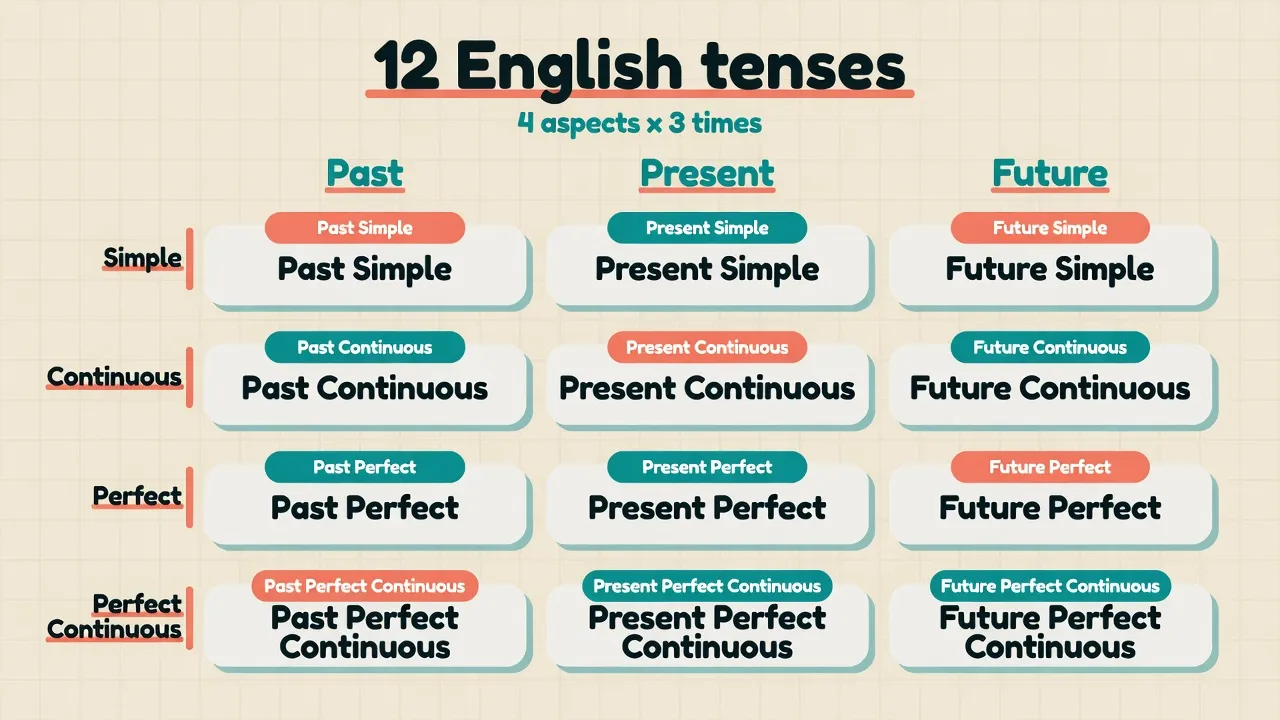
And the four aspects as a short ladder of meaning:
| Past | Present | Future | |
|---|---|---|---|
| Simple | Past Simple | Present Simple | Future Simple |
| Continuous | Past Continuous | Present Continuous | Future Continuous |
| Perfect | Past Perfect | Present Perfect | Future Perfect |
| Perfect Continuous | Past Perfect Continuous | Present Perfect Continuous | Future Perfect Continuous |
When you meet a form, ask two questions: Which time? Which aspect? The textbook name is a label for that crossing.
Present: four tenses
Present forms handle habits and facts, what is happening now, results so far, and ongoing duration up to now. Learners often mix Present Perfect with Present Perfect Continuous - result vs "how long."
Present Simple (habit / fact)
Form: Subject + verb(s)
When: stable facts, habits, general truths.
Harry lives with his aunt and uncle on a quiet street.
Present Continuous (in progress)
Form: Subject + am/is/are + verb-ing
When: happening now or around now; temporary situation.
Right now, Hermione is searching the library shelves for one more book.
Present Perfect (result / experience so far)
Form: Subject + have/has + past participle (V3)
When: past action with a present result, or experience up to now - without locking the story into a finished past date.
Ron has never ridden a broom this fast before.
Present Perfect Continuous (duration up to now)
Form: Subject + have/has + been + verb-ing
When: action started earlier and still continues (or just stopped); stress on how long.
The students have been waiting on the platform for twenty minutes.
Mini tip: Present Perfect often answers "what is true now / what experience so far?" Present Perfect Continuous answers "how long has this been going on?"
Past: four tenses
Narrative fiction lives here. Past Simple carries the spine of events. Past Continuous paints the background. Past Perfect jumps to an earlier past. Past Perfect Continuous adds duration before a past point.
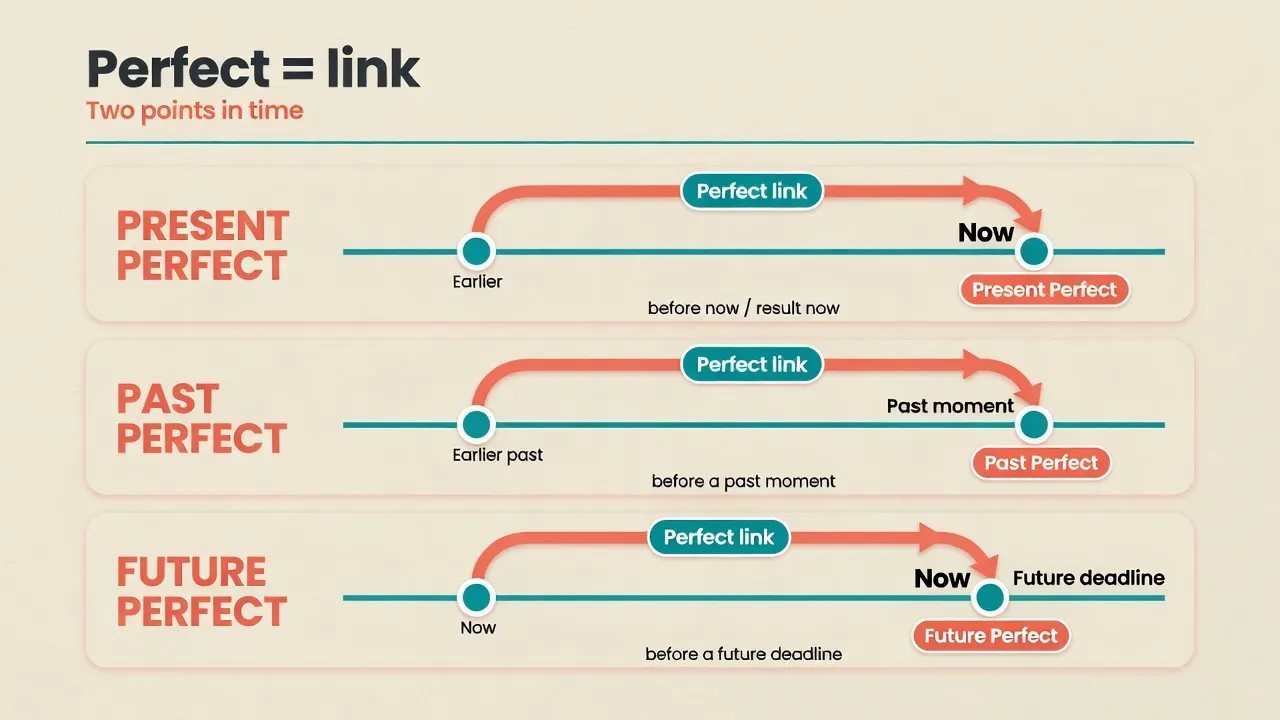
Perfect is a link between two times - not "more past for decoration." This timeline helps:
Past Simple (finished event)
Form: Subject + past form (V2)
When: completed actions in a finished past time; the backbone of most stories.
Harry opened the letter and read every word twice.
Past Continuous (background in progress)
Form: Subject + was/were + verb-ing
When: a scene in progress when something else happened; atmosphere around an event.
Snow was falling thickly when the train left the station.
Here Past Continuous (was falling) is the weather-camera shot. Past Simple (left) is the story beat.
Past Perfect (past before past)
Form: Subject + had + V3
When: something was already true before another past moment.
By the time he reached the hall, the feast had already started.
Past Perfect Continuous (duration before a past point)
Form: Subject + had been + verb-ing
When: how long something had been going on before another past event.
They had been walking through the forest for hours before they found the path.
Mini tip for reading stories: Past Continuous = background. Past Simple = event. Past Perfect = earlier past. Once you feel that cluster, long narrative pages get easier.
Future: four tenses
Future forms show up less often in prose than past narrative, but they still belong on the map: predictions, plans, actions in progress at a future moment, and "done by then" deadlines.
Note: spoken English often uses present forms for future plans (I'm leaving tomorrow, The train leaves at six). Still learn the will grid so textbooks, exams, and careful writing do not surprise you.
Future Simple (prediction / decision)
Form: Subject + will + base verb
(be going to is a close cousin for plans - one teaching line here, no long detour.)
When: prediction, promise, spontaneous decision, or simple future fact in teaching.
You will need a wand before your first class.
Future Continuous (in progress at a future moment)
Form: Subject + will be + verb-ing
When: an action ongoing at a specific future time.
This time tomorrow, they will be sitting on the school train.
Future Perfect (done before a future deadline)
Form: Subject + will have + V3
When: completed before a future point.
By June, Harry will have finished his first year of studies.
Future Perfect Continuous (duration up to a future point)
Form: Subject + will have been + verb-ing
When: how long something will have been happening by a future moment.
By next summer, she will have been studying charms for two years.
You now have all twelve crossings. The next skill is recognition - not more formulas.
How to recognize tenses in real text
Do not hunt for twelve names first. Ask two questions:
- Which time frame? past / present / future
- Which aspect? simple / continuous / perfect / perfect continuous
Form shape clues:
- -ing after a form of be (is / was / will be) → continuous family
- have / has / had + past participle → perfect family
- have / has / had been + -ing → perfect continuous
- plain verb / past form / will + base verb → simple family (check time markers)
Near-miss pairs that matter while reading:
| Pair | Quick test |
|---|---|
| Past Simple vs Past Perfect | One past story line vs "already true before that past moment" |
| Present Perfect vs Past Simple | Link to now / experience so far vs finished past time (yesterday, in 1991) |
| Continuous vs Simple | In-progress snapshot vs whole event, habit, or fact |
Markers help, but they lie if you trust them alone: already, yet, for, since, when, while, by the time, tomorrow, this time next week. Confirm with form shape + meaning.
Don't memorize twelve labels only. Do notice aspect + time in sentences you actually meet.
How to practice tenses by reading
Tables are the map. Reading is the walk through the city.
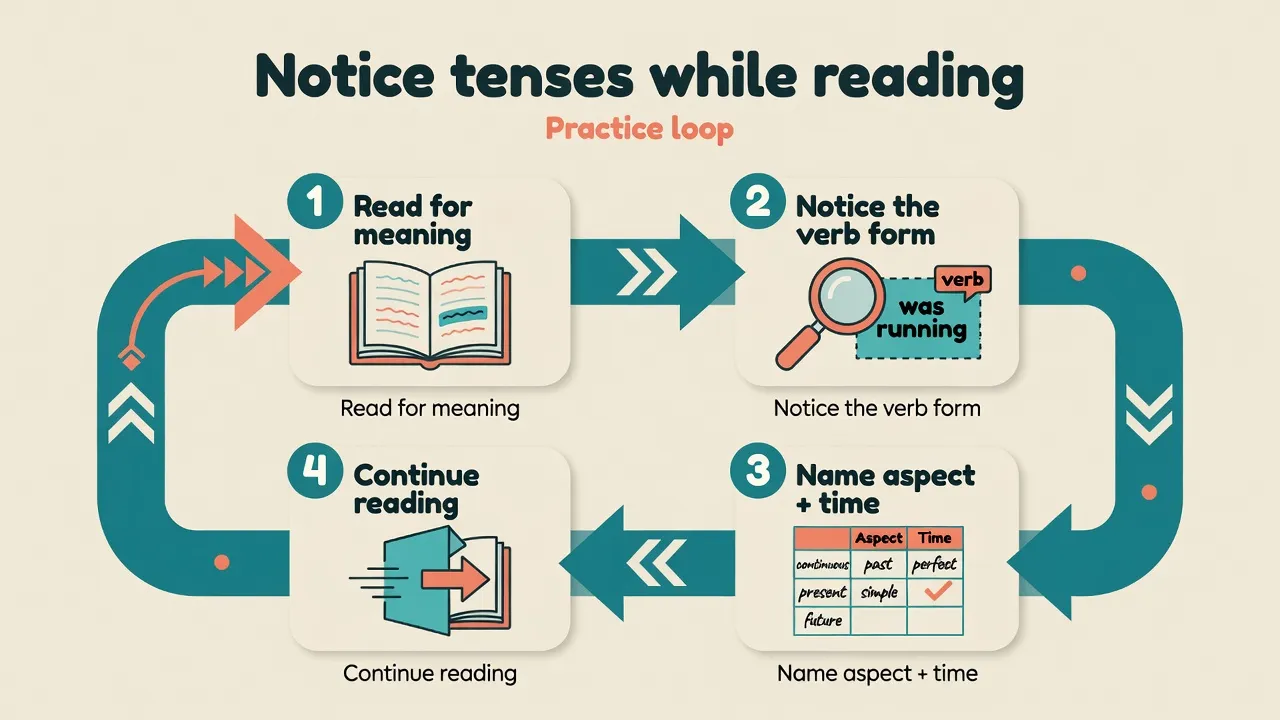
A simple loop:
- Read a short graded text - or a page of a book you own legally.
- Underline three to five verbs.
- For each one, name aspect + time (not only the textbook title).
- Compare one near-miss pair in the same chapter (went vs had gone, has left vs left yesterday).
- Optional: save useful phrases for later practice.
Here is that loop as a picture:
CEFR note: early magic-school style prose often feels approachable around B1+ - clear narrative, strong plot pull, lots of past-tense storytelling. That does not mean a commercial novel is free inside a reading app. For commercial titles, you need your own legal copy (for example EPUB you have the right to use). For supported practice pages, start with graded articles.
A practical path inside MovaReader:
- Open free graded texts in the article library (for example a public A2 sample).
- Listen while you read if that helps.
- Tap unknown words within the free plan's daily limit.
- Ask for each verb: which time? which aspect?
- Check rough level orientation on the language map if you want a CEFR-style compass.
Optional phrase trainers can help you reuse chunks you saved. They are not required to understand the 4×3 grid.
What MovaReader actually helps with
After the map, practice is simple: read with support, notice forms yourself, keep going.
What you get:
- A free graded article library you can open and read
- Listen while you read
- Click-translate words on the free plan: about 20 word translations per day
- Reader ~€1/month for more translation headroom
- Pro ~€5/month for phrase trainers and related practice tools
- Import your own legal EPUB / files you already have rights to
Details and plans: pricing. Soft practice demos if you want them later: phrase typing, type training, or trainers. None of those replace noticing aspect + time on a real page.
FAQ
How many tenses are there in English?
For learners, the practical teaching answer is 12 forms: three time frames (past, present, future) × four aspects (simple, continuous, perfect, perfect continuous). Some linguists say English has only two morphological tenses (past and non-past). You still need the 12-form grid to read and write clearly.
Do I need all 12 for daily speech?
No. Start with high-frequency forms: Present Simple, Present Continuous, Past Simple, Present Perfect, and a simple future (will / going to). Learn the rest as one system so longer texts and stories do not shock you.
Why use Harry Potter-world / story examples?
A familiar story world makes aspect differences memorable (background vs event, result vs finished past, duration vs single fact). These are original teaching sentences, not quotes from the books. The same patterns appear in many fantasy and boarding-school narratives - and in ordinary prose.
Can I learn tenses only from tables?
Tables help as a map. Real skill is recognizing aspect + time in sentences you read or hear. Formulas alone fade; forms you meet in context stick.
Is Harry Potter free inside MovaReader?
No. There is no licensed commercial Harry Potter series as a default free library novel. For commercial books, use your own legal EPUB. Free graded articles and freemium reading tools are available separately.
Does the app automatically label every verb's tense?
No. You can click-translate words, listen, and read graded text. You notice tense forms yourself. Optional phrase trainers help practice chunks. There is no AI "tense colorizer" that names the tense of any verb as a distinct UI.
Next step
You do not need twelve separate "rules of life." You need one grid: four aspects × three time frames, one clear example for each cell, and the habit of asking which time? which aspect? on real sentences.
Open a short graded text in the article library, underline a few verbs, and label the crossings. When a commercial novel is yours legally, bring that file and keep the same habit. The map stays; the stories change.
Learning English?
The English version of MovaReader teaches Spanish and Ukrainian. To read English with a translation for every word, open the reader in Ukrainian or Spanish:
Книги англійськоюЦя стаття українськоюLibros en inglésEste artículo en español