Grammar in Context
Passive Voice in Business English: When to Use It and How to Read It Fast
Business writing loves the passive for focus and diplomacy. Learn the formula, four strategic reasons, five markers, and when active is better - then train on real texts.
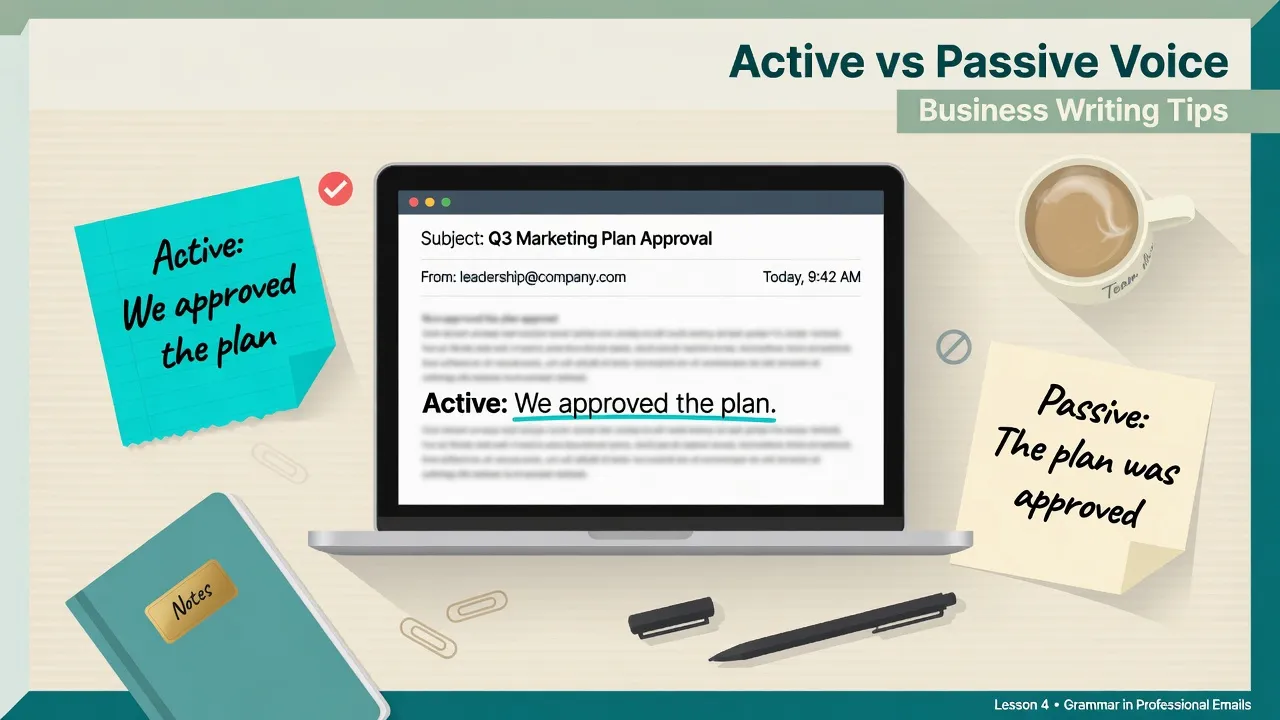
You open a report, a press release, or a careful client email. The sentence feels slightly "backwards." Instead of The team delayed the launch, you read:
The launch was delayed due to supply constraints.
Nobody is named. The result sits first. That is passive voice - and career English is full of it.
Passive voice puts the result or process first: a form of be + past participle (V3). Business writers use it for diplomacy, process focus, and when the agent is unknown or tactfully omitted. Overuse sounds vague or lifeless. Learn the formula, five markers, common email phrases, and when to switch to active. Real business reading beats isolated drills for recognition speed.
Below: the formula and tense map, four strategic reasons, worked examples you can decode yourself, five instant markers, meeting and email phrases, a clear "when not" rule, a practice paragraph, and a path for training with reading support.
Why business texts feel "backwards"
If you learned English with who did what to whom as the default, passive lines can feel like the story started in the middle.
Active: who → action → what
Passive: what → was done → (optional by whom)
Business texts do this a lot because the meeting notes, the quarterly update, and the policy change care more about the state of the world than about starring the actor. That is not a rule that "all good English is passive." It is a style choice for focus and tone.
What you need is a working ear: Is the sentence about the result, or about the person? Once you can answer that, the grammar stops feeling random.
The formula in 60 seconds
Active voice
- Who? → What did they do? → To what / whom?
- The CEO approved the budget.
Passive voice
- What? → be (in the right tense) + past participle → (by whom?)
- The budget was approved (by the CEO).
Core formula:
Subject + be (tense) + past participle (V3)
The agent (by the CEO) is optional. When it disappears, that is often intentional - not a typing error.
Here is the same idea across common business tenses:
| Tense | Active | Passive |
|---|---|---|
| Present Simple | They analyze data. | Data is analyzed. |
| Past Simple | The team launched the project. | The project was launched. |
| Present Perfect | We have signed the contract. | The contract has been signed. |
| Future Simple | They will deliver results. | Results will be delivered. |
| Modal | We must review the proposal. | The proposal must be reviewed. |
Continuous forms show up often in ops updates: is being processed, are being evaluated. Perfect continuous passive exists (has been being…) but real business prose rarely loves it; you will see simple and perfect passives far more.
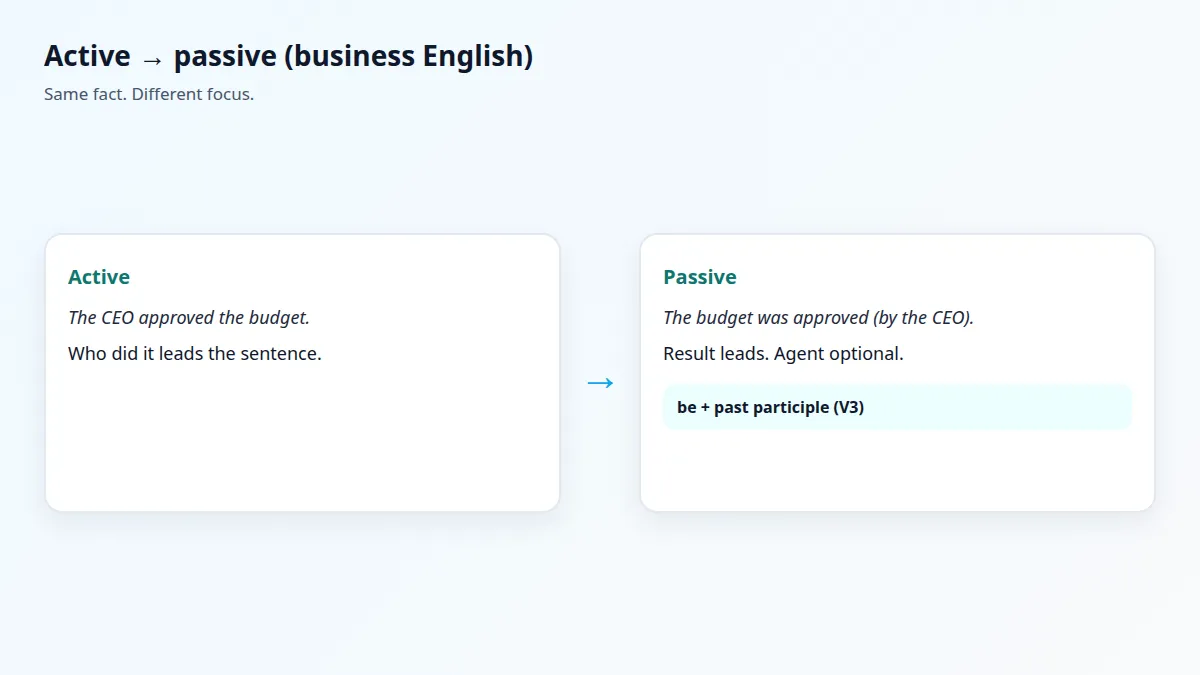
One useful habit: rewrite one passive line into active in your head. The budget was approved → Someone approved the budget. If the "someone" is obvious or unhelpful, the passive was doing its job. If the "someone" is the whole point, active is probably better.
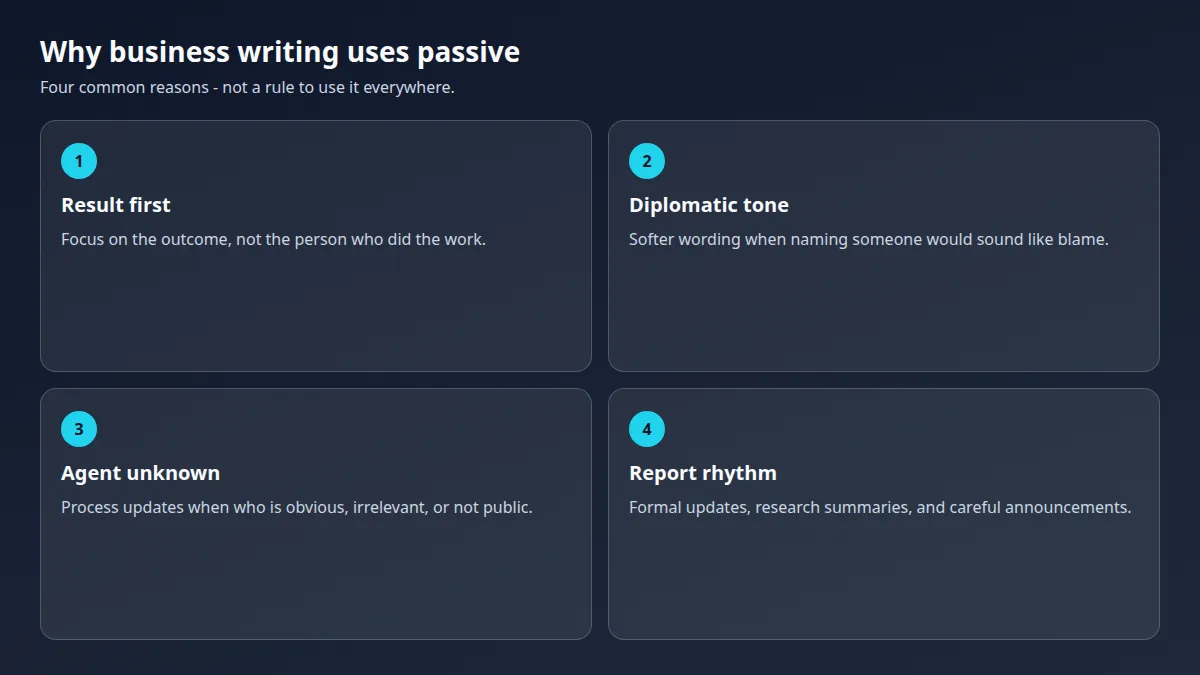
Four strategic reasons business writing uses passive
1. Focus on the result, not the person
In companies, what happened often matters more than who did it - especially when naming people would sound like blame.
John from accounting made an error in the quarterly report.
Sounds like a charge sheet.
An error was identified in the quarterly report.
Sounds like a fact that needs a fix.
Passive is a diplomacy tool. It is not a free pass to hide every mistake forever. It softens the frame so the room can solve the problem.
2. A more objective, report-like tone
Compare:
The acquisition was valued at $2.3 billion.
versus
Analysts valued the acquisition at $2.3 billion.
The second version invites a follow-up: Which analysts? The first sounds like a settled figure in the story. Use that carefully. Passive can sound authoritative; it does not create truth by itself.
3. Careful wording when responsibility is sensitive
Formal updates and legal-leaning prose often avoid a sharp subject:
The funds were allocated in accordance with regulatory requirements.
Sometimes the agent is truly collective or unknown. Sometimes the writer does not want a single name in the sentence. That can be responsible caution - or soft evasion. As a reader, notice who is missing. As a writer, ask whether clarity still holds.
4. Process and academic report rhythm
Research summaries, white papers, and methodology sections often run on process:
The study was conducted over three years. Data were collected from 500 participants.
The lab procedure is the hero, not the intern who ran the spreadsheet. That rhythm carries into business cases and market research write-ups.
Worked examples: decode like a human reader
You do not need an AI grammar professor over your shoulder. You need a short decode habit: find be + V3, name the tense, ask why passive here?
Example 1: Financial update
Revenue targets were exceeded by 15%, driven by strong performance in the Asia-Pacific region. New partnerships have been established with three Fortune 500 companies.
Decode:
- were exceeded - past simple passive → the targets went past plan (focus on result, not who beat them)
- have been established - present perfect passive → partnerships are now in place; the result still matters
- driven by - reduced passive-style participle → cause without a full which was driven by clause
Why passive? The update sells outcomes. Naming every owner would slow the paragraph.
Example 2: Press release
A new sustainability initiative has been launched to reduce carbon emissions by 40% by 2030. The program is being implemented across all global offices.
Decode:
- has been launched - present perfect passive → the launch is news with present relevance
- is being implemented - present continuous passive → rollout is ongoing, not finished
Why passive? Corporate voice often centers the initiative and the program, not the communications team writing the sentence.
Example 3: Deal coverage (news style)
The deal, which had been negotiated for over six months, was finalized last Thursday. Terms of the agreement were not disclosed.
Decode:
- had been negotiated - past perfect passive → long process before the finalization
- was finalized - past simple passive → closing event
- were not disclosed - past simple passive negative → information withheld; agent not named (often deliberate)
Why passive? The deal is the subject of the story. The negotiators and the PR filter sit in the background.
Try the same habit on any article you import or open in a reader. Tap a hard word for meaning when you need it, then keep asking: result first, or person first?
Five markers you can spot in seconds
You do not need to diagram every sentence. Watch for these signals:
- was / were + V3 - the classic: was created, were approved
- has / have / had been + V3 - perfect passives: has been completed, had been reviewed
- is / are being + V3 - process in progress: is being processed, are being evaluated
- by + agent - optional actor: designed by Apple, approved by the board
- It is / was + V3 + that… - impersonal report: It is believed that…, It was reported that…
Once these light up, you will start seeing passive everywhere - emails, slides, newsletters, policy PDFs. That recognition is the skill. Drill books teach the formula; real pages teach the speed.
Daily meeting, email, and presentation phrases
Passive is not only for long reports. It lives in everyday business English.
In meetings
- The deadline has been moved to Friday.
- This issue needs to be addressed immediately.
- The decision was made at the board level.
In email
- Your request has been received and is being processed.
- The invoice was sent on Monday.
- Please be advised that changes have been made to the policy.
In presentations
- As can be seen from the data…
- The results are summarized in the following chart.
Memorizing a list helps a little. Hearing and reading the same shapes in context helps more. Save a few of these lines when you meet them in real messages, then review them later so the pattern sticks.
When not to use passive voice
Passive is a tool, not a personality. Stack too many and the text goes flat:
- Dull: The meeting was attended by the team. The agenda was discussed. The notes were taken. Three passives in a row drain energy.
- Vague: Mistakes were made. Famous political fog - no owner, no next step.
- Stiff in chat: In casual spoken English, heavy passive can sound bureaucratic or cold.
Prefer passive when:
- the agent is unknown, obvious, or unimportant
- you need a careful, objective update
- the process or result should lead
Prefer active when:
- ownership and credit matter
- you want energy and directness
- you give instructions, sales copy, or personal feedback
A small decision board:
| Prefer passive | Prefer active |
|---|---|
| Agent unknown or unimportant | Who owns the action matters |
| Soften blame in a careful update | Give credit or clear accountability |
| Process / result focus | Direct instructions / sales energy |
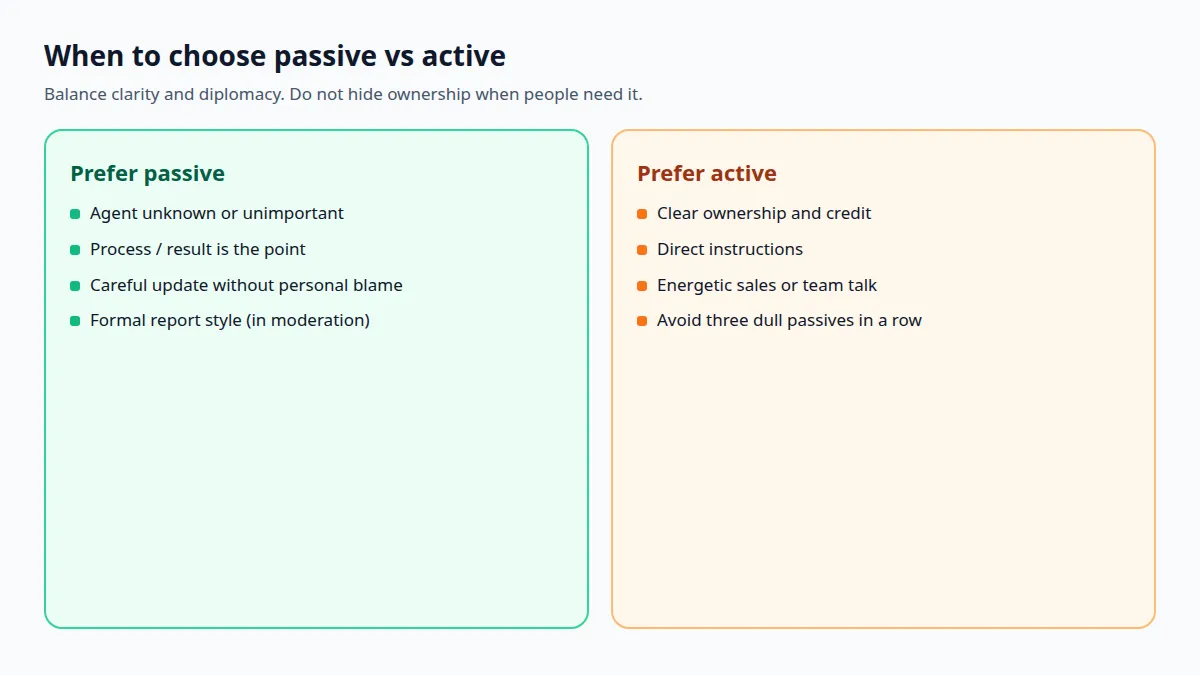
Golden mix: keep passive for result-first updates, and switch to active when a name, a commitment, or a punchy line is the point.
Practice paragraph
Decode this short business text yourself before you check the notes under it.
The company's restructuring plan was announced yesterday. Approximately 3,000 positions are expected to be eliminated over the next fiscal year. Affected employees will be offered severance packages and career transition support. The decision was driven by declining revenues and increased competition in emerging markets.
Find:
- How many passive (or passive-like) constructions are there?
- Which tenses appear?
- Why might the writer choose passive in each sentence?
Self-check
There are four main passive moves:
- was announced - past simple passive → announcement as news event
- are expected to be eliminated - present + passive infinitive → forecast without naming the decider
- will be offered - future passive → support framed as company process
- was driven - past simple passive → causes lead; people do not
Strategic function: the plan and the market story stay center stage. Naming executives would change the political temperature of the paragraph. Whether that is fair is a separate judgment - but the grammar choice is clear.
Rewrite one line in active for contrast: Leadership announced the restructuring plan yesterday. Same fact, more ownership. Both can be "correct." They answer different communication goals.
How reading builds recognition
The fastest path is not fifty transform drills with no context. It is:
- Learn the short formula and the five markers (you just did).
- Read real business-style English often enough that was approved feels automatic.
- When a word blocks you, get a quick translation in context, then keep reading.
- Save a few useful passive phrases and practice them later.
That is the loop MovaReader is built for. You open graded free articles or your own files (by plan), tap unknown words for meaning, and keep the story moving. Freemium includes about 20 word translations per day plus listening. Reader is about €1 per month for higher translation volume when you actually read a lot. Pro is about €5 per month and adds trainers for items you save.
What it is not: an auto-highlighter that labels every passive, names the tense for you, and lectures on why the author chose it. You still do the noticing. The product removes friction so you can stay inside real text instead of bouncing to a dictionary tab every sentence.
Useful starting points:
- Browse the free library: all articles
- Try trainers demos: type training, phrase typing
- Product walkthrough: how to use
- Plans: pricing
If you care about business English books as a longer ladder, pair this grammar focus with real reading volume - articles first, then longer material when your comfort grows.
Old drill cycle vs a better cycle
| Old drill cycle | Better recognition cycle |
|---|---|
| 12-tense table, then transform 50 sentences | Short formula + 5 markers, then real pages |
| Isolated examples with no audience | Emails, updates, releases with a clear purpose |
| "Always passive = professional" | Mix passive for focus; active for ownership |
| Forget by next week | Save phrases; review; reread similar texts |
| Grammar app only | Reading tool + light support + optional trainers |
Drills are not useless. They are incomplete. Recognition speed comes from meeting the same shapes under time pressure - a meeting note, a client reply, a headline - until your eye stops stumbling.
FAQ
Is passive voice more professional?
Sometimes, in reports and careful updates. Often active is clearer and still fully professional. "Professional" is not a synonym for "agent erased."
Should I avoid passive completely?
No. Avoid only passive, or using it to hide ownership when the situation needs a name and a next step.
How do I learn it faster than drills alone?
Learn the formula and markers, then read a lot of real business English. Rewrite a few passives into active so you feel the focus shift. Save phrases you keep meeting.
Does MovaReader auto-label every passive construction?
No. It helps you read with tap translation and practice saved items. You still notice the pattern: recognition is a skill, not a highlight color.
Active or passive in customer emails?
Default active for clarity and warmth (We shipped your order). Use passive for process status when the system is the subject (Your request has been received and is being processed).
Why do textbooks push passive so hard?
Because the form is regular and easy to test. Business reality is messier: tone, politics, and clarity fight for the same sentence. Learn the form, then judge the goal.
Next steps
Passive voice is not the enemy of clear English. Stacked, evasive passive is. Result-first lines help diplomacy and process writing; person-first lines protect credit and accountability.
Your next useful move is small: open one real business-style text, mark five be + V3 lines, and rewrite two of them active. Notice what changes - focus, blame, energy. Then keep reading until the markers feel automatic.
Start with a free article in the library or check pricing if you need more daily translations for real volume. The grammar is short. The skill is practice on pages that look like work.
Learning English?
The English version of MovaReader teaches Spanish and Ukrainian. To read English with a translation for every word, open the reader in Ukrainian or Spanish:
Книги англійськоюЦя стаття українськоюLibros en inglésEste artículo en español