Grammar in Context
Gerund vs infinitive: the camera rule
He stopped smoking and he stopped to smoke are two different stories. Learn gerund vs infinitive with magnet tables, meaning-change pairs, and a camera heuristic - then notice the patterns while you read.
You are deep in an English novel. The line is short: He stopped smoking. Easy. He quit the habit. Two pages later: He stopped to smoke. Same verb. Tiny change. Completely different world - he paused in order to light a cigarette.
That is gerund vs infinitive in the wild. After many verbs you choose -ing or to + verb, and the wrong form can flip the story. Textbooks hand you endless columns. There is a clearer map.
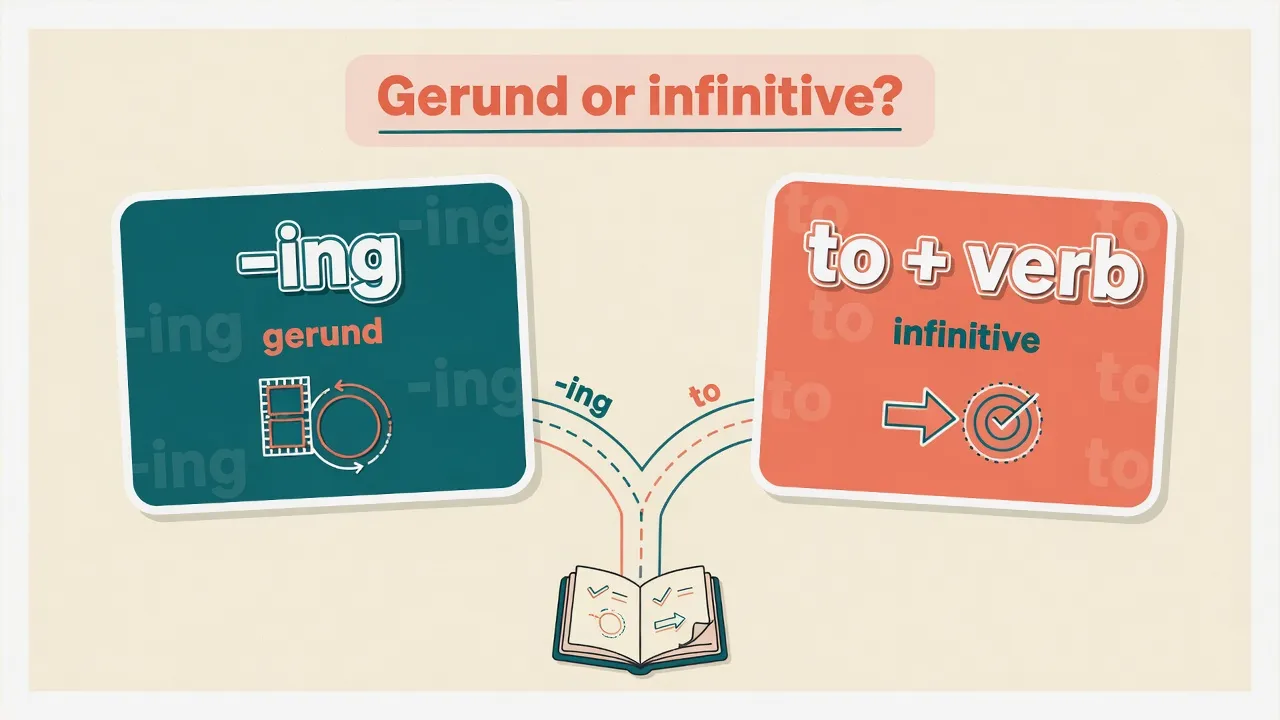
The short answer: After many verbs you choose -ing (gerund) or to + verb (infinitive). Rough map: process and experience magnets take gerund; plan and intention magnets take infinitive; a small set (stop, remember, forget, try, regret) changes meaning with the form. A useful check is the camera rule: if the action is already "on film" as process or memory, lean -ing; if it is still a plan or purpose, lean to - a heuristic, not a law. Prepositions almost always take -ing; like / love / start often allow both; real reading beats memorizing endless columns.
Below: plain definitions, three magnet types with tables, meaning-change pairs, the camera check, prepositions, flexible verbs, a hesitation checklist, and a way to practice by noticing patterns in real text.
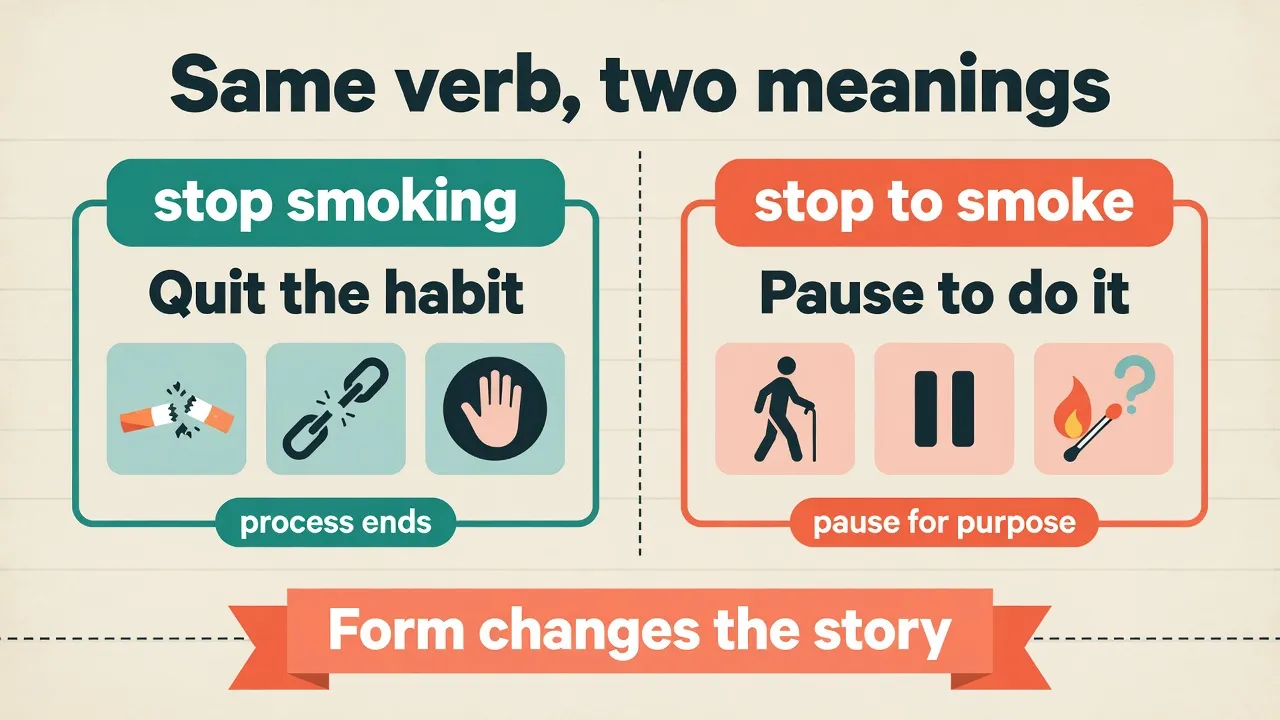
Why stop smoking and stop to smoke are two universes
Same stem. Different film.
- stop smoking = quit the habit / end the process of smoking
- stop to smoke = pause what you were doing so that you can smoke
The form is not decoration. It rewrites the scene. Once you feel that, gerund vs infinitive stops being a lottery and becomes pattern recognition.
Here is the stop pair as a split board - two meanings, one verb:
What is a gerund and what is an infinitive?
Gerund: verb + -ing used like a noun. Swimming is good for you. Here swimming is the thing, not a command.
Infinitive (to-infinitive): to + base verb. I want to swim. Plan, purpose, potential action.
Some verbs force one form. Some allow both with roughly the same meaning. Some allow both with a different meaning. That last group is where fiction feels sharpest.
Out of scope for this guide: bare infinitive after make / let / modals. We focus on gerund vs to-infinitive after verbs - the choice people search for.
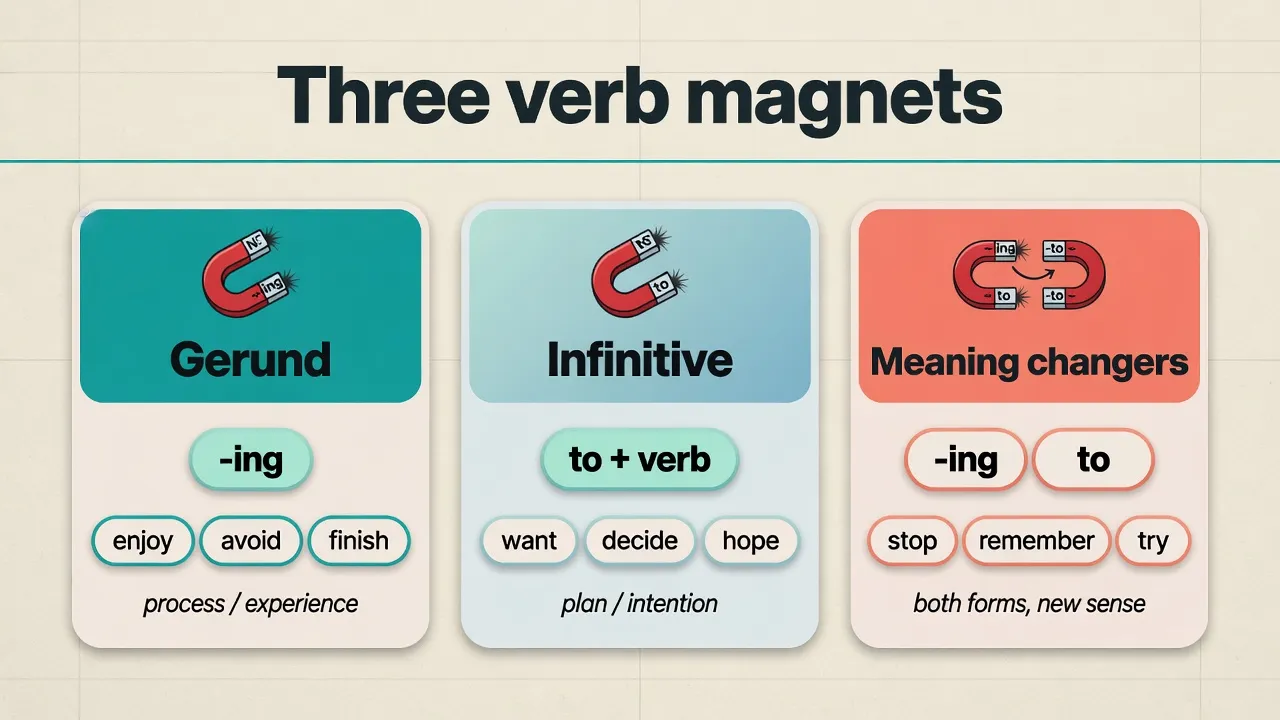
Three verb magnets: a map instead of infinite lists
Do not start with a hundred random rows. Start with three buckets. Tables support the story; they are not the whole lesson.
Here is the three-magnet board at a glance:
Gerund magnets (-ing)
These verbs pull a process, emotion, or experience that already feels real - the camera is rolling (heuristic, not law).
| Verb | Example |
|---|---|
| enjoy | She enjoys reading before bed. |
| avoid | He avoids making eye contact. |
| mind | Do you mind waiting? |
| suggest | I suggest starting early. |
| finish | Have you finished writing? |
| consider | They considered moving abroad. |
| keep | Keep practicing every day. |
| miss | I miss talking to you. |
| practice | Practice speaking out loud. |
| risk | We risked losing the train. |
| can't help | I can't help laughing. |
When you enjoy something, you are inside the action. When you avoid something, you are treating it as a process to dodge.
Infinitive magnets (to + verb)
These lean toward intention, decision, or a future-facing move - often "not yet recording."
| Verb | Example |
|---|---|
| want | I want to learn Spanish. |
| decide | She decided to leave. |
| promise | He promised to call. |
| hope | We hope to see you soon. |
| plan | They plan to travel next year. |
| agree | She agreed to help. |
| refuse | He refuses to eat olives. |
| offer | They offered to drive us. |
| learn | I learned to swim at six. |
| need | You need to rest. |
| expect | I expect to finish soon. |
| afford | We can't afford to wait. |
| manage | She managed to escape. |
Not every "future" verb is only-infinitive. Use the camera check when you are stuck; do not treat it as physics.
Meaning-change magnets (preview)
A short set takes both forms and changes the story: stop, remember, forget, try, regret. Next section is the full board. Learn these as pairs - do not force camera alone on them.
Meaning changers: both forms, different sense
Here the form is not style polish. It picks a different universe.
| Verb | -ing sense | to + verb sense |
|---|---|---|
| stop | quit the habit/process (stop smoking) | pause in order to do X (stop to smoke) |
| remember | memory of a past action (remember locking the door) | not forget a duty ahead (remember to lock the door) |
| forget | memory fail about the past (forget meeting her) | fail to do a duty (forget to meet her) |
| try | experiment / sample (try eating less sugar) | make an effort / attempt (try to eat less sugar) |
| regret | sorry about a past action (regret telling her) | formal "sorry to say" (regret to tell you) |
Hero trio in prose:
- stop - habit off vs pause-to-do-X (you already met this).
- remember - I remember locking the door (past film) vs I remembered to lock the door (duty completed).
- try - Try eating less sugar (sample a method) vs Try to eat less sugar (effort / struggle framing). Everyday speech can blur these; careful writing keeps the split.
Forget mirrors remember in reverse: past memory fail (I'll never forget meeting her) vs failed duty (I forgot to call). Regret + -ing looks backward at an act; regret to is the formal announcement voice.
Soft camera link: past-on-film often pairs with -ing; duty or plan ahead often pairs with to. Still learn the pairs. Do not lean on camera alone for meaning-changers.
The camera rule (helpful heuristic, not a law)
Picture a small hand-held camera.
-ing: the camera is already rolling. Process, experience, ongoing action, or a memory you can "watch" again.
to + verb: you have not hit record. Intention, plan, purpose still ahead.
Story-flavored lines (scenes you could meet on a page):
She stood at the window, watching the rain fall on the garden.
You see the watching. Process on film.
He decided to leave the city and start a new life.
Decision points forward. Record not started.
I can't go on living in this house. I've decided to sell it.
living = situation already true; to sell = plan not executed.
He remembered meeting her at the bookshop. He wanted to see her again.
meeting = past frame; to see = desire ahead.
The camera diagram - on vs off - as a mental check when you hesitate:
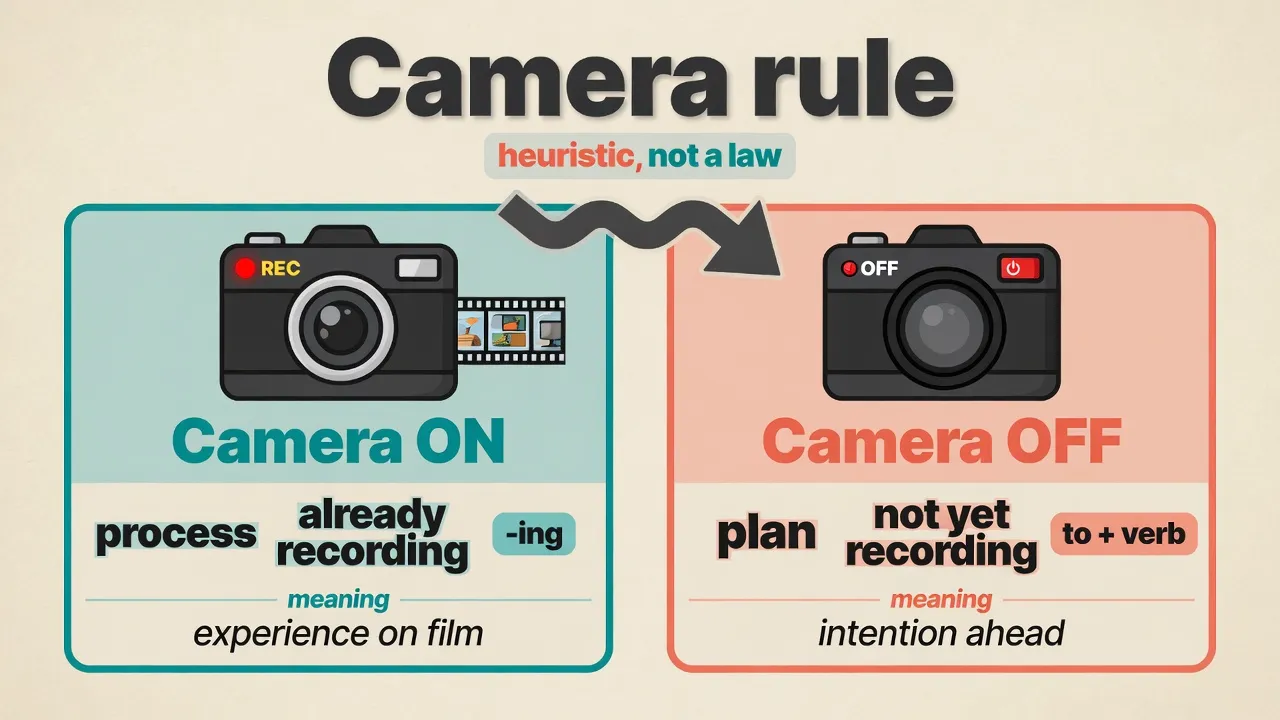
Keep in mind: the camera rule often helps when you are stuck, especially with process vs intention magnets. It is not a law. It fails as a sole rule for pure list verbs you have not learned yet, and for meaning-changers (learn those pairs). Flexible verbs allow both forms with little change. Teachers and explainers use this model because it is memorable - not because it is a secret forever-hack or a guarantee of zero mistakes.
After prepositions: almost always -ing
Prepositions take a noun-like slot. The gerund fills it. So after a preposition, you almost always want -ing.
| Pattern | Example |
|---|---|
| for + -ing | Thank you for helping me. |
| at + -ing | She is good at painting. |
| in + -ing | I'm interested in learning Japanese. |
| of + -ing | He's afraid of flying. |
| about + -ing | We talked about moving. |
| without + -ing | He left without saying goodbye. |
| before + -ing | Think before answering. |
| after + -ing | After finishing, rest. |
| look forward to + -ing | I look forward to meeting you. |
High-value trap: to is not always the infinitive marker. In look forward to meeting you, to is a preposition, so -ing follows. That is not the same to as in I want to meet you.
Flexible verbs: both forms, same meaning (mostly)
Do not overthink these. Both forms often work with the same core meaning.
| Verb | Both OK (same core meaning) | Note |
|---|---|---|
| like | I like swimming / I like to swim | both fine in many contexts |
| love | I love cooking / I love to cook | same |
| hate | I hate waiting / I hate to wait | same |
| start | She started crying / She started to cry | same |
| begin | It began raining / It began to rain | same |
| continue | He continued talking / He continued to talk | same |
| would like | - | almost always to + verb: I would like to go |
| would love / would prefer | - | same: lean to + verb |
Camera tip here: either form is often fine, so do not force a drama. The would like / would love / would prefer family is the real exception - take to.
Why list cram fades - and reading practice works better
Long columns of "verb → -ing / to" fade without context. Scenes stick better: you remember She enjoys reading before bed, not only "enjoy → -ing".
How to practice with MovaReader
- Open the free graded library and read English (or Spanish) at a level you can mostly follow.
- When a word blocks you, use click-to-translate (the free plan includes about 20 word translations per day), then re-read the whole phrase (enjoys reading, decided to leave).
- You notice verb + -ing / to patterns. Optional trainers and demos (type training, phrase typing) can help you reuse chunks. MovaReader does not label every gerund or infinitive for you or explain why the author chose the form.
- Upload your own EPUB or files you have rights to. Learning targets are English and Spanish only.
- When 20 translations/day is tight, pricing is simple advice: Reader €1/month for more volume, Pro €5/month for trainers and more practice tools. See how click-translate works and the language map for orientation.
Reading helps you see patterns. Sample paths if you want a gentle start: ES A2 article.
Related reading if you want method depth: build B1 vocabulary by reading, reported speech guide, easiest English books A2-B1, why gamified apps can trap motivation, what to do when textbooks burn you out.
Quick checklist when you hesitate
Run this micro-algorithm out loud:
- Preposition before the verb form? → -ing.
- Meaning-changer (stop, remember, forget, try, regret)? → pick form by meaning, not camera alone.
- Camera check: process / experience / memory already on film → lean -ing; plan / purpose not yet → lean to. (Heuristic.)
- Flexible verb (like, love, hate, start, begin, continue)? → either often OK; would like → to.
- Still unsure? Look up the verb in a short table or notice the same pattern in a real sentence while reading.
Five-item practice (not an exam)
- She avoided _____ (to answer / answering) his question.
- We hope _____ (to arrive / arriving) before dark.
- I don't mind _____ (to wait / waiting) a few more minutes.
- He promised _____ (to help / helping) me with the project.
- Do you remember _____ (to meet / meeting) her at the party? (memory-of-past reading)
Answers: (1) answering - gerund magnet (avoid). (2) to arrive - infinitive magnet (hope). (3) waiting - gerund magnet (mind). (4) to help - infinitive magnet (promise). (5) meeting - remember + -ing = past memory (duty reading would be remember to meet).
FAQ
When do I use a gerund vs an infinitive after a verb?
After many verbs you pick -ing or to + verb. Use three buckets: gerund magnets (process/experience: enjoy, avoid, mind…), infinitive magnets (plan/intention: want, decide, promise…), and meaning changers (stop, remember, forget, try, regret) where the form flips the story. The camera rule (process already "on film" → -ing; plan not yet recording → to) is a helpful check when you are stuck - not a law. Fixed list verbs and meaning-changers still need the pairs.
What is the difference between stop smoking and stop to smoke?
stop smoking = quit the habit / stop the process of smoking. stop to smoke = pause what you were doing in order to smoke. Same verb stop, two universes. Form choice changes meaning, not only style.
Does remember change meaning with -ing or to? What about forget?
Yes. remember + -ing = memory of a past action (I remember locking the door). remember + to = not forget a duty ahead (I remembered to lock the door). forget + -ing = fail to keep a past event in mind (I'll never forget meeting her). forget + to = fail to do something you should (I forgot to call). Learn these as pairs; do not rely on camera alone.
What about try + -ing vs try to?
try + -ing = experiment / sample a method (Try eating less sugar). try + to = make an effort / attempt something hard (Try to eat less sugar - effort framing). Close in everyday speech sometimes, but textbooks and careful writing keep the experiment vs effort split.
Is it always -ing after a preposition?
Almost always. Prepositions take a noun-like slot, so you use a gerund: for helping, good at painting, interested in learning, without saying. Trap: look forward to meeting you - here to is a preposition, so -ing follows. That is not the same to as in I want to meet you (infinitive marker).
Can I say both I like swimming and I like to swim?
Yes - often both are fine with little meaning change. Same family: love, hate, start, begin, continue. Exception: would like / would love / would prefer almost always take to + verb: I would like to go (not would like going).
Does reading really help more than memorizing verb lists?
Long columns fade without context. Scenes stick better: you remember She enjoys reading before bed, not only "enjoy → -ing". The path: free graded library, click-to-translate (~20 word translations/day on the free plan), notice patterns yourself. Reading helps you see patterns; it does not guarantee zero mistakes forever. MovaReader does not auto-label every gerund/infinitive or explain why the author chose the form. Trainers are optional practice, not a secret fluency machine. Browse the library when you want context over columns.
Next steps
Gerund vs infinitive is pattern logic, not a lottery. Magnets give you a map. Meaning-changers need pair memory. The camera rule is a friendly check when you hesitate - not a law.
Open a graded text, watch for enjoy + -ing and want + to in the wild, and re-read whole phrases after you translate a blocker. Create an account when the free plan's volume is not enough; check pricing for Reader €1 and Pro €5. That is the whole path: clear tables and patterns you notice yourself.
Learning English?
The English version of MovaReader teaches Spanish and Ukrainian. To read English with a translation for every word, open the reader in Ukrainian or Spanish:
Книги англійськоюЦя стаття українськоюLibros en inglésEste artículo en español