Grammar in Context
Reported speech: direct vs indirect English (with backshift tables)
Clear rules for reported speech - backshift table, when not to shift, questions, commands - plus how to notice them while reading.
You can retell a story in your first language without thinking. Then you try the same thing in English and freeze. He said he is tired? Was tired? Had been tired? The pronouns wobble. Today refuses to leave. A simple yes/no question turns into spaghetti with did still stuck inside.
That freeze is normal. Reported speech (also called indirect speech) is not one tiny rule. It is a small system: tense, pronouns, and time or place words, all viewed from the reporter's seat. This guide gives you the full spine - direct vs indirect, the backshift ladder, four cases where you skip the shift, reported questions and commands, common traps - then a reading path so the tables become something you notice, not only something you memorize.
Reported speech retells someone's words without quote marks. When the reporting verb is past (said, told, asked), you usually change three things: tense (backshift one step, e.g. love → loved, will → would), pronouns, and time/place markers (today → that day, here → there). Skip backshift for general facts, situations still true, present reporting verbs (says / tells), and modals that do not shift further (should, might, would, could). Learn the tables as a map, then notice said that, asked if, and told … to in news, interviews, and fiction - optional phrase drills later.
Reading near-level English helps you see reporting clauses in context. MovaReader supports graded texts and click look-ups.
Direct vs indirect speech
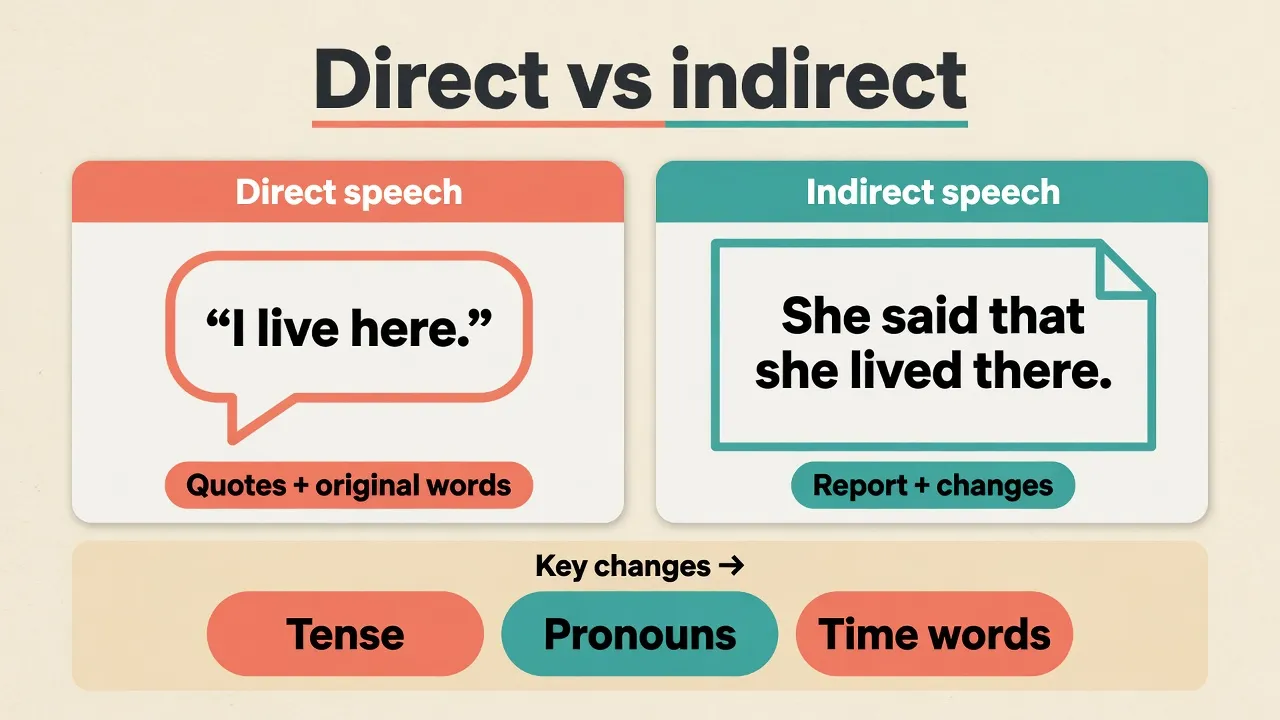
Direct speech quotes the exact words, usually with quotation marks:
"I love this city," she said.
Indirect (reported) speech retells the message in your own clause, often with that (optional in informal English):
She said (that) she loved that city.
One pair, three changes:
- Tense: love → loved
- Pronoun: I → she
- Marker: this → that
Writers keep quotes when the exact wording, voice, or drama matters - dialogue in fiction, a sharp line in an interview. They report when the content matters more than the original sound: news summaries, police notes, "what she told me later." Both forms show up in the same article. Your job as a learner is to recognize each pattern and build the reported one cleanly when you need it.
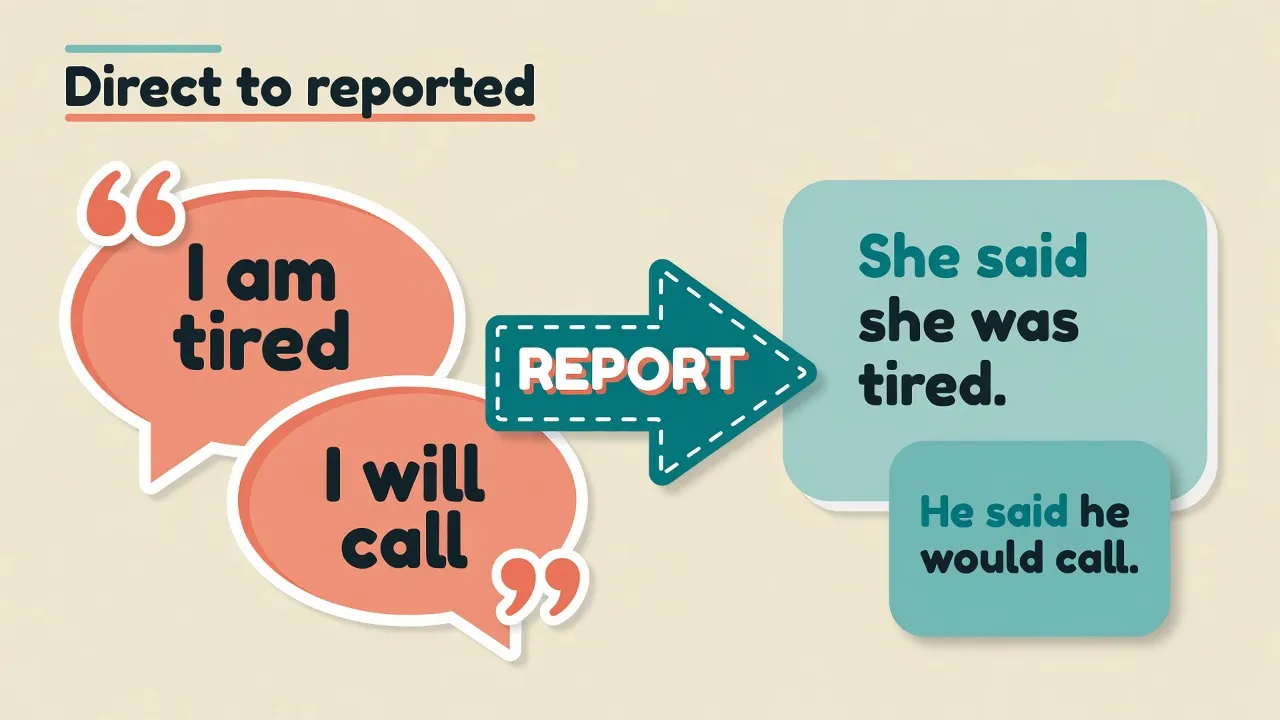
Here is the same idea side by side: quotes on the left, a that-clause on the right, with the three levers labeled.
The backshift ladder (core)
Backshift means: when the reporting verb is in the past (said, told, asked…), you usually move the verb in the reported clause one step "back" in time. Think of a ladder. You step down once. You do not invent a form beyond the bottom rung.
If the reporting verb is present (says, tells, asks), you often keep the original tense. That is the first rule of thumb. The table below is for the classic classroom case: past reporting verb.
The ladder in one glance - present steps down to past, will becomes would, can becomes could, and Past Perfect stays put.
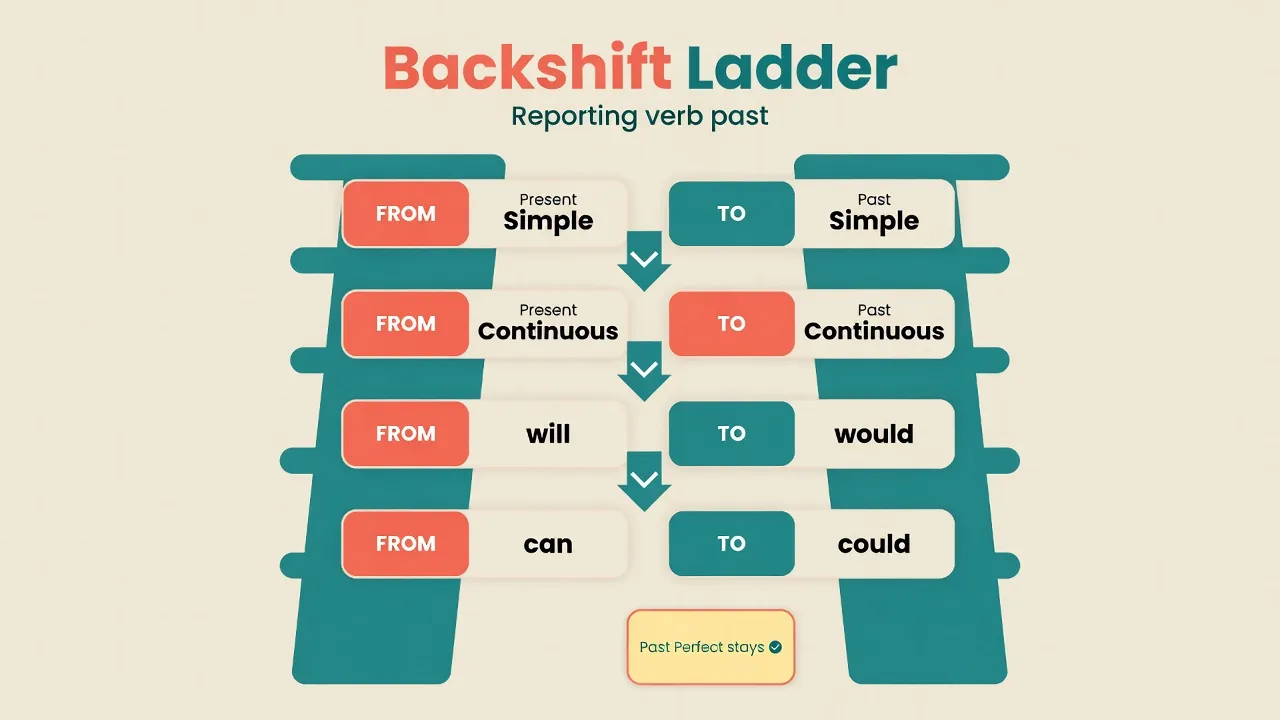
| Direct (quoted) | Reported (after past reporting verb) | Mini example |
|---|---|---|
| Present Simple | Past Simple | "I work here." → He said he worked there. |
| Present Continuous | Past Continuous | "I am reading." → She said she was reading. |
| Present Perfect | Past Perfect | "I have finished." → He said he had finished. |
| Past Simple | Past Perfect | "I saw it." → She said she had seen it. |
| Past Continuous | Past Perfect Continuous | "I was waiting." → He said he had been waiting. |
| will | would | "I will call." → He said he would call. |
| can | could | "I can help." → She said she could help. |
| may | might | "I may be late." → He said he might be late. |
| must (obligation) | had to (common) | "I must leave." → She said she had to leave. |
| Past Perfect | stays Past Perfect | "I had left." → He said he had left. |
Past Perfect stays
Past Perfect is already the furthest usual step. Do not invent a form "beyond" it.
"I had left," she said. → She said she had left.
In a detective scene you might read: The witness told the detective that he had seen a tall man near the building. The original words were closer to "I saw a tall man." Past Simple moved to Past Perfect. Same ladder, different genre.
That after said or told is optional in spoken and informal written English: She said she was tired is fine.
When backshift is optional or not needed
Students sometimes treat the ladder as a law. Real English is kinder. Here are four common cases where you keep (or may keep) the original tense.
1. General facts
Scientific truths and fixed knowledge often stay in the present:
She said water boils at 100°C.
The fact did not become past just because someone said it.
2. Situation still true now
If the situation has not changed, backshift is optional:
He said he lives / lived in Madrid.
Both appear in good English. Keeping present stresses "still true." Shifting is safer in exams when you are unsure.
3. Reporting verb in the present
With says, tells, asks (present), you usually do not backshift:
She says she will come tomorrow.
You are reporting a current claim, not a past conversation.
4. Modals that do not move further
Some modals are already "past-ish" or do not have a further classroom step:
- should, might, would, could, ought to, had better
She said she should study harder.
He told me he might be late.
Do not force a second shift that English does not use.
| # | Case | Keep or shift? | Example |
|---|---|---|---|
| 1 | General fact | Often keep present | She said water boils at 100°C. |
| 2 | Still true now | Optional | He said he lives / lived in Madrid. |
| 3 | Reporting verb present | Usually no backshift | She says she will come. |
| 4 | Unchanging modals | No further change | should, might, would, could… |
Pronouns and time/place markers
Tense is only one lever. You also re-map who and when/where from the reporter's point of view.
Pronouns (quick map)
| Direct | Typical reported |
|---|---|
| I | he / she |
| we | they |
| my / mine | his / her / hers |
| our / ours | their / theirs |
| me | him / her |
| us | them |
| myself | himself / herself |
Always ask: who is speaking about whom? "I need your help," Tom said to Anna. → Tom told Anna that he needed her help.
Time and place markers
Classroom defaults (useful when you write carefully):
| Direct | Common reported form |
|---|---|
| today | that day |
| tonight | that night |
| yesterday | the day before / the previous day |
| tomorrow | the next day / the following day |
| now | then / at that moment |
| here | there |
| this / these | that / those |
| ago | before / earlier |
| last week / month / year | the week / month / year before; the previous… |
| next week / month / year | the following week / month / year |
| this morning | that morning |
Note: news and fiction sometimes keep today or tomorrow when the time is still clear to the reader. Treat the table as a default map, not a criminal code. Prefer the map in careful writing; notice both patterns when you read.
Reported questions
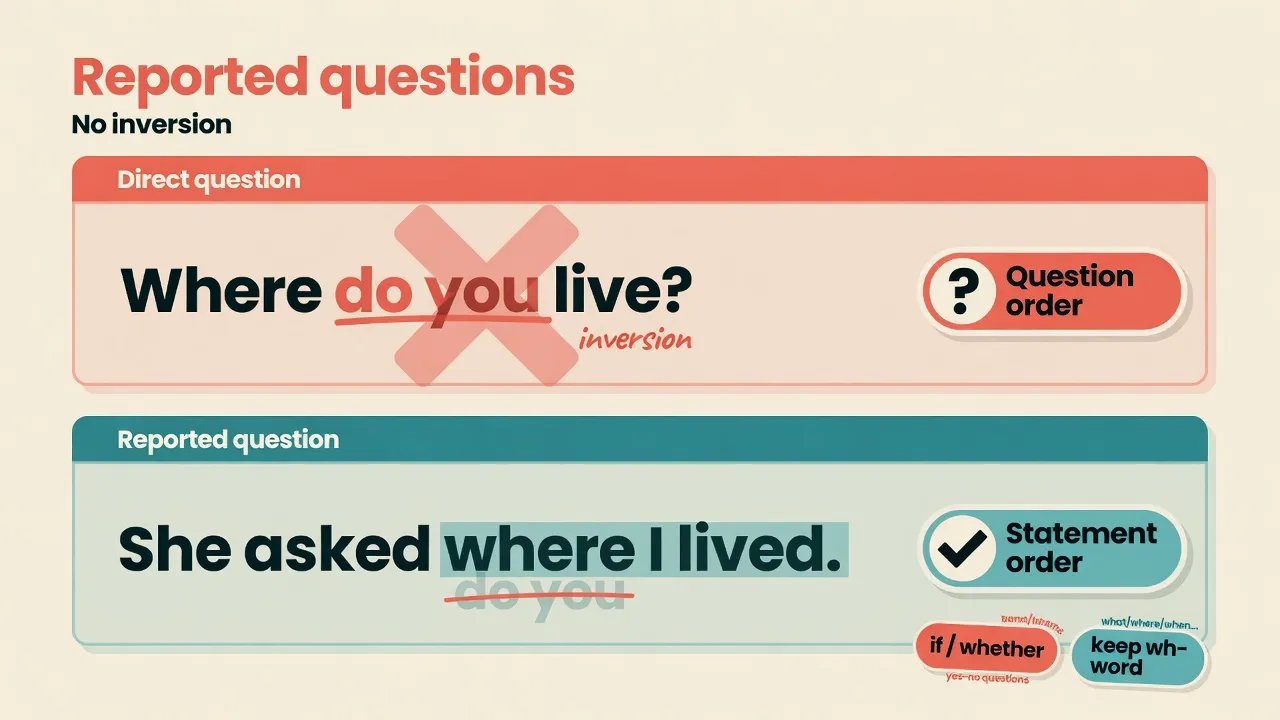
Questions are where many learners trip. The meaning stays a question, but the grammar becomes statement order. Drop inversion. Drop do / does / did inside the reported clause.
Yes/no questions
Use asked if or asked whether, then subject + verb:
"Do you speak English?" → He asked if I spoke English.
If and whether both work. Whether can feel slightly more formal and pairs well with or not: She asked whether I was ready or not.
Wh- questions
Keep the wh- word. Then use statement order. No did I flip.
"Where do you live?" → She asked where I lived.
Not: She asked where did I live.
With be:
"What are you doing?" → He asked what I was doing.
The order shift in one picture: inverted direct question on one side, calm statement order on the other.
| Type | Pattern | Direct → Reported |
|---|---|---|
| Yes/No | asked if / whether + statement order | "Do you speak English?" → He asked if I spoke English. |
| Wh- | keep wh- + statement order (no do/does/did) | "Where do you live?" → She asked where I lived. |
| Wh- + be | wh- + subject + be (shifted) | "What are you doing?" → He asked what I was doing. |
Ban pattern: keeping question inversion or do-support inside the reported clause.
Reported commands, requests, and suggestions
Commands and requests often leave the tense ladder and use a to-infinitive after an object.
Commands
told + person + to + verb:
"Stop talking!" → The teacher told us to stop talking.
Negative:
"Don't touch it." → He told me not to touch it.
Requests
asked + person + to + verb (polite force, same shape):
"Please help me." → She asked me to help her.
Suggestions
Two common patterns:
- suggested + gerund: "Let's go." → She suggested going.
- suggested that (+ should): She suggested that we (should) go.
Light extras you will meet often: ordered, advised, warned - same object + to-infinitive idea for many command-like acts. You do not need a full verb dictionary on day one; learn the shape, then collect examples while reading.
Say vs tell (and light reporting verbs)
| Verb | Person object? | Safe pattern |
|---|---|---|
| say | No person object after say | He said that he was tired. / He said, "I'm tired." |
| tell | Needs a person | He told me that he was tired. |
| Avoid | said me | Use told me or said that |
Both introduce reported speech. Tell always names who received the message. Ask, order, advise, warn join the family when the speech act is a question, command, or warning - same spirit as the sections above.
Five common mistakes
| # | Wrong habit | Fix |
|---|---|---|
| 1 | No backshift after past said | He said he was tired. (not is, unless a still-true exception) |
| 2 | Keep question inversion | She asked where I lived. (not where did I live) |
| 3 | said me | told me / said that |
| 4 | Leave tomorrow / today blindly | Default: the next day / that day (see the note above) |
| 5 | asked that for yes/no | asked if / whether |
If you fix only two habits, fix question order and say vs tell. They show up in every email summary and every classroom rewrite.
Practice by reading authentic dialogue
Tables are the map. Dialogue-heavy reading is the trail. Transforming thirty isolated textbook lines builds accuracy; it rarely builds recognition speed. Mix both, with reading first when you feel drill fatigue (learning burnout and textbook nausea is real).
Genres that teach reported speech for free:
- Interviews and journalism - "She said the company would…", "Officials asked whether…"
- Detective and thriller prose - interrogation summaries, witness retells (detective English vocabulary)
- Memoirs and first-person narrative - someone retelling what others claimed years later
A simple loop:
- Open a near-level English text in the graded library. Prefer interviews or stories with dialogue if you can choose.
- When you hit said, told, asked, ordered, pause half a second.
- Check tense, pronouns, and markers - or notice why nothing shifted (fact, still true, present says).
- Look up only the words that block meaning (how click look-up works).
- Optional later: reuse sticky chunks (told me to…, asked if…) in a trainer or the phrase typing demo - after you have seen them, not instead of reading.
If textbooks alone make you sick of grammar, near-level fiction helps. See also easiest English books for A2-B1 and building B1 vocabulary by reading. The input idea behind pattern transfer is older than any app: comprehensible input, plainly explained. Multiword patterns like told me to and asked if also sit nicely next to words vs expressions at CEFR levels.
You notice the clauses. Your attention plus a clear map is enough to start.
Using MovaReader (if you want tool support)
MovaReader is built for learning English (and Spanish) by reading: free graded articles, click-to-translate on blockers, optional own legal EPUB/files where the tier allows, and light trainers when reuse is the bottleneck.
For reported speech, the loop stays the same: map → read → notice said / told / asked → look up blockers → optional drill.
| Need | Realistic plan |
|---|---|
| See patterns in short graded texts; about 20 look-ups/day | Free plan (free graded library + ~20 word translations/day) |
| Longer sessions / more look-ups when pages get denser | Reader €1/mo |
| Deeper reuse when drilling is the bottleneck | Pro €5/mo (trainers / fuller practice path) |
Details and current limits: pricing. Orientation on levels: language map. Account trail if you want progress saved: register. Motivation without living only for streaks: the dopamine trap of gamified apps.
FAQ
When do I not change the tense in reported speech?
You can skip (or leave optional) backshift when: (1) the clause is a general fact (water boils at 100°C), (2) the situation is still true now (She said she lives in London), (3) the reporting verb is present (He says he will come), or (4) the modal does not move further (should, might, would, could). Elsewhere, with a past reporting verb, expect the usual one-step backshift.
What is the difference between say and tell?
Say does not take a person as a direct object: He said that he was late. Tell needs a person: He told me that he was late. Avoid He said me… - use told me or said that. Both can introduce reported speech; tell always names who received the message.
How do I report a yes/no question (if vs whether)?
Use asked if or asked whether, then statement word order (subject before verb), not question inversion. "Do you speak English?" → He asked if I spoke English. If and whether are both fine here; whether can feel slightly more formal and pairs well with or not.
Why is "She asked where did I live" wrong?
Reported questions drop do/does/did and drop question inversion. Keep the wh- word, then subject + verb like a statement: She asked where I lived. The same rule applies to yes/no reports: She asked if I lived there - not if did I live.
Do I always change today / tomorrow in reported speech?
Default classroom map: today → that day, tomorrow → the next day / the following day, yesterday → the day before. In real news and fiction, writers sometimes keep today or tomorrow when the time reference is still clear to the reader. Prefer the table when writing carefully; notice both patterns when reading.
How can I practice reported speech without only transforming textbook sentences?
Use the table as a map, then read interviews, journalism, detective reports, and memoirs where people retell dialogue. Pause on said that, asked if, told … to, and check tense, pronouns, and markers. Optional phrase trainers help stick patterns after you have seen them in context - not instead of reading. A practical start: the graded library.
Does Past Perfect backshift further?
No. Past Perfect is already the furthest step on the usual ladder. "I had left," she said. → She said she had left. Do not invent a form beyond Past Perfect for standard reported speech.
Next steps
Tables are the map. Dialogue in real reading is the trail. To make progress, you need a clear ladder, four exceptions, clean question order, and pages where people retell what others said.
Three concrete clicks:
- Browse all graded articles and pick something near your level.
- Open one sample - or a detective-leaning path after you skim the thriller vocab guide.
- When patterns feel familiar and you want reuse, try trainers or check pricing if look-up limits block real pages.
See reporting clauses. Look up blockers. Drill only what stuck. That is enough for a solid next month of reported speech.
Learning English?
The English version of MovaReader teaches Spanish and Ukrainian. To read English with a translation for every word, open the reader in Ukrainian or Spanish:
Книги англійськоюЦя стаття українськоюLibros en inglésEste artículo en español