Grammar in Context
How to Use A, An, The Without 50 Rules
Stuck between a dog and the dog? Feel articles through three intuitions and daily reading - not fifty tables.
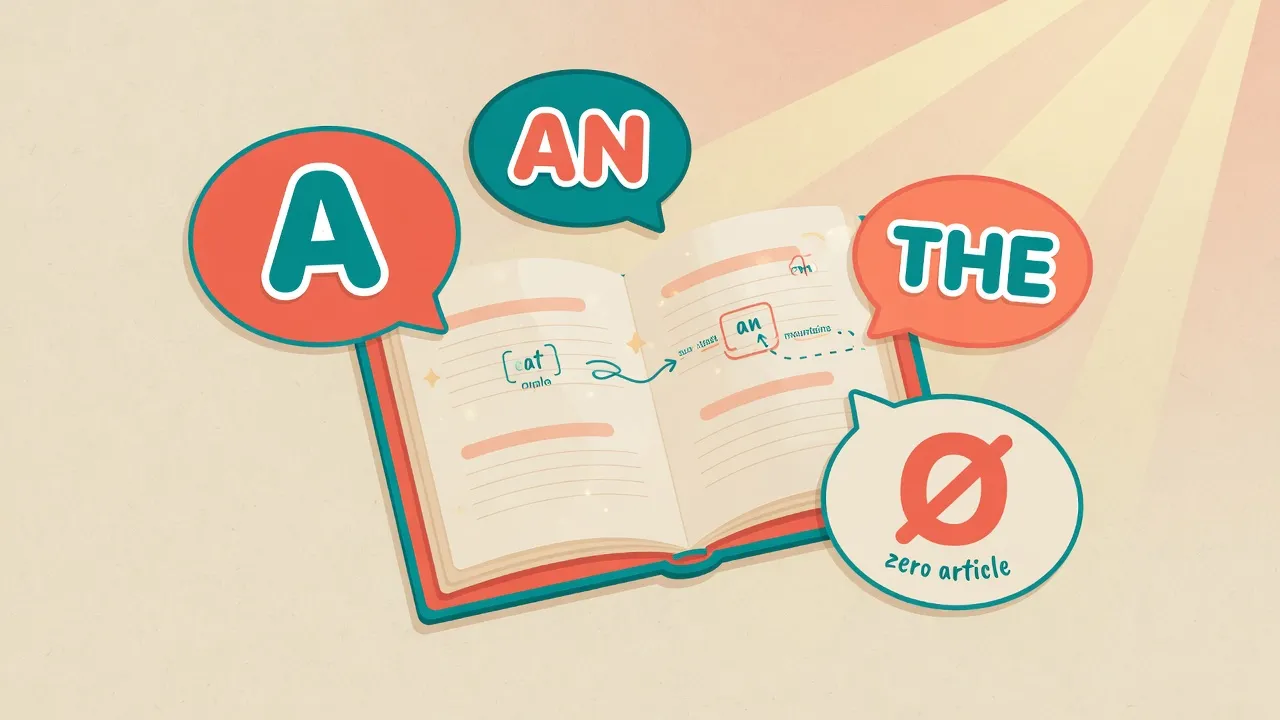
You open a chat. You type I saw… and your hand freezes. A dog or the dog? She is teacher or She is a teacher? The message sits half-written while your brain scrolls through school tables you once memorized and already forgot.
That freeze is normal if your first language skips articles. Slavic, Turkic, East Asian, and many other systems do not force a tiny choice before almost every noun phrase. English does. Under time pressure, fifty exceptions do not help. Three clear modes do - plus noticing them while you read.
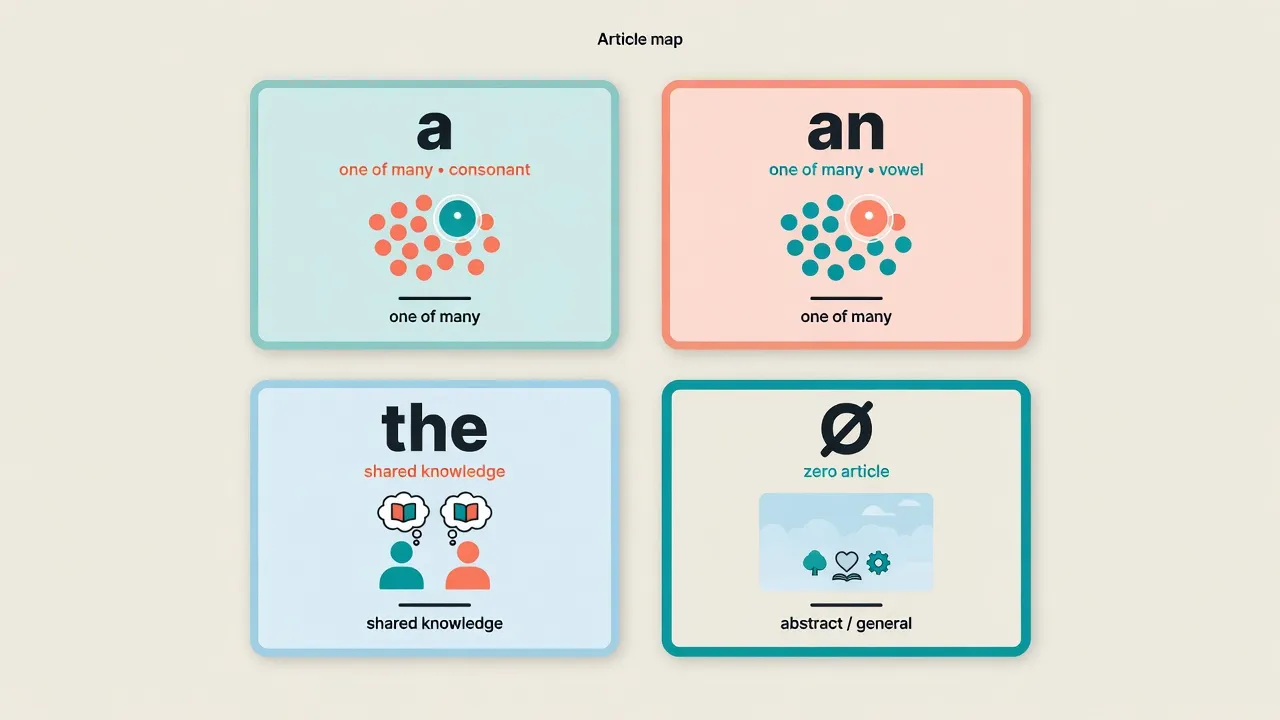
English articles are three modes, not fifty equal rules. A/an means one of many (new, not yet shared). The means shared knowledge (both of you know which one). Zero means abstract or a general class (no single item in focus). A vs an follows the next sound (a university, an hour), not only the letter. Tables help once; feeling comes from input. Mini-loop: first a room, later the room.
What follows is the map, a short drill on real text, a reading ladder, and an optional product path if you want graded pages with word help.
Why your first language fights you
If your L1 has no articles, English asks for a decision your brain never practiced: before many noun phrases, pick a/an, the, or nothing. The blank feels wrong at first. You are not slow. You are building a new habit.
If your L1 has articles but maps them differently (for example Spanish el/la/un/una), the trap often looks different: too much the, or a/an chosen by spelling instead of sound. The fix is still the same core map - one of many, shared, abstract - not a longer list of national "exceptions."
Is this a memory problem or a noticing problem?
Most adults freeze because they try to recall under pressure. Real-time writing and speech need a fast feel. That feel grows when you see the same patterns thousands of times in stories and news you mostly understand. Rules are a flashlight for sticky traps. Input is the daily light.
So if you came here for how to use a an the in real messages, start with modes and noticing - not with a geography encyclopedia.
Three intuitions that beat fifty rules
Hold these as feelings, not as a courtroom code.
A / an: one of many
You mean "some member of the class, not yet shared."
I saw a cat in the garden. (some cat; we do not both know which)
She is a teacher. (job as a class: one of many teachers)
First mention of a countable thing is often a/an. Jobs as categories usually need a/an too: He is an engineer.
The: shared knowledge
You and the listener (or reader) both know which one - second mention, unique in the scene, or unique in the world of the text.
I saw the cat again. (that same cat)
Close the door. (the door right here)
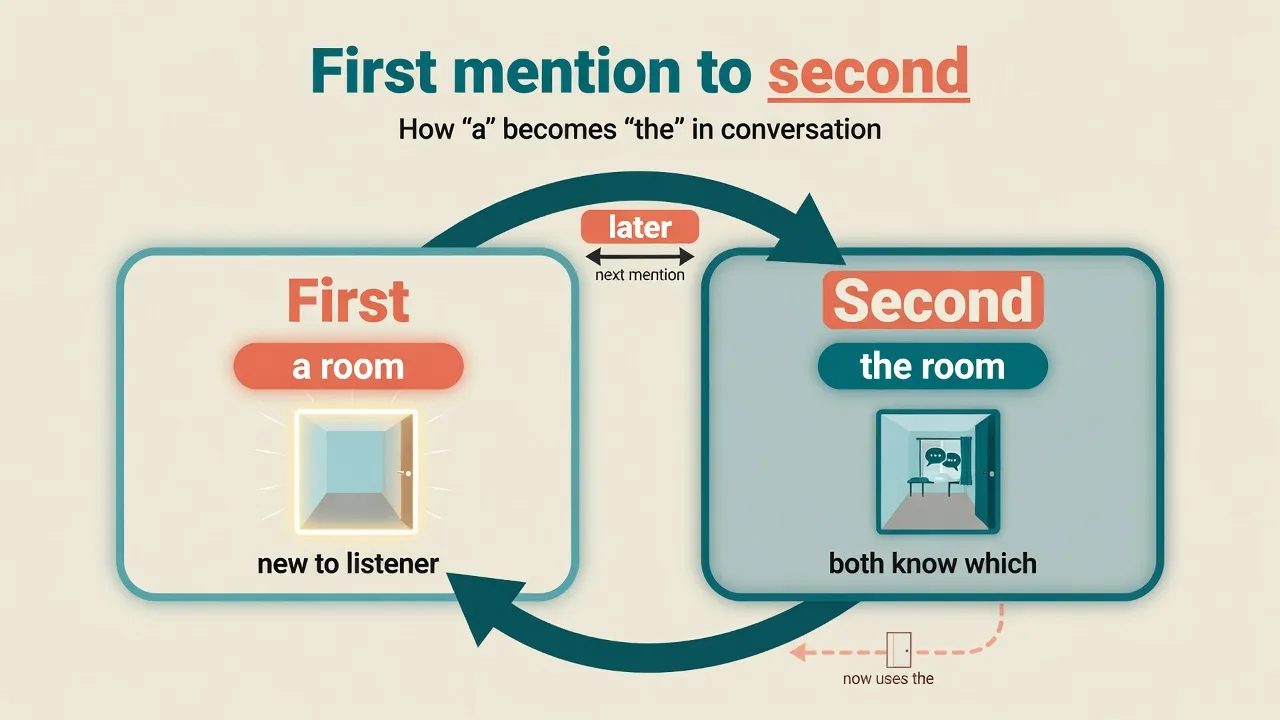
He entered a room. The room was cold. (first open; then shared)
Zero: abstract or general
No single shared item is in focus.
Love is complicated.
Dogs bark.
I had lunch. / I study history. (habit or field as a whole)
Meals, school-as-process, and many abstract nouns often sit with zero until a specific shared case appears (the lunch we booked, the school on Main Street).
| Mode | Intuition | Quick example |
|---|---|---|
| a / an | One of many; not yet shared | I saw a cat. / She is a teacher. |
| the | Shared knowledge; both know which | I saw the cat again. / Close the door. |
| zero | Abstract or general class | Love is complicated. / Dogs bark. |
A vs an is sound, not spelling: a university (yoo-), an hour (silent h), an MBA (em-).
Here is the map in one picture:
The mini-loop you will see everywhere
Stories and news live on this switch:
He walked into a room. The room was dark.
First: one of many. Second: we both know which. Train that loop until it feels automatic in fiction; real chat will get easier.
Why reading trains articles
On the page, a and the are tiny and visible. In fast speech they often shrink to a blur. That is one reason silent reading is a friendly gym for English articles: you can see the choice, then keep the story moving.
Exposure builds pattern feel. Steady noticing plus volume helps many learners more than cramming tables alone. Expect fewer freezes and more "that sounds right," not perfect exam scores from reading alone.
If you like the wider input frame, see Krashen and comprehensible input and why grammar tests can slow you down. For levels and vocabulary shape, see the language map.
| Focus | Rule-table heavy hours | Level-fit daily reading |
|---|---|---|
| What you train | Slow conscious choice with time | Pattern feel while chasing meaning |
| Examples | Few artificial sentences | Many natural noun phrases in real prose |
| Live writing/speech | Often weak without extra practice | Stronger base for intuition; still not overnight |
| Edge cases (geo, idioms) | Long lists to memorize | Meet in input; look up only sticky ones |
| Best use | Exam cram; flashlight on one trap | Main diet for a/an/the/zero feel |
| Limit | Rules alone rarely stick under pressure | Reading alone will not make you sound native overnight |
Literary scan drill: Orwell 1984 opening
Practice on a short public-domain-friendly paragraph. First enjoy the line. Then label each article with the three modes.
It was a bright cold day in April, and the clocks were striking thirteen. Winston Smith, his chin nuzzled into his breast in an effort to escape the vile wind, slipped quickly through the glass doors of Victory Mansions.
Quick labels:
- a bright cold day - one day among many; new in the discourse
- the clocks - the clocks of that world (shared / unique in context)
- an effort - one-of-many + vowel sound
- the vile wind - the wind already in the scene
- the glass doors - the doors of Victory Mansions (shared frame)
The five-step scan method
Use this on any graded page, news paragraph, or book you own legally. Do not turn every page into a grammar exam.
- Read for meaning first. Follow the story or argument.
- Notice a / an / the / zero on a second pass or a short stretch.
- Ask why this one? One of many, shared, or abstract/general?
- Optional: tap-translate unknown words so you stay in flow (the free plan allows about 20 word translations per day).
- Continue. Do not stall on every determiner. One quick scan beats a frozen chapter.
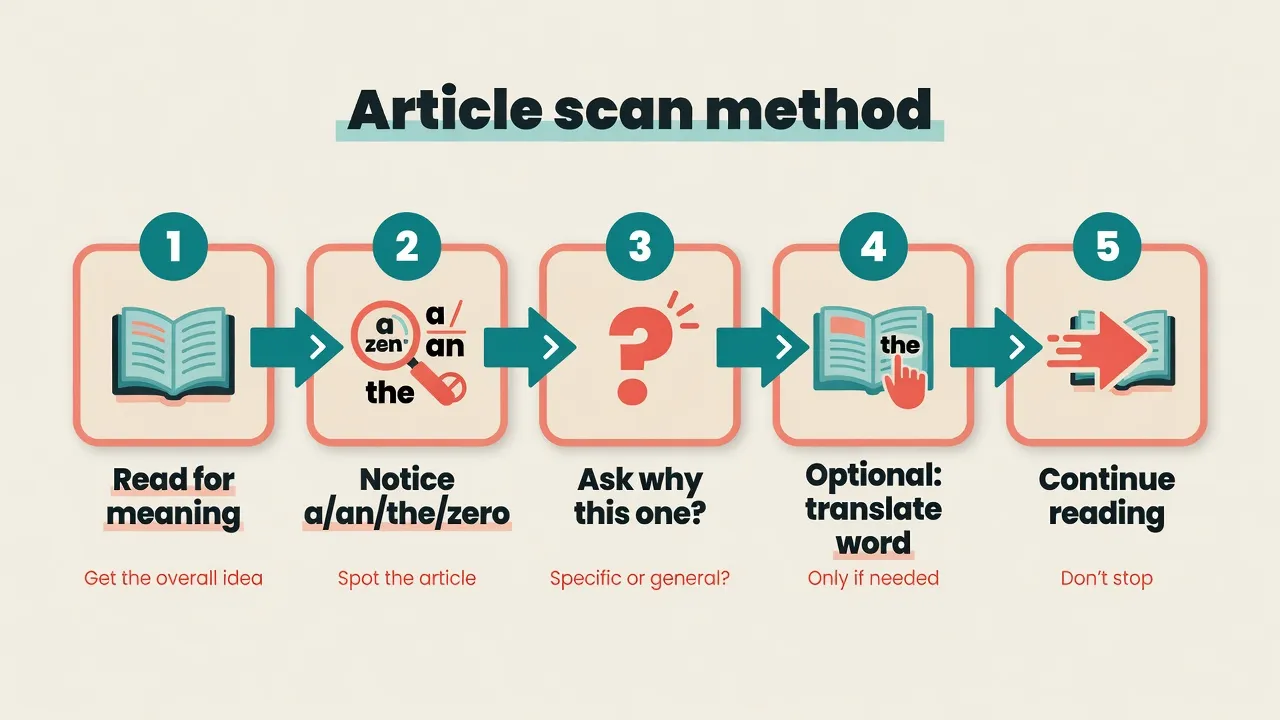
Try the same five steps tomorrow on a short graded sample from all articles (for example an A2 graded piece if it still fits your level).
Mistakes board: fix the high-frequency traps
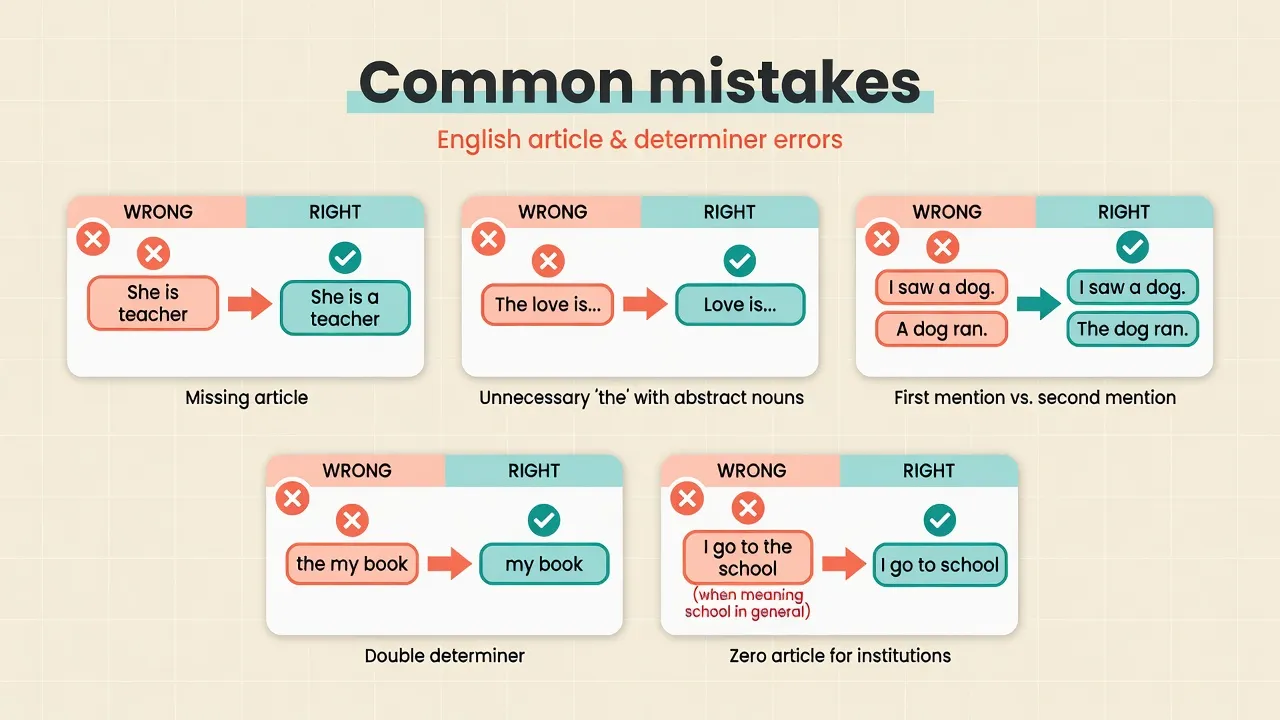
These show up in messages, essays, and job applications. Use the three intuitions, not shame.
| Wrong | Right | Why |
|---|---|---|
| She is teacher. | She is a teacher. | Job as one-of-many class needs a/an |
| The love is important. | Love is important. | Abstract concept → zero (unless a specific love is shared) |
| I bought the car yesterday. (no shared car yet) | I bought a car yesterday. The car is blue. | First = a/an; second = the |
| I had a lunch. | I had lunch. | Meal as activity often zero; the lunch only if a shared event |
| the my book | my book / the book | One determiner slot; possessives already specify |
| an university / a hour | a university / an hour | Next sound, not spelling |
If your L1 has no articles, freezing before the noun is the first hurdle - not proof you "cannot do grammar." If your L1 maps articles differently, watch the overload on abstract nouns (the life is hard when you mean life in general).
Traps lite (not a mega rule book)
Keep these as "meet in input," not "memorize the continent."
Geography (heuristic only). Many country names take zero (France, Japan). Some take the (the United States, the Netherlands). Cities usually zero (Madrid). Full lists live in good reference sites (for example Purdue OWL or British Council style pages). Learn sticky ones when you meet them in reading.
School vs the school. go to school often means the process of education. the school points to a specific building or institution you both know. Same idea with hospital, church, prison in many contexts - process vs place.
Instrument vs sport. play the guitar (instrument) vs play tennis (sport) is a fixed pattern you will see often. Notice it; do not build a 40-row table on day one.
A few idioms as input, not a wall. in the morning, at night, go home, by car, on the internet - collect them when they appear in your books, not as a homework list of fifty.
When a trap keeps tripping you, one clear rule is fine. When the whole map feels foggy, return to the three modes and more pages at your level.
Reading ladder by CEFR (what to open next)
Stay mostly understandable. Step down if every line is a wall. Own legal EPUBs and free graded text; MovaReader does not host commercial bestsellers free as full library novels.
| Band | Sample titles / series | Why it helps articles |
|---|---|---|
| A2-B1 | Graded readers (Penguin / Oxford Bookworms style); adapted classics; early middle-grade or YA entry if you own a legal copy; simple learner news | Short sentences; clear first/second mention loops; lots of a/an with concrete nouns |
| B1-B2 | Contemporary page-turners at mid level (own copy); popular nonfiction excerpts; longreads at a comfortable speed; graded articles on site | More abstract zero contexts; the with unique referents and institutions; natural meals/school patterns |
| B2-C1 | Modern literary and classic originals you have rights to (Orwell 1984, Hemingway, Fitzgerald editions); essay-style magazines; field abstracts | Dense determiner choice; zero vs the with abstract nouns; idioms and geo patterns in authentic density |
For easier A2-B1 book ideas, see easy English books you can keep reading. For where bands sit in the product, open the language map.
How to use the ladder: one scan pass per session (read → notice → ask why → optional word translate → continue). Volume at the right level beats heroic pages you abandon.
Read with light tools
Textbooks are good flashlights for exams and sticky traps. Daily reading is the main diet for a/an/the/zero feel. Neither turns you into a native speaker overnight. A quiet reader app just keeps the page usable so you stay in the story.
MovaReader is built for that loop: graded samples, on-tap word translation, listen-along, and phrase trainers on paid tiers. There is no auto "article colorizer" that paints every a/an/the for you, and no AI tutor that explains every whole sentence like a private teacher. You notice; the app keeps the page usable.
| Path | What you get for this topic |
|---|---|
| Free plan | Graded library samples; about 20 word translations/day; listening often unlimited where offered; limited trainers |
| Reader ~€1/mo | Unlimited reading translations and practical personal dictionary volume for real pages |
| Pro ~€5/mo | Full phrase / typing trainers and deeper paid tools as on the site |
Soft path: open all articles, try free listening and limited word translation, step to pricing when the daily cap breaks flow. Use phrases when review volume is the bottleneck, not as the only CTA for pure reading. Optional demos: type training, phrase typing. How the product works: how to use.
Import legal files you own. Free graded articles on the site are the low-friction start.
FAQ
When do I use a vs an?
Follow the next sound, not only the letter. Consonant sound → a (a book, a university starts with /j/). Vowel sound → an (an apple, an hour, an MBA). Spelling alone misleads.
When is the zero article correct?
When you mean an abstract concept or a general class, not one shared item: Love is hard, Dogs bark, I study history. Also common with many meals and activities as habits (have lunch, go to school as the process). Specific shared referents switch back to the (the lunch we booked, the school on Main Street).
Why a room then the room?
First mention of one among many → a/an. Once both speaker and listener know which one → the. Classic loop: He entered a room. The room was cold. Same pattern with almost any countable noun in stories and news.
Do native speakers learn article rules in school?
Mostly no for everyday use. Children build feel from massive input. Explicit rules and lists help later for editing, exams, and rare edge cases (geography lists, fixed phrases). Feeling still comes from noticing patterns in real language.
How much reading actually helps with articles?
Short answer: steady volume at a comfortable level plus light noticing beats cramming tables alone for many learners. Expect gradual comfort and fewer freezes, not overnight native accuracy. Combine reading with a short "why this article?" check when something feels odd. Start light on all articles.
My language has no articles - where do I start?
Start with the three modes (one of many / shared / abstract), practice the first → second mention loop on short graded text, and ignore mega geography tables until the core feel is less scary. Freeze is normal: English forces a choice on almost every noun phrase; your L1 does not. One scan today is enough to begin.
Next steps
- Remember the three modes: a/an = one of many; the = shared; zero = abstract or general.
- Run one scan today on a short paragraph (Orwell snippet above, or a graded page). Read → notice → ask why → optional word help → continue.
- Read one level-fit page this week from all articles or a book you own. Keep going; do not stall on every determiner.
Three intuitions plus noticing while you read will take you further than fifty rules you cannot recall mid-message. The product is a quiet reading companion when you want word help and listen-along - not a rule encyclopedia, and not a shortcut to native speech. When you need plans and limits spelled out, check pricing.
Learning English?
The English version of MovaReader teaches Spanish and Ukrainian. To read English with a translation for every word, open the reader in Ukrainian or Spanish:
Книги англійськоюЦя стаття українськоюLibros en inglésEste artículo en español