Grammar in Context
Why Grammar Tests Slow Progress (and What Reading Does Better)
Perfect on grammar tests, stuck in real speech? Tests train slow, conscious checking. Reading builds forms in context. Grammar still helps as a flashlight - not as the whole diet.
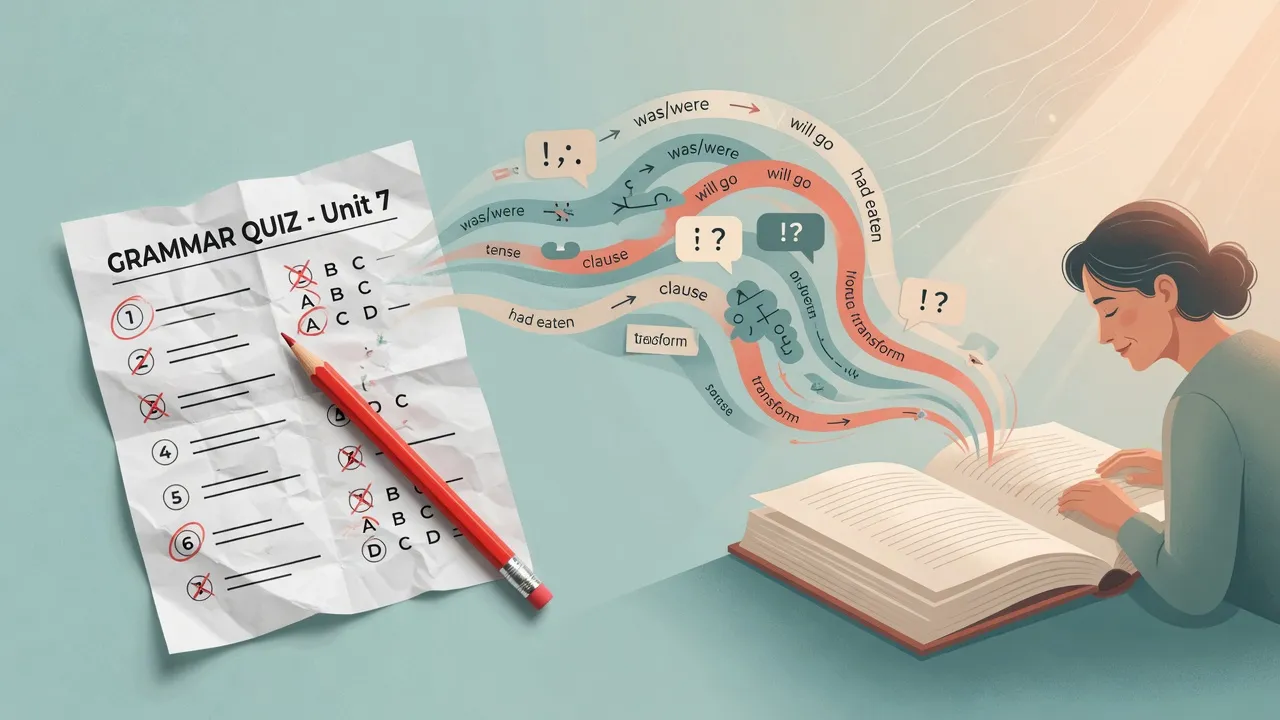
You sit over a test. The gap fills itself: She ___ (go) to the store yesterday. You write went. Ten out of ten. Later you tell a colleague about last night, and what comes out is closer to She go store yesterday.
If that feels familiar, you are not broken. You are living with a common mismatch: grammar tests measure slow, conscious rule work. Real speaking and writing need fast access to forms while you chase meaning.
The short answer: multiple-choice and gap-fill train checking under quiet conditions with time and options. Lots of mostly understandable reading puts grammar patterns next to plot, emotion, and real frequency - which helps transfer better than isolated blanks for many learners. Short explanations still help when one form keeps blocking you. Treat them like a flashlight, not like the whole diet.
This is not "delete every exercise forever" and not "thirty days of pages = automatic native grammar." It is a clearer split between what tests train and what reading feeds - plus a realistic habit plan and a light product path if you want support while you read.
The knowledge illusion: perfect test, broken speech
When you solve a grammar item, your brain often works like an analytical processor. It spots clues (yesterday points to past), checks a table in memory, and outputs an answer. That is useful. It is conscious knowledge about the system.
When you speak or write under real conditions, you rarely get that pause. You need the form while you hold the message, the listener, and the next idea. The form has to surface fast enough that meaning still leads. Tests mostly train the slow system. Spontaneous use leans on a faster, more automatic base.
A simple picture: someone who only studied the highway code on paper versus someone with thousands of hours driving. Both "know" the rules. Only one reacts under traffic pressure.
High test scores are not fake. They are just a different skill from smooth use. Treating them as proof that speech will follow is the illusion.
Learning vs acquisition
Stephen Krashen and related work popularized a practical distinction many teachers still find useful:
- Learning - conscious rules, metalanguage, drills, tests. Good for noticing, editing, and exam formats when you have time.
- Acquisition - growth through understood messages (comprehensible input). Feeds more of the base that spontaneous use draws on.
Reading a lot of level-fit text is one strong way adults get that input. Listening to content you mostly follow is another. The frame is helpful. It is not the only research tradition, and it is not a commandment to never open a grammar page again.
In short, lots of comprehensible input supports acquisition for many learners. Output practice, feedback, and short form-focused work also matter for a lot of people - especially for sticky errors and exams. For a longer walkthrough of the input idea, see Krashen and comprehensible input.
Here is the contrast in one image: slow conscious monitor versus fast use under meaning pressure.
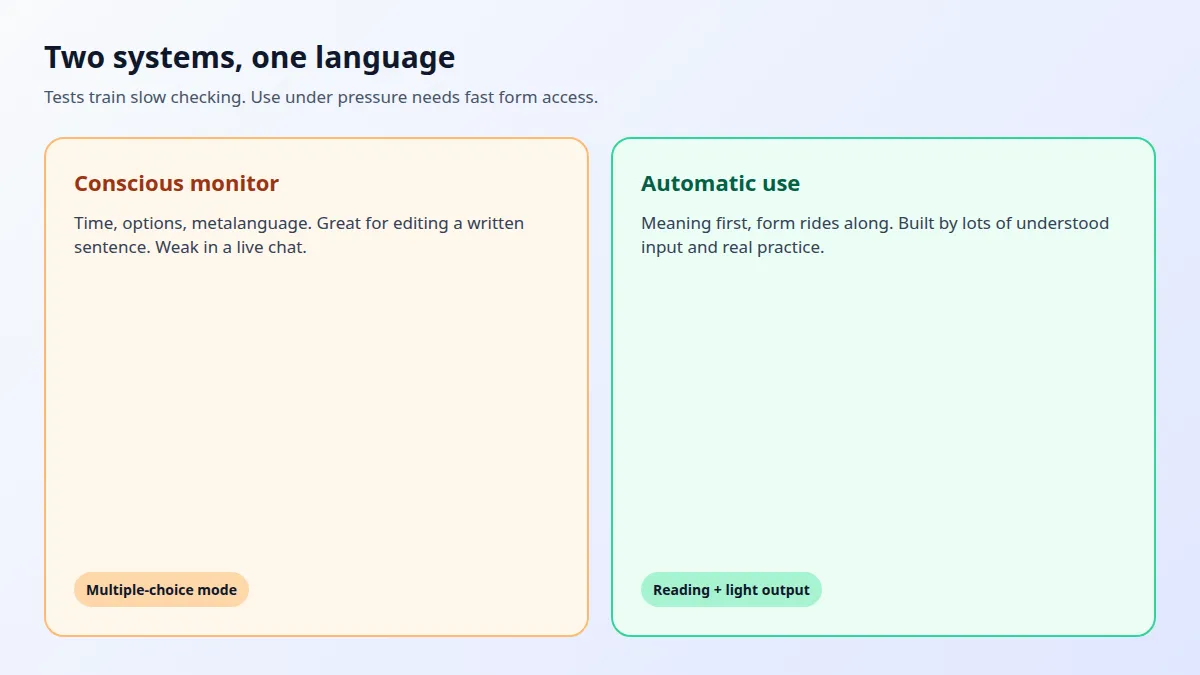
Monitor mode: time, options, rule check, score.
Use mode: message first, form has to keep up.
Tests live mostly on the left. Interesting reading feeds the right.
"I know the rule but can't use it"
Open any intermediate book on Present Perfect. You will find a clean formula:
Present Perfect = have/has + past participle
I have visited Paris. - experience that still matters now; exact time not the point.
You can explain it. You can pass a quiz on it. Feeling the difference in real lines is harder:
"I've seen things you people wouldn't believe."
- Roy Batty in Blade Runner (from Philip K. Dick's world)
versus
"I saw things that changed me forever."
The first ties past experience to who the speaker is now. The second reports a finished past. No single gap-fill teaches that feel. Seeing Present Perfect dozens of times in stories, articles, and dialogue does more for automatic choice than another isolated blank.
Conditionals work the same way. The textbook table for third conditional is fine. A line like this does different work:
"If I had known what was going to happen, I would never have opened that door."
You meet regret, plot, and form together. The pattern sticks as a message, not only as a formula. That is what people mean when they say "I know the rule but can't use it": the table is there; the fast path under pressure is not.
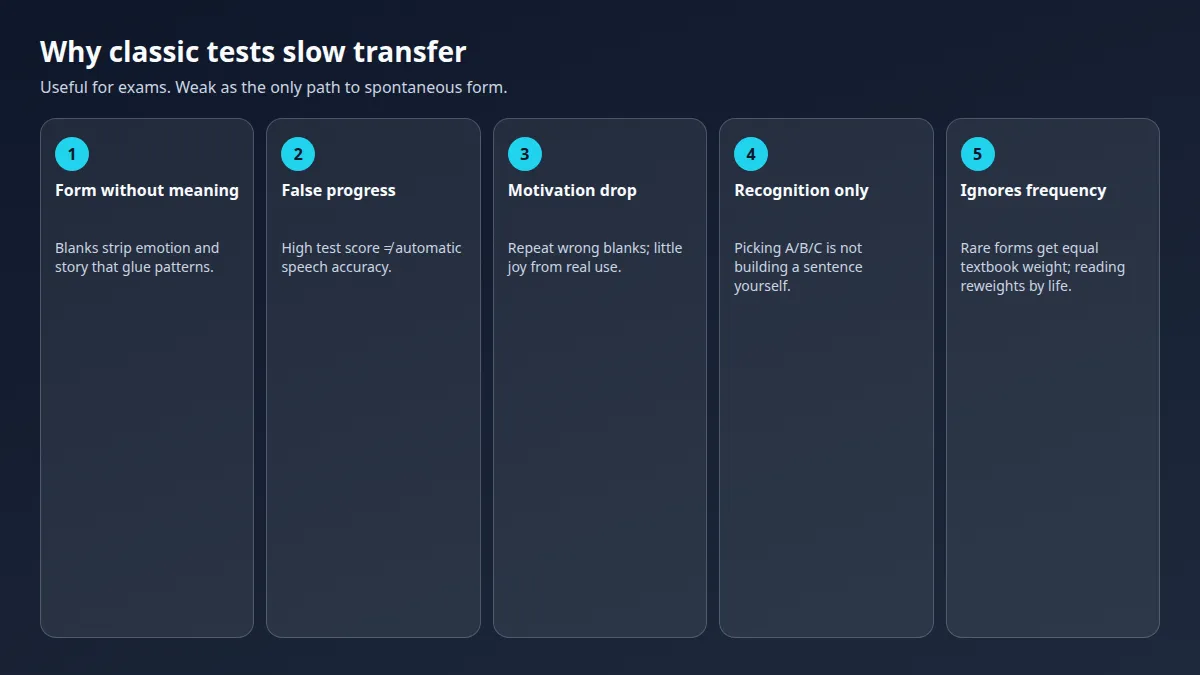
Five reasons classic tests slow transfer
Tests are not evil. As the main diet for real use, they often fail to transfer. Here is why.
1. They isolate form from meaning and emotion
In real language, grammar rides on content. When you read:
"He had been waiting for two hours when she finally arrived."
you are not only tagging Past Perfect Continuous. You feel the wait. The brain links form to situation. On a test you often get: He ___ (wait) for two hours when she arrived. Correct answer possible. Emotion optional. Transfer weaker.
2. They create false progress
Ninety percent on a quiz is not ninety percent accuracy in speech. Learners with strong test scores still drop the same forms when time pressure and meaning take over. Tests measure slow recognition of the system. Spontaneous accuracy is a different check.
3. They drain motivation
A common loop: take a test, score 7/10, feel small, re-drill the rule, retake, score 9/10, forget half a week later. Repeat. Little pleasure from using the language for anything you care about. Motivation dies even when "study hours" look fine.
4. Recognition is not production
Choosing one of four options is recognition. Building the sentence yourself is production. Related skills, not the same drill. Many classic tests train the first and barely touch the second.
5. They ignore real frequency
Textbooks can give Future Perfect Continuous and Present Simple similar unit weight. Real English does not. Reading at a sensible level reweights exposure: common patterns return often; rare exam favorites show up when they matter. Your brain gets a better priority list without you building a spreadsheet.
How reading builds grammar patterns
When you read a story or article you mostly understand, you are not running a full parse of every clause. You follow meaning. Along the way, the brain absorbs patterns in context: word order, tense choices, connectors, typical pairs (make a decision, do the laundry).
Each sentence is a tiny lesson wrapped in plot or information. You see the same structures return with different characters and topics. That repetition is soft, not shouty. Over time, more forms feel "right" before you can name them - and naming them later is easier because you already have examples.
Research and classroom experience often point the same practical direction: regular reading in the language tends to support not only comprehension but also more natural grammar in writing and speech for many learners - especially when the text is interesting and mostly clear. The practical claim is smaller and still useful: level-fit reading is a strong base for grammar in use, stronger than endless isolated blanks as the main method.
Reading does not mean you never need a short explanation, feedback, or speaking practice. It means forms arrive with meaning first, tables second.
"But I don't understand everything" - and light support
The most common objection: "I hit constructions I don't get, and I freeze." Fair. The fix is usually level + interface, not proof that reading "doesn't work for me."
If every line is a wall, step down. Aim for text that is mostly comfortable with a little stretch - enough unknown to grow, not enough to thrash. Graded free pieces help: browse free graded articles.
When a blocker stops meaning, light support is enough: tap a word or short phrase, get a translation, move on. Stay in the flow. You do not need a full lecture on every line.
That is the MovaReader style of help: reading tool first, lookup for blockers, freemium limits on word translations (about 20 per day), unlimited listening where offered, own files per plan rules. Pro adds trainers to reuse saved words and phrases. Reader is about €1/month; Pro about €5/month. No free pile of licensed commercial novels by default - bring your own rights-cleared files when you want books beyond the free library.
For interface habits, see how to use MovaReader. For a quick feel of reuse practice, try the type training demo or phrase typing demo.
When grammar study still helps
Grammar is not the villain. Grammar as the whole diet is the problem.
Short, sharp study helps when:
- One pattern keeps blocking reading or listening (same form, same confusion, every page).
- An exam is soon - tests match the exam format. Using tests for exam prep is smart.
- You want a label after examples - notice the form in text, open a two-minute explanation, hunt three more examples in real pages. Flashlight, then back into the story.
A useful rhythm: read for meaning most of the time; when one structure is sticky, learn its name and shape briefly; return to input so the form stays tied to messages. You do not need to "delete all grammar apps." You can shrink them and grow interesting reading time.
30-day reading habit plan (realistic outcomes)
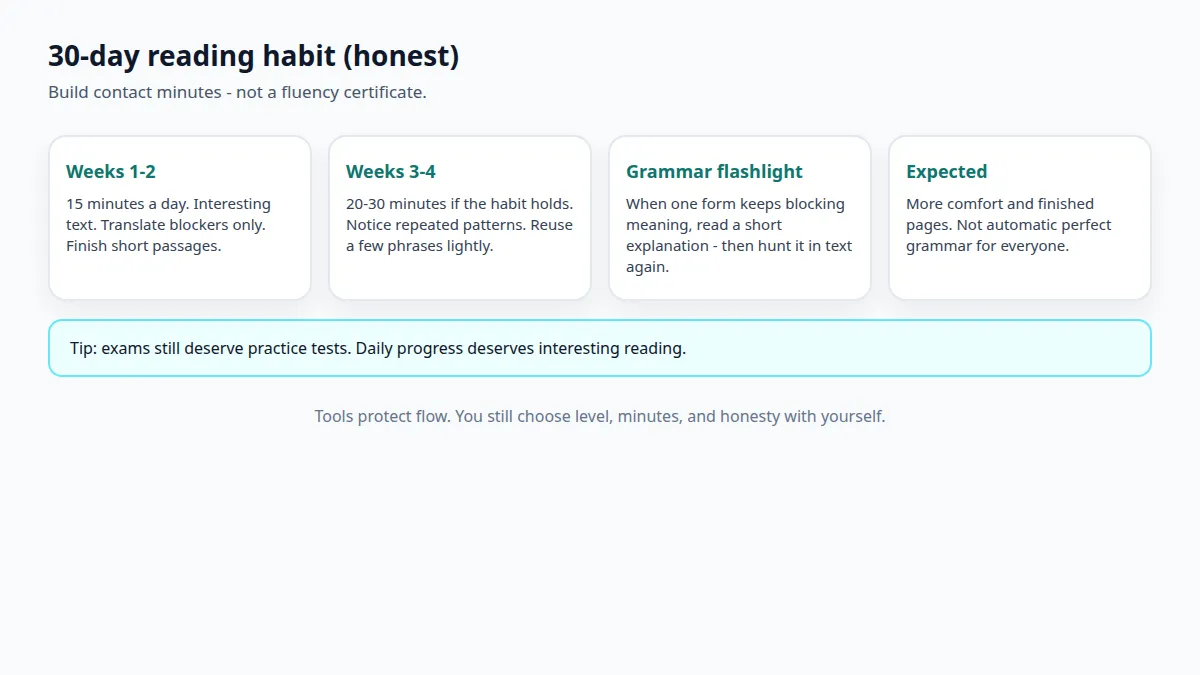
This is a habit plan. After thirty days you should expect more comfort with finished pages, not automatic grammar and not "natural English overnight."
Weeks 1-2: start small, protect interest
- Pick text you care about at a level you can mostly follow (news, hobby piece, graded story - not the hardest novel on the shelf).
- Read about 15 minutes a day. Stop while it still feels possible to continue tomorrow.
- Translate blockers only. Skip the urge to look up every mild unknown if the sentence still makes sense.
- Optional: free graded samples in the library if your own files are too hard right now.
- Keep a little grammar if you need it for school or exams - just do not let tests own the hour.
Weeks 3-4: grow volume if the habit holds
- Move toward 20-30 minutes if weeks 1-2 felt sustainable. If not, stay at 15. Consistency beats heroic days.
- Start noticing repeated patterns (the same tense shape, the same connectors). Curiosity is enough; no need to build a full notebook unless you enjoy it.
- Light phrase reuse: save a few useful lines and practice them in the demos or on Pro trainers if you use them - short, not a second full course.
What to expect after 30 days
- More pages finished without dread.
- Slightly better "feel" for common patterns you met often.
- Clearer sense of which forms still need a flashlight.
What not to expect: automatic grammar, native-like speech, or a permanent end to every error. Those take longer and usually need more than reading alone (some output, some feedback, time).
Advanced learners and sticky errors
At B2-C1 you often already know the rules. You still trip on nuances: make vs do, article choices, prepositions, formal inversions. Tests are weak here because the problem is not missing the table - it is missing dense, natural examples under time pressure.
Reading a lot in your domains (work blogs, fiction you like, long-form journalism) rebuilds an internal model: make a decision, do business, make an effort, do the laundry. Frequency and collocation beat another abstract explanation.
When a form stays sticky, combine: notice it in text, short rule or example set, then hunt it again in reading. Advanced progress is often narrow repair + massive input, not another full grammar course from unit one.
Comparison: test-heavy hours vs reading-heavy hours
Qualitative only - what each focus tends to train.
| Focus | Grammar-test heavy hours | Reading-heavy hours (level-fit) |
|---|---|---|
| Main skill trained | Slow rule recognition under quiet conditions | Meaning first + pattern exposure in context |
| Transfer to speech | Often weak without extra practice | Stronger base for many learners; still needs some output |
| Motivation | Often drops (score loops, blanks) | Higher if texts are interesting |
| Grammar feel | Tables and metalanguage first | Forms inside stories and arguments |
| Frequency | Textbook unit weight | Real recurrence in the language you meet |
| Best add-on | Timed exam prep that matches the test | Light grammar flashlight + short phrase reuse |
Both columns can appear in a good week. The question is which one owns most of your time if your goal is use, not only scores.
A note on MovaReader
MovaReader is a reading tool with light support.
Helps with: free graded articles; tap translation for blockers (freemium about 20 word translations per day); listening where the free tier includes it; your own EPUB/files under plan rules; Pro trainers to reuse saved words and phrases.
Pricing in plain terms: freemium to try; Reader ~€1/month for more reading volume; Pro ~€5/month when you want trainers and deeper reuse tools. Details live on pricing.
A simple path: browse all articles → try a demo → read how to use → check pricing if the habit sticks.
FAQ
Are grammar tests useless?
No. They measure slow rule knowledge and help with exam prep. They are a weak main diet if your goal is spontaneous speaking and writing.
Does reading replace all grammar study?
No. Reading is a strong base for patterns in context. Short explanations help when a form keeps blocking you. Keep grammar as a flashlight, not as the whole day.
What about Krashen?
Useful frame: lots of comprehensible input supports acquisition. It is not the only tradition. Output and form-focused work still matter for many learners and for exams.
How hard should the text be?
Mostly understandable with a little stretch. If every line is a wall, step down. Comfort plus curiosity beats heroic struggle.
Can I keep doing some exercises?
Yes - especially for exams or sticky forms. Shrink them. Grow interesting reading time.
How does MovaReader fit?
Tap translations for blockers, free graded library, freemium limits, Reader/Pro tiers, trainers for reuse on Pro.
Close: train what you actually need
Grammar tests train a real skill: careful checking when you have time. That skill has a place - exams, editing, first notice of a form. It is a poor substitute for hours of messages you understand and care about.
If test scores look fine and real use still stumbles, change the diet before you change your self-story. Read something interesting at a level you can mostly follow. Use short grammar only where it unblocks meaning. Give the habit thirty days of real pages.
Start with one short text you actually want to finish - from the free library or your own file - and let meaning lead. The forms will ride along more often than another blank ever made them.
Keep reading with translations inside the text
With a free account, an unknown word translates with one tap, and the words you are learning wait for you in the trainer.
Free account: 7 days of Pro, then 20 word translations a day or a paid plan.