Grammar in Context
Spanish Passive Voice in Business Texts: Read Without Freezing
Business Spanish hides the agent on purpose with three tools English speakers mix up. Here is a usable map, press-style examples, and a simple three-pass reading method.
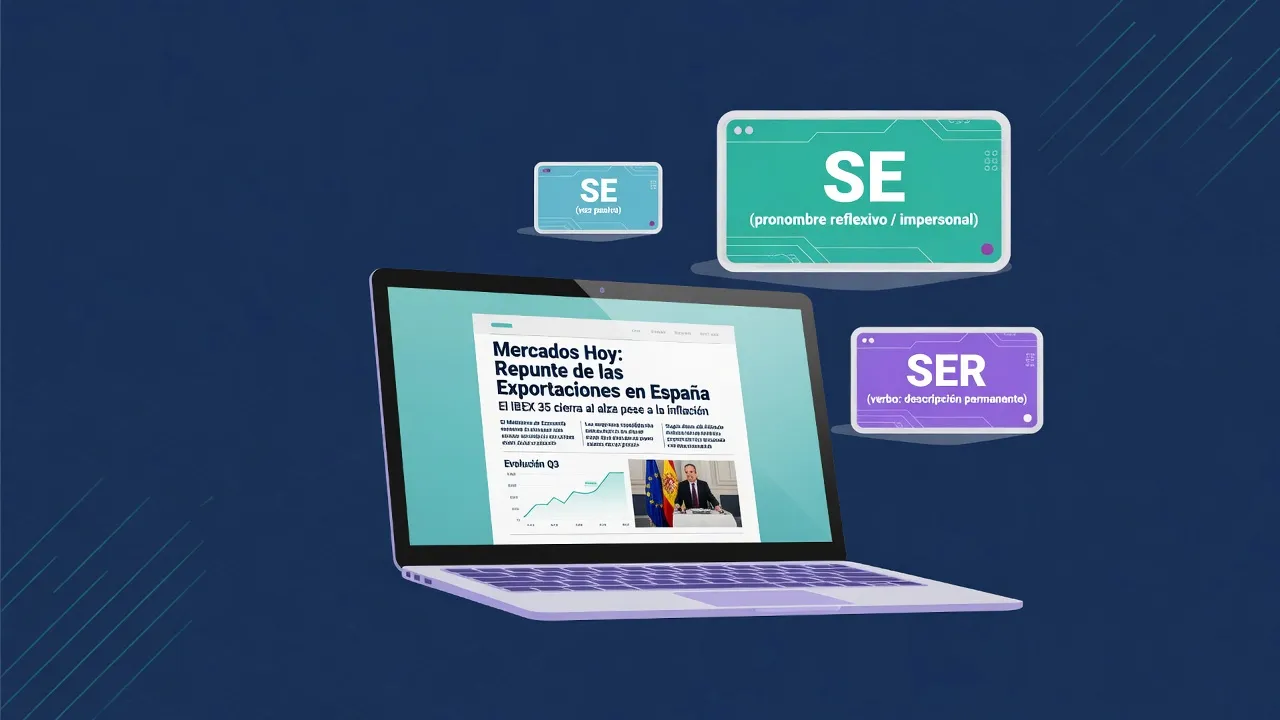
You open an economics piece and hit this line: "Se espera que la inversión sea aprobada por los reguladores antes de que el informe sea presentado." You read it twice. Who expects? Who approves? Who presents?
That is not (only) your Spanish "failing." That is passive voice and se constructions doing their usual job in formal Spanish: push the agent off stage, raise the action, and sound institutional.
Textbooks often give you one passive lesson, then move on. Economic press, reports, and official writing live on these structures. This guide gives you a usable map, real-style examples, and a reading method.
Why business Spanish loves the passive (and se)
In everyday chat, ser passives are rare. Almost nobody says "La cena fue preparada por mí." They say "Preparé la cena" or "Hice la cena."
Company text and economic journalism change the style:
- Apparent objectivity: "Los resultados fueron analizados" sounds more "neutral" than "El equipo analizó los resultados."
- Institutional tone: impersonal form carries weight of "what is established."
- Useful ambiguity: "Se cometieron errores" is not the same as "Nosotros cometimos errores."
If you want real Spanish (not only textbook Spanish), you need to spot these shapes quickly.
You already know a cousin of this story if you read passive voice in business English. English leans on was written. Spanish splits the work across three tools English speakers often mash into one label: "passive."
Three faces of "passive" in Spanish
Unlike English, where was written covers most of the map, Spanish rewards a clean split into three mechanisms. Mixing them up is the classic B1-B2 trap.
Here is the board in one glance:
| Type | Pattern | Example | Reading move |
|---|---|---|---|
| Periphrastic passive | ser + participle (+ por) | El acuerdo fue firmado por ambas partes. | Find the participle; agent after por if present |
| Passive se | se + verb that agrees | Se publicaron los resultados. | Singular/plural follows the patient |
| Impersonal se | se + usually 3rd singular | Se habla de una fusión. | Verb stays singular; "people / the market say" |
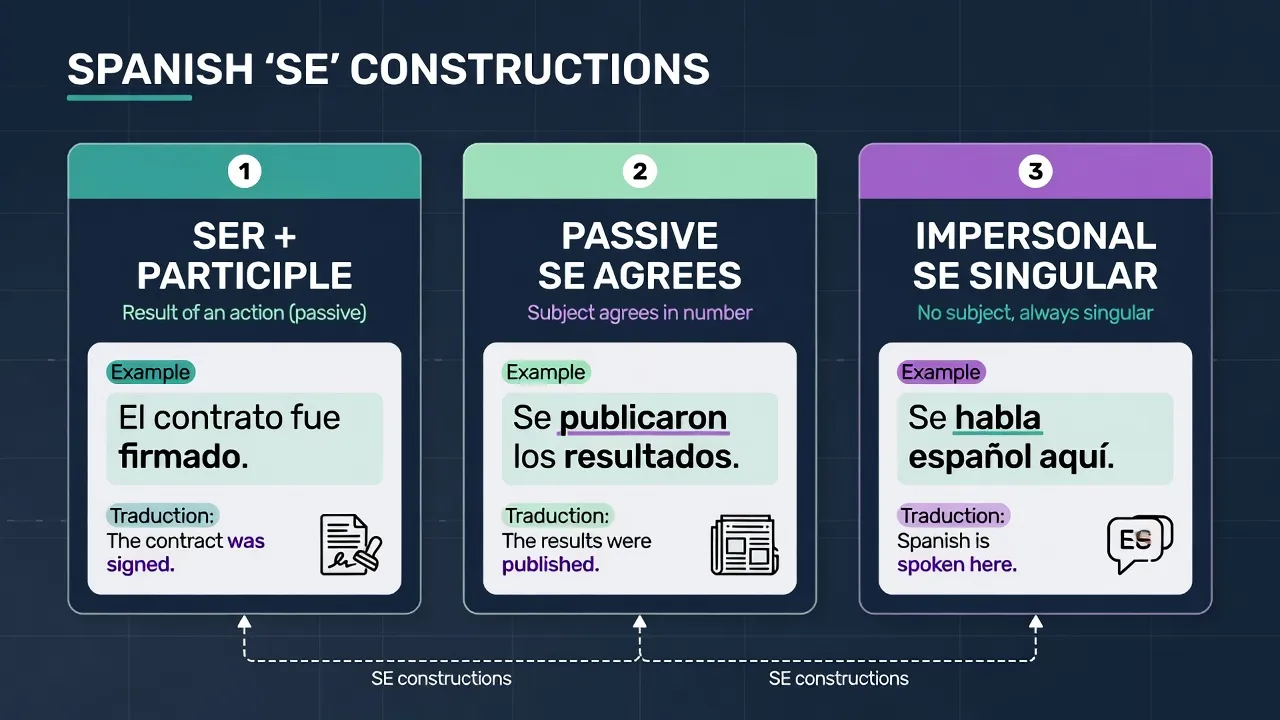
1. Periphrastic passive (ser + participle)
"El acuerdo fue firmado por ambas partes."
Structure: patient subject + conjugated ser + participle (+ por + agent, optional)
Where it thrives:
- contracts and legal text
- academic writing
- historical chronicles
- official press releases
Reading trick: find the participle (firmado, aprobado, presentado). Ask: who did the action? If you see por, the agent is there. If por is missing, the writer left the agent out on purpose.
Press-style example:
"La adquisición fue valorada en 3.200 millones de dólares por los analistas."
Active equivalent: Los analistas valoraron la adquisición en 3.200 millones de dólares.
You do not need a magic highlighter. Mentally rewrite in active when the sentence clouds over.
If ser and estar still fight for space in your head, pair this section with ser vs estar for writers. Here the key is simple: ser + participle is the formal passive you expect from contracts and careful reports.
2. Passive se (pasiva refleja)
"Se publicaron los resultados del primer trimestre."
Structure: se + verb that agrees with the patient subject + subject
- "Se vendió la empresa." (singular)
- "Se vendieron las acciones." (plural)
This form is everywhere in news because it sounds natural in Spanish and keeps an "objective" tone. One economics article can stack it many times.
3. Impersonal se
"Se habla de una posible fusión."
Structure: se + verb in 3rd person singular (+ complement, often with a preposition)
The verb does not go plural just because the idea after it feels plural:
- Passive se: "Se firmaron los contratos." (verb tracks contratos)
- Impersonal se: "Se habla de los contratos." (verb stays singular)
Also common: "Se espera que...", "Se estima que...", "Se prevé que..." - classic frames for forecasts and market rumor.
Word order can hide the subject too. If Spanish still feels "scrambled" after English templates, see Spanish word order without English templates.
Drill: a Forbes / Expansión style paragraph
Practice on this block (invented, but realistic):
"Se espera que la nueva regulación sea aprobada por el Congreso antes de fin de año. Los cambios fueron propuestos por el ministerio de economía, y se prevé que las reformas se implementen de manera gradual. Se habla de un período de transición de dieciocho meses, aunque no se ha confirmado la fecha exacta."
Breakdown:
Se espera que... sea aprobada por...
- Se espera: impersonal frame
- sea aprobada por el Congreso: ser passive + agent inside the subordinate clause
- Idea: People / the market expect Congress to approve the regulation...
Los cambios fueron propuestos por el ministerio...
- ser passive + clear agent
- Active: El ministerio propuso los cambios...
se prevé que las reformas se implementen...
- se prevé: impersonal
- se implementen: passive se (reforms = patient; subjunctive because of the subordinate frame)
Se habla de...
- Impersonal: there is talk / rumor about the timeline
no se ha confirmado la fecha exacta
- Passive se (or passive-with-se reading): the date is not confirmed; agent hidden
Five sentences, several layers. That is normal business Spanish, not a sadistic exam.
Five patterns you will see almost daily
| Pattern | Example | Useful reading |
|---|---|---|
| Se espera que... | Se espera que la inflación baje. | Generic expectation; agent does not matter |
| Fue + participle + por | La decisión fue tomada por la junta. | Agent = the board |
| Se + plural verb | Se registraron pérdidas récord. | Fact with no explicit author |
| Se ha + participle | Se ha anunciado una reestructuración. | Announcement made; who? sometimes unsaid |
| Se prevé / se estima que | Se estima que el mercado crecerá un 4%. | Figure or "market / analyst" view |
With these five frames you cover a large share of journalistic passive without memorizing endless conjugation tables.
Passive se vs impersonal se (the contrast that unlocks news)
If you only take one distinction from this article, take this one.
Passive se: the verb agrees with the thing affected.
"Se publicaron los resultados." - results were published.
Impersonal se: the verb stays third singular; the focus is "one / people / they (unspecified)."
"Se habla de una fusión." - there is talk of a merger.
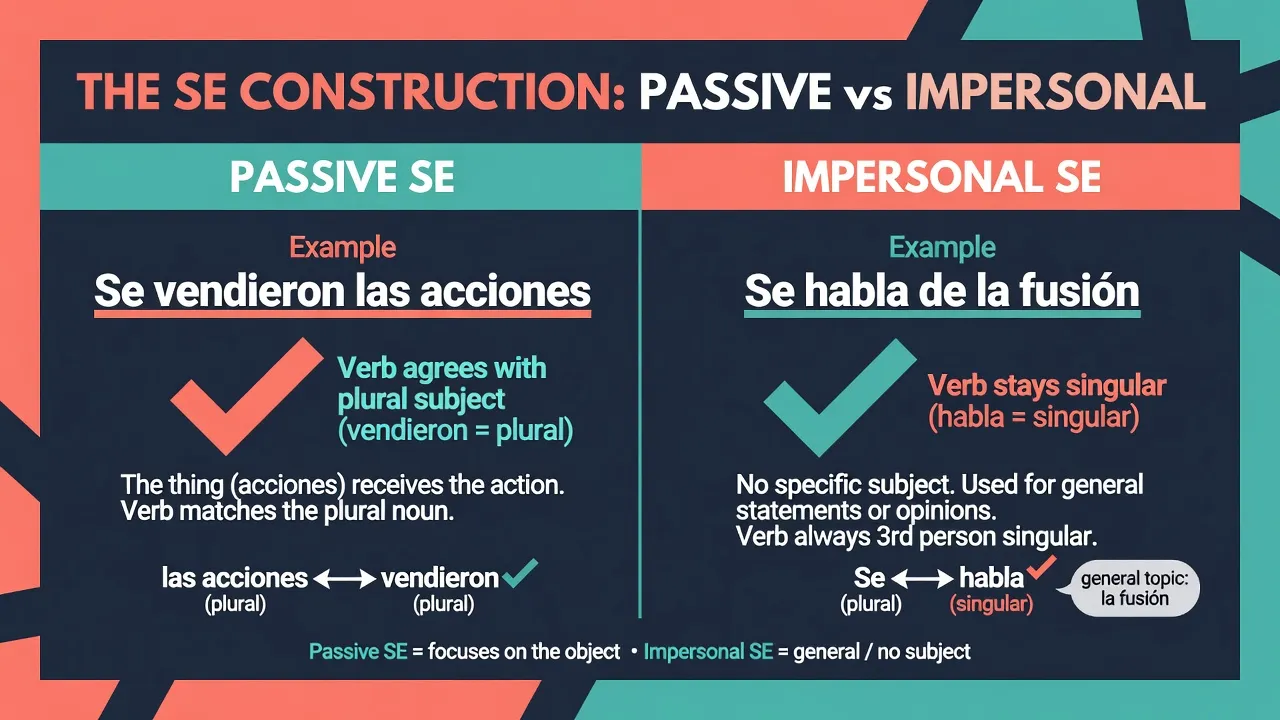
Quick self-check:
- Can you swap in a clear plural patient and does the verb go plural? Likely passive se.
- Is the line a frame like se espera / se habla / se estima with no plural agreement? Likely impersonal se.
Linguists argue finer points. For reading under time pressure, agreement plus "is there a patient subject?" is enough.
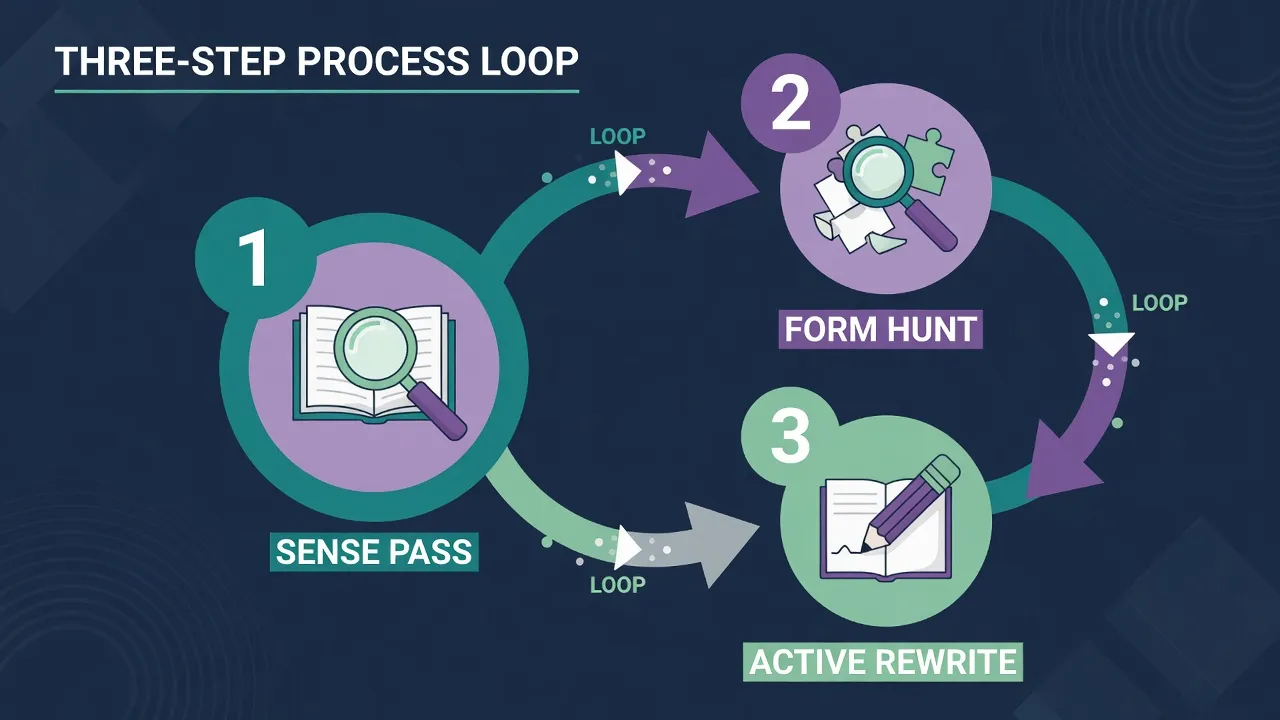
Reading method: decode in three passes
You can do this with a piece from Expansión, Bloomberg Línea, El Economista, or a graded text from the article library:
First pass (gist only)
Read the paragraph without stopping. Do not analyze. Keep the topic: regulation, merger, results, inflation?Second pass (form hunt)
Mark only:- ser + participle
- se + verb
Ask each time: is there an agent (por)? Does the verb agree in the plural?
Third pass (mental active rewrite)
Rewrite out loud or in a note as active or "someone + verb."
Example: Se publicaron los resultados → Publicaron / La empresa publicó los resultados (even if the exact subject is unknown, you recover the action).
Golden rule: do not translate word by word. Translate the relationship: patient, action, agent (if any).
Mini exercise (5 minutes)
Take three headlines or lines and label them: A) ser + participle, B) passive se, C) impersonal se.
- Se vendieron más de un millón de unidades.
- El informe fue elaborado por un comité externo.
- Se habla de recortes en el segundo semestre.
Answers: 1-B, 2-A, 3-C.
From recognize to produce
If you write reports or formal email in Spanish, passive and se help you. The realistic path is slower than a marketing funnel:
- Recognition - you see them while reading
- Fast comprehension - they no longer freeze you
- Imitation - you copy useful frames (Se adjunta..., Los datos fueron revisados por...)
- Flexible use - you choose passive or active for tone
A useful bridge from reading to production: hand-copy or type 5-10 real sentences that helped you, then change only the content (company, figure, date). That is deliberate practice, not an app miracle.
Past forms stack inside these frames often (fue firmado, se han tomado). If tense choice still slows you down, Spanish past tenses with Harry Potter examples is a solid companion.
Why workbook blanks are not enough
The exercise "La carta _____ (escribir) por el director" trains conjugation. It barely trains:
- when to prefer passive se over impersonal se
- why the author hides the agent
- how to recover meaning under reading pressure
That trains with heavy exposure to authentic or semi-authentic text plus the mental rewrite habit. Workbook items are a short map, not a full diet.
For longer business reading after the grammar map, see business Spanish books worth the salary case.
Where else this style dominates (beyond business)
- Science: Se observó una correlación...
- Law: El demandado será notificado...
- Politics: Se han tomado medidas...
- Tech: La actualización fue diseñada para...
- NGO / reports: Se estima que... fueron afectadas...
The three mechanisms repeat. Only domain vocabulary changes.
How MovaReader fits
What is actually useful:
- Read graded texts or import a file you own (for example EPUB). The app does not replace buying or borrowing commercial books with "Chapter 1" buttons for bestsellers.
- Use tap translation only on blockers (words that collapse the sentence). Freemium includes about 20 word translations per day and unlimited listening. Reader (€1) removes the translation cap. Pro (€5/month) unlocks full trainers. See Pricing.
- Save phrases with passive / se, not only bare lemmas. Practice with demos: Spanish typing practice, Spanish phrases practice.
- Browse the library: All articles. Walkthrough: How to use.
Recommended 15-minute flow:
- One economics paragraph or one graded article
- Three passes from the method above
- Save 3 model phrases
- Type them once the next day
FAQ
Is heavy ser passive wrong when speaking?
Not "wrong," but it sounds formal or English-translated if it piles up in casual chat. In reports, minutes, and press, it is normal.
Is Se venden casas passive or impersonal?
In classroom terms it is usually taught as passive se (se + agreeing verb). Fine-grained debate is for linguists. For you: houses are for sale / house-selling happens, with no explicit agent.
Should I always translate into active voice?
As a comprehension technique, yes, it helps. As a writing style, no: sometimes you want the impersonal tone.
Is the subjunctive inside se espera que... another trap?
Yes, it shows up a lot: se espera que sea aprobada. First recover the frame (se espera que); then look at the inner passive. Do not solve both layers on day one.
How long until it feels automatic?
It depends how much you read. With frequent press or report reading, many people notice less friction in several weeks, not over a weekend. No tool can promise instant automatic decoding.
Spain Spanish or Latin America too?
The three mechanisms are pan-Hispanic. Lexicon and register preferences shift; the basic logic stays.
Close
Passive voice and se are not a wall. They are a style code of formal Spanish: sometimes they hide the agent, sometimes they only sound professional.
Learn to:
- split ser + participle / passive se / impersonal se
- hunt for the agent only when it exists
- rewrite in active to check you understood
Do it on texts that matter to you. Use tools to remove vocabulary friction, not to outsource grammatical thinking.
If you want to start today: open an article in the library, mark three se or passives, and write the active version next to each in one line. That habit beats any promise of "instant decode."
Keep reading with translations inside the text
With a free account, an unknown word translates with one tap, and the words you are learning wait for you in the trainer.
Free account: 7 days of Pro, then 20 word translations a day or a paid plan.