Grammar in Context
Spanish Subjunctive Without Tears: Feel the Mood Through Emotional Dialogues
Why venga not viene? Subjunctive marks speaker attitude (doubt, desire, emotion), not the clock. Learn fact-frame vs attitude-frame, mini dialogues, and a realistic B1-B2 reading plan.
Textbooks list "desire, doubt, emotion." Then a real line hits venga and your brain freezes. Normal. The calendar did not change. One letter shifted, and the frame did.
If you are still early in Spanish, you get to read this before the first shock. If you already met Subjuntivo, you know the pain: the rule sounds clear, but living text still feels random.
The Spanish subjunctive is a mood (speaker attitude), not a tense. Indicative frames something as fact or given; subjunctive frames desire, doubt, emotion, evaluation, or something still in the speaker's head - often after a trigger and que with two subjects. Same world event can take either mood (viene / venga) depending on the frame. Learn the feel in short emotional dialogues, then notice forms in graded Spanish you mostly understand. Tables help. They are not the whole game.
Below: fact-frame vs attitude-frame, emotional trigger groups plus a WEIRDO cheat sheet, multi-turn mini-dialogues, formation without panic, classic mistakes, a light imperfecto layer, a realistic reading plan, and FAQ.
What the Spanish subjunctive actually is
Typical textbook line:
"Subjunctive is used for desire, doubt, emotions, and unreal situations."
True. Too abstract to light up inside a sentence.
Useful rewrite:
- Indicativo = fact, certainty, "I treat this as given."
- Subjuntivo = desire, doubt, emotional reaction, hypothesis, "it lives in the speaker's head."
Minimal pair:
Sé que ella viene a la fiesta.
I know she is coming to the party. (fact → Indicativo)
Espero que ella venga a la fiesta.
I hope she comes to the party. (hope → Subjuntivo)
One word flips the frame: viene → venga. Not the clock.
Doubt pair:
No creo que entiendas lo que siento.
I don't think you understand what I feel.
Entiendas, not entiendes, because the speaker is not asserting understanding as fact.
One rule for intuition: fact vs attitude
Ask: Is this a fact for the speaker, or their reaction / interpretation?
Es verdad que ella habla español.
It is true that she speaks Spanish. (Indicativo)
Es increíble que ella hable español.
It is incredible that she speaks Spanish. (Subjuntivo)
She may speak Spanish in both lines. The world can stay the same. The speaker's frame changes.
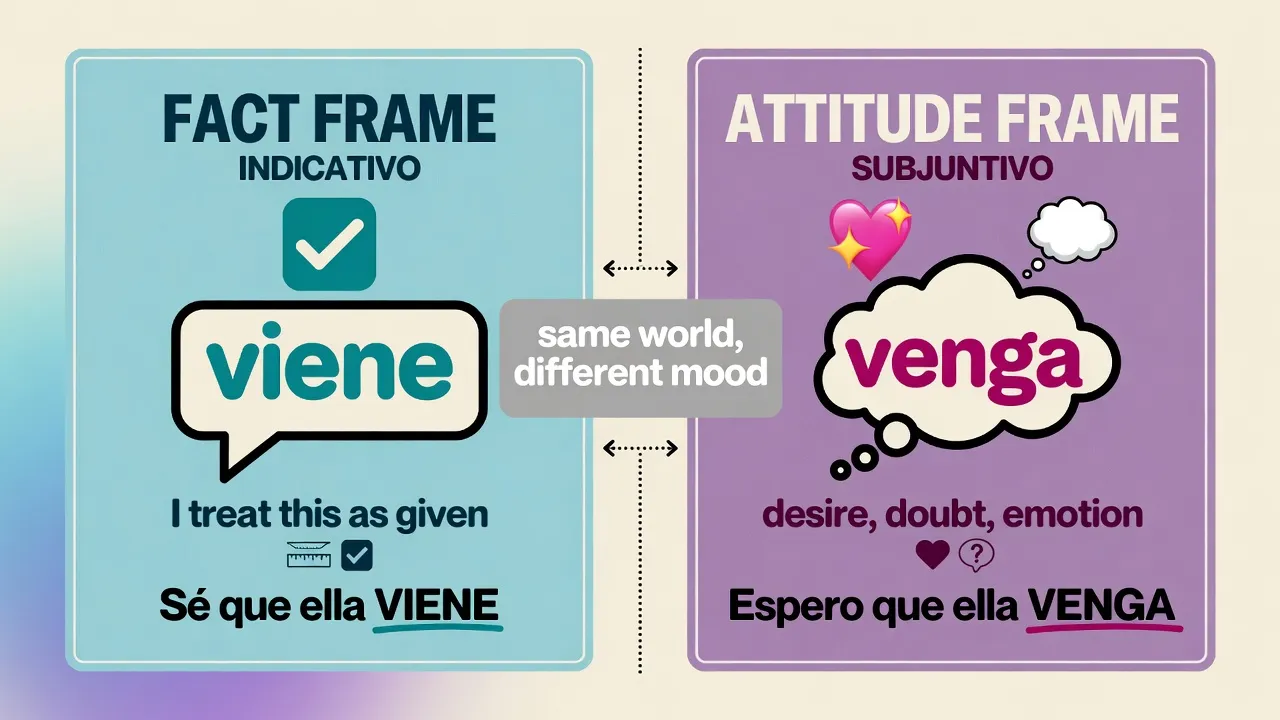
Same event. Different mood. When a form looks odd, run that question before you open a conjugation wall.
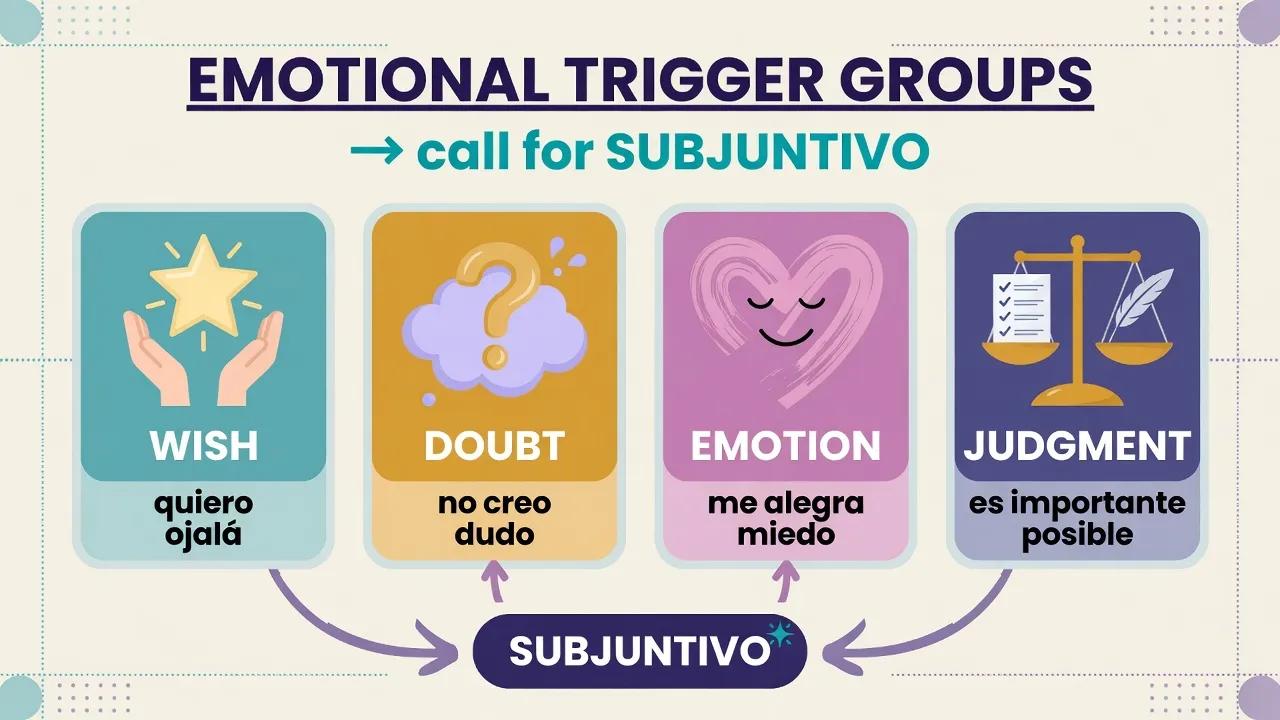
Triggers without memorizing 50 words: emotional groups
Skip a 50-word trigger dump on day one. Hang examples on groups. WEIRDO can wait as a cheat sheet.
Wishes / will
- Quiero que vengas conmigo. - I want you to come with me.
- Ojalá que llueva. - Hopefully it rains.
- Necesito que entiendas que no es tan simple. - I need you to understand it is not that simple.
Emotions
- Me alegra que estés aquí. - I'm glad you are here.
- Tengo miedo de que se vaya. - I'm afraid he/she will leave.
- Es una lástima que no puedas venir. - It's a pity you cannot come.
Key: often two different subjects. "I'm glad that you are here."
Doubt and denial
- No creo que sea verdad. - I don't think it is true.
- Dudo que llegue a tiempo. - I doubt he/she will arrive on time.
- No es seguro que funcione. - It is not certain it will work.
Contrast:
- Creo que es verdad (belief as assertion → Indicativo)
- No creo que sea verdad (doubt → Subjuntivo)
Impersonal judgments
- Es importante que estudies. - It is important that you study.
- Es posible que nieve mañana. - It may snow tomorrow.
- Es necesario que hablemos. - We need to talk.
But: Es obvio / es verdad / es cierto que... often pull Indicativo, because the speaker presents a fact frame.
Trigger cheat sheet (WEIRDO optional)
If you like a cheat sheet, hang letters on the emotional groups. Do not treat WEIRDO as the only brain.
| Letter / group | Cue | Example |
|---|---|---|
| W Wishes | want, hope, need, ojalá | Quiero que vengas |
| E Emotions | glad, fear, regret | Me alegra que estés |
| I Impersonal | es posible / importante / necesario (not es obvio/cierto) | Es posible que nieve |
| R Requests / recommendations | ask, recommend, suggest | Te pido que digas la verdad |
| D Doubt / denial | dudo, no creo, no es seguro | No creo que sea |
| O Ojalá / open desire | ojalá, strong wish | Ojalá pudiera |
Keep in mind: WEIRDO is incomplete. Categories, mini-dialogues, and noticing beat pure acronym drills.
Mini emotional dialogues (presente)
The scenes below are pedagogical examples in emotional-prose style. Train the same patterns on graded Spanish at your level or in a legal EPUB you own.
When you see the form, ask: fact or attitude?
Desire / request (deseo)
A: Necesito que me escuches un momento.
I need you to listen for a moment.
B: Vale. ¿Qué pasó?
OK. What happened?
A: Quiero que vengas conmigo al médico. No quiero ir solo.
I want you to come with me to the doctor. I don't want to go alone.
Teaching cue: Necesito / Quiero + que + different subject → subjunctive. Same subject stays infinitive: No quiero ir solo.
Doubt (duda)
A: ¿Crees que llega a tiempo?
Do you think he/she arrives on time? (affirmative lean → Indicativo llega)
B: No creo que llegue. El metro va fatal.
I don't think he/she will make it. The metro is a mess.
A: Ojalá haya otro tren.
Hopefully there is another train.
Teaching cue: flip creo → no creo and the verb mood often flips with it.
Emotion / fear (miedo / emoción)
A: Me da miedo que se enfade.
I'm scared he/she will get angry.
B: Es normal que tengas miedo, pero hay que hablar.
It's normal that you're afraid, but we have to talk.
A: Me alegra que estés aquí.
I'm glad you are here.
Teaching cue: emotion verb + que + another person's situation → subjunctive.
Evaluation (evaluación)
A: Es importante que digamos la verdad.
It's important that we tell the truth.
B: Sí. Es una lástima que no podamos esperar más.
Yes. It's a pity we can't wait any longer.
Short dialogues stick better than fifty isolated verbs. You hear who wants, who doubts, and what they react to.
Present subjunctive: formation without panic
Intuition first. Endings second - compact, not a panic wall.
| Infinitive type | Endings | Example |
|---|---|---|
| -ar | -e, -es, -e, -emos, -éis, -en | hablar → hable, hables, hable... |
| -er / -ir | -a, -as, -a, -amos, -áis, -an | comer → coma...; vivir → viva... |
Light mnemonic: "shoe swap" vowels relative to indicative. Not cute overload.
Irregulars to recognize early: sea, vaya, haya, sepa, dé, esté (ser, ir, haber, saber, dar, estar).
Best glue: meet ojalá que sea, quiero que vayas, es posible que haya in real lines - not table-only. Perfect subjunctive exists (haya hablado); notice it later. This is not a full tense course.
Classic mistakes
These four catch almost everyone. Fix the frame, not your talent story.
| # | Trap | Wrong | Right | Why |
|---|---|---|---|---|
| 1 | Subjunctive after creo que | Creo que sea importante. | Creo que es importante. / No creo que sea importante. | Affirmative belief → Indicativo; doubt/denial → Subjuntivo |
| 2 | Same subject after quiero que | Quiero que yo vaya. | Quiero ir. / Quiero que tú vayas. | Same subject → infinitive; different subject → que + subjunctive |
| 3 | Subjunctive after "obvious fact" | Es obvio que tenga razón. | Es obvio que tiene razón. | Es obvio / cierto / verdad present a fact frame |
| 4 | Calling it a "tense" | "the subjunctive tense" as the whole label | Mood (modo) Subjuntivo; tenses Presente / Imperfecto / Perfecto live inside it | Mood ≠ clock |
Micro-beats to hear the traps:
- Belief: Creo que es importante. Doubt: No creo que sea importante.
- Same person: Quiero ir. Different person: Quiero que vayas.
- Fact frame: Es obvio que tiene razón. Attitude frame: Es posible que tenga razón.
When que is not enough (and light extras)
Not every que = subjunctive
Look at the main verb / attitude, not only que.
| Spanish | Mood | Note |
|---|---|---|
| Sé que vienes. | Indicativo | knowledge as fact |
| Espero que vengas. | Subjuntivo | hope / desire |
Same word que. Different frame.
Cuando and time (light)
| Spanish | Mood | Note |
|---|---|---|
| Cuando tengo tiempo, leo. | Indicativo | habit / known |
| Cuando tenga tiempo, te llamo. | Subjuntivo | future / not yet |
One pair is enough. Not a full adverbial-clause chapter.
Busco un X que... (relative, unknown)
| Spanish | Mood | Note |
|---|---|---|
| Tengo un libro que explica esto. | Indicativo | known specific book |
| Busco un libro que explique esto. | Subjuntivo | unknown / desired book |
Imperfecto de subjuntivo: next layer
Stabilize presente recognition first. Then add imperfecto for past desires, soft requests in past narrative, and common si / ojalá patterns.
| Spanish | EN gloss |
|---|---|
| Si yo tuviera dinero, viajaría por el mundo. | If I had money, I would travel the world. |
| Ella quería que yo viniera a la cena. | She wanted me to come to dinner. |
| Ojalá pudiera volver atrás. | If only I could go back. |
Formation sketch: 3rd person pretérito indefinido stem + -ra set (tuviera, viniera, pudiera). A -se variant exists (tuviese, etc.). Same job; different register flavor.
Literary-style imperfecto trio (pedagogical)
Again: teaching style, not product-library novels.
Él le pidió que no llorara...
He asked her not to cry... (content of a past request, not "she cried" as fact)
Esperaba que el tiempo borrara las huellas de lo que había sucedido.
She hoped time would erase the traces of what had happened. (past hope)
No quería que supiera cuánto le importaba.
He didn't want her to know how much she mattered to him. (past desire to hide)
Short imperfecto mini-dialogue
A: Ayer me pidió que fuera con ella.
Yesterday she asked me to go with her.
B: ¿Y qué le dijiste?
And what did you tell her?
A: Que ojalá pudiera, pero tenía trabajo.
That I wish I could, but I had work.
Rule of order: recognize present subjunctive in text without panic. Then stack past desire and conditions.
Why tables alone often fail
Triggers + endings + fill-ins help exams. Fine.
Speech and reading need something else: recognition in flow. Who wants? Who doubts? What are they reacting to?
"Just read Márquez" is bad advice if every sentence breaks you. Text level beats author prestige. Graded dialogues and short prose at B1-B2 build the eye. Dense classics can wait until you finish pages without freezing on every que.
Realistic practice plan through reading
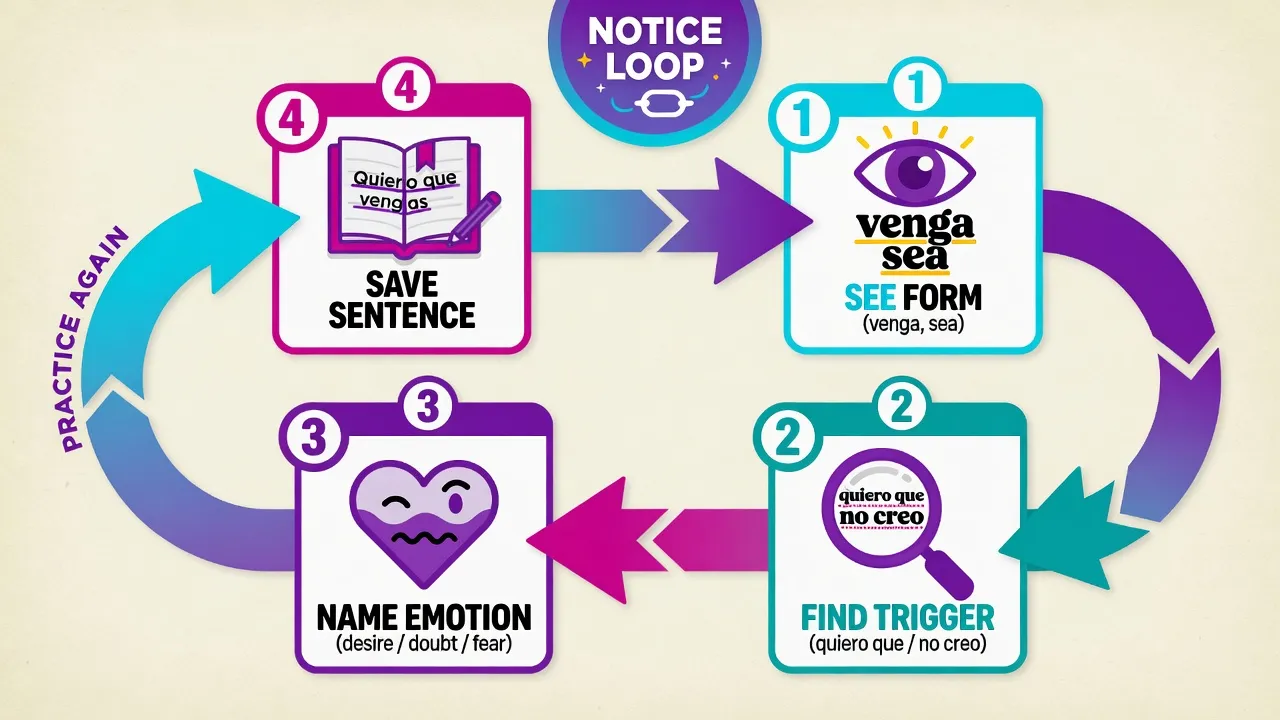
Tables help exams. Reading needs a notice loop.
- Pick text at your level (B1-B2: short dialogues / graded first, not dense classics on day one).
- Notice "odd" endings (venga, sea, hable, estuviera).
- Find the trigger to the left (quiero que / no creo que / es posible que / me alegra que...).
- Name the emotion in one word: desire, doubt, fear, joy, evaluation.
- Save 5-10 full sentences per week, not 100 isolated verbs.
- Once a week: light production - five sentences with Espero que..., No creo que..., Me molesta que...
Warm-up samples if you want a soft start: Spanish A1 sample article, Spanish A2 sample article. More at your level: browse graded Spanish articles.
If tables alone never stuck, try one graded Spanish article this week: pause on three odd endings, name the emotion, save one sentence. That is the whole method.
How MovaReader fits
MovaReader is for the notice loop, not a subjunctive highlighter.
What exists:
- Free graded Spanish library + click-to-translate
- Upload EPUB/files you legally own
- Freemium: about 20 word translations a day; listening often unlimited
- Reader about €1/mo - unlimited translations
- Pro about €5/mo - full trainers
Useful subjunctive path:
- Warm up on the A1 and A2 samples above.
- Browse more at all articles.
- When a form is unclear: translate the word if needed, you decide fact-frame vs attitude-frame.
- Save full sentences (5-10/week). Optional demos: Spanish typing practice, Spanish phrases practice.
- Pricing: freemium, Reader, and Pro. Product path: how to use MovaReader for reading.
Legal literature path: book, library, your file. Train the same pattern on accessible texts in-product. The app keeps you inside Spanish you can finish.
FAQ
Is the subjunctive a tense or a mood?
A mood (modo). Tenses live inside it: present subjunctive, imperfect subjunctive, perfect subjunctive, and more. "Subjunctive tense" as the whole label confuses the calendar with speaker attitude.
Does every que take the subjunctive?
No. Watch the main verb / attitude, not only que.
- Sé que vienes → Indicativo (knowledge as fact)
- Espero que vengas → Subjuntivo (hope / desire)
Same word que; different frame.
When should I start imperfect subjunctive?
After you recognize present subjunctive in real text without panic. Then add imperfecto for past desires, soft requests in past narrative, and common si / ojalá patterns. Stacking every tense on day one mixes endings.
Do I have to learn WEIRDO?
Useful as a cheat sheet, weak as your only strategy. Hang letters on emotional groups (wishes, emotions, doubt, impersonal, requests). Categories + mini-dialogues + noticing beat pure acronym drills. WEIRDO is incomplete - that is normal, not a failure.
Can I avoid the subjunctive in conversation?
Early A2 survival hacks exist (simpler statements, rephrase). From B1 upward, dialogue, series, and media use it constantly. There is no real "skip forever" path if you want natural Spanish. Survival is temporary; recognition is the growth path.
How long until I "feel" it?
No universal clock. Short daily sessions with 3-5 conscious examples (see form → find trigger → name emotion) beat rare multi-hour table marathons. Progress shows as less freeze when venga / sea / hable appear.
Closing
Subjuntivo is a tool of attitude: you want, doubt, feel glad, fear, evaluate. Same world event can be viene or venga depending on the frame.
Notice loop recap: see the form → find the trigger → name the emotion → save one full sentence → light production once a week.
Today: open a short Spanish text at your level, find three subjunctive forms, and label each deseo / duda / emoción. That beats another lonely conjugation wall.
Keep reading with translations inside the text
With a free account, an unknown word translates with one tap, and the words you are learning wait for you in the trainer.
Free account: 7 days of Pro, then 20 word translations a day or a paid plan.