Grammar in Context
Por vs Para in Spanish: a Through-Path vs Forward-Goal Model
English "for" is not one Spanish word. Por looks back or through (cause, path, exchange, duration); para looks forward (goal, recipient, deadline, direction). Model, pairs, hard cases, and noticing in graded Spanish.
Months of Spanish, and your brain still freezes between por and para. Normal. The textbook table never lights up inside a real sentence. English for keeps collapsing two Spanish lenses into one word, so every choice feels random.
Lo hice por ti and Lo hice para ti both gloss as "for you." They do not mean the same thing. Until you feel two directions, the freeze stays.
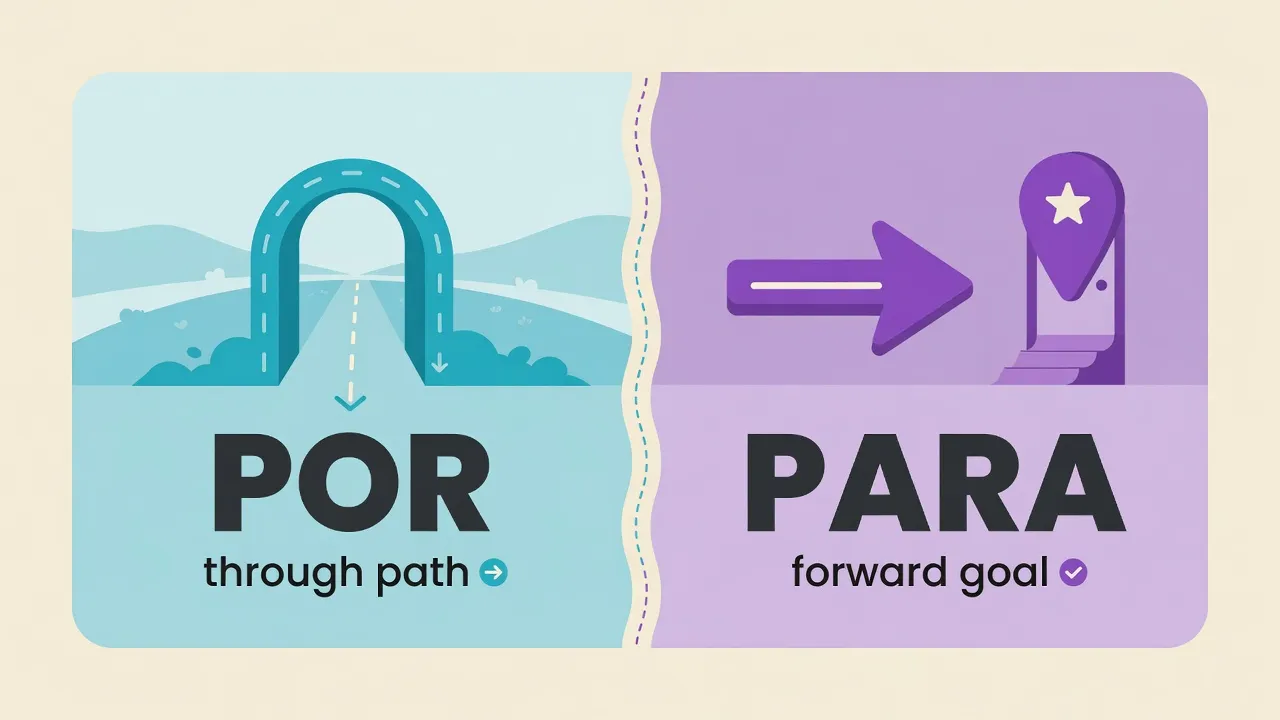
Por vs para both often map to English "for," so one translation rule fails. Think in two lenses: por looks back or through (cause, path, exchange, means, duration); para looks forward (goal, recipient, deadline, direction, standard). Learn the conflict zones and fixed phrases, then notice both in Spanish texts you mostly understand.
Below: why the simple rule fails, the through/back vs forward model, a uses map, six minimal pairs, hard cases, fixed phrases, a mini-test with answers, calm reading practice, how MovaReader helps, a week plan, and FAQ.
Why "por = cause, para = purpose" is not enough
The simplification is fine on day one. It breaks as soon as real Spanish shows more jobs than "reason" and "goal."
English for is a wide bucket. Spanish splits that bucket. If your first language also collapses path, price, deadline, and opinion into one preposition family, your brain will keep guessing.
These are the usual break zones:
- movement through space (por el parque)
- exchange / price (cien euros por el libro)
- deadlines (para el viernes)
- opinion / standard (para mí, para un principiante)
- fixed phrases (por supuesto, para siempre)
Better tool: two lenses on the same situation, not two dictionary glosses you try to force on every line.
Core model: back / through vs forward
Here is the whole spine of por vs para Spanish in two lines:
- Por often looks back or through: cause, path, exchange, means, duration, passive agent.
- Para often looks forward: goal, recipient, direction, deadline, standard or opinion.
Think of two lenses on one scene. Por asks "through what / because of what?" Para asks "toward what / for whom / by when?"
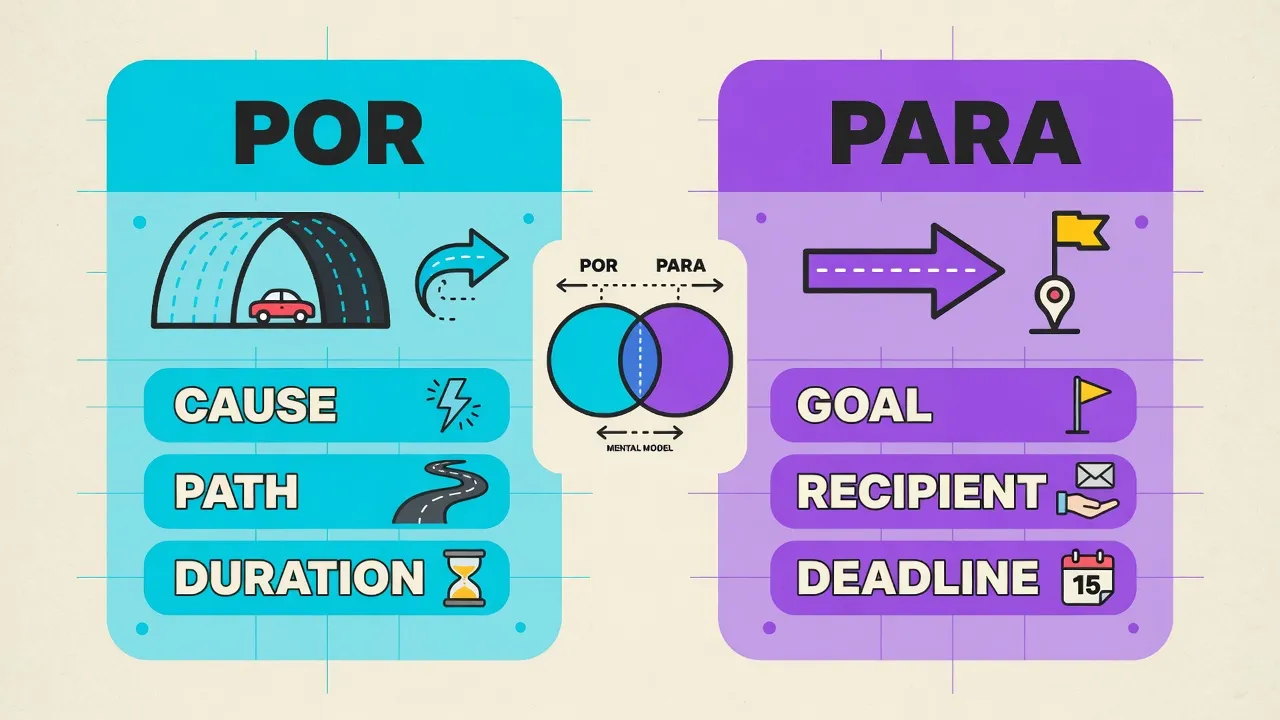
Por in action
Lo hice por amor, no por dinero.
I did it out of love, not for money. Cause / motive.
Caminamos por tres horas bajo la lluvia.
We walked for three hours in the rain. Duration.
(Conversation often drops por: caminamos tres horas.)
Pagué cien euros por este libro.
I paid a hundred euros for this book. Exchange / price.
El tren pasó por un túnel.
The train went through a tunnel. Path.
Para in action
Estudio español para leer novelas en el original.
I study Spanish in order to read novels in the original. Purpose.
Este regalo es para ti.
This gift is for you. Recipient.
El informe debe estar listo para el viernes.
The report must be ready by Friday. Deadline.
Salimos para Madrid a las seis.
We left for Madrid at six. Direction.
When you are unsure, name the lens before you open a grammar wall. Through/back or forward?
Uses map: hang categories on the same two lenses
If you like a cheat sheet, hang the categories on the same two lenses. Do not treat the table as a second brain.
| Lens | Typical uses | Quick cue |
|---|---|---|
| Por (back / through) | reason, path/route, exchange/price, means, duration, passive agent | through, because of, for (in exchange), by, for (time) |
| Para (forward) | purpose, recipient, deadline, destination, employment (job for), standard/opinion | in order to, for (someone), by (deadline), toward, for (a beginner) |
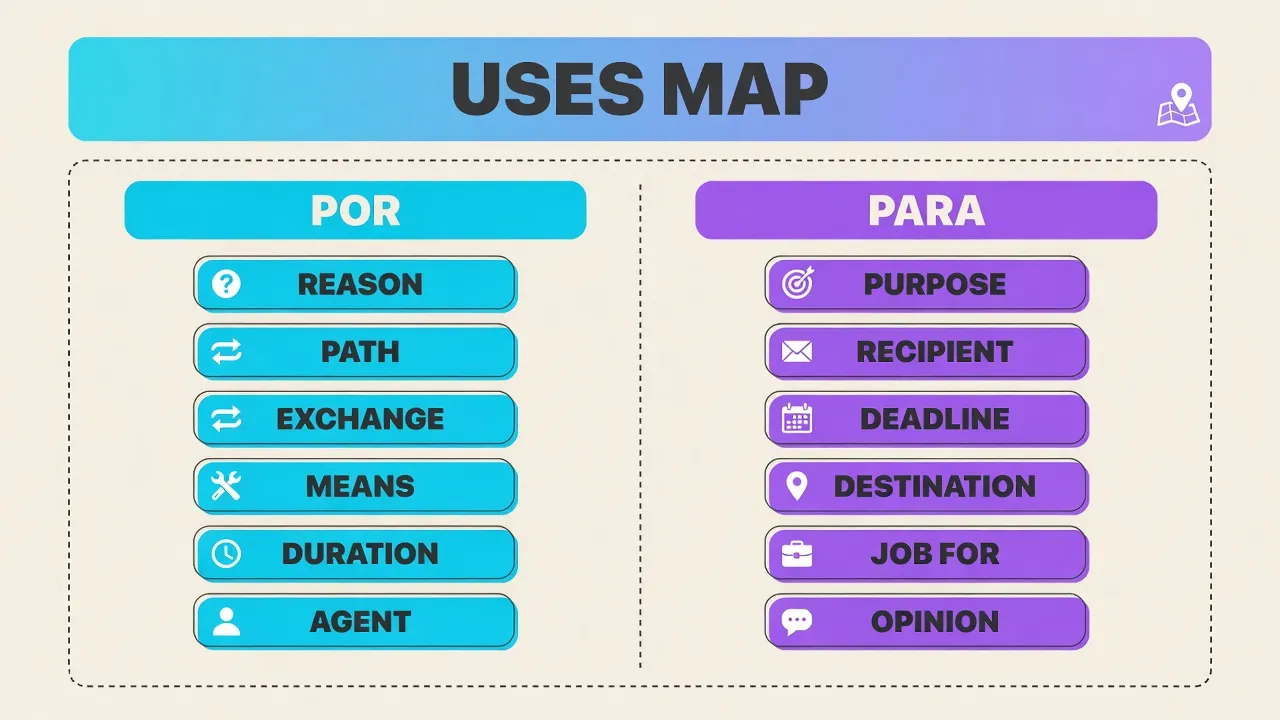
Already memorized a Duolingo-style DREAM / PERFECT list? Fine. Hang those letters on these hooks. Mnemonics store labels; minimal pairs resolve real choices. Memorizing twelve letters is not a finish line.
Minimal pairs: one frame, two meanings
Same skeleton, two lenses. Context almost always chooses. When you meet a pair in a text, pause one second and name the lens.
| Por | Para | Split |
|---|---|---|
| Lo hice por mi familia. (because of / for the sake of family as cause) | Lo hice para mi familia. (for family as beneficiary) | cause vs beneficiary |
| Caminé por el parque. (through / along the park) | Caminé para el parque. (toward the park) | path vs destination |
| El tren pasa por Valencia. (via Valencia) | El tren va para Valencia. (bound for Valencia) | via vs destination |
| Lo hice por ti. (because of you / for your sake) | Lo hice para ti. (for you as recipient) | classic "for you" split |
| ¿Por qué lo hiciste? (why / cause) | ¿Para qué lo hiciste? (what for / purpose) | cause-why vs purpose-what-for |
| Pagué 10 euros por el libro. (price paid) | Ahorro para el libro. (saving toward the book) | price vs saving-toward |
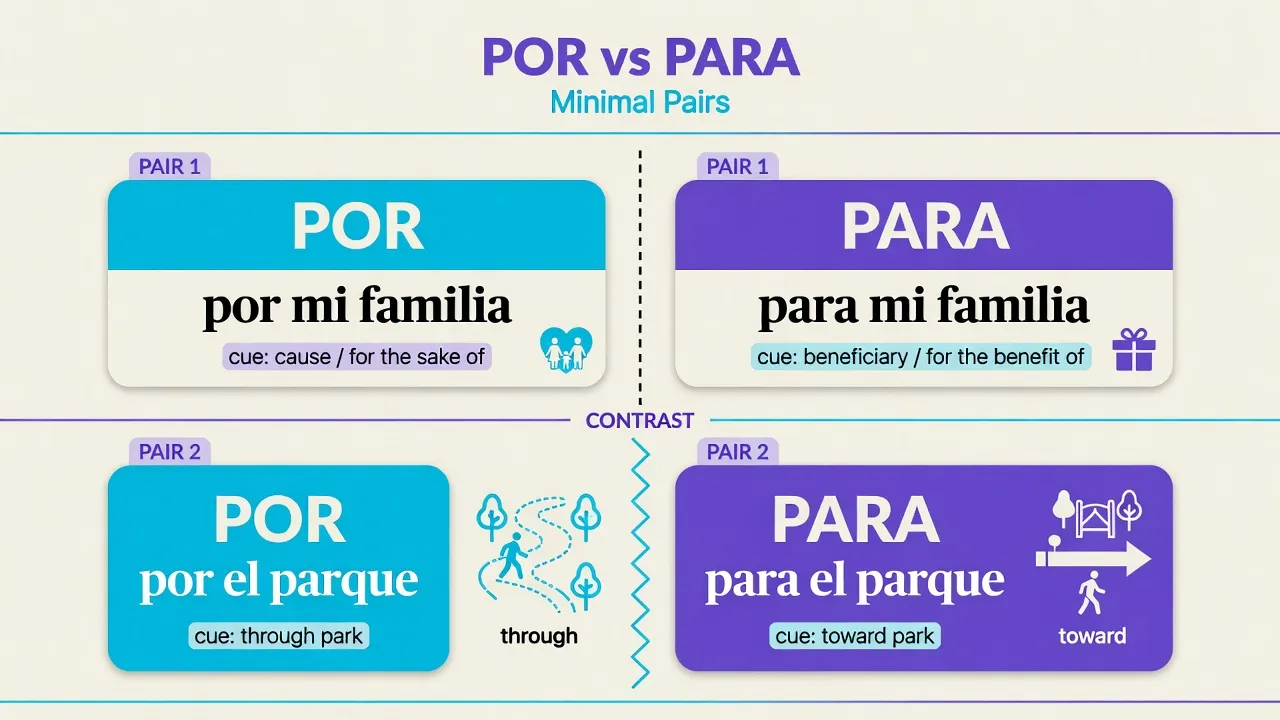
The useful habit is not "never confuse por and para again." It is: notice the split once, label it, keep reading.
Harder but frequent cases
Opinion and standard
Almost always para, not por:
Para mí, este libro es difícil.
In my opinion, this book is hard.
Para ser principiante, hablas muy bien.
For a beginner, you speak very well.
Passive agent
El libro fue escrito por Cervantes.
The book was written by Cervantes. Agent = through-whom. Classic por.
Para que (+ subjuntivo)
Te lo explico para que lo entiendas.
I explain it so that you understand.
Treat para que + subjuntivo as a chunk: the goal is not yet a fact. Light only here; this is not a full subjunctive course.
Two light extras that fit the model
Hablo por teléfono.
I talk on the phone. Means / channel = through.
Trabaja para una ONG.
She works for an NGO. Employment / role = forward for whom you work.
Fixed phrases: rules will not save you
Some strings just come with por or para. Collect them whole from reading. Do not only drill an orphan alphabet list.
With por: por favor, por supuesto, por lo menos, por fin, por cierto, por ejemplo, por si acaso, por eso, por otro lado
With para: para siempre, para nada, para colmo, para que, para variar, para empezar
Rough sense map:
| Phrase | Rough sense |
|---|---|
| por favor | please |
| por supuesto | of course |
| por lo menos | at least |
| por fin | finally |
| por cierto | by the way |
| por ejemplo | for example |
| por si acaso | just in case |
| por eso | that is why / therefore |
| por otro lado | on the other hand |
| para siempre | forever |
| para nada | not at all |
| para colmo | to top it off |
| para que | so that (usually + subjuntivo) |
| para variar | for a change |
| para empezar | to begin with |
Emotion plus situation sticks better than pure list memory. When a phrase hits you in a story, save the whole line.
Mini-test: fill por or para
Cover the answers. Write your choice first.
Set A
- Gracias ___ venir a mi fiesta.
- Este café es ___ llevar.
- Fue castigado ___ llegar tarde.
- Necesito gafas ___ leer.
- Viajamos ___ toda Europa el verano pasado.
Set B
- El cuadro fue pintado ___ Frida Kahlo.
- ___ mí, la película es larga.
- Te lo digo ___ que no te preocupes.
- ¿___ qué estudias español? (both possible; different meaning)
Answers
- por (thanks for / because of coming)
- para (for takeaway / intended for carrying)
- por (punished because of arriving late)
- para (glasses in order to read)
- por (through / around all of Europe)
- por (passive agent)
- Para (opinion: Para mí)
- para (para que + purpose chunk)
- both possible: ¿Por qué? = cause why; ¿Para qué? = purpose what-for. Teach the question; neither is "the wrong word."
Four of five on Set A is a solid base. You still need volume of examples, not a new table.
How to practice without burnout
- Short Spanish text at a level you mostly understand.
- On each por/para, ask: back/through or forward?
- If unsure: check one dictionary example, save the phrase, keep reading.
- Three to eight saved phrases a day is enough, not forty.
- Retest cold after a week.
Noticing walkthrough
Pause → name the lens → continue. That loop is the practice.
María camina por el centro todas las mañanas.
Por = path / through the center. Continue.
Compra pan para la cena.
Para = for dinner as purpose of the bread. Continue.
Lo hace por dinero, no por gusto.
Por = cause / motive (twice). Continue.
Pasamos por Sevilla para llegar a Cádiz.
Via (por) vs goal of arriving (para) in one line.
You do not need heavy literature first. The same prepositions live in graded stories and simple news. Try free samples in the library: ES A1 story and ES A2 story, or browse graded Spanish articles.
How MovaReader helps
MovaReader supports the reading loop.
What exists:
- free graded Spanish library + click-to-translate
- upload EPUB / files you legally own
- unlimited listening on the free plan
- about 20 word translations a day free; Reader €1/mo for unlimited translations; Pro €5/mo for full trainers
How to use it for this topic:
- Open a graded Spanish text you mostly understand.
- Pause on each por/para and name the lens.
- Translate blockers only when needed (about 20 a day on the free plan; Reader if you want unlimited).
- Save fixed phrases and minimal-pair lines to phrases; Pro trainers if you want full drill loops.
- Listen once to the same passage for recognition speed.
Start paths: how to use MovaReader, freemium, Reader, and Pro pricing, Spanish phrases practice, Spanish typing practice. You still decide por or para. The app keeps you inside Spanish you can finish.
FAQ
Is there one rule for every case?
No. Back/through vs forward covers a lot; fixed phrases and some constructions still need context. There is no single dictionary gloss that wins every time.
Should I learn tables at all?
Yes as a cheat sheet after confusion. No as the only decision tool in speech. Hang categories on the two lenses; do not memorize a wall and call it done.
Why do I still mix them at B1-B2?
Strong L1 / English interference plus automaticity needs volume. Not a "no talent" verdict. You need more examples in real sentences, not a longer acronym.
What first: por/para or ser/estar?
Whichever breaks your real reading or speaking more. Both matter; practice sets priority, not fear. Related conflict: ser vs estar.
Can I learn only from conversation?
Yes with lots of input and correction. Reading simply gives more por/para examples per minute, so noticing is faster.
Are por qué and para qué the same?
No. Por qué often asks cause (why / because of what). Para qué asks purpose / what for. Pair them as a hard-case habit, same family as other minimal pairs.
Is "for you" always para ti?
No. Por ti (because of you / for your sake as cause) vs para ti (for you as recipient). Classic pair: Lo hice por ti / Lo hice para ti.
Will an app auto-fix por/para forever?
No. Noticing + chunks + volume beats a magic grammar oracle. MovaReader supports reading with click-to-translate; it does not replace your attention or auto-X-ray every por/para.
Duration vs deadline?
Duration often leans por (por tres horas). Deadlines lean para (para el viernes). When unsure, name the lens: through a stretch of time, or forward to a target moment.
Weekly mini-plan
Fifteen minutes of live context beats a perfect table you forget by Friday.
| Day | Do | Time |
|---|---|---|
| 1 | Read 1 easy text; note 5 por/para | 15 min |
| 2 | Replay back/through vs forward on new examples | 15 min |
| 3 | Collect 5 fixed phrases from text | 10-15 min |
| 4 | Write 6 own sentences (3 por, 3 para) | 15 min |
| 5 | Cold mini-test (sets A+B) | 10 min |
| 6 | Read + listen same passage once | 15 min |
| 7 | Short recap: which zones still confuse | 10 min |
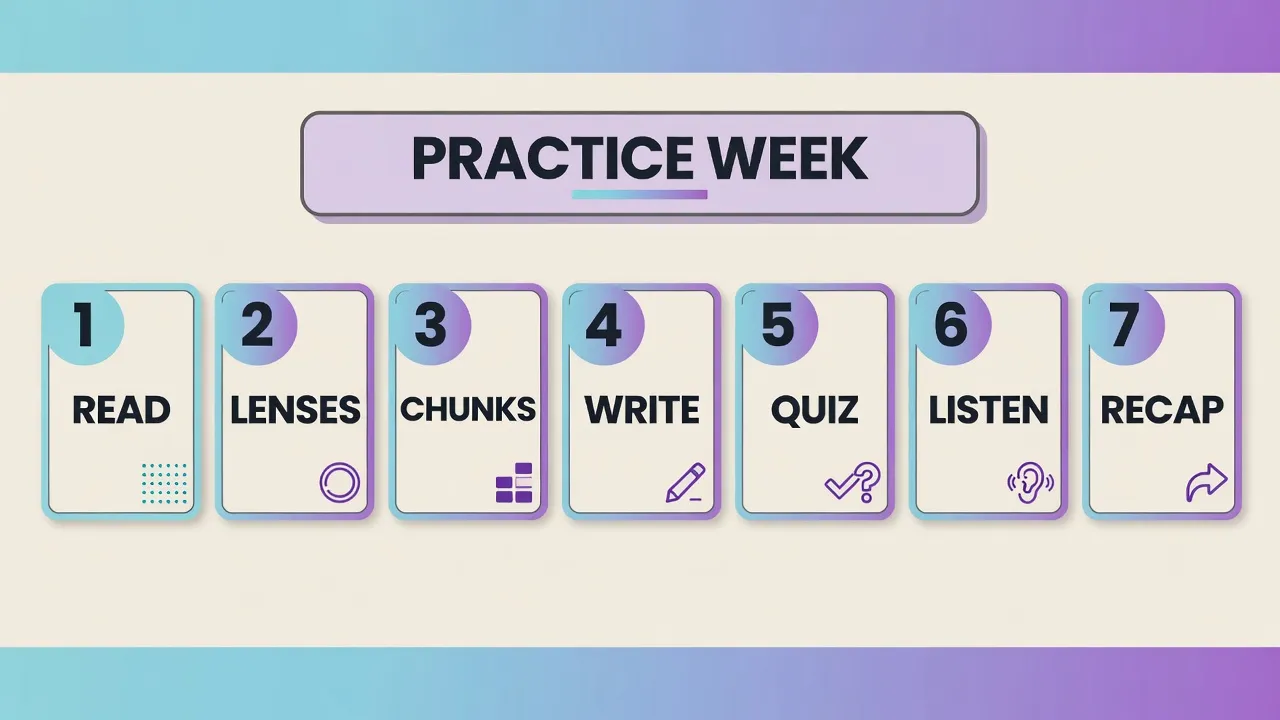
Soft daily loop: 10-15 minutes of easy Spanish, one-second pause on each por/para, up to five fixed phrases into your bank, retest cold on day 7.
If day 7 still has one or two weak zones (for example deadline vs duration), that is normal. Next week focus only there. Week one is practice volume, not a forever-clean score.
Takeaway
Stop hunting one English translation of "for." Use the direction model, walk the conflict zones, collect chunks, and read Spanish at a level you mostly understand.
Fifteen minutes of live context daily beats a dead table. Por vs para gets clearer when both lenses keep showing up in sentences you can finish, not when you promise yourself a perfect rule book by Friday.
Keep reading with translations inside the text
With a free account, an unknown word translates with one tap, and the words you are learning wait for you in the trainer.
Free account: 7 days of Pro, then 20 word translations a day or a paid plan.