Grammar in Context
Spanish Reported Speech: Backshift Map + Reading Method
You know the reported-speech table - then a real Spanish chat freezes you. Backshift compass, five verb families, four reading steps.
You know the Spanish reported speech table. The book exercise goes fine. Then someone asks what María said, or you try to summarize a WhatsApp thread, and the tenses fall apart.
That is not a talent problem. It is a useful-exposure gap. Spanish estilo indirecto (reported speech) gets smoother when you see it hundreds of times in context: interviews, gossip columns, detective dialogue, meeting recaps - not only gap-fills.
Here is the one-beat version before any long list:
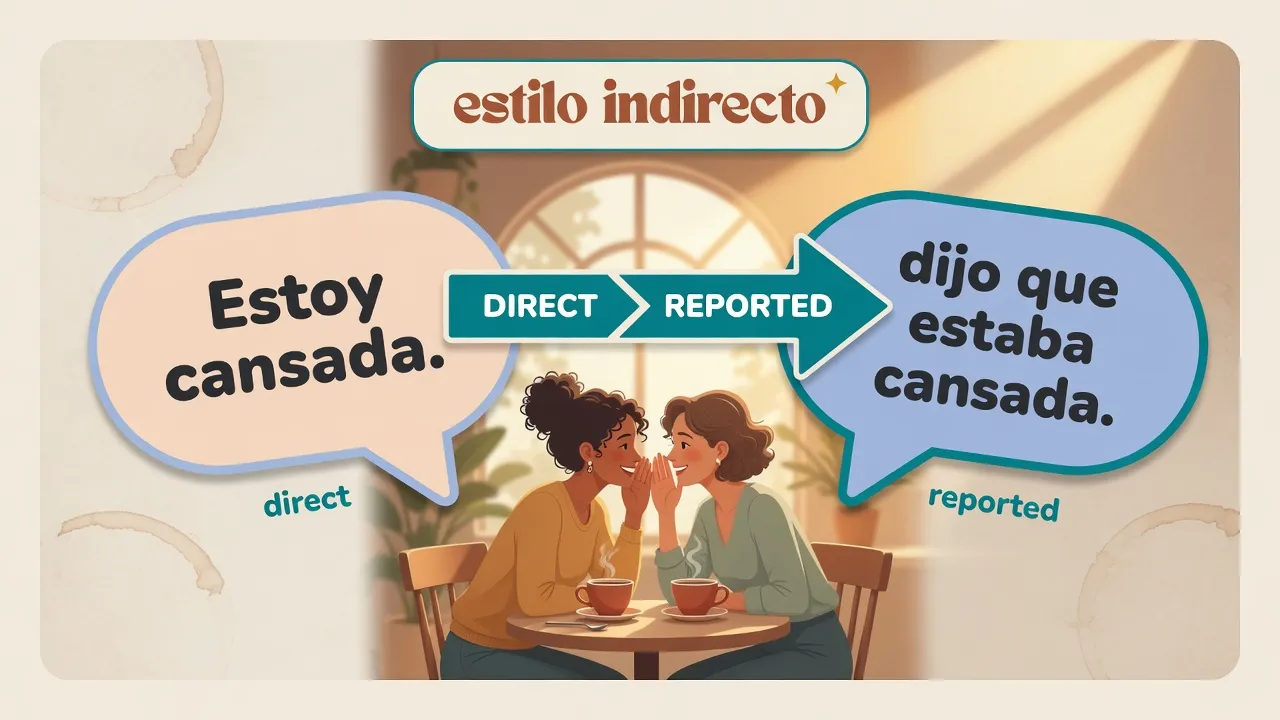
María dijo: "Estoy cansada."
María dijo que estaba cansada.
Spanish reported speech (estilo indirecto) means you report what someone said with que or si (or an interrogative), plus person, tense, and time/place shifts when they are needed. When the reporting verb is past (dijo, explicó), Spanish often backshifts (present → imperfect, future → conditional, imperative → imperfect subjunctive after pedir/decir que). When the reporting verb is present, or the fact still holds, you often do not backshift. The classroom table is a compass, not a muscle; the muscle comes from seeing the pattern in real text, then reconstructing direct and indirect forms.
This post is Spanish grammar (estilo indirecto), not English reported speech. For learners of English, we keep a separate English reported speech guide.
Below: a short definition, the backshift map, when not to shift, five report-verb families, frequent traps, a 4-step reading method, a mini workshop, where MovaReader fits, and FAQ.
What is estilo indirecto?
Direct style quotes the words as said.
María dijo: "Estoy cansada."
Indirect style reports the content, usually with que, plus person and tense adjustments.
María dijo que estaba cansada.
Same story, different shape. In real life you use estilo indirecto for chismes / gossip, meetings, news summaries, "me contó que...", and long chat recaps. You are not always repeating a perfect quote. You are carrying the meaning forward.
Why is this hard if you already saw the table?
Because the table is a summary, not a muscle.
In class you see clean pairs:
- "Estoy cansado" → Dijo que estaba cansado.
- "Iré mañana" → Dijo que iría al día siguiente.
In conversation you also have to:
- pick the report verb (dijo / contó / admitió / negó)
- fix pronouns
- adjust time and place words (hoy, aquí, mañana)
- decide whether the fact still holds
Twenty gap-fills help you pass a unit. They do not, by themselves, make summarizing feel automatic. That needs volume of real phrases.
Backshift map (when the reporting verb is past)
If the reporting verb is past (dijo, comentó, explicó, confesó), Spanish often takes one step back in tense. Think compass, not religious law.
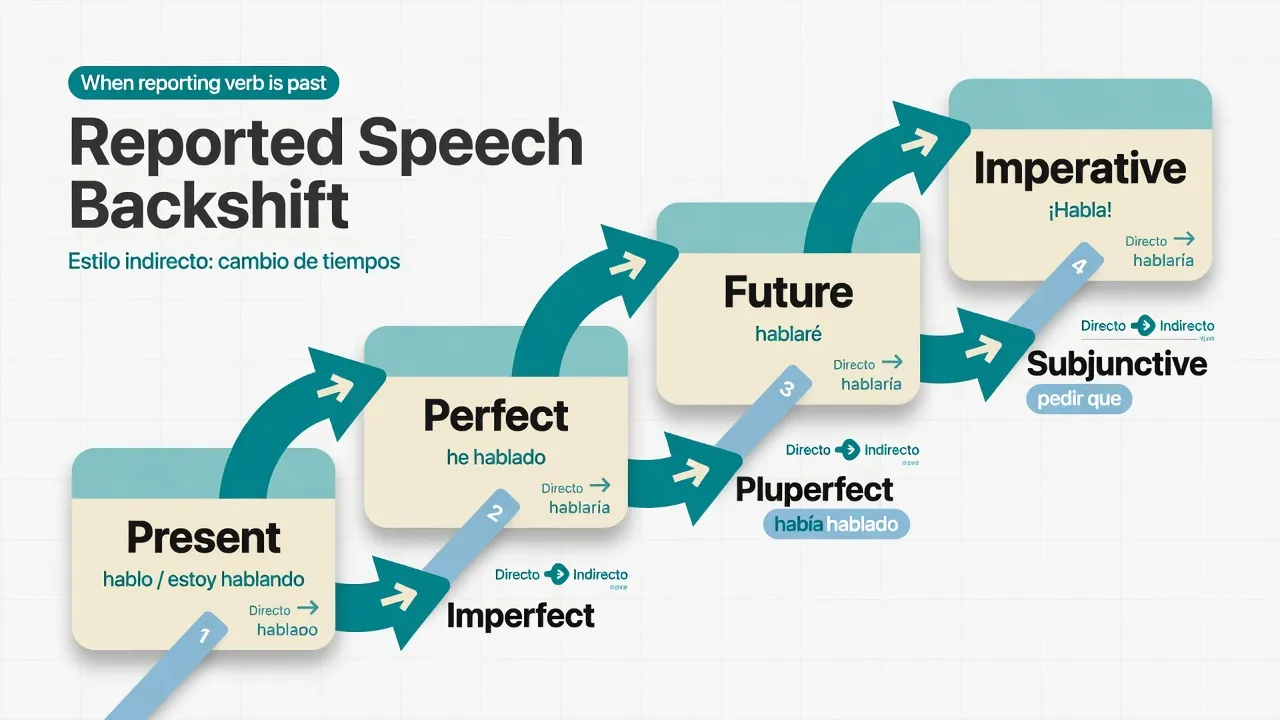
| Original tense (direct) | Frequent form in indirect | Example |
|---|---|---|
| Present | Imperfect | "Tengo hambre" → Dijo que tenía hambre. |
| Pretérito perfecto | Pluscuamperfecto | "He comido" → Dijo que había comido. |
| Pretérito indefinido | Pluscuamperfecto (or kept in some styles) | "Llegué tarde" → Dijo que había llegado tarde. |
| Future (iré) | Conditional (iría) | "Vendré" → Dijo que vendría. |
| Conditional | Conditional (often stays) | "Me gustaría ir" → Dijo que le gustaría ir. |
| Imperative | Imperfect subjunctive (with pedir/decir que) | "Ven aquí" → Le pidió que viniera. |
Real Spanish admits variation, especially in speech. Exams and careful writing stick closer to the map. If imperfect and pluscuamperfecto still feel fuzzy as forms, our piece on Spanish past tenses (preterite vs imperfect) can shore up that muscle while you train reported speech.
When the reporting verb is present (often no backshift)
If you report with dice, comenta, explica in the present, you often keep the original tense:
Dice que está cansada.
Comenta que vendrá mañana.
María dice que no va.
Journalism and same-day gossip love this shape. You are not "wrong" for not backshifting when the report itself is present.
Report-verb families that cover almost everything
You do not need a hundred verbs. You need families that show up in news, gossip, and dialogue again and again.
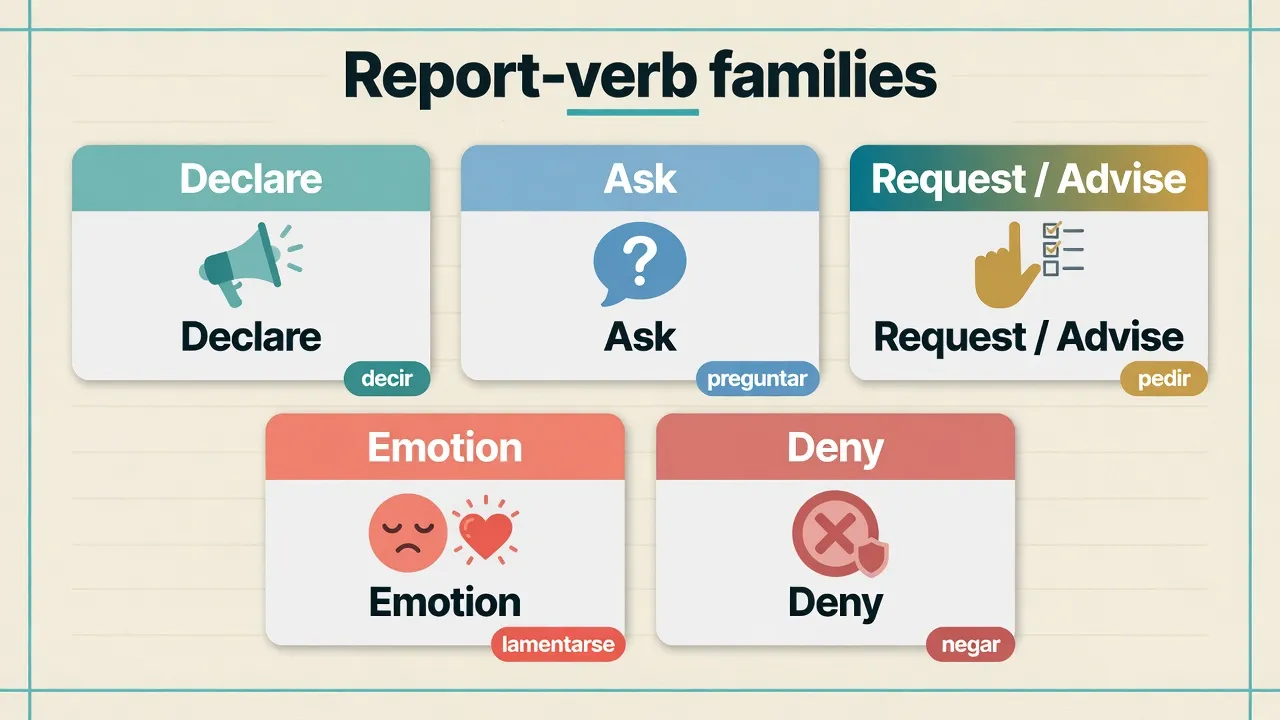
Declare / tell
decir, comentar, explicar, afirmar, señalar, confesar, admitir
María afirmó que conocía al sospechoso desde hacía años.
Ask
preguntar, querer saber, indagar
- Yes / no: preguntó si...
- Wh-: preguntó dónde / cuándo / por qué...
El periodista preguntó si la cantante pensaba retirarse.
Le preguntó dónde vivía.
Request / order / advise
pedir, ordenar, rogar, sugerir, aconsejar, recomendar
These usually take subjunctive:
El médico le aconsejó que dejara de fumar.
Le pidió que llamara más tarde.
If subjunctive after requests still feels sticky, our Spanish subjunctive without tears piece goes deeper without another dry drill bank.
Emotion / complaint
lamentarse de, alegrarse de, quejarse de, sorprenderse de
Se quejó de que nadie le hubiera avisado.
Deny / doubt
negar, dudar, no creer
El acusado negó que hubiera participado en el robo.
After negar que, subjunctive is frequent. Judicial chronicles make that less abstract than a textbook footnote.
Frequent traps
Most slips are not "forgot the whole table." They are pronouns, deixis, over-shifting, or English calque.
Pronouns
Direct: "Yo lo hice por mi cuenta."
Indirect: Confesó que él lo había hecho por su cuenta.
When you report a third person, yo / mi usually become él/ella / su.
Time and place (deixis)
Time and place words point from the speaker's "now." When you report later, the compass often shifts.
| Direct | Frequent in indirect |
|---|---|
| hoy | ese día / aquel día |
| ayer | el día anterior |
| mañana | al día siguiente |
| aquí | allí |
| esta noche | esa / aquella noche |
| el próximo lunes | el lunes siguiente |
Not always obligatory if context is already clear. Exams and careful writing care more.
Backshifting when you should not
If the information still holds when you report, Spanish can keep the present:
Dijo que la Tierra gira alrededor del Sol.
Me dijo que se llama Ana. (she is still called Ana)
You will also hear the backshifted version. Both appear. The useful skill is recognizing the logic, not policing every native speaker.
Translating word-for-word from English
English has reported speech too, but the habits are not identical - especially subjunctive after pedir / aconsejar / negar. If you want the English-language map for learners of English, use the English reported speech guide.
4-step reading method
No new app stack required. Four steps you can run on any Spanish text full of reported voice.
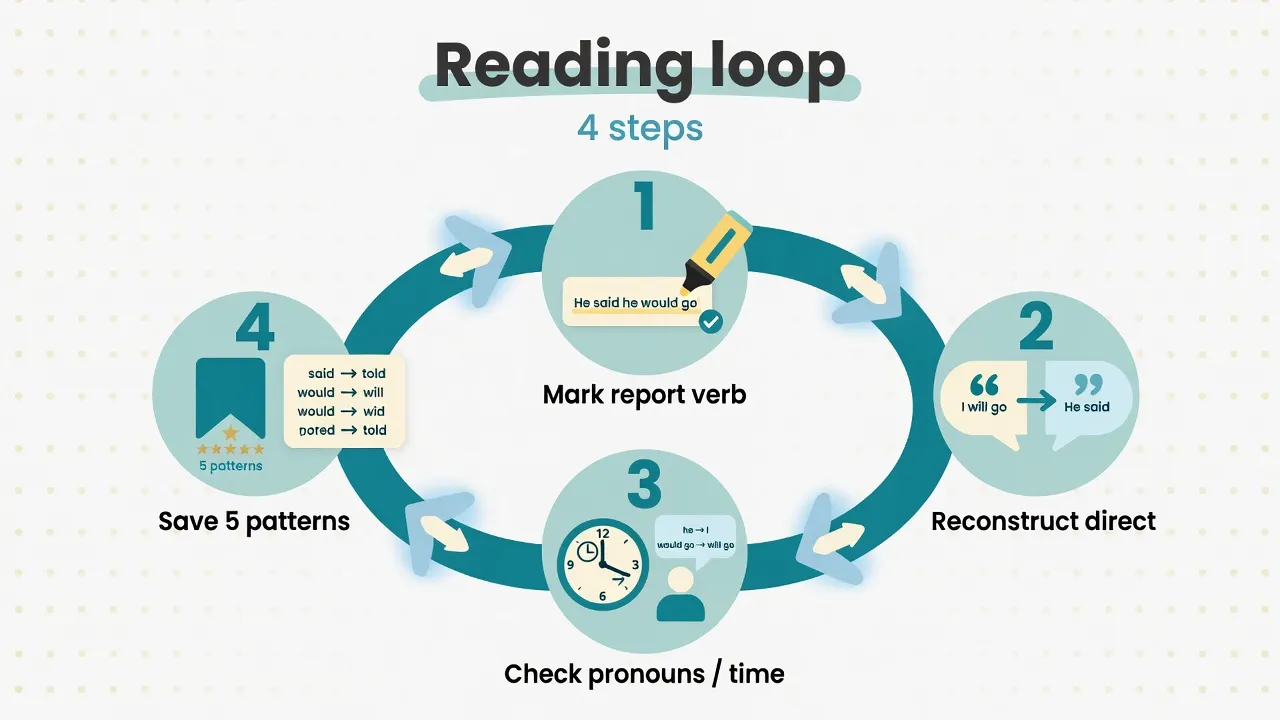
Step 1: pick texts full of reported voice
Good mines:
- interviews and journalistic profiles
- court / true-crime chronicles (serious ones)
- novels with interrogations and testimony
- gossip magazines (input, not your only model of formal Spanish)
- political columns and same-day news
Step 2: mark the reporting verb
Every time you see dijo que / explicó que / negó que / preguntó si, pause for one second. That pause trains recognition.
Step 3: reconstruct the direct form
You read:
El detective le preguntó si había estado en la casa aquella noche.
Possible original:
"¿Estuviste en la casa anoche?"
Flipping both ways builds the transform, not only "fill the blank from left to right."
Step 4: save 5 patterns, not 40 table rows
Useful note shapes:
- dijo que + imperfecto
- preguntó si + pluscuamperfecto
- le pidió que + imperfecto de subjuntivo
- negó que + hubiera + participle
- present report: dice que + present (often no backshift)
You can browse free graded Spanish articles when you want cleaner register than a gossip page, or open a sample Spanish A1 article / sample Spanish A2 article and mark three reports before the plot ends.
Mini workshop
Four core drills. Optional fifth for negar que. Read them aloud; the ear helps more than recopying the table.
Direct: "No puedo ir mañana."
Indirect: Dijo que no podía ir al día siguiente.
Direct: "¿Has visto las llaves?"
Indirect: Me preguntó si había visto las llaves.
Direct: "Llama a tu madre."
Indirect: Me dijo / pidió que llamara a mi madre.
Direct: "Nunca he estado en Lima."
Indirect: Afirmó que nunca había estado en Lima.
Optional: "No participé en el robo."
Indirect: Negó que hubiera participado en el robo.
Notice the package: tense shift, si for yes/no questions, imperfect subjunctive after a request, and person shifts where the report changes who is speaking.
How MovaReader fits
For Spanish estilo indirecto you need volume of Spanish text and a little analysis. MovaReader is a reading app with lookup friction reduced. You meet reported speech inside graded Spanish and files you own. You mark dijo que / preguntó si / negó que yourself.
What exists today:
- free graded Spanish library with click-to-translate
- freemium: about 20 word translations per day + unlimited listening
- Reader (€1): unlimited word translations
- Pro (€5/month): full type / phrase trainers
- upload an EPUB or file you own (we do not host licensed commercial novels free by default)
Suggested path for today:
- Open a short Spanish text from the free library (or A1 / A2).
- Mark 3-5 reports: dijo que / preguntó si / pidió que / negó que.
- Rewrite one back into direct speech (or the other way).
- Save the pattern - e.g. le pidió que + imperfect subjunctive - in phrases if you use that bank.
- Optional: practice the line in free Spanish vocabulary trainer or the everyday Spanish phrases practice (Pro for full trainers).
Translate only the blockers (freemium ~20/day; Reader if unlimited lookups matter). Listen after you understand the page, if that helps. For orientation, see how to use MovaReader and plain pricing. Start with a free article; go paid when the daily translate limit actually bites.
FAQ
Are estilo indirecto and reported speech the same thing?
Yes in language-learning practice: both mean reporting what someone said (content, not always a word-for-word quote). The usual Spanish name is estilo indirecto. English "reported speech" / "indirect speech" points at the same skill for learners of Spanish - just remember Spanish habits (including subjunctive after pedir and negar) are not a carbon copy of English.
Do you always have to change the tense?
No. It depends on the reporting verb's tense and whether the content still holds. Past report (dijo, explicó) often backshifts. Present report (dice, comenta) often keeps the original tense. Still-true facts can keep present (Me dijo que se llama Ana). Real speech varies; the table is a compass, not a fine.
What is harder: dijo que or le pidió que?
For many learners, commands and advice hurt more. Dijo que + indicative backshift is one map. Le pidió / aconsejó que usually wants subjunctive (llamara, dejara). Negó que often wants subjunctive too. If dijo que feels OK but requests feel sticky, that is normal - train the request family on purpose.
Do gossip magazines help?
Yes as input. They are full of confesó que / aseguró que / fuentes afirman que. Use them to see reported voice in the wild - not as your only model of formal Spanish. Pair with interviews, serious chronicles, and graded articles when you want cleaner register.
Can grammar exercises alone get you fluent at this?
Enough for a short exam unit, often. Speaking and summarizing ease need the pattern in real texts plus practice retelling what people said. Exercises label the map; exposure builds the muscle. Neither path promises fluency on its own.
Does MovaReader auto-correct my reported speech when I write?
That is not a core feature. Main value here: read Spanish with click-to-translate support, listen when useful, and practice phrases you choose to save in demos/trainers. The app is not an AI professor that unpacks every reported clause for you.
Close
Spanish reported speech is not "done" after one textbook unit. It feels natural when you can summarize what a character, interviewee, or coworker said without translating word-for-word from English.
Start today with a short text, mark five reports, rewrite one. If you want less friction while reading Spanish, open a free graded article and leave paid plans for when the daily translation limit matters for real. For English grammar, see the English reported speech guide.
Keep reading with translations inside the text
With a free account, an unknown word translates with one tap, and the words you are learning wait for you in the trainer.
Free account: 7 days of Pro, then 20 word translations a day or a paid plan.