Reading Strategies
Reading Aloud vs Silent: Pronunciation Method
You can understand a page and still freeze when you speak it. Here is a realistic way to combine silent volume, listening, and short aloud practice without fake fluency promises.
You open a page in English, follow the plot, and feel smart. Then someone asks you to read one sentence out loud, and your mouth freezes. The words in your head were smooth. The words in your mouth were not.
That gap is normal. Silent reading and spoken pronunciation are related skills, not the same skill. Silent reading builds the language in your head: vocabulary, grammar feel, stamina. Reading aloud trains the mouth: stress, rhythm, connected speech. Aloud without an audio model can lock wrong pronunciation. The habit that works is daily silent volume plus short shadowing with a model on texts you mostly already understand.
Here is the simple version: understand first, hear a model, then speak. Keep it short so you actually repeat it.
What silent reading is great for
Silent reading is excellent when you want volume without turning every page into a performance. It is strong for:
- vocabulary growth from repeated patterns
- grammar intuition (you "feel" what looks right)
- reading speed and stamina
- motivation, if the text is interesting and not too hard
It is weaker for:
- the exact sound form of words
- connected speech (how natives blend words)
- stress and intonation
- muscle memory for sounds your first language does not use
When you read silently, your brain often grabs word shapes and meaning without fully simulating native sound. That is efficient for comprehension. It does not reliably train speech.
Take a familiar trap line:
"She had a gorgeous smile that could light up the entire room."
Silently, you may get the meaning in one glance. Aloud, gorgeous may come out wrong, or the stress may land on the wrong syllable. Until you hear a model, those private guesses can harden into habits.
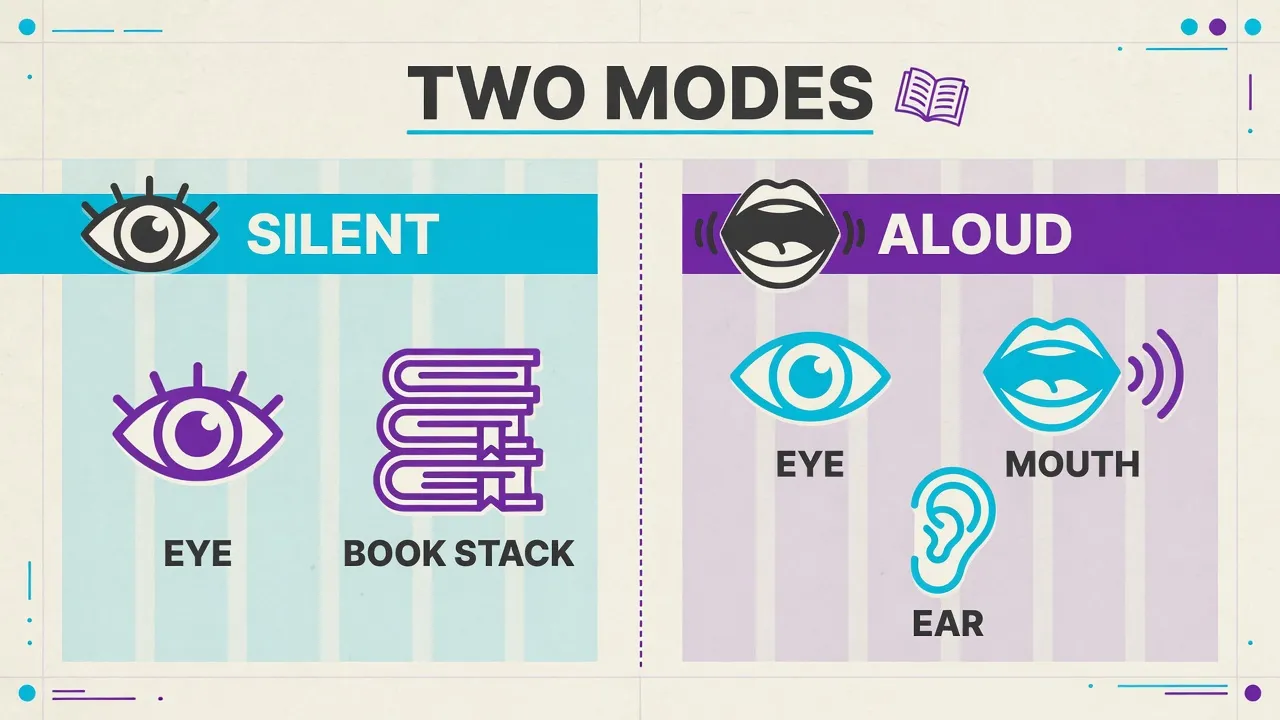
Two different jobs, two different channels:
Why reading aloud helps (and the trap)
Reading aloud lights up more than vision:
- eyes decode text
- mouth produces sound
- ears hear what you actually said
Memory research often talks about a production effect: material spoken aloud can be remembered better than material only read silently. For language learners, the practical point matters more than the lab label. Pronunciation is partly a motor skill. Motor skills need repetition with a model, not only silent recognition.
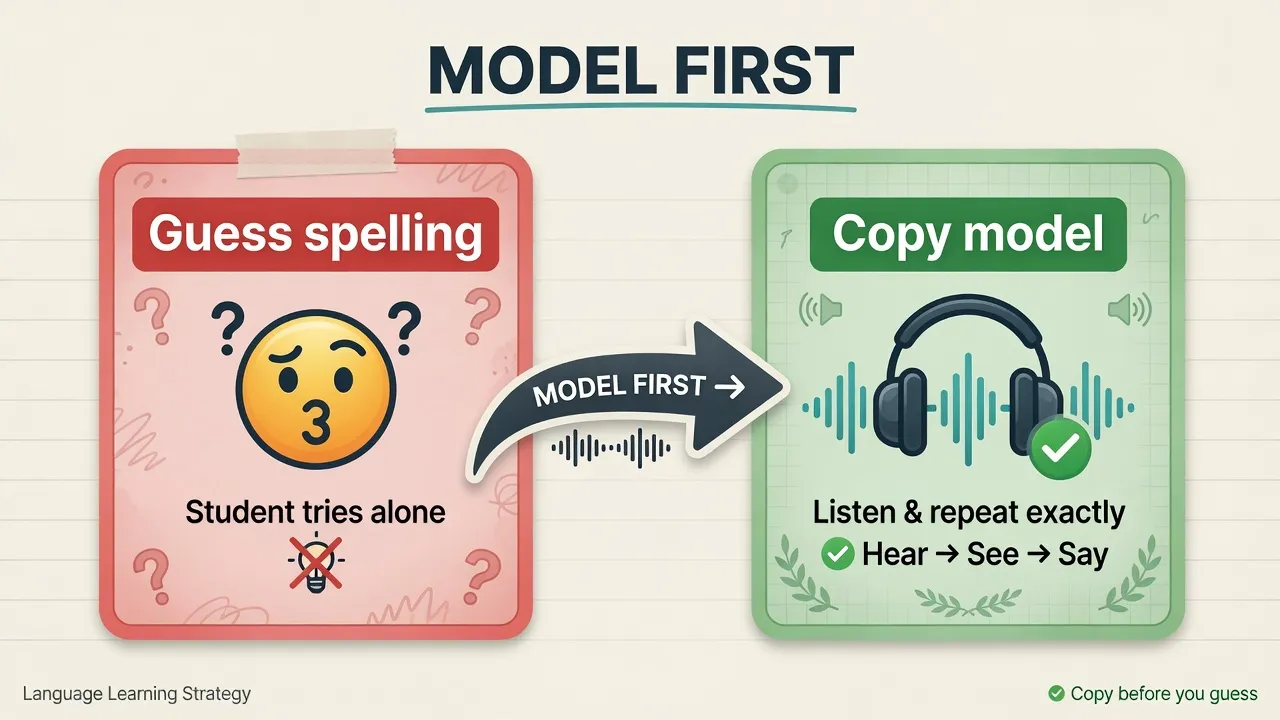
The catch: if you do not know how a word sounds, reading it aloud can train the wrong version. English colonel is the classic trap. Though, through, thought, and tough look like cousins and sound like strangers. Guessing from spelling is a risky teacher.
So the useful formula is not "always read aloud." It is:
- Understand the text (silent)
- Hear a decent model
- Shadow or re-read aloud
- Keep sessions short enough that the habit survives
Guessing from letters vs copying a model:
Shadowing: when reading becomes speaking practice
Shadowing means listening to a speaker and repeating almost immediately. You copy rhythm, stress, and melody, not only single phonemes.
It trains:
- prosody (rise and fall of the phrase)
- connected speech (how words blend)
- stress timing
- natural pacing
The classic self-study mess: audio lives in one app, text in another. You pause a podcast, lose the line, restart, get annoyed, quit.
A better setup:
- Text in front of you
- Sentence-level or paragraph-level audio
- Pause, repeat, continue
- Material you actually care about
You are not trying to sound native in a week. You are teaching your mouth the shapes of phrases you already understand. That is why shadowing works best after a silent pass, not before.
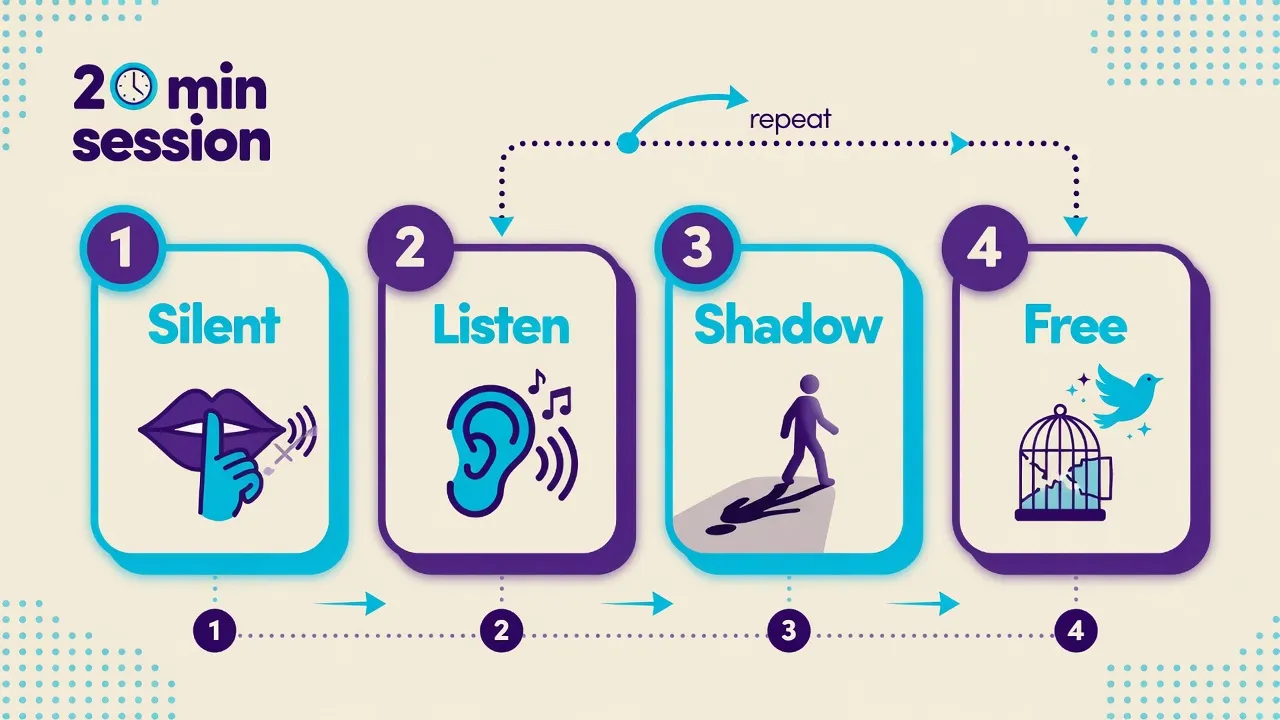
A practical session: 20-30 minutes
You do not need a perfect studio. You need a loop you can finish on a tired Tuesday.
1) Silent pass (~5 min)
Read for meaning only. Look up blockers, not every mild unknown. If you understand much less than about 80% of the page, choose easier text. Hard text plus pronunciation is too many jobs at once.
2) Listen with text (~5 min)
Play audio while your eyes follow. Notice:
- where stress falls
- where the speaker pauses
- which function words reduce (to, and, of)
- how emotion changes pitch in dialogue
3) Shadow (~8-12 min)
For each sentence:
- Listen
- Pause
- Say it aloud
- Re-listen if the gap is large
- Move on after 1-3 tries (perfectionism kills the habit)
4) Free aloud (~3-5 min)
Turn audio off. Read the same passage once. Once a week, record a short clip on your phone if you want proof of change later.
The loop in one picture:
Five drills that stay useful
Echo
Listen to one sentence, wait two seconds, repeat from memory. Forces you to hold melody, not only words.
Speed match
Read first yourself, then play the model. Notice where you added extra pauses. Re-read a little closer to the model.
Whisper
Shadow in a whisper. Useful for mouth shape when you cannot speak loud (late train, shared flat, sleeping kids).
Emotion copy
Use dialogues. Copy not only sounds but attitude: irritation, hesitation, warmth. Prosody carries meaning, not only phonemes.
Record and compare
Phone vs model. Do not grade yourself with twelve criteria. Pick one focus for the week (final consonants, English th, question intonation, Spanish rr, whatever keeps biting you).
You still need silent reading
This is not a war against silent reading. Aloud practice without volume reading is like gym day with no protein: thin gains, weak stamina.
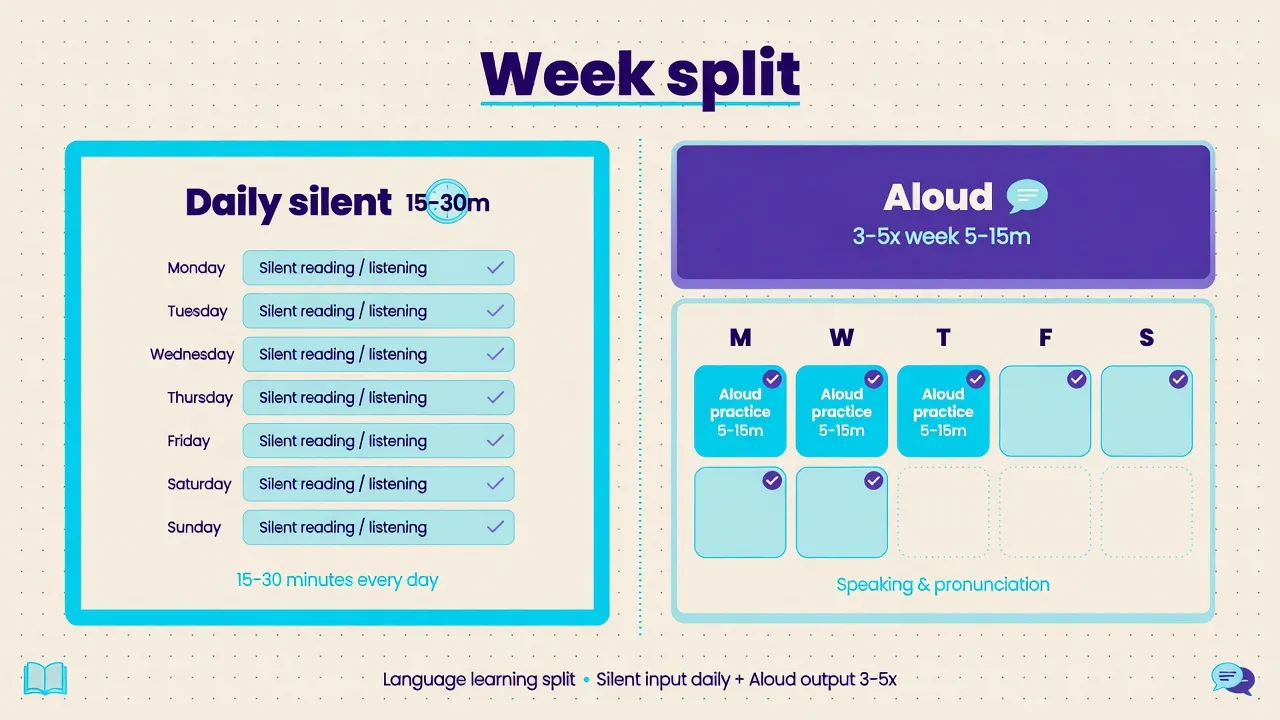
A realistic weekly split:
- Silent reading daily for volume and comprehension (15-30 minutes)
- Aloud / shadowing 3-5 times a week for pronunciation (5-15 minutes)
Same book can serve both modes. Understand first. Then sound it out.
If words keep blocking you before you even get to sound, check the language map for rough orientation, then pick easier material. For words you "know" but never use out loud, see passive to active vocabulary. If your head still translates every line, how to stop translating in your head pairs well with this method.
Which texts work best
Start with material that is slightly easy for your ego:
- dialogues and modern prose
- graded texts at your level
- pages where you understand most words already
Worse places to start:
- heavy poetry
- archaic classics
- dense technical jargon
In the article library you can open something like English A2 or another graded sample and stay there until the mouth work feels boring (boring is good; it means the form is settling).
Common mistakes
- Reading aloud on text you do not understand. Sound without sense is empty practice.
- Only isolated sounds for weeks. Useful for a stubborn phoneme; not a full speaking diet.
- Prestige books that are too hard. Pride is a terrible coach.
- No audio model. Spelling is not a reliable guide in English.
- One long marathon a week instead of short frequent reps. Pronunciation likes frequency more than hero sessions.
How MovaReader helps (honest version)
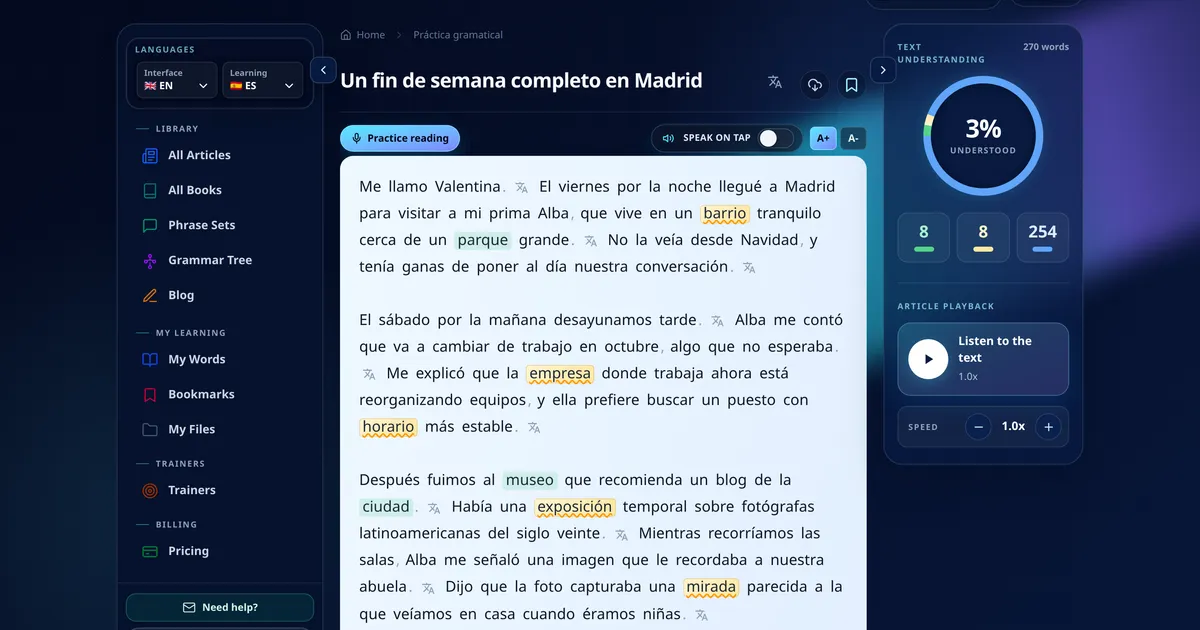
MovaReader is useful here because text and listening can live in one reading workflow. You follow the line, play audio, pause, try again, without juggling three apps.
Product facts, plain:
- free graded library + click-to-translate
- upload EPUB and files you own legally
- unlimited listening on freemium (audio is not locked behind a premium wall)
- about 20 word translations per day free
- Reader ~€1 for unlimited translations when volume grows
- Pro ~€5/month for full trainers after you save phrases
- demos: type training, phrase typing
- paths: all articles, pricing, how to use, trainers, phrases
What it does not do:
- replace a human teacher for pinpoint accent feedback
- host commercial novels by default without your own legal file
- promise native-like speech in a fixed number of days
A simple sequence:
- Open an easy free sample
- Silent read once for sense
- Listen and shadow for five minutes
- Optionally save a few spoken phrases for later practice
TTS is a convenient rhythm and sound model. It is not a full accent coach. Use it for daily reps; use a teacher when you want targeted feedback.
7-day challenge
- Pick one text slightly easier than your ego wants
- Shadow 5 minutes a day (same text family all week)
- Do not hop books every day
- On day 7, record one paragraph without audio
If day 7 is only a little better than day 1, that still counts. Pronunciation compounds slowly. Compare monthly recordings of the same paragraph if you want calmer evidence than daily mood.
FAQ
Is reading aloud better than silent reading?
For pronunciation and sounding more confident with English in your mouth, usually yes, if you have a model. For reading volume and broad vocabulary, silent often wins. You need both.
Does TTS replace a teacher?
No. TTS is a convenient model for rhythm and many sounds. A teacher can still catch subtle errors and adapt drills. Different tools.
Should beginners read aloud?
Yes, on easy texts. If every other word is unknown, lower the level first. Mouth practice on chaos only builds chaos.
When will I notice progress?
Often within a few weeks for common phrases; longer for overall accent. Monthly recordings beat guessing.
Do I need Pro for pronunciation in MovaReader?
No. Listening is available on freemium. Pro is more about full trainers after you save phrases. See pricing if you want the full plan map.
Is reading aloud the same as speaking practice?
Not fully. Aloud helps fluency of form and confidence with known text. Real speaking still needs spontaneous sentences and conversation. Treat aloud work as one strong gym for the mouth, not the whole sport.
Bottom line
Silent reading builds the language in your head. Reading aloud with a model builds the language in your mouth. The productive habit is short, repeated, and slightly easy: understand, listen, shadow, stop before it becomes punishment.
Start with one easy page today. Five honest minutes beat another perfect plan you never run.
Keep reading with translations inside the text
With a free account, an unknown word translates with one tap, and the words you are learning wait for you in the trainer.
Free account: 7 days of Pro, then 20 word translations a day or a paid plan.