Vocabulary
Why Spanish Words Fade: Forgetting Curve + Spaced Review
Evening Spanish list, morning blank? See what the forgetting curve actually measured, a simple review ladder, cards vs context, and how Spanish phrases stick better in real sentences.
You studied a short Spanish list last night. El tenedor. Encontrar. ¿Dónde está? This morning the page is blank in your head. Or worse: the word sits on the tip of your tongue in a chat, and you freeze.
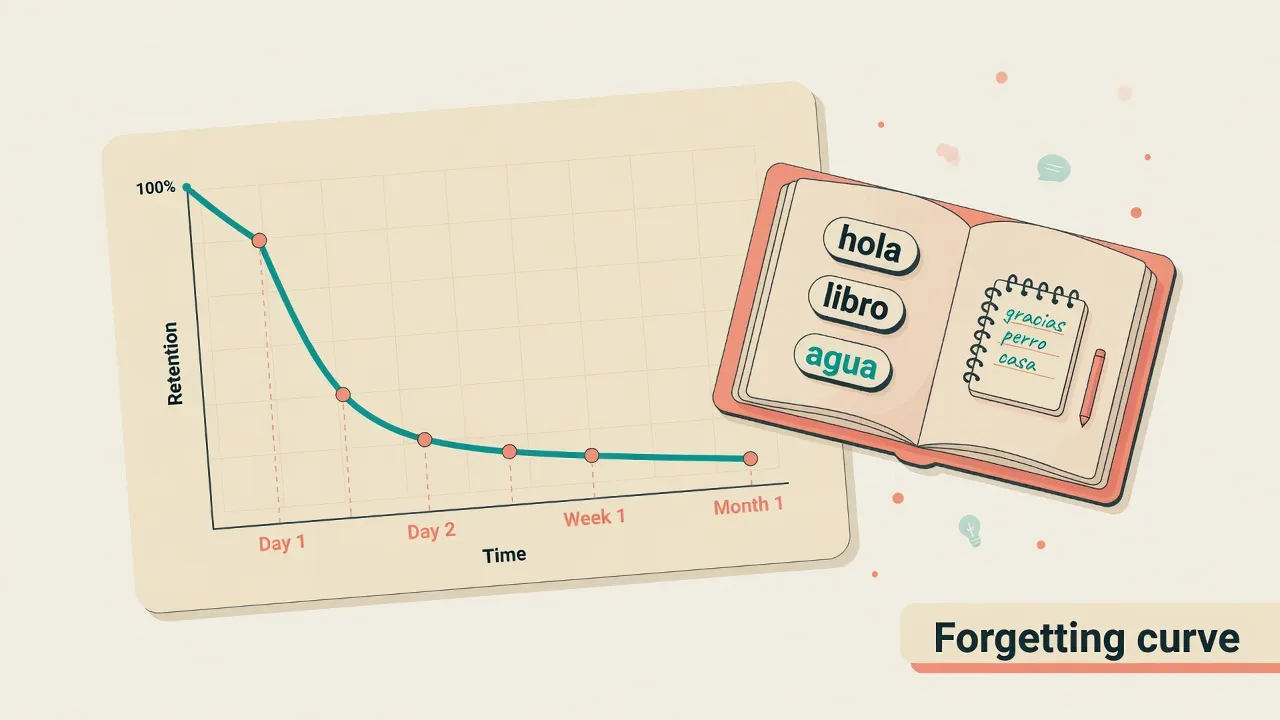
That is not proof you "have no talent for languages." It is normal forgetting. Your brain drops weak, unused traces first. The classic picture of that drop is the Ebbinghaus forgetting curve.
Here is the simple version. Forgetting new Spanish words is biology, not a character flaw. Hermann Ebbinghaus mapped a steep early drop using nonsense syllables - the classic percentage bands are a historical illustration, not an exact law for modern Spanish learners. Spaced review (revisit a word just as it starts to fade, then stretch the gap) is one strong tool. It works better when you also re-meet words in real sentences and practice short chunks with articles and verbs. Use a rough ladder: same day, next day, a few days, a week, a month. Not a promise that one app will lock Spanish into your head for life.
Here is the path for the rest of this guide: what the curve really measured, how spaced review works, a simple schedule table, cards versus reading, Spanish chunk practice, a tool path if you want less friction, and a short FAQ.
What is the Ebbinghaus forgetting curve?
In the late nineteenth century, German psychologist Hermann Ebbinghaus ran careful self-experiments on memory. His materials were not kitchen Spanish. They were nonsense syllables - artificial items like wid or zof - so he could study pure repetition without story or emotion.
The shape he described still helps learners: memory often falls steeply at first, then more slowly. After one weak encounter, a lot can fade fast. Later, the drop flattens. Think of a slope that is sharp near the start, then gentler - a mental model, not a scoreboard for your next Spanish test.
Classic reports are often summarized in rough bands like the ones below. Treat them only as a historical illustration. They are not a law for modern Spanish learners who meet el tenedor in a real kitchen scene.
| Time after learning (classic reports) | Rough memory remaining (historical illustration) |
|---|---|
| ~20 minutes | ~60% retained (about 40% already gone) |
| ~1 hour | under ~50% retained |
| ~1 day | around one-third retained |
| ~1 week | around one-fifth retained |
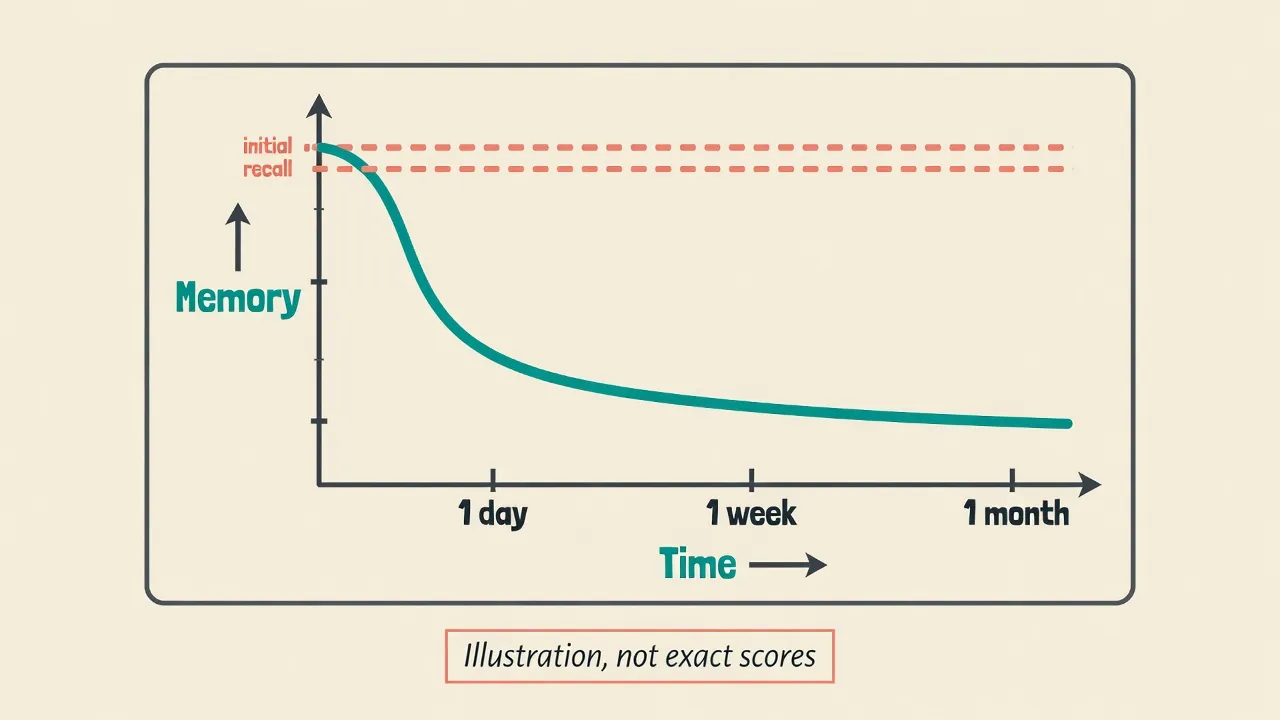
Illustration of how unused memory can fade fast after one encounter - not your personal Spanish exam score.
What still matters for you:
- One glance at a word is weak storage.
- Meaningful Spanish can still fade if you never re-meet it.
- Context, emotion, frequency, and active recall change stickiness - so real learner curves differ from nonsense-syllable labs.
Modern spaced-repetition apps (Anki, SuperMemo lineage, and others) build on spacing ideas. Ebbinghaus did not invent any app's algorithm. He gave us a clear historical picture of early forgetting and a reason to return to material on purpose.
What is spaced review, and what can it do?
Spaced review (also called spaced repetition) means you do not cram the same list ten times in one evening and then disappear for a month. You wait until recall starts to feel hard, try to pull the word again, then stretch the gap if you succeed.
Each successful retrieval can flatten the next drop. You are teaching your brain: this Spanish still matters. That is useful. It is also not magic.
Keep in mind:
- Spaced review is one strong tool, not the only method.
- It does not promise lifelong recall from a single program.
- It does not certify fluency. Real fluency needs listening, speaking, grammar in use, and lots of input - not only a deck.
Active recall pairs well with spacing: try to say or type the Spanish before you peek at the answer. Looking is easy. Retrieving is the workout.
You do not need a lab timer. A rough ladder on a calendar is enough to start. The next section gives one you can copy.
A simple spaced review schedule for Spanish words
This is a rough guide for Spanish words and phrases. If recall is easy, stretch the gap. If it is hard, shorten it. The rhythm loosely matches common 1-3-7-14-30 style schedules you see online - not algorithm perfection.
| When | Purpose | What to do (Spanish vocab) |
|---|---|---|
| Same day | Catch the steepest early drop | Quick re-see of new words / phrases from today's reading |
| Next day | First consolidation | Try to recall before you peek; 5-10 min is fine |
| ~3 days | Strengthen | Same; prefer phrase form over orphan lemma when you can |
| ~1 week | Stretch interval | Re-meet in text or short phrase drill |
| ~1 month | Long-term check | Light review; re-read a graded piece if the word is still fuzzy |
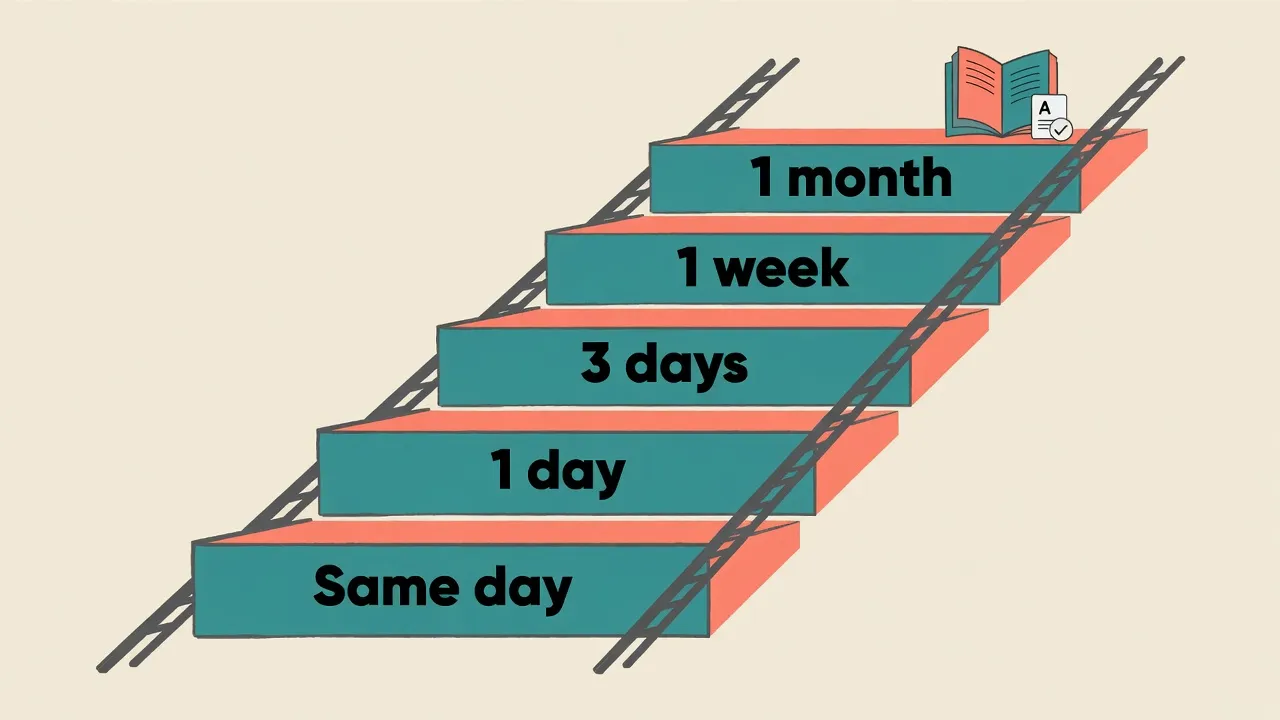
Same day → next day → about 3 days → about 1 week → about 1 month. Stretch if easy; shorten if hard.
What if I miss a day?
Restart gently. No guilt marathon. One short re-look at yesterday's phrases is enough to re-enter the ladder. Fewer words next week beats an abandoned deck of fifty lemmas you never touch.
If you want a broader reading habit around vocabulary volume, see how to build B1 vocabulary by reading.
Flashcards vs context reading - do you need both?
You do not have to pick a religion. Cards help when they carry story glue. Pure isolation is where many decks die.
| Isolated card | Word in context |
|---|---|
tenedor = fork |
No puedo encontrar el tenedor, ¿dónde está? |
| Easy to start; easy to abandon | Story, grammar, emotion, and use sit together |
| Weak gender / article glue | el tenedor sticks with the article and situation |
| Deck can feel like an exam drill | Re-meeting in graded text feels like reading |
Anki (or any cards) is fine - especially for phrases pulled from reading, not pure random word lists. Fatigue comes from deck-as-exam energy, the setup tax of a manual card factory, and zero story glue.
A stronger stickiness path for Spanish:
meet word in story
  → optional save / phrase card from the sentence
  → spaced review OR re-read graded text
  → phrase practice (type / say the chunk)
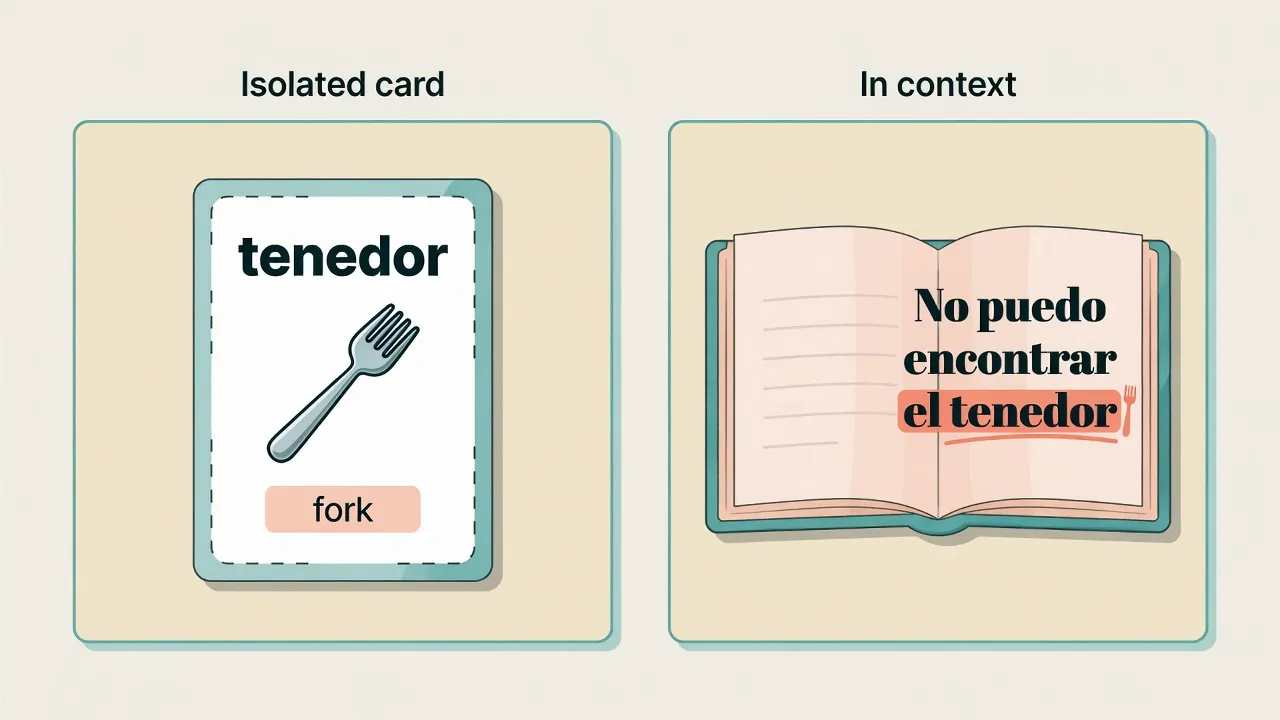
Bare flashcard on the left; full Spanish sentence with story glue on the right.
When you want active phrase work later, a short phrase hub or typing demos (free Spanish vocabulary trainer, everyday Spanish phrases practice) can support that last step without turning reading into pure exam mode.
How to practice Spanish vocabulary so it sticks
Prefer high-frequency chunks over orphan lemmas when you can. Spanish gender and articles stick better in sentences. Verb patterns travel as usable speech.
| Weaker (lemma only) | Stronger (chunk / pattern) |
|---|---|
| tenedor | el tenedor |
| encontrar | no puedo encontrar... |
| dónde | ¿dónde está...? |
Keep one concrete line in your pocket:
No puedo encontrar el tenedor, ¿dónde está?
(I can't find the fork - where is it?)
Why this helps retention: the article rides with the noun (el / la), the verb pattern is ready to reuse, and the tiny scene gives memory a hook that a bare dictionary line does not.
A simple Spanish workflow
- Read a graded Spanish piece (easy enough to enjoy).
- Tap unknowns that block meaning or keep repeating.
- Save a useful phrase, not only a bare lemma.
- Same-day + next-day quick re-look (use the schedule table above).
- Re-meet the phrase in the next article or a short trainer session.
How many new words per day?
Small sets beat fifty-word dumps. A few sticky contextual phrases often beat a long orphan list. If you use a tool with a daily translation cap (about 20 word translations/day on MovaReader's free plan), that limit can still form a habit if you pick what matters.
Start with free graded Spanish in the article library. An accessible sample path is this ES A2 piece. For level planning by CEFR bands, see the Spanish vocabulary CEFR plan. If a text feels too hard, the 5-finger rule for book level helps you choose kinder material so re-reading stays pleasant.
Reading tools: reduce friction, not magic memory
Tools should make the stack above easier, not claim to implant memory. MovaReader is a reading + phrase practice path for Spanish (and other languages). It is not a medical memory device and it does not certify fluency.
A simple path:
- Read free graded Spanish, or upload a legal EPUB you already own.
- Tap unknown words; the free plan includes about 20 word translations/day, so save phrases that matter.
- Re-meet words by reading the next graded piece (story glue beats isolation).
- Practice saved phrases in trainers when you want active recall (Pro path if you need full trainers).
- Optional progress views (for example the language map) help you see marks - they do not secretly rebuild every text around forgotten lemmas.
| Plan | In one line |
|---|---|
| Free plan | Free graded library + ~20 word translations/day + listening often unlimited |
| Reader ~€1/mo | Heavier daily reading without the free plan's translation cap |
| Pro ~€5/mo | Full trainers for active phrase practice |
We do not host licensed commercial novels free by default. Your own EPUB files are welcome. Details live on pricing. Setup and own-file tips are in how to use. For marking what you know over time, track vocabulary progress pairs well with reading.
MovaReader does not run a hidden Ebbinghaus schedule or insert forgotten words into every article for you. What helps: re-encounter via reading, save phrases, short trainers.
FAQ
Is forgetting Spanish vocabulary normal?
Yes. An early drop after a single encounter is expected biology, not proof you lack talent. Meaning, emotion, and context help stickiness, but unused words still fade. Tip-of-the-tongue moments in a Spanish chat are common - the fix is re-meeting and light review, not shame.
Are Ebbinghaus percentages exact for modern Spanish learners?
No. Classic figures come from nonsense-syllable experiments (artificial items, not el tenedor in a real sentence). Treat the curve shape and the need for review as the lesson - not the exact percentages as a Spanish law. Your words can stick better or worse depending on frequency, context, and practice.
What is a simple spaced review schedule for new Spanish words?
Rough guide: same day, next day, about 3 days, about 1 week, about 1 month. Shorten if recall is hard; stretch if it is easy. Prefer phrases from real sentences (el tenedor, no puedo encontrar...) over orphan lemmas. You do not need a lab timer - a calendar note is enough to start.
Is Anki enough, or do I need reading too?
Anki (or any cards) can work, especially for phrases taken from reading. Pure isolated word lists often cause fatigue and weak use in speech. Re-meeting words in stories adds story glue, grammar, and emotion - that stack usually beats cards alone for long-term usable Spanish.
Do I need a special app algorithm to use the forgetting curve?
No. A simple ladder (same day → next day → few days → week → month) is enough to start. Apps can reduce friction (tap, save, re-read, short phrase drill). They are not a memory implant and not required for spacing to help. Skip any tool that promises lifelong recall from one click.
How does reading graded Spanish texts help retention?
You re-encounter words with story glue, articles/gender, verbs, and emotion - not as bare dictionary lines. Pair short reading with light spaced review of the phrases you actually need. Graded pieces keep difficulty kind enough that re-reading is pleasant, which makes the "month check" easier than grinding an abandoned deck.
Next steps
- Pick 5-10 Spanish phrases from a real text today (include the article when you can: el tenedor).
- Schedule a same-day re-look and a next-day recall try - five to ten minutes is enough.
- Re-read the piece or run a short phrase drill once this week so the month check has something to stand on.
If you want less setup tax, open the free graded library, try an ES A2 sample, and use the free plan: about 20 word translations a day. Upgrade only if you want heavier reading (Reader) or full trainers (Pro). No memory hacks, just longer retention and Spanish you can actually use.
Keep reading with translations inside the text
With a free account, an unknown word translates with one tap, and the words you are learning wait for you in the trainer.
Free account: 7 days of Pro, then 20 word translations a day or a paid plan.