Vocabulary
Top 50 Most Common Spanish Words: a High-Frequency Starter List
These 50 Spanish words are the high-frequency glue that holds sentences together. Here is the list by category, why flashcards alone fail, and how to meet the words in real text.
You search "most common Spanish words," open a top 50 (or a top 1000), and start a neat notebook or Anki deck. A week later the table is dead. A real cafe line still freezes you. That is not a character flaw. Lists without situations rarely stick.
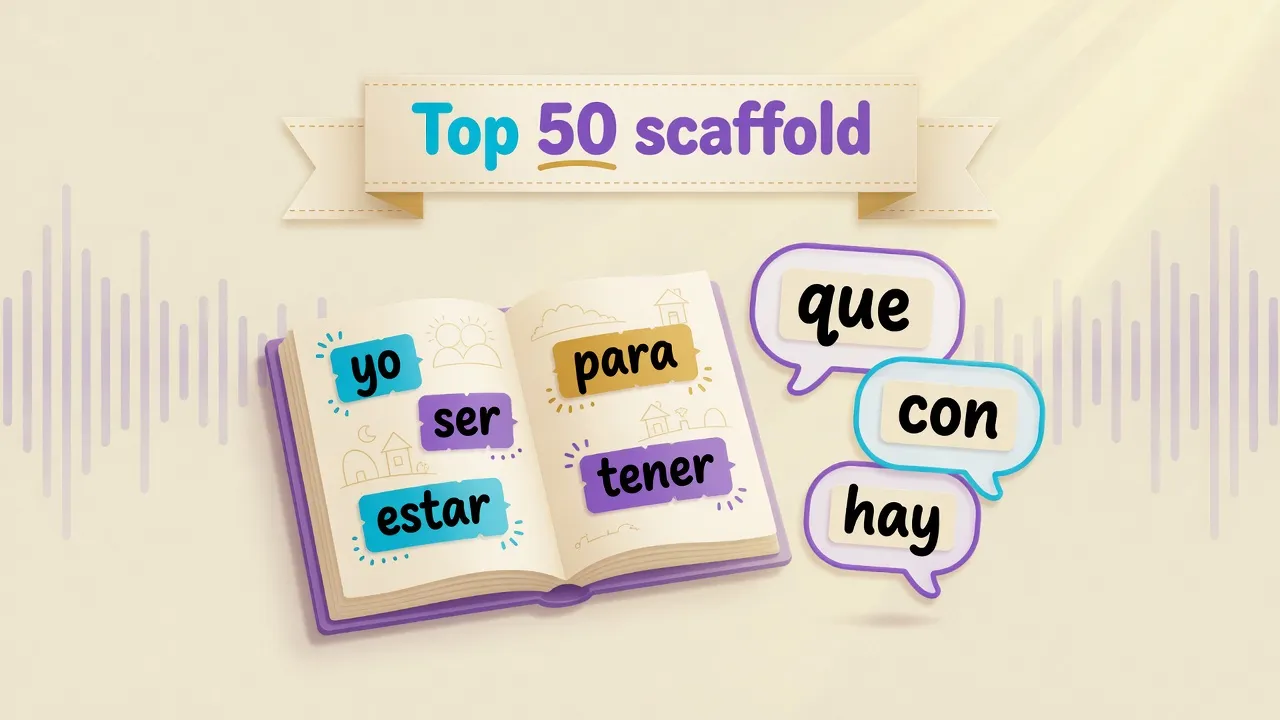
Here is the calm version. The most useful "top 50" for beginners is a high-frequency scaffold: pronouns, core verbs, prepositions, question words, and a few adverbs that hold Spanish sentences together. It is not a pure CREA/Davies rank 1-50 dump (raw lists are dominated by articles and clitics like el, la, se, me). A small high-frequency band can cover a large share of tokens in many corpora, but that is not the same as understanding 60% of a real conversation. Learn the list as glue, then meet the words in graded Spanish reading - lists alone fade.
Below: rough coverage bands, a labeled scaffold list by category, why flashcards alone fail, mini-dialogues, a short practice plan, a soft reading path, and FAQ. Related reading if you want size orientation later: how many words by CEFR and Spanish vocabulary by CEFR / Plan Curricular. For frequency in daily talk, see 50 most frequent Spanish words for daily conversations.
What you will get:
- What frequency means: tokens vs comprehension
- A labeled 50-word scaffold by category
- Function words vs content words in plain language
- Mini-dialogues plus a 7-day practice plan
- FAQ and a free graded-reading path
How "common" works - and what 50 can (and cannot) do
Frequency is uneven. A few words show up constantly; a long tail of rarer words carries most of the meanings. That soft Zipf / Pareto idea is why high-frequency lists feel powerful - and why people overclaim what a short list can do.
Three units matter before you trust any percentage:
- Tokens = running words in a text or transcript. Every de and que counts again.
- Types = distinct vocabulary items.
- Comprehension = understanding the message. Knowing glosses for glue is not the same as understanding the content words that paint the scene.
Coverage also depends on the corpus. Spoken chat, news Spanish, Spain vs Latin America - tops shift. There is no single universal top 50 for every life.
Lists of infinitives (ser, ir, poder) and pure form ranks (es, estoy, voy, puedo) disagree. Learn lemmas and meet conjugated forms in reading. For the unit problem in plain language, see lemma vs word form.
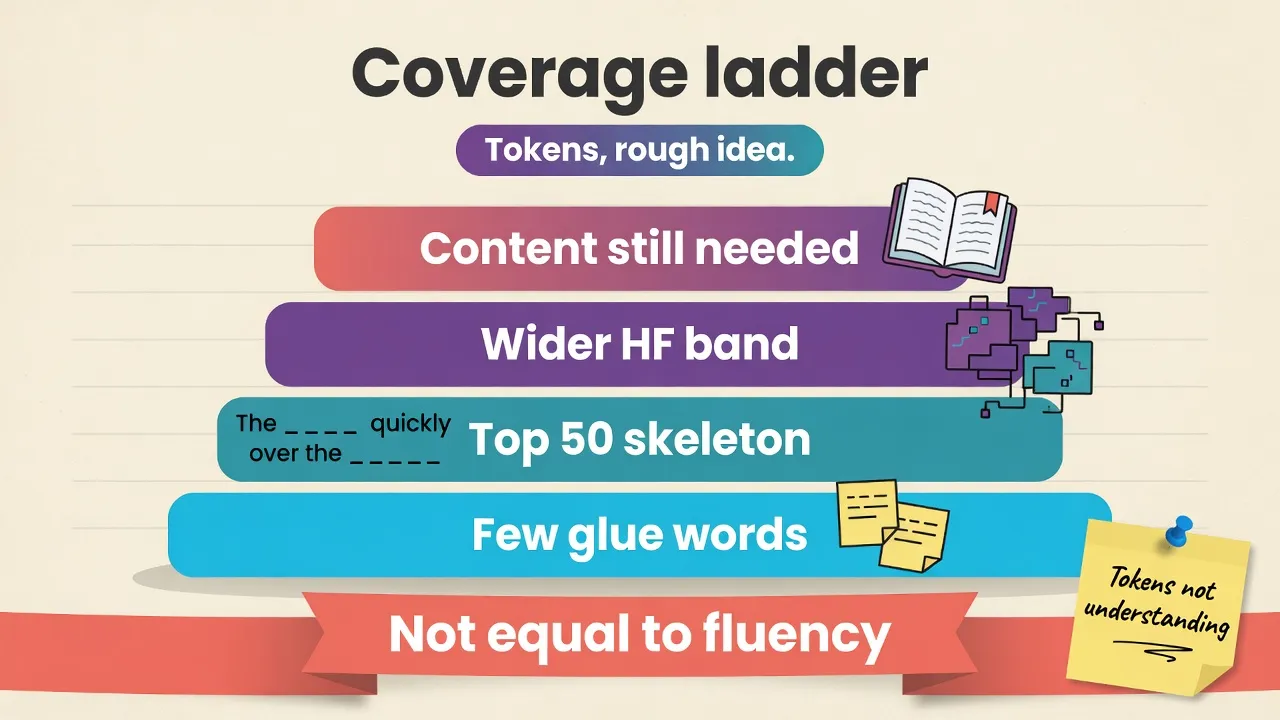
Think rough bands, not a science certificate for these exact 50:
| Band (rough) | What it usually buys you |
|---|---|
| ~10 ultra-HF glue | Big slice of running text tokens |
| ~50 scaffold (this article) | Stronger sentence skeleton |
| ~100 | Wider everyday spine |
| ~1000+ frequent lemmas | Real independent-reading territory (order of magnitude; register still matters) |
Research-style coverage talk often points toward ~1000 frequent words for high oral or written bands - not "exactly these 50 = 60% of conversations."
Pure corpus top vs learner scaffold
Open a raw frequency dump and you almost always see closed-class items first: de, la, que, el, en, y, a, los, se, del, un, por, con, no... plus object clitics (me, te, lo, le...). Those forms dominate token counts because they repeat constantly.
A study list of 50 "headwords you can learn as lemmas" often skips bare articles and clitics on purpose. It prioritizes pronouns, full verb lemmas, questions, and adverbs instead. This article's 50 is a pedagogical high-frequency scaffold of glue words, not a certified RAE, CREA, or Davies rank 1-50.
When you read, notice el / la / un / se / me / lo constantly. They are glue too - just harder to study as isolated trophy headwords.
The 50: high-frequency scaffold by category
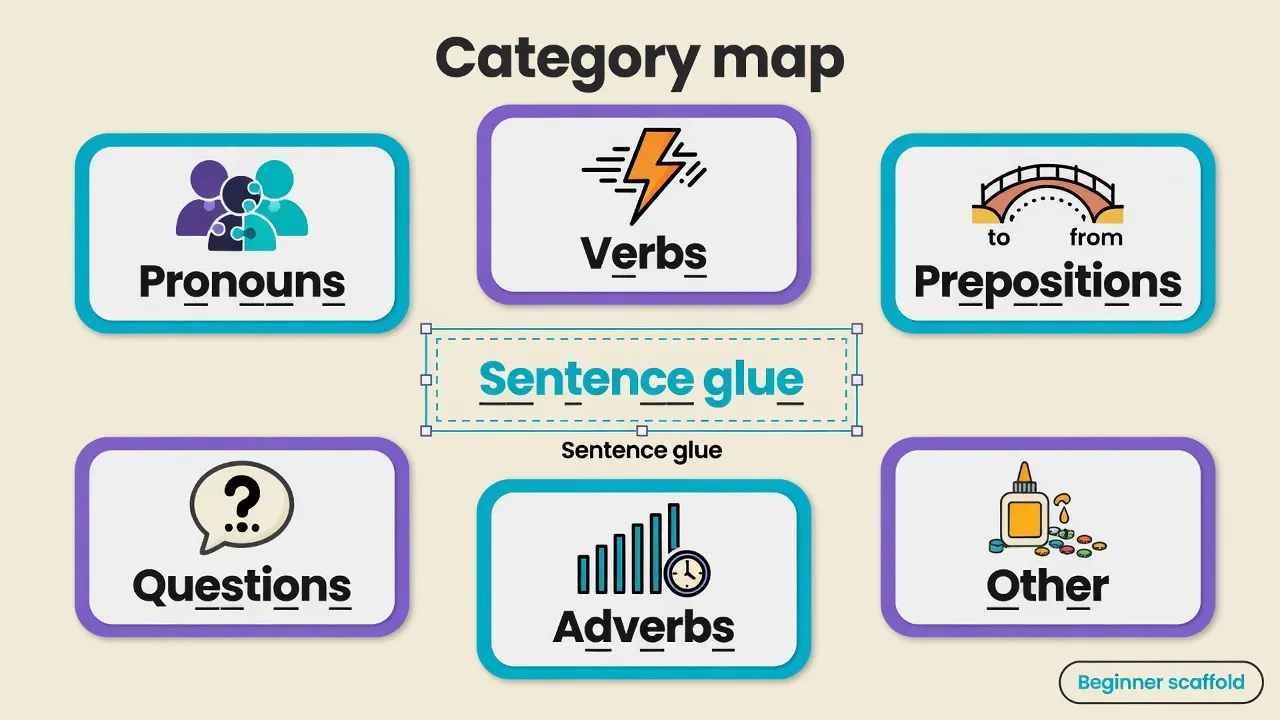
Treat this as glue for sentences, not a trophy Anki deck. Six jobs. One skeleton.
| Category | Count | Job in the sentence |
|---|---|---|
| Pronouns and demonstratives | 10 | Who / this-that / all-something-nothing |
| Core verbs (infinitive lemmas) | 10 | Skeleton actions and states |
| Prepositions and conjunctions | 10 | Links and direction of meaning |
| Question words | 7 | Information requests |
| Time and place adverbs | 8 | When / where frame |
| Other high-use chips | 5 | Yes/no, well, much/little |
Pronouns and demonstratives (1-10)
Who is talking, who is mentioned, and this vs that - plus a few "all / nothing / something" chips.
| # | Spanish | English gloss |
|---|---|---|
| 1 | Yo | I |
| 2 | Tú | you (informal singular) |
| 3 | Él / Ella | he / she |
| 4 | Nosotros | we |
| 5 | Ellos / Ellas | they |
| 6 | Este / Esta | this (m/f) |
| 7 | Ese / Esa | that (m/f) |
| 8 | Todo | everything / all |
| 9 | Nada | nothing |
| 10 | Algo | something |
Core verbs - infinitive lemmas (11-20)
These are the skeleton actions and states. In real text you will mostly meet forms (es, estoy, voy, puedo), not the bare infinitive.
| # | Spanish | English gloss |
|---|---|---|
| 11 | Ser | to be (identity / lasting trait) |
| 12 | Estar | to be (state / location) |
| 13 | Tener | to have |
| 14 | Hacer | to do / make |
| 15 | Poder | can / to be able |
| 16 | Decir | to say / tell |
| 17 | Ir | to go |
| 18 | Ver | to see |
| 19 | Dar | to give |
| 20 | Saber | to know (facts / how) |
Light split for ser vs estar: ser for identity and lasting traits; estar for state and location. Both stay in the 50 for a reason. Meet es / soy / está / estoy in graded reading until the choice feels less random.
Prepositions and conjunctions (21-30)
Links that hold phrases together. Several of these are multi-job words - one English gloss is never the whole story.
| # | Spanish | English gloss |
|---|---|---|
| 21 | De | of / from |
| 22 | Que | that / which / what (multi-job) |
| 23 | Y | and |
| 24 | En | in / on / at |
| 25 | A | to / at (direction, etc.) |
| 26 | Por | through / for / by (multi-job) |
| 27 | Para | for / in order to / toward (multi-job) |
| 28 | Con | with |
| 29 | Como | like / as / how |
| 30 | Pero | but |
For the classic pair that freezes beginners, see por vs para when you want a deeper through-path vs forward-goal model.
Question words (31-37)
Information requests. Accent marks matter in writing (qué vs que).
| # | Spanish | English gloss |
|---|---|---|
| 31 | Qué | what / which |
| 32 | Quién | who |
| 33 | Cuándo | when |
| 34 | Dónde | where |
| 35 | Por qué | why |
| 36 | Cómo | how |
| 37 | Cuánto | how much / how many |
Time and place adverbs (38-45)
When and where frames. Mañana can mean "tomorrow" or "morning" depending on context.
| # | Spanish | English gloss |
|---|---|---|
| 38 | Hoy | today |
| 39 | Mañana | tomorrow / morning (context) |
| 40 | Ayer | yesterday |
| 41 | Ahora | now |
| 42 | Siempre | always |
| 43 | Nunca | never |
| 44 | Aquí | here |
| 45 | Allí | there |
Other high-use chips (46-50)
Small words that appear everywhere in yes/no answers and degree talk.
| # | Spanish | English gloss |
|---|---|---|
| 46 | Sí | yes |
| 47 | No | no / not |
| 48 | Bien | well / fine |
| 49 | Mucho | a lot / much |
| 50 | Poco | little / few |
Function words vs content words - why the list looks "boring"
Beginners often want café, playa, aeropuerto first. Fair for travel. Those content words carry most of the picture. Function words (many of this 50) hold structure so every sentence is parseable.
| Kind | What they do | Examples from / near this list | Beginner trap |
|---|---|---|---|
| Function (glue) | Hold structure: who, links, questions, time frame | yo, de, que, en, qué, hoy, no | Feels dull on flashcards; multi-job words need many meetings |
| Content (picture) | Carry most of the scene: nouns, vivid verbs, themes | café, playa, aeropuerto, hermano (not in this 50) | Travel lists first; every sentence still needs glue to parse |
After the scaffold, grow themes plus more high-frequency vocabulary plus reading. Size orientation lives in how many words by CEFR and Spanish CEFR / Plan Curricular.
Why memorizing the list alone fails
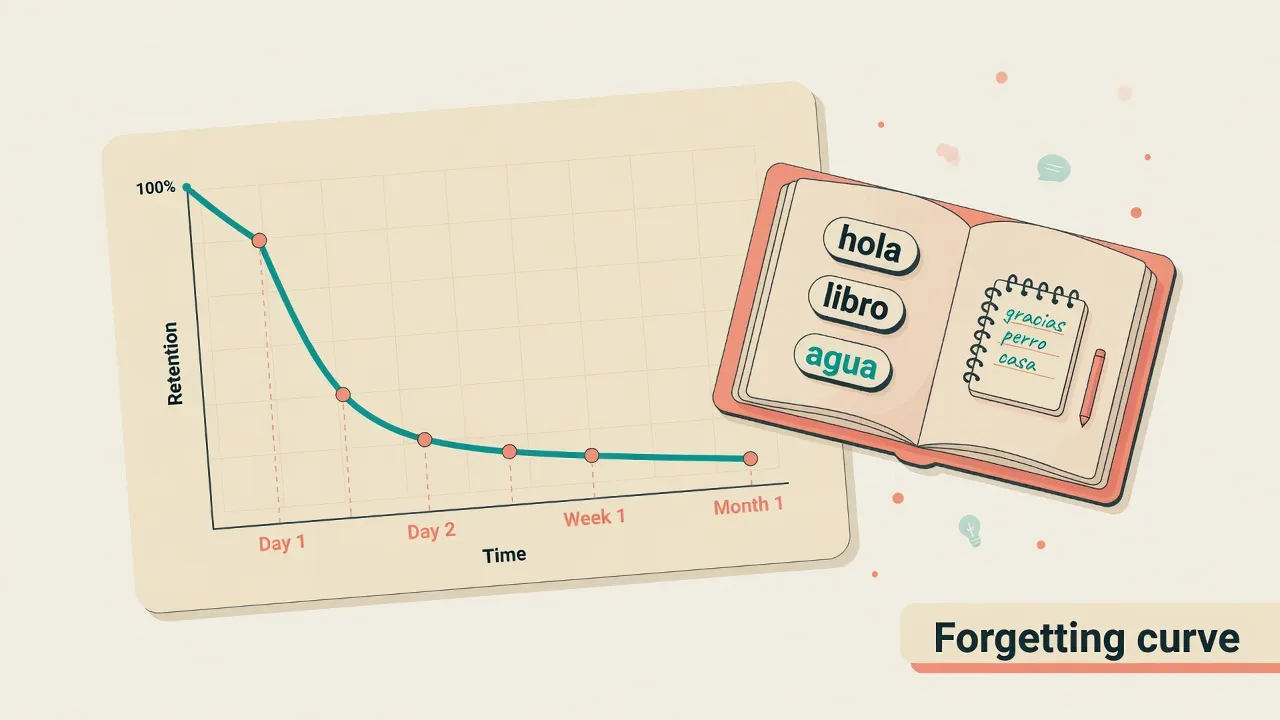
Isolated hacer is letters on a card. ¿Qué vas a hacer hoy? is situation, grammar, and a little emotion. Without retrieval in context, the forgetting curve wins.
Multi-job words (que, por, de, como) need several meetings, not one gloss. One English line cannot cover every job those words do in Spanish.
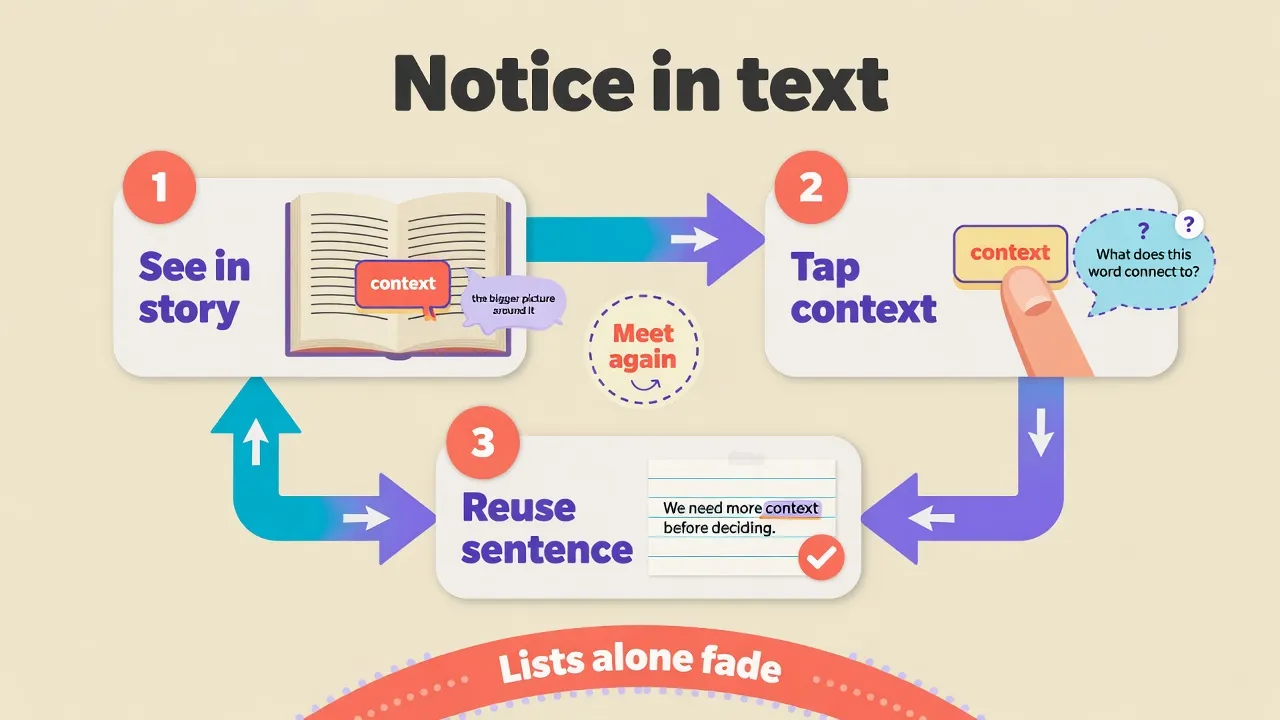
The fix is not a longer list on day one. It is notice + reuse in text you mostly understand. Read short Spanish, spot the glue in conjugated form, and reuse a few lines of your own.
Mini-dialogues: meet many of the 50 in one scene
Scaffold hits are marked in bold. Short gloss under each line. Count how many of the 50 appear if you like.
Scene A: plans (cafe / free time)
- ¿Qué vas a hacer hoy?
What are you going to do today? - No puedo ir con ellos. Tengo mucho que hacer.
I can't go with them. I have a lot to do. - ¿Por qué? ¿Cuándo puedes?
Why? When can you? - Mañana por la mañana. Ahora estoy aquí, pero poco a poco puedo hacer algo.
Tomorrow morning. Right now I'm here, but little by little I can do something.
Scaffold hits (approx.): qué, hacer, hoy, no, poder, ir, con, ellos, tener, mucho, que, por qué, cuándo, mañana, por, ahora, estar, aquí, pero, poco, a, algo. Conjugated forms (vas, puedes, estoy) are list verbs in real clothes.
Scene B: location / state
- ¿Dónde están ellos ahora?
Where are they now? - Están allí, pero yo estoy aquí.
They're there, but I'm here. - ¿Todo bien?
Everything okay? - Sí. Nunca sé mucho, pero sé algo.
Yes. I never know a lot, but I know something.
Scaffold hits: dónde, estar, ellos, ahora, allí, pero, yo, aquí, todo, bien, sí, nunca, saber, mucho, algo. If you later meet No lo sé, lo is a common clitic from the closed-class callout - useful glue, not one of the numbered 50.
Scene C: questions rapid-fire
- ¿Quién es ella? - Who is she?
- ¿Cuándo vas a ir? - When are you going to go?
- ¿Cuánto es esto? - How much is this? (esto sits near the demonstratives; este / esta are on the list)
- ¿Cómo estás hoy? - How are you today?
- ¿Por qué no puedes ir con nosotros? - Why can't you go with us?
- ¿Para qué es eso? - What is that for? (para qué vs por qué)
Underline scaffold once. Say a few lines aloud. Then open real text and hunt the same glue again.
Practice plan: 7 days with the scaffold
About 15-25 minutes a day.
| Day | Move (15-25 min) |
|---|---|
| 1 | Skim categories; mark which 15 you already "kind of" know |
| 2 | Read Scene A aloud once; cover glosses; retell in 3 short lines |
| 3 | Graded Spanish article (A1-A2); click unknown forms of scaffold verbs |
| 4 | Write 5 original questions using question words + one core verb each |
| 5 | Scene B + notice por / para / de / en / a in any short text |
| 6 | Language-map or personal marks: only words you can use in a sentence |
| 7 | Reread day-3 article; list 10 scaffold hits you saw conjugated |
Rules of use, short and warm:
- Prefer notice in text over adding 50 isolated cards on day one.
- If you use SRS, add phrase lines, not bare lemmas only.
- After 50 glue words: keep reading; grow toward ~100 then broader high-frequency vocabulary plus themes.
The loop looks like this: read, notice the form, get a brief meaning, meet it again, optionally mark it.
For day 3, open the free library at all articles and pick short Spanish. When you want a compass for size, the language map is orientation - not a fluency finish line.
How graded Spanish reading makes the 50 stick
High-frequency glue repeats naturally in short, adapted stories. You see puedo, vamos, está, qué, con inside a situation you care about - not as a dead table row. Goal: notice form → brief meaning → meet again. Optional audio can help sound stick when tracks are available.
Soft path:
- Open the free graded library and pick a Spanish sample.
- Read; click unknown forms of scaffold verbs and multi-job glue.
- Hear audio when useful.
- Mark only words you can use in a sentence (language-map when ready).
- If freemium volume blocks daily reading, upgrade only for volume - not from guilt.
Try a Spanish sample such as article 1127 or article 1209. Setup notes live on how to use.
Plans
The free plan gives a free graded library, about 20 word translations a day, and listening. When you need more reading volume, Reader is €1/mo. Pro is €5/mo for the optional full trainers path - not required to learn this 50 via reading. You can use your own EPUB or files.
Details: pricing. Free start: register.
FAQ
Is this the official top 50 most common Spanish words?
No. This is a pedagogical high-frequency scaffold of glue words (pronouns, core verbs, prepositions, questions, time/place chips) - not a certified CREA, Davies, or RAE rank 1-50. Pure corpus tops skew to articles and clitics like el, la, un, se, me, lo. Those matter in reading; they are just harder to study as isolated headwords.
Do these 50 words cover 60% of Spanish conversations?
Not as a hard science fact for exactly these 50. In many corpora, a small high-frequency band covers a large share of tokens (running words). Exact percentages depend on the corpus (spoken vs written, register, region). Token share is not the same as understanding 60% of real talk - content words still carry most of the message. Research-style coverage claims often talk about ~1000 frequent words, not 50 alone.
Why 50 and not 100 (or 1000)?
Fifty is a first scaffold rung: enough skeleton to parse simple sentences without a 1000-card graveyard. Rough ladder: ~10 ultra-HF glue → ~50 skeleton → ~100 wider everyday spine → hundreds to ~1000+ frequent lemmas for independent-reading territory (order of magnitude; register still matters). More on size orientation: how many words by CEFR. Spanish progression framing: Spanish vocabulary CEFR / Plan Curricular.
Should I learn these with flashcards or by reading?
Reading + noticing first. Meet forms in text you mostly understand. Use cards for stubborn multi-job items (que, por, de, como) as phrase lines, not bare lemmas only. Lists alone fade because multi-job words need several meetings and a situation, not one gloss.
Ser vs estar - both mean "to be." Which first?
Both sit in this 50 for a reason. Light split: ser for identity / lasting traits; estar for state / location. One FAQ line will not finish the topic. Learn the split lightly, then meet es / soy / está / estoy in graded reading until the choice feels less random.
What should I learn after these 50?
Keep the glue. Add high-frequency content for your life themes (work, travel, family). Grow toward ~100 HF spine, then broader frequent vocabulary plus graded → more authentic reading. Track orientation on the language map when you want a compass - not a fluency finish line.
What should I do after reading this article?
Open a short graded Spanish article, notice scaffold hits in conjugated form, and mark only words you can put in a sentence. Soft path: all articles, sample 1127 or 1209, how to use, pricing.
Short takeaway + next steps
- These 50 are a scaffold of glue, not a certified rank 1-50.
- A large share of tokens is not the same as understanding most of real talk.
- Use the categorized list as sentence skeleton, then meet forms in context.
- Mini-dialogues + the 7-day plan beat a dead table.
- Free graded reading is enough to start noticing the glue in the wild.
Next steps:
- Skim the 50 as scaffold, not a trophy.
- Open a short Spanish article and notice glue in conjugated form (all articles).
- Optional: mark usable words on the language map.
- If ~20 translations/day blocks you, check pricing (Reader €1).
- Grow toward ~100 high-frequency words plus your life themes.
Keep reading with translations inside the text
With a free account, an unknown word translates with one tap, and the words you are learning wait for you in the trainer.
Free account: 7 days of Pro, then 20 word translations a day or a paid plan.