Vocabulary Tips
The 50 Most Frequent Spanish Words for Daily Conversations
High-frequency Spanish words do most of the daily glue work. Here is a usable top-50 with real sentence examples, a deep look at multi-job que, por/para, and se, plus a short reading habit that makes them stick.
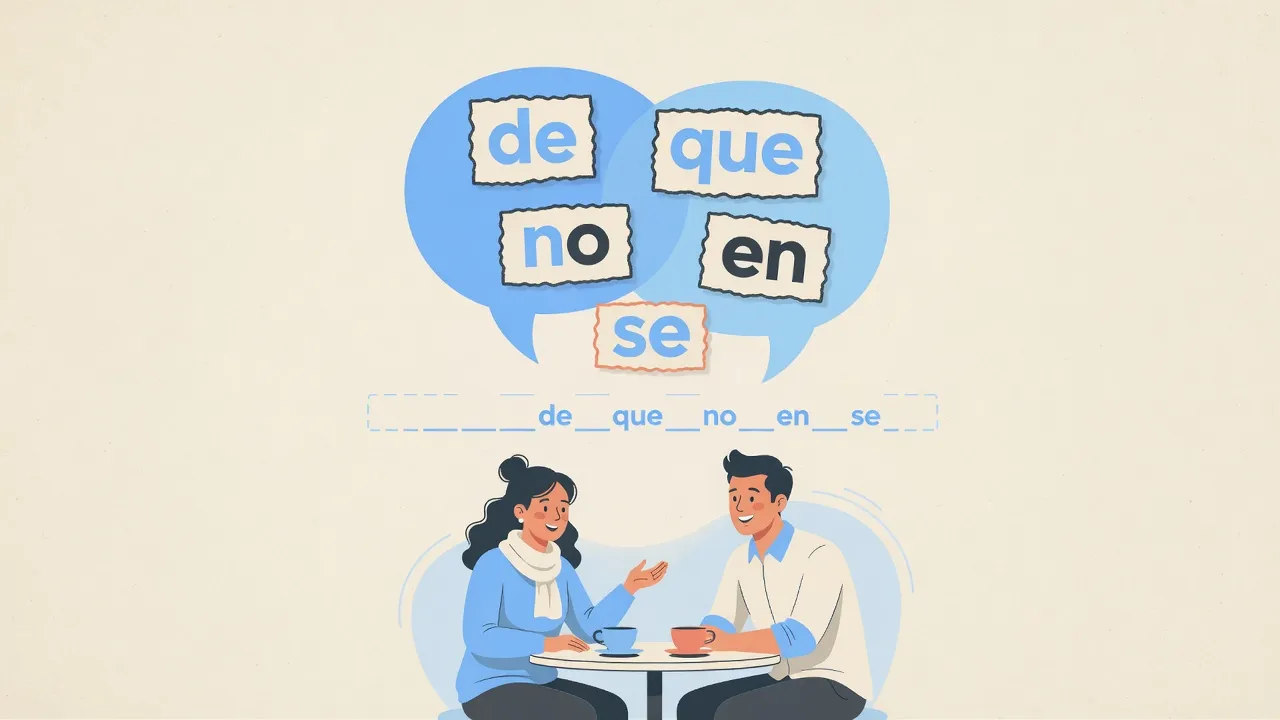
You have probably seen "Top 100 Spanish words" lists that look useful for five minutes and evaporate by Tuesday. Travel phrase packs can feel just as wrong: real talk is full of tiny chips like que, de, and se, not only "Where is the station?" Isolated rows are weak memory anchors. Frequency still helps, though. A small core of Spanish words does most of the glue work in everyday speech and writing.
The ~50 most frequent Spanish words for daily conversations are mostly glue: articles, pronouns, de/que/en/a/no, and a handful of core verbs that hold everyday speech and writing together. In many spoken and written samples they dominate tokens (running words), so noticing them makes sentence skeletons easier to follow. That is not the same as understanding most of a real chat, and this list is a practical high-frequency set, not one permanent official ranking. Learn each word as a job in real sentences - especially multi-job que, por/para, and se - then meet them again in short graded Spanish reading.
Here is what you will get below:
- Honest coverage bands (tokens vs understanding - no fake science seal)
- A multi-job deep dive on que, por/para, and se
- A practical top-50 with example tables by function
- A short micro-text plus a simple reading routine (not a week calendar)
- FAQ and a soft freemium path when you want to practice in graded Spanish
If you want size orientation later, see how many words by CEFR.
What "50 words cover a lot of conversation" really means
Frequency research (including corpus work such as Davies' Corpus del Español) and the Zipf idea both point the same way: a few words repeat a lot; a long tail of rarer words carries most of the meanings.
Think rough bands and tokens, not a certificate that these exact 50 equal 60% of every chat.
| Band (rough) | Rough idea | What you actually gain |
|---|---|---|
| Top ~10 | Large slice of tokens | Sentence glue: articles, de, que, no, en |
| Top ~50 | Majority of tokens in many samples | Structure: follow the skeleton better |
| Top ~1,000 | Most everyday text territory | Real independent reading starts to feel possible |
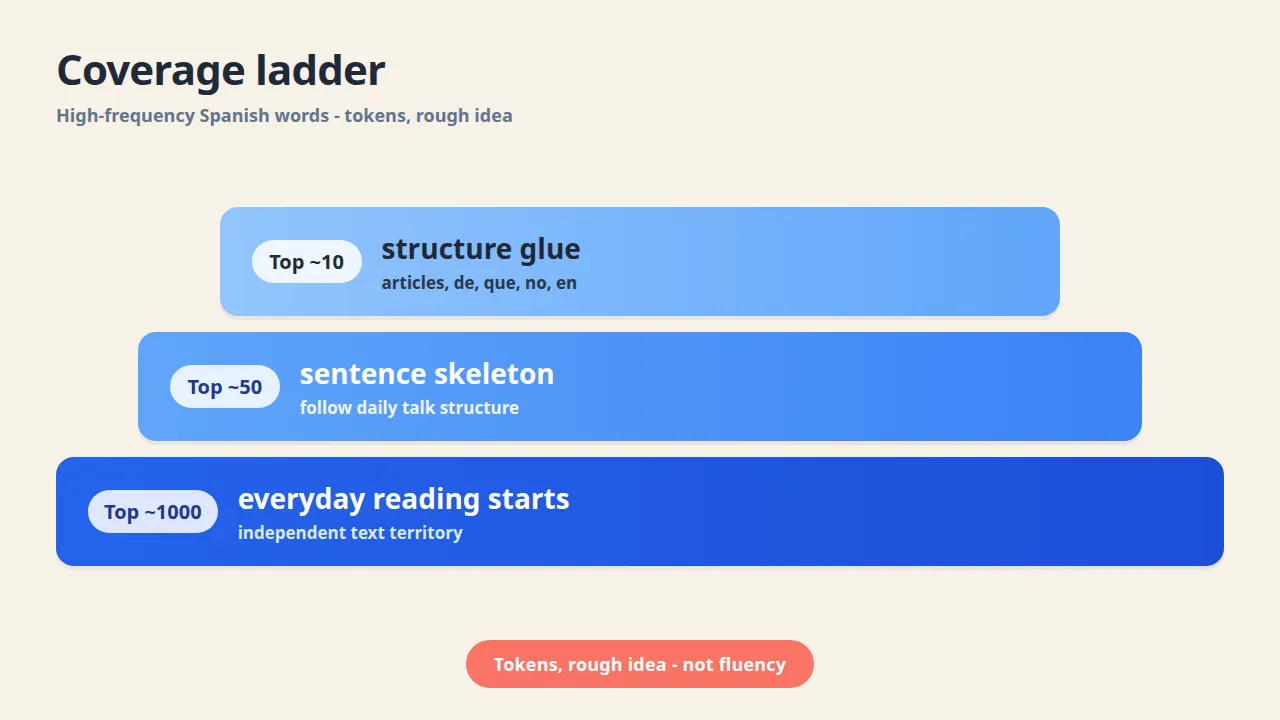
Three caveats keep this honest:
- Tokens means every running word. Every de and que counts again. That inflates coverage for glue words.
- Knowing a gloss for glue is not the same as understanding the content words that paint the scene (casa, trabajo, mañana...).
- Coverage depends on register: spoken chat vs news, Spain vs Latin America. There is no single universal top-50 forever.
The goal is not "memorize 50 rows." The goal is automatic recognition of high-frequency patterns in real sentences. Memorizing the table alone will not make you understand most of real conversation.
Multi-job words that run daily conversations
A list gloss is often true - and almost useless. These words stabilize only when you see several jobs in sentences you understand. This is the part pure dumps skip, and the part that actually changes how you hear Spanish.
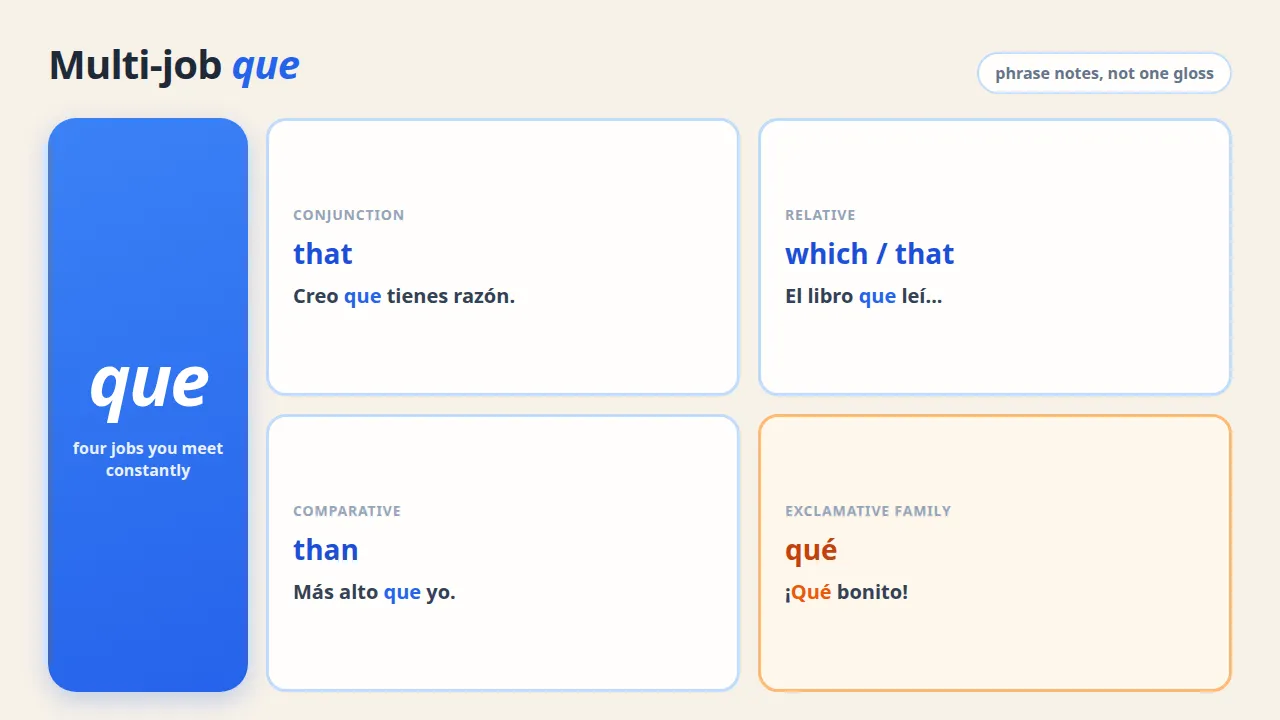
que (and qué): four jobs you will meet constantly
Do not save que = that. Save phrases that show the job.
| Job | Plain role | Example |
|---|---|---|
| Conjunction | "that" | Creo que tienes razón. |
| Relative | "that/which/who" | El libro que leí fue increíble. |
| Comparative | "than" | Es más alto que yo. |
| Exclamative / question family | qué (related family in practice) | ¡Qué bonito! / ¿Qué haces? |
Useful phrase notes: creo que..., el libro que leí, más alto que yo, ¿qué haces?. Treat qué as a related family you will meet constantly, not as a separate mystery.
por vs para: two "for"s with different jobs
English "for" hides two Spanish habits. Keep it light at first; add examples only when you meet a new job.
| Word | Core jobs (learner-level) | Examples |
|---|---|---|
| por | cause, exchange, "through/by", thanks for | Gracias por todo. / Paso por el parque. / Lo hice por ti. |
| para | purpose, recipient, deadline/direction | Es para ti. / Estudio para entender. / La tarea es para mañana. |
If you want a longer walk-through later, see por vs para. You do not need a full grammar course to start noticing the split in daily talk.
se: reflexive, impersonal, passive-ish
Se is not one flashcard. It is a small set of grammar habits.
| Job | Plain role | Examples |
|---|---|---|
| Reflexive / pronominal | self / set phrases | Se llama María. / Se levanta temprano. |
| Impersonal | "people / one" | Se habla español aquí. |
| Passive-ish / middle | thing happens | Se vende pan. / Se abrió la puerta. |
Same story later for ser vs estar: two jobs that both belong in any serious high-frequency set, not two English "to be" clones.
The 50 high-frequency words for daily conversations
Treat these as glue for daily talk, not a trophy Anki deck. Counts vary by corpus (spoken vs written, Spain vs Latin America). This is a practical high-frequency set for daily Spanish - not a permanent official ranking forever.
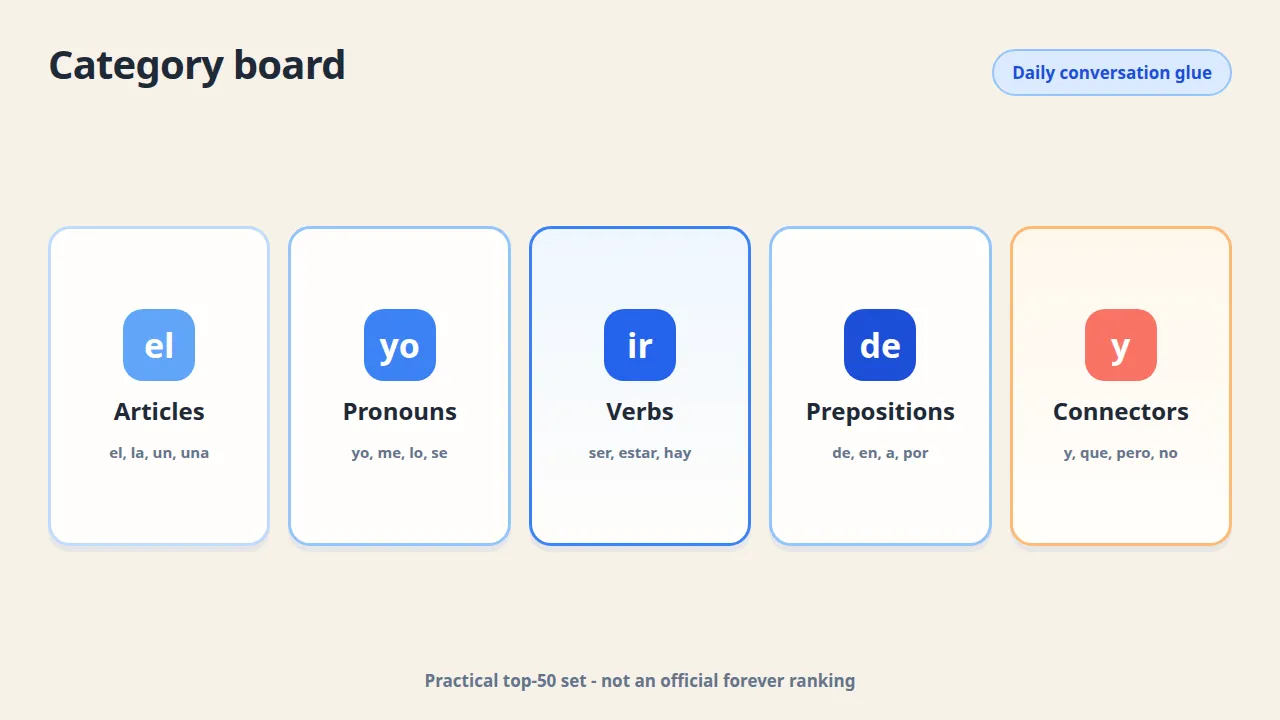
Articles and basic determiners
These name the thing. Conversation is full of them, so they belong here even if pure "study lists" sometimes skip them.
| Spanish | Role | Example |
|---|---|---|
| el | the (masc.) | El café está caliente. |
| la | the (fem.) | La casa es grande. |
| un | a/an (masc.) | Tengo un perro. |
| una | a/an (fem.) | Es una buena idea. |
| los | the (pl. masc.) | Los niños juegan. |
| las | the (pl. fem.) | Las flores son bonitas. |
Core pronouns and clitics
Who is talking, who is affected, and the tiny chips that sit before the verb.
| Spanish | Role | Example |
|---|---|---|
| yo | I | Yo quiero aprender. |
| tú | you (informal) | Tú hablas bien. |
| él / ella | he / she | Ella trabaja aquí. |
| nosotros | we | Nosotros vamos al parque. |
| me | me / myself | Me gusta el chocolate. |
| lo | it / him / that | Lo sé. |
| le | to him/her | Le dije la verdad. |
| se | multi-job (see above) | Se llama María. / Se habla español. |
High-frequency verbs (and forms you meet constantly)
Meet them conjugated in real lines (es, estoy, voy, puedo), not only as infinitive trophies.
| Spanish | Role | Example |
|---|---|---|
| ser / es | to be (identity/quality) / is | Es muy importante. / Quiero ser feliz. |
| estar | to be (state/location) | Estoy en casa. |
| tener | to have | Voy a tener tiempo mañana. |
| hay | there is/are | Hay mucha gente. |
| hacer | to do/make | Voy a hacer la cena. |
| ir | to go | Quiero ir a España. |
| poder | can / be able to | No puedo dormir. |
| decir | to say | Quiero decir algo. |
| saber | to know (facts/how) | No sé la respuesta. |
Ser and estar both belong here. Learn them as different jobs (identity/quality vs state/location).
Prepositions and glue
Links, direction, and the small words that hold phrases together.
| Spanish | Role | Example |
|---|---|---|
| de | of / from | Soy de México. |
| en | in / on | Estoy en casa. |
| a | to / at | Voy a la tienda. |
| con | with | Café con leche. |
| por | multi-job (see above) | Gracias por todo. |
| para | multi-job (see above) | Es para ti. |
| sin | without | Sin azúcar, por favor. |
| sobre | about / on | Hablamos sobre el tema. |
Connectors and everyday adverbs
Join clauses, frame time and place, and keep the conversation moving.
| Spanish | Role | Example |
|---|---|---|
| y | and | Tú y yo. |
| o | or | ¿Café o té? |
| que | multi-job (see above) | Creo que sí. |
| no | no / not | No entiendo. |
| pero | but | Quiero, pero no puedo. |
| si | if | Si puedes, ven. |
| como | like / as | Como siempre. |
| más | more | Quiero más. |
| también | also | Yo también. |
| ya | already / now (context) | Ya lo sé. |
| muy | very | Es muy bueno. |
| bien | well / fine | Estoy bien. |
| todo | all / everything | Todo está bien. |
| aquí | here | Estoy aquí. |
| ahora | now | Ahora mismo. |
| cuando | when | Cuando quieras. |
Do not panic if another ranking swaps sobre for su or más for muy. Method beats one contested slot.
For a beginner scaffold list plus a week plan and mini-dialogues (a different shape from this page), see Top 50 most common Spanish words. This page stays on daily-conversation examples and multi-job depth.
How to actually learn them for real conversations
Skip the giant cram session. Use a short daily loop that puts the words back into sentences you can picture.
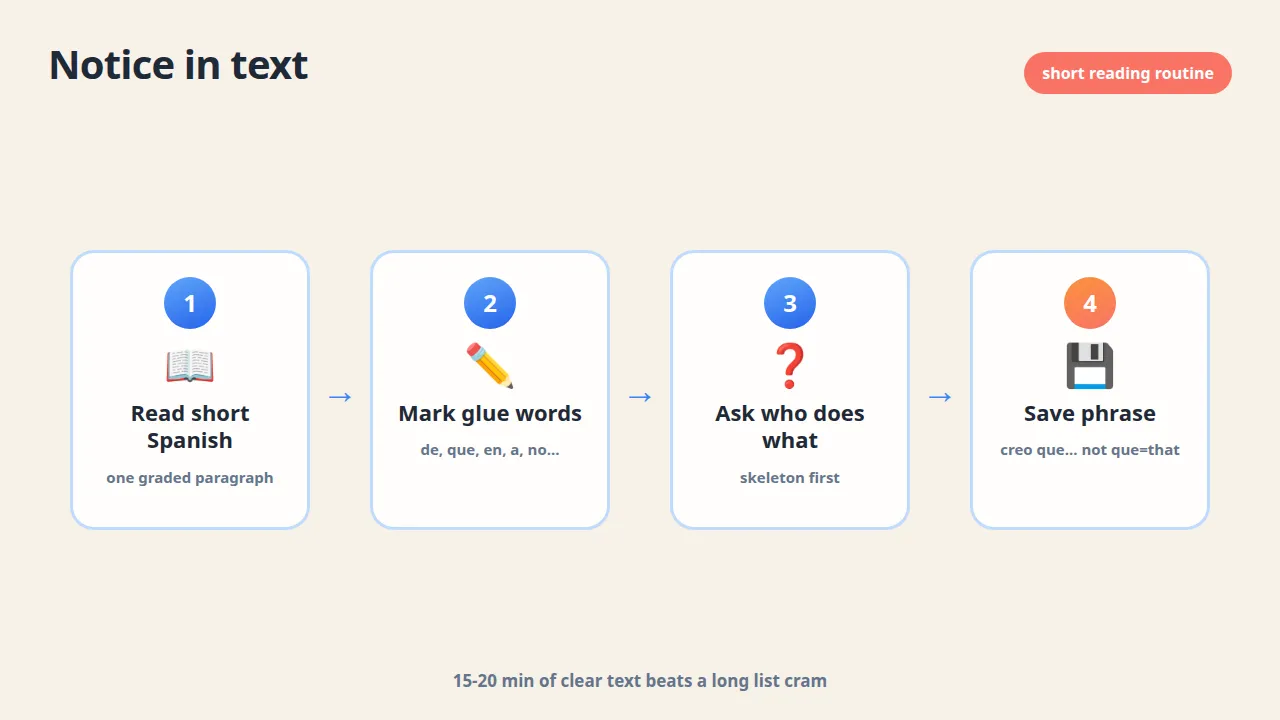
Read for skeleton first
In any short Spanish paragraph, underline only the high-frequency glue: articles, de/que/en/a/no, basic verbs. Ask: who does what, to whom, when? You are training eyes, not filling a spreadsheet.
Collect phrases, not rows
Bad note: que = that
Better notes: creo que... / el libro que leí / más alto que yo
Save 5-10 phrases per session max. A short stack you will reuse beats a wall of single words.
Separate multi-job words into job buckets
For por, para, se, and que, keep mini-buckets by function, each with one example. Add a new example only when you meet a new job. That keeps the mess honest without freezing you.
Prefer short daily reading over big cram sessions
Fifteen to twenty minutes of understandable text beats a 90-minute list review. Re-read yesterday's page once before new material. Repetition in context is the whole point.
Use listening after the page makes sense
If audio is available, listen after you can follow the written text. Audio on a page you do not understand yet often adds noise, not clarity.
Sample micro-text packed with high-frequency words
Read this slowly. Do not translate every item. Track the skeleton: who does what, when, and why.
María no sabe qué hacer. Ella está en la cocina de su casa, y el teléfono no deja de sonar. Es su madre. Pero María no quiere hablar con ella ahora, porque ya sabe lo que le va a decir.
Optional drill: underline multi-job hits (que, qué, de, clitics, está). You just met many top-frequency items in one short scene. That is the point of context: the words do jobs inside a situation you can picture.
Try the same habit on a free graded Spanish page:
- Spanish A1 sample: Mi día en el parque
- Spanish A2 sample: Aprendiendo a reciclar en casa
- Browse free articles
Beyond the first 50
Do not wait for a perfect list to finish before reading. Reading is how the list becomes usable.
| Band | Focus | Practice idea |
|---|---|---|
| ~51-200 | Common nouns, adjectives, want/need/see/give verbs | Short graded stories and daily dialogues |
| ~201-1,000 | Everyday coverage for independent reading | News-lite, graded B1, simple blogs |
| 1,000+ | Nuance, register, humor, regional flavor | Longer books you own + selective lookup |
Keep the glue automatic. Grow content vocabulary for your life themes. For orientation ranges (not a free exam), use the language map and how many words / CEFR.
How MovaReader helps (honest version)
High-frequency glue repeats naturally in short, adapted stories. You meet que, de, se, está, por, and para inside a situation you can picture - not as a dead table row. MovaReader is a reading tool for that habit, not a secret frequency package.
What it does:
- Free graded library with click-to-translate
- Unlimited listening on freemium where audio exists
- Upload of files you own (for example EPUB)
- Phrase practice on demos and trainers after you save useful chunks
What it does not do:
- Host a special "all 50 words story" product feature as a one-click curriculum
- Guarantee fluency from fifty words
- Replace meeting que / por / se in many contexts
- Auto-highlight "most frequent Spanish words" as a magic curriculum layer
A simple free path
- Read the Spanish A2 sample Aprendiendo a reciclar en casa (or the A1 sample Mi día en el parque)
- Tap only words that block sentence meaning - especially multi-job glue
- Save a few multi-word chunks (creo que..., gracias por..., se llama...), not every unknown adjective
- Try the free Spanish vocabulary trainer and the everyday Spanish phrases practice
- When you want orientation ranges, open the language map; setup detail lives on How to use
Pricing honesty (once)
Freemium gives about 20 word translations a day, a free graded library, and listening freemium where audio exists. When daily reading needs more translation volume, Reader is about €1. Pro is about €5/mo if you want the full trainers path - optional, not required to learn these 50 through reading. We do not host unlimited licensed commercial novels by default, and there is no fluency guarantee from a short list. Details: Pricing.
FAQ
Do 50 Spanish words really cover 60% of conversation?
As a token-frequency idea, a small high-frequency band can cover a large share of running words in many spoken or written samples. As a promise that you understand 60% of real life after memorizing a table: no. Structure words dominate counts; meaning still needs content vocabulary. Exact percentages depend on corpus and register - treat "60%" as marketing shorthand, not a science certificate for these exact 50. More on size orientation: how many words by CEFR.
Should I memorize this list with flashcards?
Lightly if you want. Better: phrases inside short texts, then review those phrases. Pure single-word cards are weakest for multi-job glue - que, se, por, para. Save lines like creo que..., gracias por..., se habla español, not bare que = that.
What are the most important Spanish words for beginners (daily talk)?
Start with articles, de/que/en/a/no/y, personal pronouns and clitics, and verbs ser, estar, tener, ir, hacer, poder, decir, saber, plus hay. Then treat multi-job items as jobs, not one gloss each - see the multi-job section above on que, por/para, and se.
How many jobs does que have - and is qué the same word?
Several common jobs in daily Spanish: conjunction ("that"), relative ("that/which/who"), comparative ("than"). Treat qué (questions / exclamations) as a related family you will meet constantly: ¿Qué haces?, ¡Qué bonito! Phrase notes beat one dictionary line.
What should I do after these 50?
Keep the glue automatic. Grow content vocabulary for your life themes. Path: graded texts, then short authentic pieces, then books you own. Use the language map for orientation ranges when you want a compass, not a fluency finish line.
Can I jump straight to novels after this list?
Not usually. Graded texts first, then short authentic pieces, then books you own. The top 50 is scaffolding for the daily skeleton - not a novel-readiness certificate. Soft free start: all articles and samples such as the Spanish A2 page.
Final takeaway
- These 50 hold daily Spanish together as glue, not as a trophy Anki deck.
- A large share of tokens is not the same as understanding most of a real chat.
- Multi-job que, por/para, and se need jobs and phrases, not one gloss each.
- A short micro-text plus daily reading beats a dead list and a week calendar you will abandon.
- Freemium graded reading (
20 translations/day, listening freemium) is enough to start; Reader (€1) when volume needs it.
Open a short graded Spanish text today, track the glue words, and save a handful of real phrases. A clean start: the free Spanish A2 article, then the language map when you want orientation, and Pricing only when freemium volume starts to block daily reading.
Keep reading with translations inside the text
With a free account, an unknown word translates with one tap, and the words you are learning wait for you in the trainer.
Free account: 7 days of Pro, then 20 word translations a day or a paid plan.