Tips & Methods
Learn Spanish from Zero Alone: A Practical Starter Plan
You can learn Spanish alone from zero with a small daily habit and a clear order: sounds, core words, present tense and ser/estar, easy input, tiny speaking early. Months of work for solid A2 - not a weekend miracle.
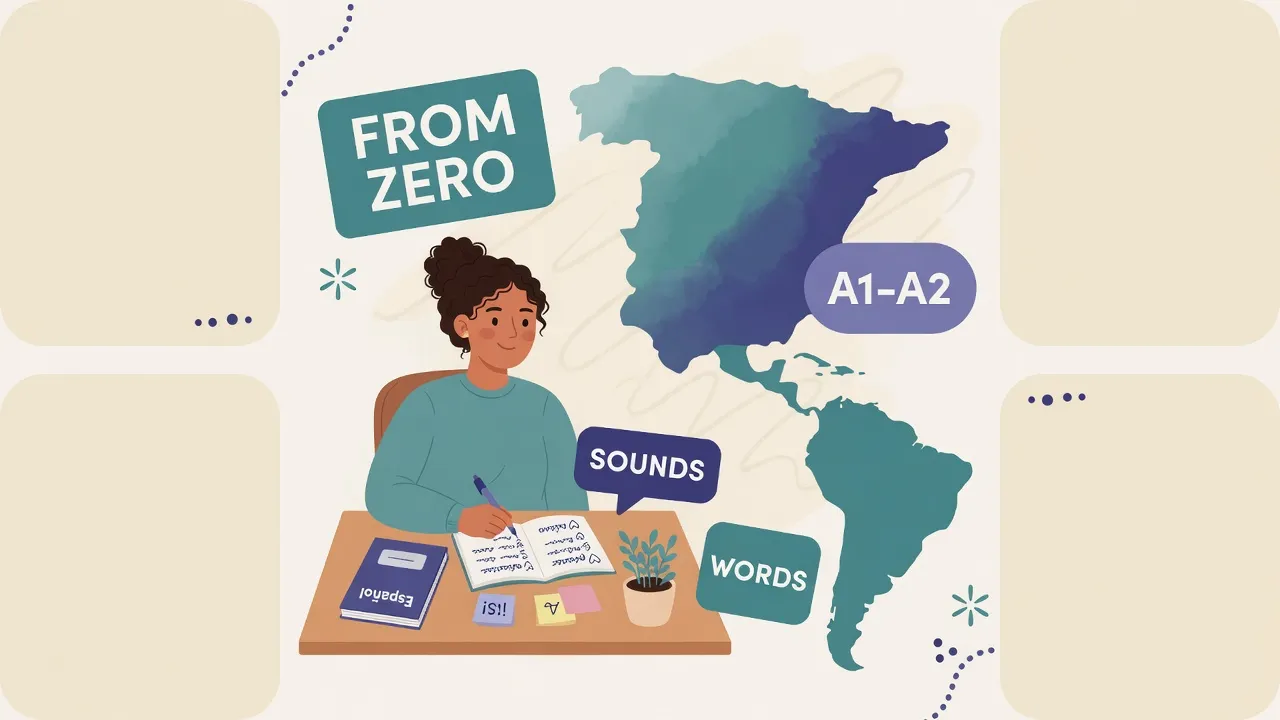
You decide to learn Spanish alone. Day one feels clean: open an app, learn hola, feel smart. Day twelve feels messy. Too many verb charts. Too many accents. Someone online says "B1 in three months." Someone else says you must live in Madrid first.
Here is the calm version. Self-study Spanish from zero is doable if you keep a simple order and protect daily minutes: sounds and stress so reading does not fight you; high-frequency words and phrases; core grammar (gender, articles, present tense, ser vs estar); easy input every day; tiny speaking or writing early, not after "perfect grammar." Many learners reach a usable A2 over months of regular work - not days. Speed depends on hours, languages you already know, and whether you only swipe apps or also read and speak.
Below: why Spanish is a strong self-study pick (without calling it ideal for everyone), a starter roadmap, pronunciation notes, methods that actually stick, Spain vs Latin America without panic, a sample week, tools, beginner mistakes, and FAQ.
Why Spanish works well for self-study
Spanish is not "the easiest language on Earth for every brain." It is, for many adults studying alone, a friendly European option.
Spelling is relatively transparent. Once you know the sound rules, most words read as written. English is harder that way. French often hides more in silent letters. Spanish still has stress marks and regional sound choices, but you are not guessing ough every line.
There is huge content supply. Spain plus Latin America means series, podcasts, music, news, and graded texts at almost every level. Alone, that matters more than a perfect textbook.
Romance cognates help if you know English, French, Italian, or Portuguese. Words like familia, problema, importante reduce the freeze on day three. Cognates are a boost, not a free pass on verbs and gender.
Motivation still decides more than "ease." Travel, family, work, music, or a show you love will outlast a generic "Spanish is popular" speech. Pick a reason you can still feel on a tired Tuesday.
Starter roadmap: from zero to short sentences
Do not start with the subjunctive, DELE tips, or a 500-page novel. Start with a ladder.
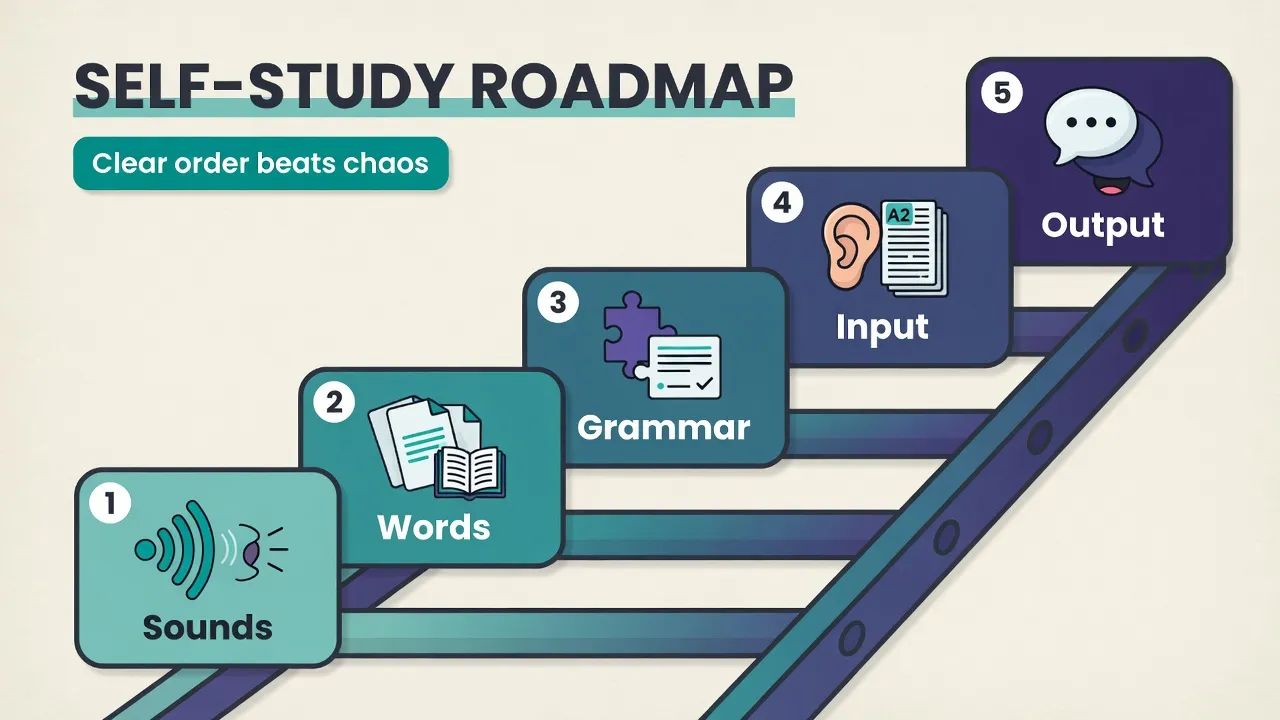
| Phase | Focus | Goal |
|---|---|---|
| Week 1-2 | Alphabet, stress, silent h, ñ, ll | Read aloud without panic |
| Week 2-4 | 200-400 high-frequency words and phrases | Greet, count, basic needs |
| Month 1-2 | Present -ar/-er/-ir, ser/estar, articles | Short present sentences |
| Ongoing | Graded reading + listening | Grow vocabulary in context |
| Ongoing | 5-10 min output | Not freeze in real talk |
1. Alphabet and basic reading rules
Spanish uses the Latin alphabet, so the letter shapes look familiar if you know English. Still, a few items deserve day-one attention:
- ñ - soft ny sound, as in España
- ll - often like y in many places; some regions keep an ly-like sound
- h - silent: hola sounds like ola
- rr and initial r - stronger trill than a soft single r between vowels
- Stress rules - if a word ends in a vowel, n, or s, stress usually sits on the second-to-last syllable; otherwise on the last. Exceptions wear a written accent (canción, fácil)
Spend a few short sessions reading simple words aloud. You are training your mouth and eyes to cooperate. That pays off every time you open a graded text later.
2. High-frequency words and phrases first
Grammar without bricks is a empty blueprint. Build a small, useful stock:
- Greetings and exits: ¡Hola!, ¿Cómo estás?, Buenos días, Adiós, Por favor, Gracias
- Pronouns: yo, tú, él, ella, nosotros, ustedes (and vosotros if you aim at Spain)
- Numbers, days, months, colors
- Core verbs as lemmas: ser, estar, tener, hacer, ir, querer, poder
- Everyday nouns: casa, agua, comida, trabajo, tiempo, amigo
Learn words in short phrases, not only isolated translations. Tengo hambre sticks better than bare hambre on a lonely card. For a scaffold of glue words, see our top 50 most common Spanish words. For size orientation by level, Spanish vocabulary by CEFR / Plan Curricular keeps the counts honest.
3. Core grammar that unlocks real sentences
Once you have roughly 100-200 items in play, start combining them. For early self-study, four topics are enough:
Gender. Most nouns ending in -o are masculine (el libro), most ending in -a are feminine (la casa). Exceptions exist (el día, la mano). Learn the article with the noun: el problema, not "problema = problem" alone.
Articles. Definite el / la / los / las. Indefinite un / una / unos / unas. They travel with gender and number, so they train agreement while you speak.
Present tense of regular verbs. Three families: -ar (hablar), -er (comer), -ir (vivir). Master the present endings for yo, tú, él/ella, nosotros, ustedes (add vosotros if Spain is your target). You will meet irregulars early (ser, ir, tener, hacer). Learn the high-frequency ones as chunks, not as a 40-page irregular table on week one.
Ser vs estar. Both can translate as "to be." That is the classic beginner headache - and it is manageable with a simple first map:
| Use | Prefer | Example |
|---|---|---|
| Identity, origin, profession, permanent traits | ser | Soy estudiante. Ella es de México. |
| Location, temporary state, how you feel now | estar | Estoy en casa. Estamos cansados. |
| Time and dates (clock / calendar talk) | ser | Son las tres. Hoy es lunes. |
You will refine edge cases later (está muerto, es aburrido vs está aburrido). For month one, the table above already builds useful sentences.
Pronunciation notes that save months of guesswork
You do not need a perfect native accent on day seven. You do need sounds stable enough that listening and reading reinforce each other.
Vowels stay clear. Spanish a e i o u are short and steady. Do not reduce unstressed vowels the way English does in casual speech.
Single r vs rr. Soft r between vowels (pero); stronger trill for rr and word-initial r (perro, rosa). Practice a little; do not stall your whole plan on a perfect trill.
C and Z by region. In much of Spain, c before e/i and z often sound like English th in think. In most of Latin America, they sound like s. Both are correct. Pick one reference for your own speaking practice so you are not switching every week.
Shadow short lines. Play a slow beginner clip, pause, repeat. Five minutes of shadowing beats thirty minutes of silent "I understand the rule."
Methods that work when you study alone
Apps are fine as a spine. Alone, you also need input and tiny output, or you plateau on streaks.
Build a light Spanish environment
Change phone or browser language when it will not break your work day. Keep a playlist with Spanish songs and glance at lyrics sometimes. Stick sticky notes on objects only if that still feels fun after a week - drop it if it becomes guilt furniture.
Series and podcasts with a caption ladder
Start with Spanish audio + captions in a language you know, then Spanish captions, then short scenes without text. Series like La casa de papel or Élite are motivating, but early on, slow learner podcasts (Coffee Break Spanish, Notes in Spanish beginner episodes, or similar) often teach more per minute. Entertainment is fuel; graded audio is training.
Graded reading as your vocabulary engine
Reading is where high-frequency words stop being a list and start being a language. Choose short texts where you understand most of the page. If every line is a dictionary fight, drop a level. A practical A1-B1 path lives in how to start reading in Spanish.
Try free graded samples when you are ready for real sentences:
- Spanish A1 sample
- Spanish A2 sample
- Browse more: all articles
Save phrases you want to reuse, not fifty random nouns. Me gustaría... will serve you more than three rare food words you never order.
Speak (and write) early in small doses
You do not need full conversations on day one. You need the habit of producing Spanish:
- Say your day in five slow sentences aloud
- Record a 30-second voice note to yourself
- Write eight present-tense lines about your week
- Later, try HelloTalk, Tandem, or a cheap tutor for feedback
Mistakes are normal. Freezing until "perfect grammar" is how alone learners stay silent for a year.
Spain or Latin America first?
Spanish is one language with regional norms. Madrid does not sound like Mexico City or Buenos Aires. That is variety, not a trap.
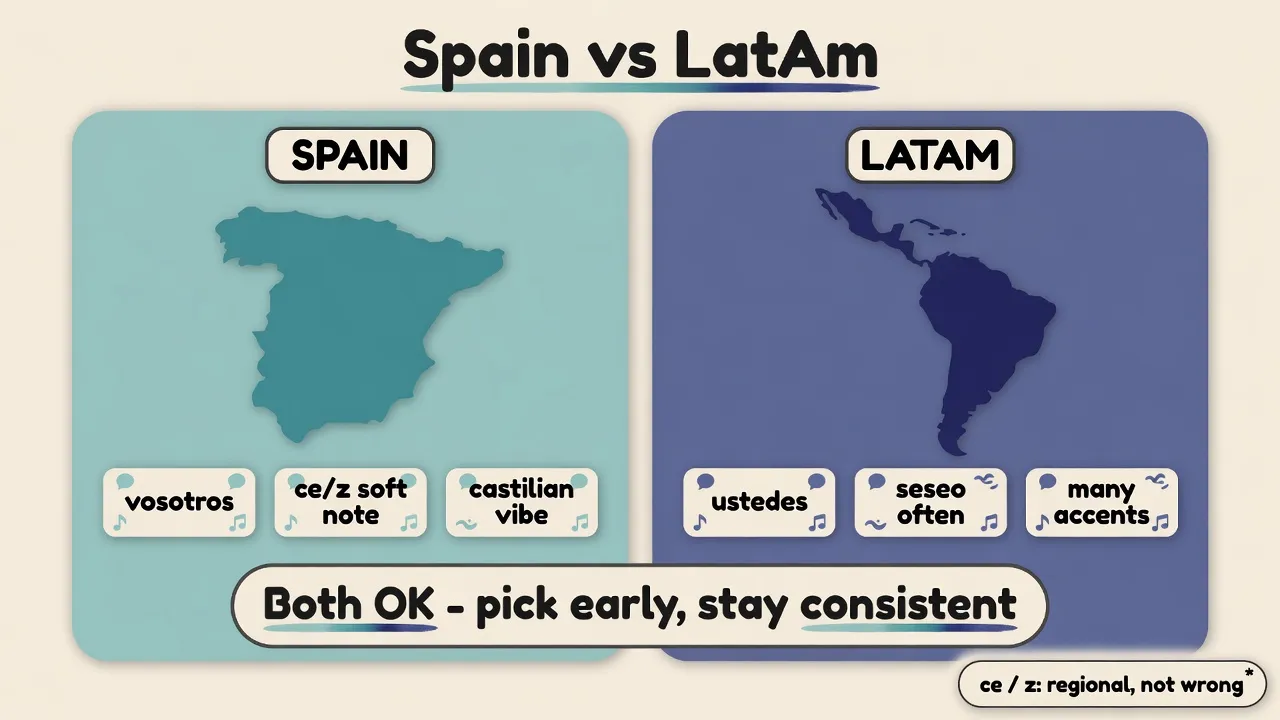
Pronunciation. Many Spain speakers use the th-like sound for c/z; most of Latin America uses s. Ll and y also vary (yeísmo and friends). Pick one model for your own speaking practice.
Vocabulary. Some everyday words differ: Spain often ordenador, much of LatAm computadora; Spain piso, elsewhere often departamento or apartamento. Context usually saves you.
Grammar note. Spain still uses vosotros for informal plural "you." Much of Latin America uses ustedes for both polite and informal plural. Learning materials from both sides remain mutually useful.
How to choose. Follow your life: job or travel in Europe leans Spain; plans in Mexico, Colombia, Argentina, or US Spanish communities lean LatAm media. If you only know you like the language, pick one podcast host or course accent and stay with it for a few months. You can still watch media from the other side without drama.
You will understand speakers across the Spanish-speaking world far earlier than marketing posts claim you need "two separate languages."
Sample weekly schedule (about 45-60 minutes a day)
Regular short contact beats one heroic Sunday. Adjust times to your life; keep the mix: sounds or review, grammar bite, input, output.
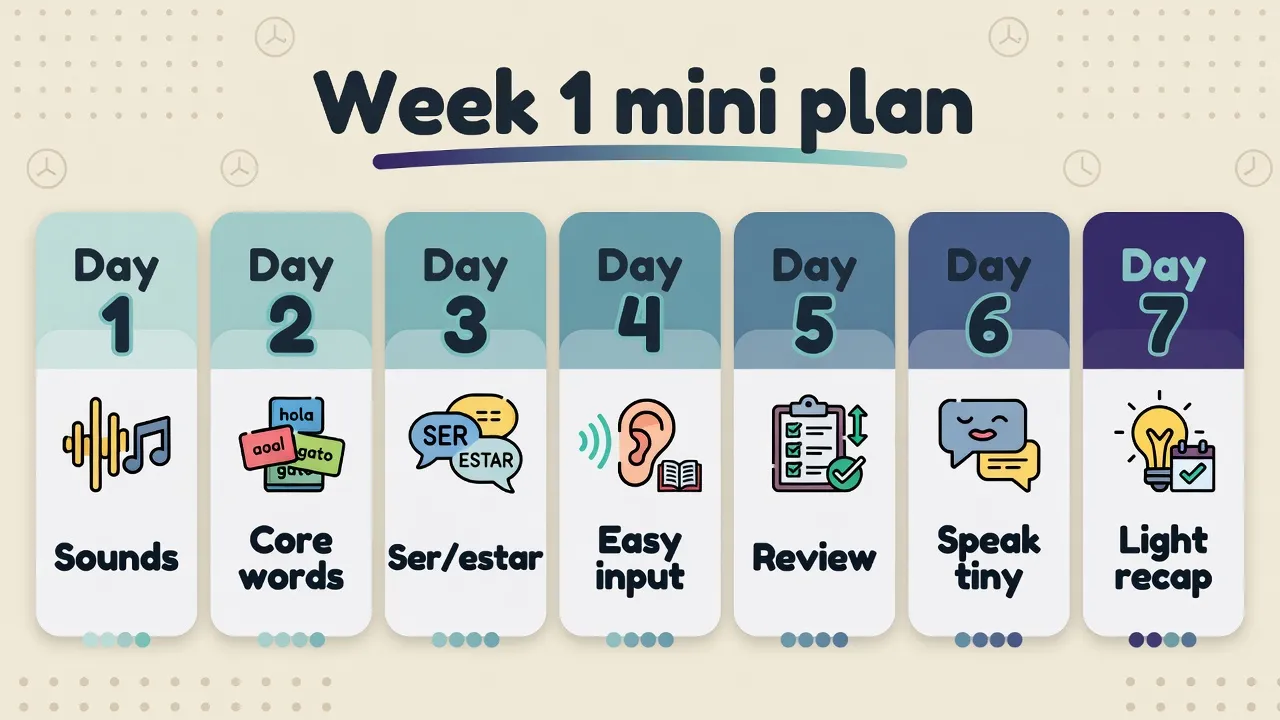
| Day | Focus (example) | Time |
|---|---|---|
| Mon | Sounds + 15 new phrases | 45 min |
| Tue | Present tense drills + 15 min graded text | 50 min |
| Wed | Beginner podcast + shadow 5 lines | 45 min |
| Thu | Reading + save 5-10 chunks | 50 min |
| Fri | Write 8 sentences about your day; read them aloud | 40 min |
| Sat | Series 20 min with Spanish captions + light review | 50 min |
| Sun | Light review, music, or full rest | 0-20 min |
If you only have 20 minutes, protect one block: either graded reading or phrases + aloud review. Streaks on games alone rarely build A2 listening.
For CEFR size orientation while you grow, keep how many words by CEFR as a compass, not a panic meter.
Tools and MovaReader
You need three tool jobs, not twenty apps:
- Explanation - a clear beginner grammar source or course for ser/estar and present tense
- Input - graded texts and slow audio you will actually finish
- Practice - spaced review of words and phrases you met in context
MovaReader is built around reading-first Spanish: graded library, click-to-translate, listening where available, and phrase practice on paid tiers. It is not a live speaking coach. Upload your own EPUB when you own the rights.
Plans:
- Free plan: Spanish graded articles with click translate, about 20 translations per day - enough to start
- Reader (€1): more room for real reading volume (unlimited translations in the paid reading path)
- Pro (€5): full trainers and heavier practice load
Useful doors:
- All articles
- Spanish A2 sample
- Spanish phrases practice and Spanish typing practice
- How to use
- Phrases
- Pricing
Pair any reading app with real speaking practice outside it. Reading grows the map; conversation uses the roads.
Beginner mistakes that slow self-study
Grammar-only months. Tables feel productive. Without easy listening and reading, you train for tests, not for language.
App streaks without input. Swiping is fine as warm-up. If the day never includes a short text or audio, progress stalls.
Waiting to speak. Tiny output early prevents the "I understand more than I can say" wall - or at least softens it.
Jumping levels for prestige. A famous novel at A1 is not ambition; it is friction. Finish easy pages first.
Switching Spain/LatAm materials every week. Exposure to both is fine. Copying three accents into your own speaking in the same month is chaos.
All-or-nothing weeks. Five quiet minutes of review beats a guilt spiral after a missed two-hour plan.
FAQ
How long to reach A2 alone?
Often several months of regular study. Hours and methods matter more than calendar slogans. Prior languages, daily minutes, and how much you read and speak all move the date.
Can I learn only with free apps?
Yes for a long stretch. Add real input (texts and audio) early, or you plateau on games and isolated items. Free graded samples already beat another empty deck.
Spain or Latin America first?
Either. Choose one media accent for your own speaking practice to reduce chaos. Vocabulary overlap is huge, and mutual understanding comes earlier than social media arguments suggest.
Should I speak from day one?
Yes, in tiny doses: read aloud, shadow, self-record, write short present-tense notes. Full conversations need more input - both can coexist.
Grammar first or reading first?
A tiny grammar map plus lots of easy reading beats pure textbook or pure "vibe only." Learn enough ser/estar and present tense to parse sentences, then meet them in graded text.
Is the free plan enough?
Enough to start graded Spanish reading and feel the method. Move to Reader or Pro if you need more translations per day or full trainers. Speaking practice still needs another channel.
Do I need a tutor from the start?
No. Many people start alone with free materials and add a tutor later for feedback. A tutor is a multiplier, not a mandatory gate.
Next steps
- Spend two short sessions on sounds and stress, reading simple words aloud.
- Collect a first pack of high-frequency phrases (greetings, ser/estar/tener/ir, numbers).
- Learn present tense + the ser/estar table until you can write five true sentences about yourself.
- Open one easy Spanish article and save a few chunks, not a dictionary dump.
- Put a weekly mix on your calendar - even 20 focused minutes count.
- When volume grows, check pricing only if the free plan's limits block real reading.
Self-study Spanish from zero is not a weekend transformation and not a mystery reserved for people who move abroad. It is a ladder: sounds, core words, core grammar, easy input, small output, repeated for months. Start the next small rung today - un paso a la vez.
Keep reading with translations inside the text
With a free account, an unknown word translates with one tap, and the words you are learning wait for you in the trainer.
Free account: 7 days of Pro, then 20 word translations a day or a paid plan.