Tips & Methods
How to Start Reading in English (Beginner Path)
You do not need perfect grammar before page one. Here is a day-zero path: pick level, stay in the comfort band, read 10-15 minutes, and build week one without dictionary torture.
You keep waiting. "I'll start reading in English after more grammar." Or "after more words." The page never opens. Or you open a thick novel on day one, hit a wall of unknowns, and quit by page five. That frustration is normal. It is almost never a talent problem. It is timing plus difficulty.
Reading is a practice tool from day one, not a prize you unlock after textbooks. You can start now with the right kind of text.
To start reading in English today, open an easy graded text you can almost understand (~95-98% known words), read for 10-15 minutes, and look up only words that block the story. Interest beats a perfect classic you will abandon. You do not need to finish grammar first - reading is a practice tool from day one, not a prize at the end.
Here is the rest of the path: why start before your grammar feels "ready," a level-to-text ladder, the ~95% comfort band, extensive vs intensive in one glance, a 10-15 minute habit, a first-week plan, concrete starters (including free samples you can open now), mistakes that kill momentum, tools that help, and FAQ.
Why start reading before your grammar is "ready"?
Many learners treat books like a final exam. First finish the course. First collect "enough" vocabulary. Then maybe read.
The useful flip: reading itself teaches. Easy pages give you words in context, grammar that feels natural instead of memorized, and a feel for how English looks on the page. You still need grammar study if you want rules on demand. You do not need perfect rules before the first graded article.
Teachers and researchers often talk about extensive reading: lots of easy text for pleasure and volume, not line-by-line analysis. Treat that as a useful practice pattern, not a miracle percentage. Small daily sessions of almost-clear text beat rare marathons of text you cannot follow.
Waiting for a perfect word list can last years. Learning words inside stories you actually finish tends to stick better, and it is less boring. If you want a broader "where do I start English at all" map, see where to start learning English. This post stays narrow: day-zero reading.
What should you read at your level?
Match the text to your band. Ego can wait. Interest still wins.
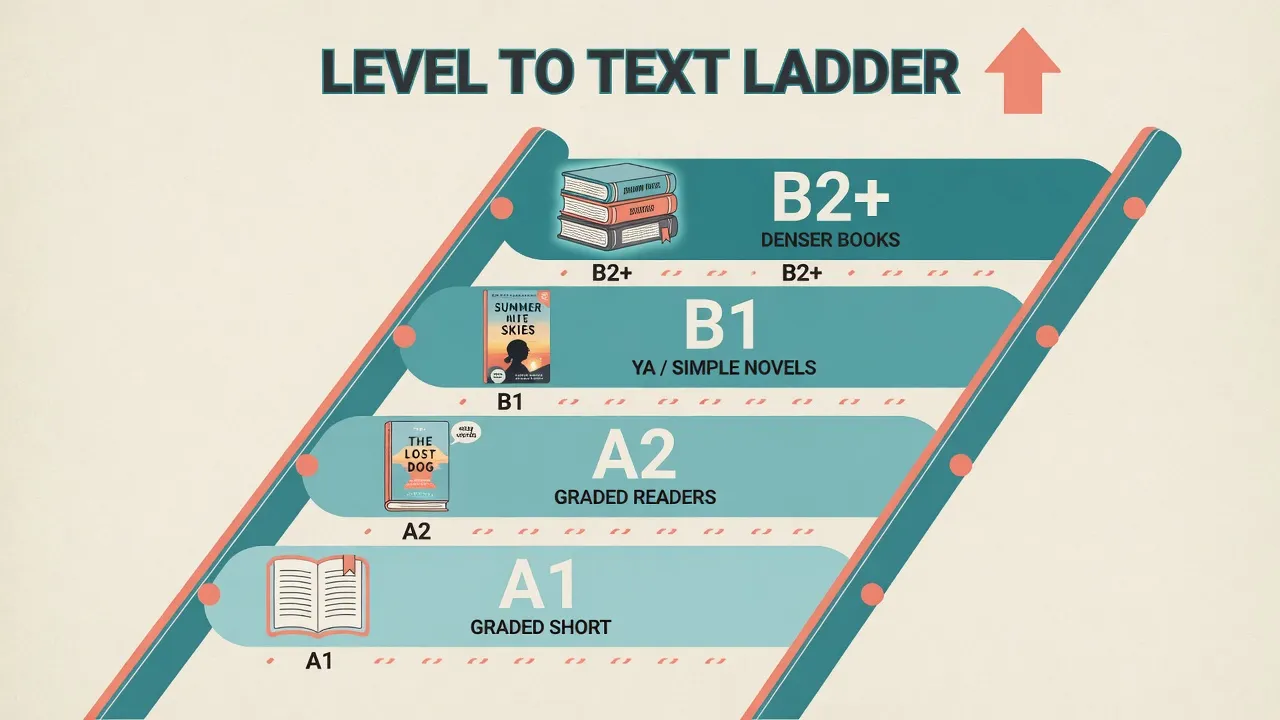
From short graded pages up toward originals you enjoy - step by step, not prestige first.
| Band | Start with | Then stretch | Avoid day one |
|---|---|---|---|
| A1-A2 | Short graded articles; graded readers level 1-2; simple kids chapter books if interest fits | Longer graded readers; easy YA with short chapters | Full unadapted classics; long commercial series as default |
| B1-B2 | Graded readers mid levels; easy YA; easy modern prose; light news for learners | Known-plot / film-book; short modern novels | Dense 19c prestige as first habit text |
| C1+ | Original fiction/nonfiction you enjoy; quality journalism | Harder lit, essays, field texts | Nothing "required" - interest still wins |
Boring text kills the habit faster than a slightly imperfect level match. If the story does not pull you, swap titles.
At A1, open something finishable today - not only a famous novel you hope to "grow into." Free graded English samples you can try now: browse all articles. For the graded-vs-original trade-off, see adapted vs original books for A2 learners. When you are ready to finish a full first book, hand off to how to read your first book in English.
How hard should the text feel? The ~95% comfort band
The page should mostly feel clear. A few unknowns are fine. Constant hard stops kill the story.
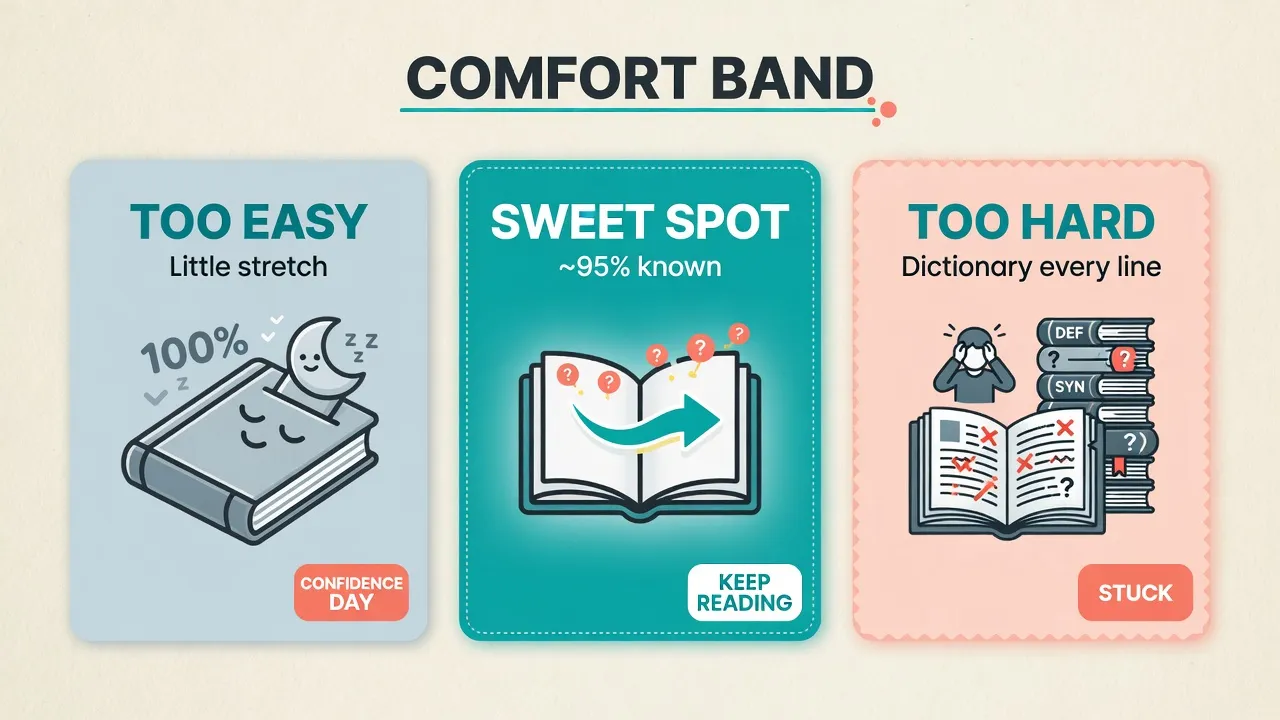
Too easy, sweet band (~95% known), or too hard - adjust the book, not your self-worth.
| Feel | Rough signal | What to do |
|---|---|---|
| Too easy | Almost no unknowns; zero struggle | Fine for confidence days; stretch later if you want growth |
| Sweet band | You understand most words; plot holds; roughly ~95-98% known (orientative) | Stay here for day-zero habit |
| Too hard | Stop every line or every sentence; plot dies | Drop a rung: shorter graded text, easier title |
That ~95-98% range is a rule of thumb from extensive-reading practice. Prefer the whole band over rigid "must be 98 only" dogma.
Dictionary rule for day zero: look up blockers and words that keep repeating. Skip optional color so the plot survives.
Quick offline check: open a page and count hard stops (the five-finger idea). Full walkthrough: five-finger rule for book level. If help can stay in the text (click a word, see meaning, keep reading), you lose less flow than hopping to another app every line. That is a friction idea, not a pitch.
Extensive vs intensive reading (short)
Day-zero habit is mostly easy volume. Intensive study has a place - just not on every page.
| Mode | Goal | Dictionary | Length |
|---|---|---|---|
| Extensive | Flow, volume, pleasure, input | Rare; blockers only | Many easy pages |
| Intensive | Study hard passage, grammar/vocab depth | Often dense | Short hard text |
Use extensive mode for the daily habit: easy text, story first, few lookups. Intensive is fine for class homework or a short hard paragraph. If every page becomes intensive, you quit.
If you translate every sentence in your head, that is a separate skill trap. This can help: how to stop translating in your head.
Build a 10-15 minute daily habit
Minimum: 10-15 minutes daily beats rare two-hour marathons. Habits grow with repeats, not magic calendars. There is no guaranteed "X days until automatic."
Stack reading on something you already do: coffee, commute, before sleep. Set a timer. Stop while you still feel curious so tomorrow's session is easy to start.
Light tracking (pages or minutes) is optional. Guilt streaks are not required.
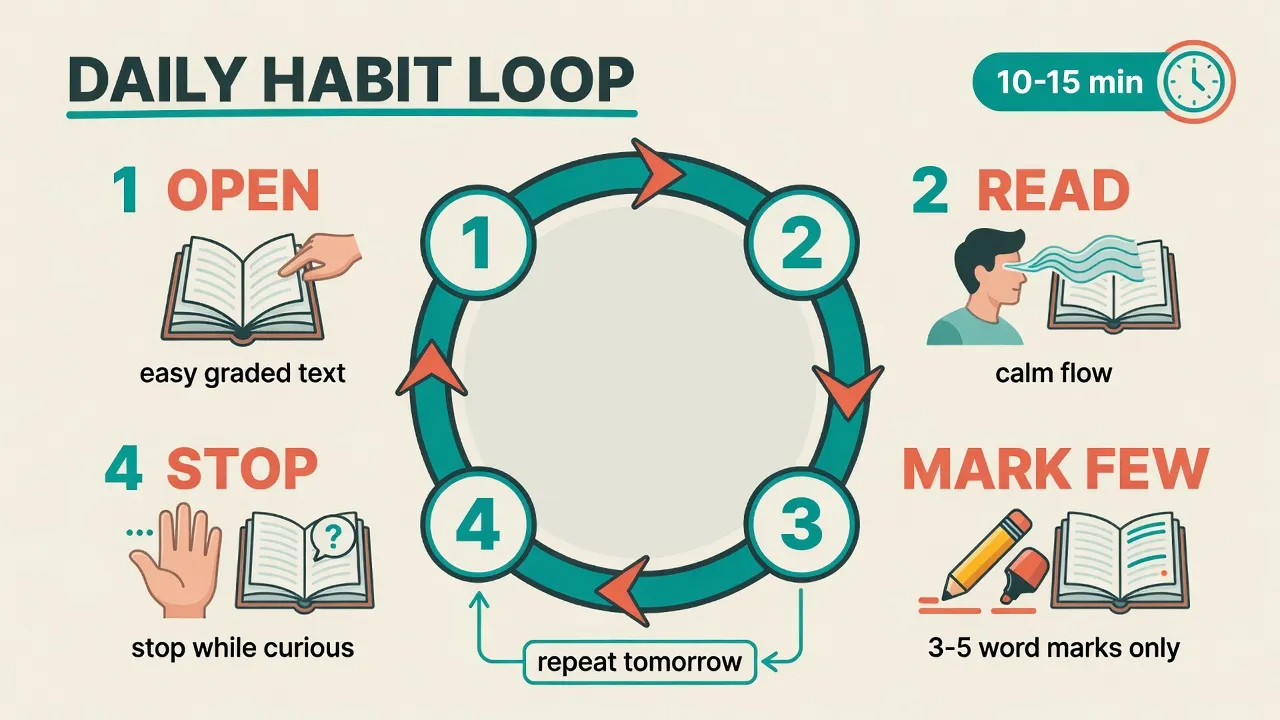
Open easy text → read for the story → mark a few blockers → stop while curious.
| Step | Action |
|---|---|
| 1 | Open easy graded text (comfort band) |
| 2 | Read for story, ~10-15 min |
| 3 | Mark / look up few blockers only (≤5-10 words total when starting) |
| 4 | Stop while still curious; optional light review later |
Your first-week plan
Finishable over impressive. Swap text if boring. No novel marathon required week one.
| Day | Action | Time |
|---|---|---|
| 1 | Quick level check; open one easy graded text (sample article OK) | ~15 min |
| 2-3 | Read 2-3 short sections; look up only blockers; mark ≤5-10 words total | ~15 min |
| 4-5 | Continue same text; light review of marked words (optional trainer) | ~15-20 min |
| 6 | Same book/article deeper or second short graded text if first bored you | ~15-20 min |
| 7 | Note what worked: minutes done, interest level, was text too hard? Plan week 2 | ~10 min |
Week one success is showing up with easy pages, not finishing a commercial series. If the text is too hard or too dull, change it on day 6 without calling the whole method a failure.
What to read first: concrete starters
Commercial novels need a legal copy you own. We do not host full licensed bestsellers as a free warehouse.
A1-A2 starters
- Graded reader series at printed levels (Oxford Bookworms, Penguin Readers, and similar).
- Free graded English articles: all articles.
- Optional: very simple kids chapter books if the topic fits your interest.
- Easy learner news (BBC Learning English, VOA) as a secondary diet.
B1-B2 bridge
- Mid-level graded readers; easy YA (Wonder-type); short modern prose.
- Known plot or film-book after the comfort habit is real. Harry Potter is great motivation for many people, but length and vocabulary make it a stretch for a lot of A1-A2 readers - treat it as later stretch, not the default day-one book.
- Longer book lists: top 10 easiest English books for A2-B1.
C1+ and commercial titles
- Original fiction and nonfiction you actually enjoy; quality journalism.
- Legal path for commercial novels: buy, borrow, or use an EPUB you already own. Upload your legal file if you use a reading app that supports it. Interest still wins at every level.
Mistakes that kill reading momentum
Normal traps, not a shame list. Fix the habit, not your "talent."
- Starting harder than ego - prestige over comfort. Drop a rung.
- Looking up every unknown word - the story dies; keep blockers and high-repeat words only.
- Only textbooks - study is useful; it is not the same as extensive reading for pleasure and volume.
- Translating every sentence in your head - slows flow; work on thinking in English over time (stop translating guide).
- Quitting after one bad book - swap text; do not quit reading itself. Finish tactics live in how to read your first book in English.
- Waiting for "perfect level" forever - the comfort band is good enough to start this week.
Tools: click-translate without dictionary hell
Tools only cut friction. Reading is not a full speaking course if speaking is your main goal.
What helps in one breath: stay in the text, click a word, see meaning in context, keep reading. Free graded library path. Upload a legal EPUB you own when you want a commercial title.
Practical path:
- Open free graded texts on all articles.
- Run the week-1 plan on easy text; look up blockers only.
- When ready, upload a legal book you own.
- Optional light vocab work if words stick: type training demo, phrase typing demo, progress on the language map.
Plans on pricing:
| Need | Realistic plan |
|---|---|
| Try the loop / free graded start | Free plan (~20 word translations/day; listening often free) |
| Real volume with translations | Reader €1/mo |
| Trainers beyond reading | Pro €5/mo |
| Commercial novel / series you care about | Your legal EPUB/file - not an unlimited hosted bestseller warehouse |
What MovaReader does not offer: unlimited free commercial bestsellers.
If ~20 free translations a day cut the middle of every session, that is a product signal (shorter free texts, or Reader for volume) - not moral failure.
FAQ
Can I start if my vocabulary is almost zero?
Yes, with very easy graded texts and short sessions. Expect more support and shorter pages at first. Interest plus daily minutes still beats waiting forever for a "perfect" word list.
Is Harry Potter a good place to start?
Great motivation and a known plot, but length and vocabulary make it a stretch for many A1-A2 readers. Prefer short graded texts first; try HP later with a legal copy you own if you love it. We do not host free commercial bestsellers.
Should I look up every unknown word?
No. Look up blockers and words that keep repeating. Skip optional detail so the story survives. Dictionary torture is a common quit reason, not a badge of hard work.
Are bilingual / parallel texts a good start?
They can lower fear at A1, but they do not train pure English flow forever. Mix with monolingual easy graded text as soon as comfort allows. Click-in-context help is a middle path: stay in one text, get meaning when you need it, keep reading.
How long until I can read a full book?
Depends on starting level, minutes per day, and text difficulty. Many learners finish a short graded reader or a long article series before a commercial novel. Use how to read your first book in English for finish tactics - this post gets you started this week.
What free limits apply if I try MovaReader?
Free path: graded library on all articles plus about 20 word translations/day. Listening is often free. Reader ~€1/mo for full translation volume; Pro ~€5/mo for trainers. Details: pricing. Commercial bestsellers are not an unlimited free library - upload legal EPUBs you own. Reading builds vocab and grammar feel; speaking still needs separate practice if that is your goal.
Next steps
You do not need perfect grammar before page one.
- Start today: one easy graded page, 10-15 minutes, blockers only.
- Stay in the comfort band (~95-98% known-words feel); interest beats prestige.
- Run the week-1 table; swap text if boring or too hard.
- Open free samples: all articles.
- Stay on the free plan while testing; move to Reader on pricing when the daily translation cap stops real pages. Pro only if trainers are the bottleneck.
- When you own a commercial title, upload a legal file.
- Related reads: five-finger rule, first book without quitting, adapted vs original, easiest A2-B1 books.
This week: one easy graded text, a comfort-band check, a 10-15 minute timer, and lookups that protect the story. The tool cuts dictionary friction; the free plan has daily limits; commercial pages still come from books you legally own. Reading is a tool from day one - not a prize, and not a full speaking replacement.
Learning English?
The English version of MovaReader teaches Spanish and Ukrainian. To read English with a translation for every word, open the reader in Ukrainian or Spanish:
Книги англійськоюЦя стаття українськоюLibros en inglésEste artículo en español