Tips & Methods
Learn English Through Reading: A Working Method
Not a word-list grind. A calm daily loop: finishable pages, stay in the story, and keep only the phrases that actually matter.
You know the pattern. An evening of flashcards, a green streak in an app, and the next day half of it is gone. The word felt "known" in a quiz and then vanished in a real paragraph. That is not a character flaw. Isolated words are thin. They have almost nothing to hang on.
Reading English is different. Not magic, not a full language diet by itself, but a strong daily channel for input: words in context, grammar in motion, and a story that pulls you forward when willpower is low.
Here's the simple version. Learn English through reading with a short loop you can run almost every day. Pick a finishable text a little above comfort (roughly i+1). Read for meaning. Look up only the words that block the sentence. Save 5-10 real phrases, not fifty naked words. Stop while you still want more. That builds vocabulary with hooks and a feel for patterns. It does not replace speaking practice on its own.
The goal is pages you finish, not prestige titles you abandon. The core idea we will keep returning to: stay in the story. Every needless dictionary trip is a tax on flow. Pay that tax only when the sentence truly collapses without help.
If you want the science angle and a broader 30-day overview of why reading accelerates progress, see our sister piece How reading accelerates English learning. This article owns the daily machine: session rules, weekly skeleton, phrase capture, and a tool path.
Why isolated cards often lose to context
When you learn run = to move quickly on foot, your brain gets one thin line. In real text, run keeps changing face:
- I run every morning - physical running
- She runs a company - manage / operate
- The engine is running - machine is on
- We ran out of time - finished the supply
- Don't run a risk like that - take a risk (collocation)
A book or article places the word next to plot, emotion, and neighbors (run a risk, run late, run the meeting). That is not mystical neuroscience. It is simply more memory hooks: same spelling, richer cue set, easier recall later.
Flashcards still help as a supplement for hard items you already met on the page. As the only system past beginner stages, they often create an illusion of progress: you recognize the word in a test and freeze in a paragraph.
Here is the contrast in one picture: a lonely card on the left, the same word living inside a story on the right.
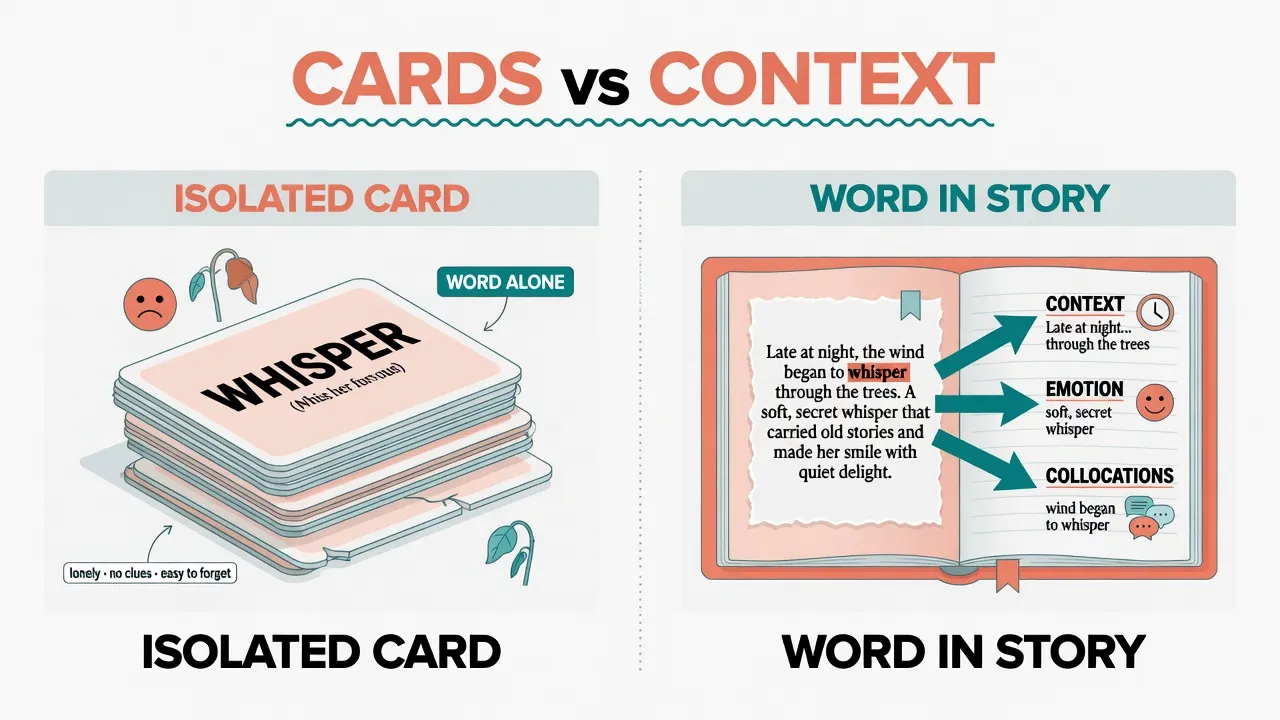
Cards give clean pairs. Context gives texture. For learning English by reading, texture is the point.
What reading actually builds
Grammar patterns you absorb, not only memorize
Native speakers rarely replay a Present Perfect table in their head before speaking. They have seen and heard thousands of correct examples. Reading gives a stream of working structures: word order, prepositions, articles, tenses in motion.
Short grammar notes still help when something confuses you. What reading reduces is the fantasy that endless charts alone will make sentences feel natural.
Vocabulary that repeats across scenes
For a word to settle, you usually need more than one meeting. A novel chapter or a series of articles on one topic reuses the same field of language. That is cheaper for willpower than forty brand-new cards every night with no story to hold them.
Motivation from meaning, not only XP
When you care what happens next in a detective story or a piece about your job, you keep going even when the page is a little hard. That is not lazy learning. It is ordinary attention to content, the kind that keeps a habit alive for months.
Pace you control
A film will not wait. A text will. You can reread a sentence, check one blocker, and return to flow. For many adults, that is the least stressful way to stack hours of English input.
Pick a text at the right difficulty
Stephen Krashen's comprehensible input idea (roughly: understandable messages a bit above your current level, often written as i+1) is a useful compass, not a religion. For a fuller walk through the idea, see Krashen's comprehensible input hypothesis.
Practical page test:
| Band | Rough sense without help | Use as |
|---|---|---|
| ~80-90% | Comfortable daily reading | Main habit text |
| ~70-80% | Stretch if the story holds you | Occasional challenge |
| below ~70% | Decoding with a dictionary | Too hard for flow reading |
Do not chase prestige (The Economist on a shaky B1). Chase pages you finish. Another quick check: the 5-finger rule for book level. For a map of levels and what "about right" can look like in the product, open the language map.
A1-A2
- Graded readers and short adapted texts
- Very simple learner news
- Stories with concrete vocabulary (home, work, food, travel)
Try free samples: more in all articles. For first-book nerves, how to read your first book in English walks the start gently.
B1-B2
- Young adult and lighter modern prose
- Blogs and news on familiar topics
- Series in one niche (IT, sport, psychology) so vocabulary repeats
A short list that many learners actually finish: top 10 easiest English books for A2-B1.
C1+
- Original literature, essays, specialist analysis
- Rotate genres on purpose so you do not freeze in one register
A note on MovaReader: it does not open commercial novels for free. You read free graded library pieces, or you import a file you legally own (for example EPUB). Interesting text first, tool second.
The 15-25 minute session (the core method)
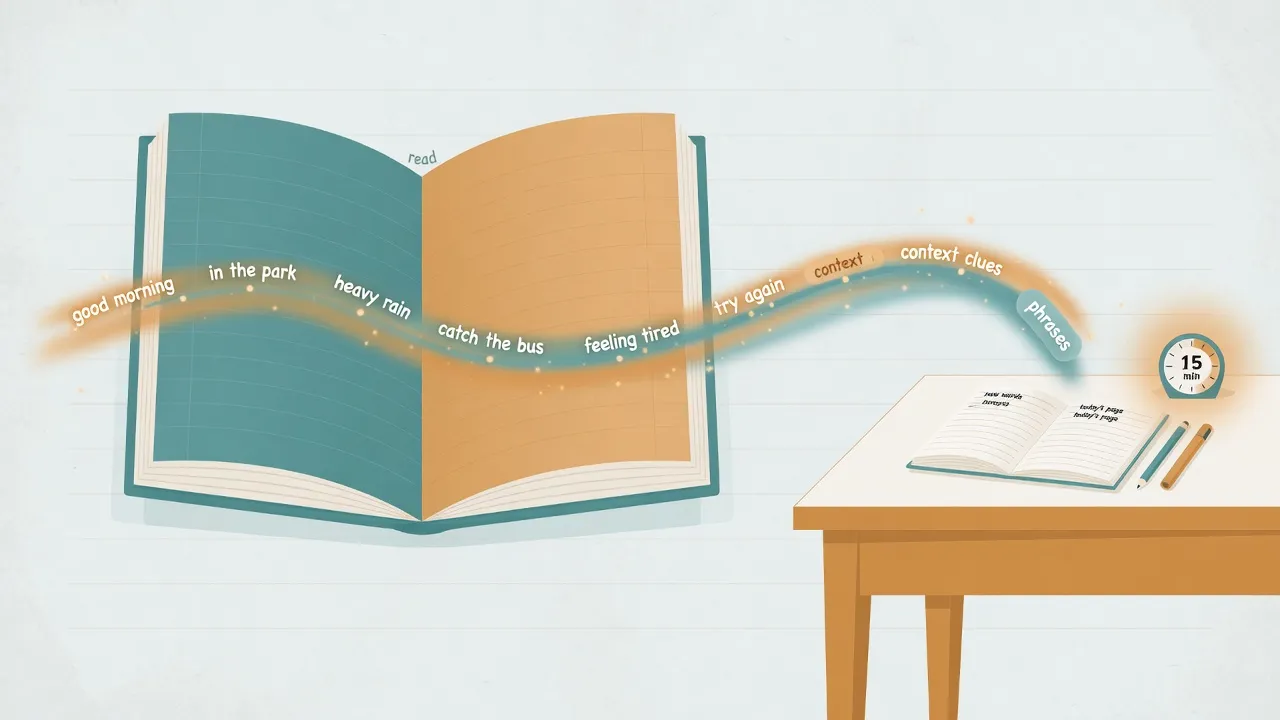
This is the working method, not a mood. Set a timer. Fifteen minutes is enough on a tired day. Twenty-five is plenty when energy is good. The point is a loop you can repeat, not a heroic weekend binge.
The five-step loop looks like this:
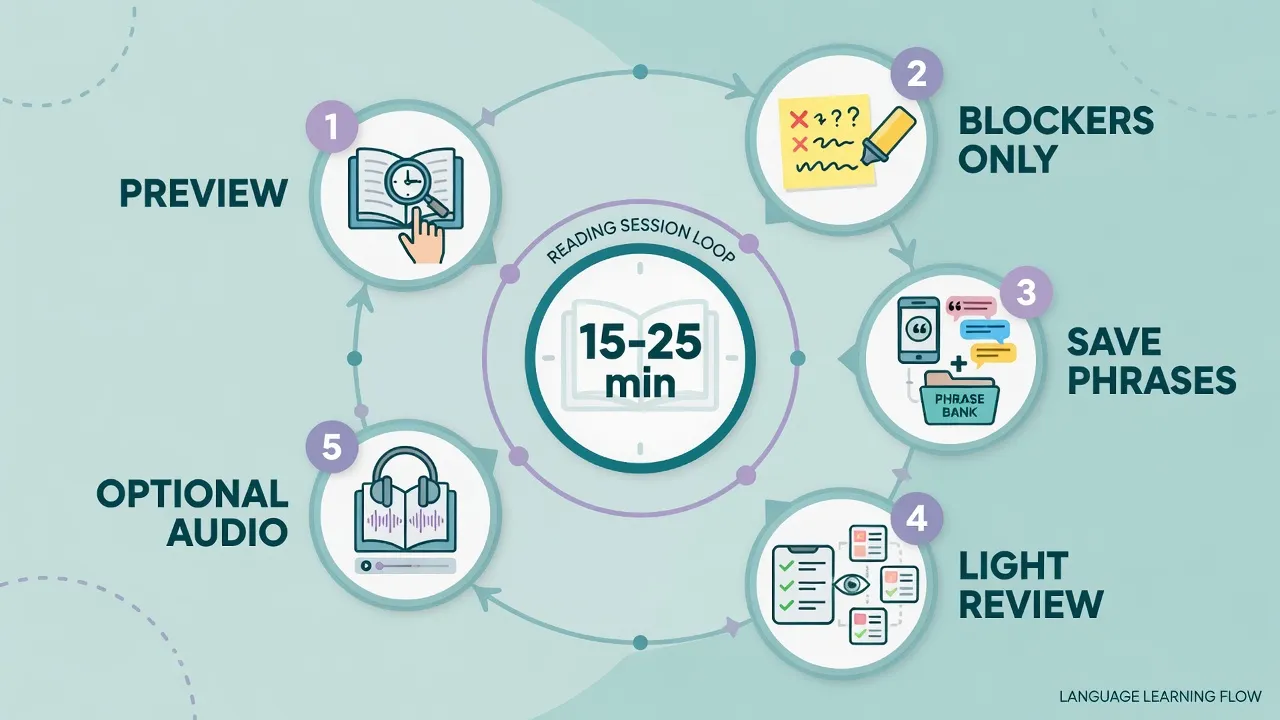
| Step | Action | Rule |
|---|---|---|
| 1 | Preview pass | One question: what is this about? |
| 2 | Second pass | Translate blockers only |
| 3 | Capture | 5-10 phrases max (not 50 naked words) |
| 4 | Light fix | Say aloud or type 3-5 phrases |
| 5 | Optional audio | Only after text sense is clear |
Step 1. Preview pass
Read a paragraph or a page without stopping. Your only job is the big picture: who, where, roughly what happens. Guess from context. Do not open a dictionary yet. If the whole page is fog, the text is probably too hard for today's flow session. Switch down a band.
Step 2. Second pass, blockers only
Now allow lookups, but with a strict rule: translate only the word or phrase without which the sentence collapses. Not every adjective. Not every "nice-to-know" item.
This is where the dictionary tax shows up. Five tabs, copy-paste, lose the plot, return colder. If a reading app helps at all, it helps here: one tap in place, then eyes back on the paragraph. On freemium MovaReader you get about 20 word translations per day; when you need more volume for real reading, Reader is about €1/month. Details live on pricing. Listening is often available more freely than word translations, so use audio as support, not as a second full dictionary grind.
Step 3. Capture little, capture well
Save 5-10 phrases per session. Prefer make a decision over bare decision if that is how the text sounded. Prefer run out of time over abstract run. Your future self reviews usable chunks, not a landfill of orphan words.
Step 4. Light fix
Say three to five phrases out loud. Or type them once while the scene is still warm. A short typing pass in the phrase typing demo is enough for many days. Full trainer suites sit on Pro (about €5/month) in trainers. Pro is optional for the method. The method needs contact with phrases, not a subscription guilt trip.
Step 5 (optional). Audio or read-aloud
If the text has audio, understand it in writing first, then listen. Audio on a page you do not understand mostly adds noise. Shadowing or quiet reading aloud after sense is clear is useful; audio as a substitute for understanding is not.
Stop on time. Leave a little hunger for tomorrow. That is how the habit survives week three.
Parallel access to meaning, without romance
Older bilingual books, such as parallel texts, tried to keep meaning close to the line. Today the practical form is often: target-language text plus a fast check on a word or short phrase, then straight back into the paragraph.
Useful principle:
- Guess from context first.
- Check the blocker with one click (or a quick note).
- Reread the sentence or paragraph in English.
Unhelpful principle:
- Translate every word in order
- Read only a full sentence translation and ignore the English
- Build a giant "later" word dump you never review
Parallel layout or click-translate is a safety net, not the destination. Over weeks you want more guessing and fewer clicks. That is extensive reading with a seatbelt, not bilingual dependence as a lifestyle.
Weekly skeleton and a realistic month
A method dies if every day needs a new heroic plan. Use a boring skeleton and protect it.
| Days | Action |
|---|---|
| 4 | Graded article or easy text, 15-20 minutes |
| 2 | Your own legal EPUB / longer book in short slices |
| 1 | Review 20-30 saved phrases |
On graded days, stay near the 80-90% band so you finish pages. On book days, accept shorter slices; finishing a chapter over several sessions still counts. On review day, speak or type phrases, do not invent fifty new cards.
If almost every day means 15-20 minutes of real reading:
| Horizon | Realistic effect |
|---|---|
| 1 week | Ritual starts; less fear of the page |
| 2-4 weeks | Familiar words land faster on your topics |
| 1-3 months | Noticeable passive vocabulary on themes you actually read |
Progress depends on starting level, text difficulty, and whether you finish sessions at all. Reading builds a strong base. Speaking still needs mouth time later.
Stay in the story: the dictionary tax
Here is the metaphor one more time, because it is the whole method in a picture. On one side: tab chaos, lost plot, cold return. On the other: calm stay-in-text, one targeted check, back to the scene.
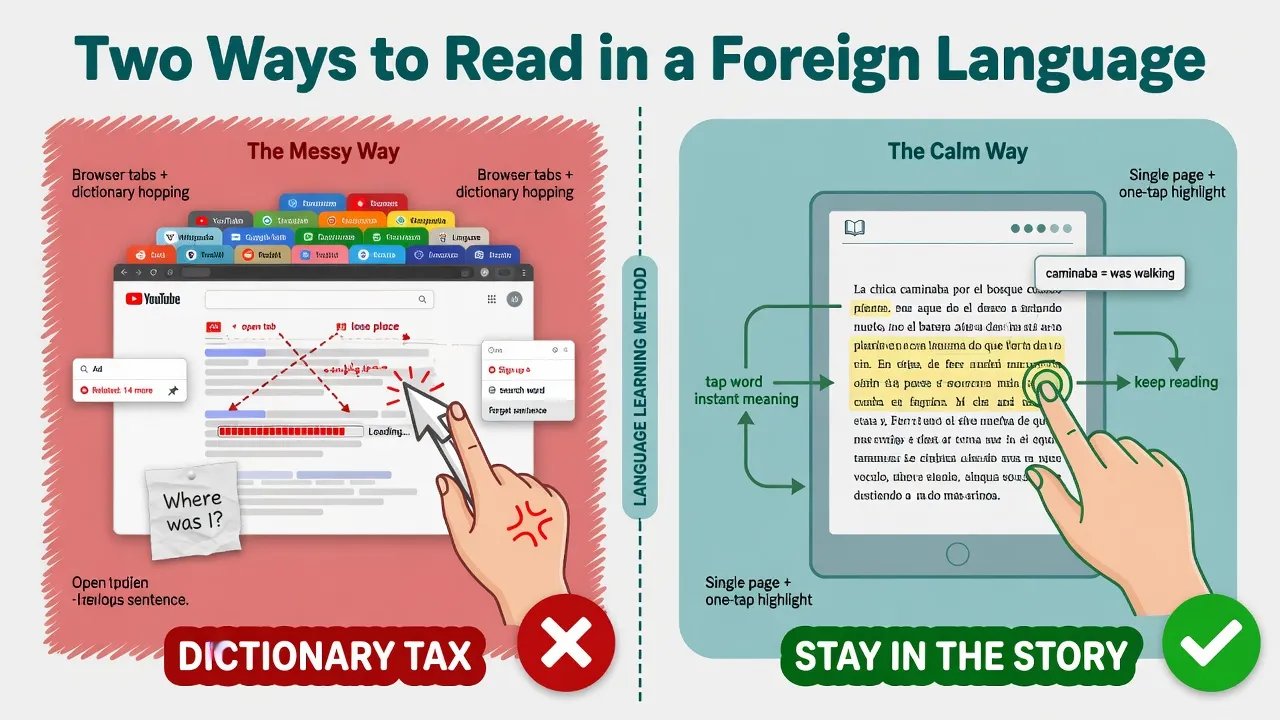
The tax is not "using a dictionary." The tax is leaving the story so often that interest dies. Blockers only. Short sessions. Phrases that matter. That is how reading stays a habit instead of becoming homework you resent.
A calm tool path (MovaReader)
You can run this method with paper books and a notebook. A reading tool is useful when it reduces friction: tap for a blocker, save a phrase, keep listening handy, train a small set later.
MovaReader is built around that path: free graded English (and Spanish) texts, in-context translation, optional phrase practice. Warm up on free pieces in all articles, learn the click habit in how to use, then bring your own legal EPUB when you want real books.
The plans:
| Tier | Approx | Best use |
|---|---|---|
| Freemium | free | ~20 word translations/day; listening often unlimited; free graded library |
| Reader | ~€1/mo | More reading comfort when the freemium wall hits |
| Pro | ~€5/mo | Trainers / SRS optional - not required for the method |
What the product does not do:
- Replace buying or borrowing commercial books you want to own
- "Learn English for you" while you only scroll
- Offer unlimited free shelves of commercial novels by default
If freemium's ~20 lookups feel tight, that is a signal you are reading for real volume, not a failure. Reader is priced for that moment. Pro is for people who want structured review on top. Neither is a personality upgrade.
For the research-flavored companion (why reading helps, a wider 30-day frame), keep how reading accelerates English learning next to this method post. Different jobs: that one explains the engine; this one hands you the steering wheel for today.
FAQ
Can I learn English only by reading?
You can build a strong base: vocabulary in context, grammar patterns, reading comfort and speed. Free spoken conversation still needs oral practice later. Reading is a foundation wall, not the whole house.
Anki or reading?
Often both, with clear roles: reading as main input; short cards or trainers for phrases you already met on the page. Anki-only at intermediate levels often creates recognition without page comfort.
How many pages per day?
Start with time (15 minutes), not a page quota. Three pages every day beats thirty once a week and burnout.
Do I need parallel texts always?
No. Click-translate or a bilingual layout is a safety net. The goal over weeks is to guess more and click less.
What if graded texts feel boring?
Pick a theme that holds you: IT, sport, true crime, food, business. Interest beats "correct classics" for habit. When you are ready for longer fiction, import a legal EPUB you chose yourself.
Is not understanding 100% normal?
Yes. 100% is a myth for growth reading. Working range: overall sense plus a few targeted checks. If you need a dictionary for almost every line, drop a band.
How is this different from "just read more"?
The method adds rules: finishable level, blockers only, small phrase capture, short sessions, weekly review. Random hard PDFs without rules often die in week two.
Will this replace speaking apps?
No. Patterns from reading help speaking later; mouth practice is still a separate track. Use reading for input volume, then practice saying something out loud, even if only for five minutes.
Next step
Do not wait for a perfect yearly system. Find a text you will finish this week.
- Open a free sample: browse all articles.
- Set a 15-minute timer. Preview, then blockers only. Save 5-10 phrases.
- Tomorrow, same level or slightly harder. On one day this week, review the phrase stack.
If you want book-first guidance, start with how to read your first book in English. If levels feel foggy, check the language map and the 5-finger rule. For product setup, how to use and pricing stay short and clear.
Stay in the story. Pay the dictionary tax only when the sentence needs it. That is the working method.
Learning English?
The English version of MovaReader teaches Spanish and Ukrainian. To read English with a translation for every word, open the reader in Ukrainian or Spanish:
Книги англійськоюЦя стаття українськоюLibros en inglésEste artículo en español