Reading Strategies
Parallel texts and language feel: when bilingual pages stall you
Parallel texts are not evil, but a translation that is always on screen can become a permanent shortcut. When bilingual pages help, when they stall language feel, and what to do instead.
You open a dual-language book. Spanish on the left. English on the right. Unknown word? Glance right. Odd syntax? Glance right. A chapter flies by. It feels like reading in two languages at once.
Often it is not. You are reading in one language - your L1 - with the target language running like a screensaver at the edge of the page.
Short answer: side-by-side parallel texts can be a useful temporary scaffold. They lower fear and let you meet longer stories early. For language feel - the habit of understanding and predicting in the target language without leaning on L1 - always-on translation often becomes the default shortcut: less guessing, less retrieval, more "English story with L2 wallpaper." The better long game for intermediate readers is pure original text at a fair level, try context first, then on-demand help only when a word blocks you. Parallel texts do not "ruin you forever." Habits train your brain.
Why parallel pages feel so productive
Give the method credit. Raw books at B1 or B2 can be rough. Unknown words stack up. Comprehension dips. Pleasure dies. Parallel texts remove that friction. You move near native speed. Finishing a chapter feels like progress. The dopamine is real.
Your brain is also optimizing for ease, not for the work that builds independence. When a full L1 version sits next to every line, the cheap path is always open. That is not a moral failure. It is how attention works.
| Mode | What you see | Brain tends to do | Best for |
|---|---|---|---|
| Always-on parallel | Full L1 next to L2 | Glance early; skip hard retrieval | Short confidence boost; deliberate line comparison |
| On-demand help | L2 only; help after a tap | Try first; fill the gap when blocked | Building independent reading feel |
| Full machine dump | Whole page L1 first | Read L1; sample L2 | Emergency gist, not feel training |
What language feel actually needs
Language feel is the quiet sense that a sentence "sounds right," or that meaning is forming before you could translate it word by word. It is not a grammar quiz score. It grows when you:
- Retrieve and guess - try meaning from context before you get a ready answer
- Tolerate ambiguity - real talk has flexible phrases, not one fixed gloss
- Build a mental model in L2 - the scene and argument live in the target language, not only as an English summary tagged with foreign words
Always-on L1 does not ban those skills. It simply makes them optional. Optional skills rarely get practiced.
Research and teaching debates often circle the same idea under different names: desirable difficulty, retrieval practice, comprehensible input with less L1 interference. The practical takeaway is simple: if the answer is always visible, you practice less of the hard part.
When always-on L1 stalls progress
These are practical risks, not a moral panic. Many learners use parallel books for a stretch and still improve. The stall shows up when dual pages become the only reading mode for months or years.
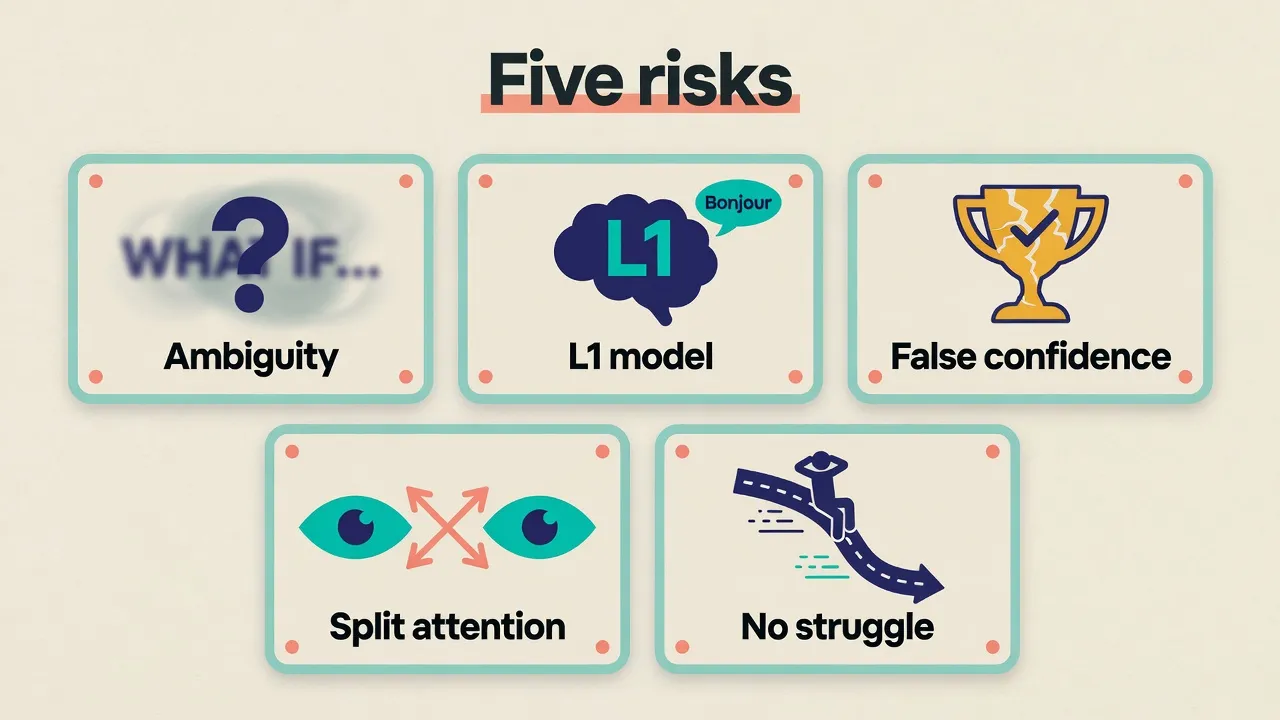
1. Ambiguity muscle weakens
A phrase like Spanish ya veremos can mean "we'll see," "maybe," or a polite brush-off, depending on tone and context. A fixed L1 column hands you one gloss. Real speech flexes. Fluent readers learn to hold options open. Parallel layout trains "there is one English answer."
2. Mental model stays in L1
Advanced reading is not word-by-word. You hold a running scene or argument. With a full translation always available, many readers build that model in English and treat the L2 as wallpaper. Ask them to retell the page in the target language and the gap appears.
3. False confidence
"I finished a hard classic with a dual edition" is not the same as "I can pick up a same-level book with no L1 column." The parallel page may have done the heavy lifting. That is fine for a scaffold. It is a problem if you never test independence.
4. Attention splits
Eyes dart left-right, left-right. Flow stretches break. Deep reading likes longer stretches of uninterrupted engagement. Micro-checks feel free; they still cost immersion. Related: flow and long-form reading in a target language.
5. Desirable difficulty collapses
Learning sticks better when work is slightly hard but still doable. Zero struggle every page can feel pleasant and leave less residue. You still "see" vocabulary. You may not own it.
Here's a simple map of those five risks:
When parallel still makes sense
- Short early scaffold so fear drops
- Deliberate noticing: read L2 first, then compare a few lines
- Classroom tasks built for comparison
- Then graduate: cover the L1 side, or switch to pure text + on-demand help
A note on embedded methods (interlinear books)
Interlinear books put translations and notes inside the foreign text instead of on the facing page. That can reduce eye-darting. Fair point.
It can also make L1 inescapable inside the line. Traditional parallel books at least let you hide the English side with a hand or a bookmark. Embedded notes sit in the sentence you are reading. Used sparingly as a bridge, they can help. As a permanent default, they train the same dependency: meaning arrives through L1 first.
Not a "dead end forever." A habit to outgrow when pure pages become possible.
A better default: pure text + on-demand lifeline
You do not need to white-knuckle raw novels with a paper dictionary for every third word. That kills motivation.
A cleaner model:
- Read pure original - no full L1 column in peripheral vision
- Try context first - activate retrieval and inference
- Get targeted help when blocked - one word or phrase, not a whole dual page
- Let help disappear - it should not sit there training automatic glances
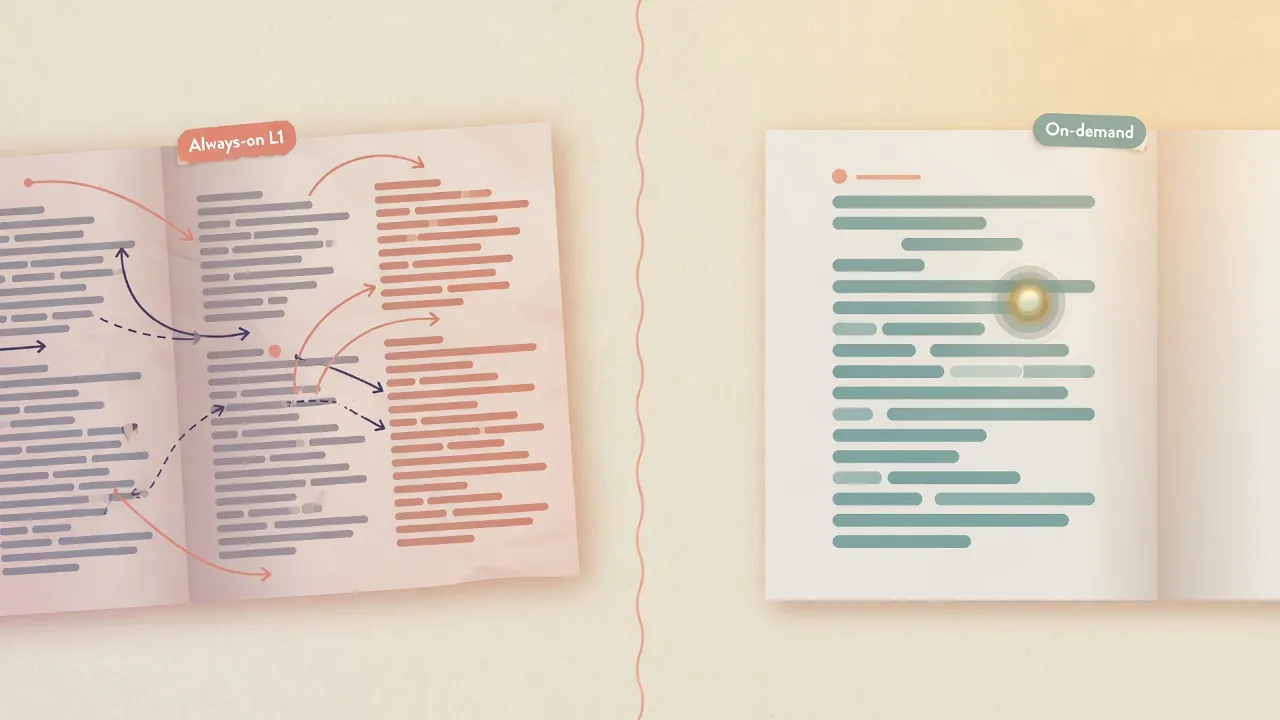
Here is the contrast in one glance:
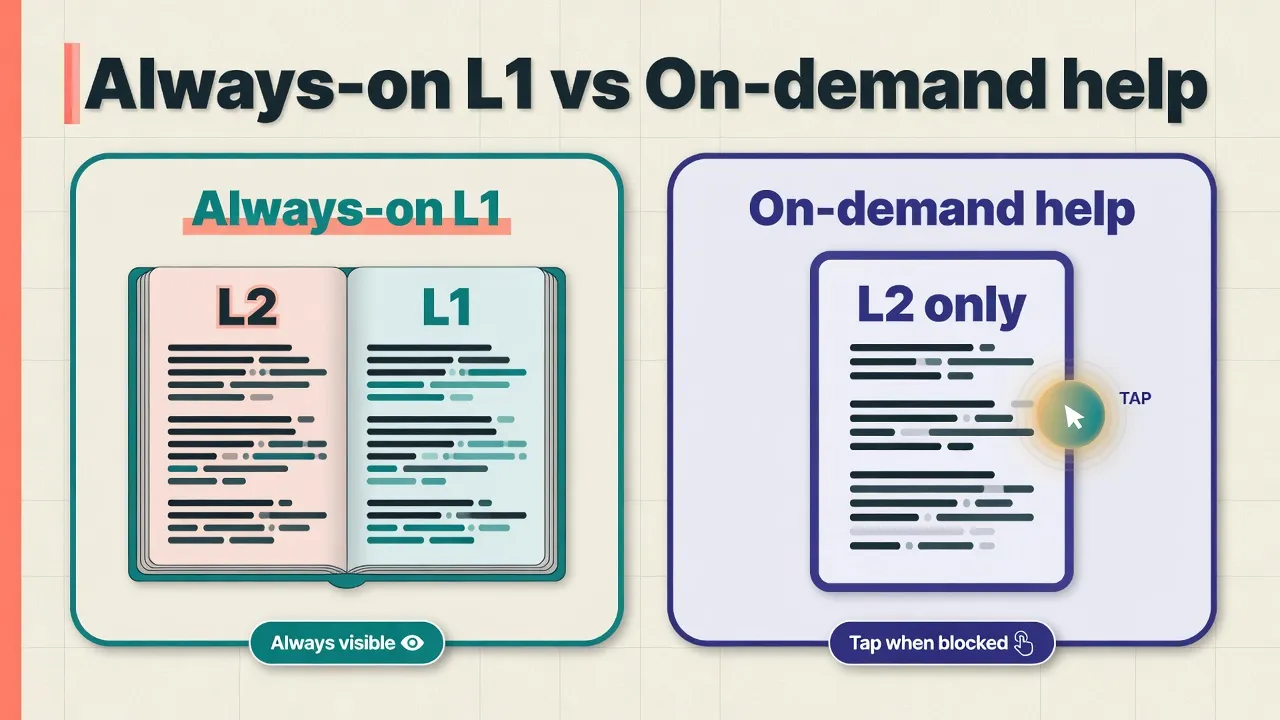
Always-visible help feels like notes on a phone contact list: your brain may not bother storing what it can always see. On-demand help asks for a try first. Even a failed try marks the gap as important. Then the explanation lands in a prepared slot. That is soft science, but it matches how many of us actually learn hard skills.
Click-translate tools are helpful, not a perfect literary oracle on every tap. Idioms, humor, and literary style still need judgment. Good enough contextual help beats a permanent dual page for independence training.
Transition protocol (weeks, not guilt)
If dual books are your default, you do not need a dramatic purge. You need a few weeks of different practice.
| Weeks | Move |
|---|---|
| 1-2 | Easy pure originals (comfort level). Look up only true blockers. |
| 3-4 | Level-matched pure text. More taps are fine if you tried first. |
| 5+ | Mild stretch books. Keep on-demand help, not dual-page default. |
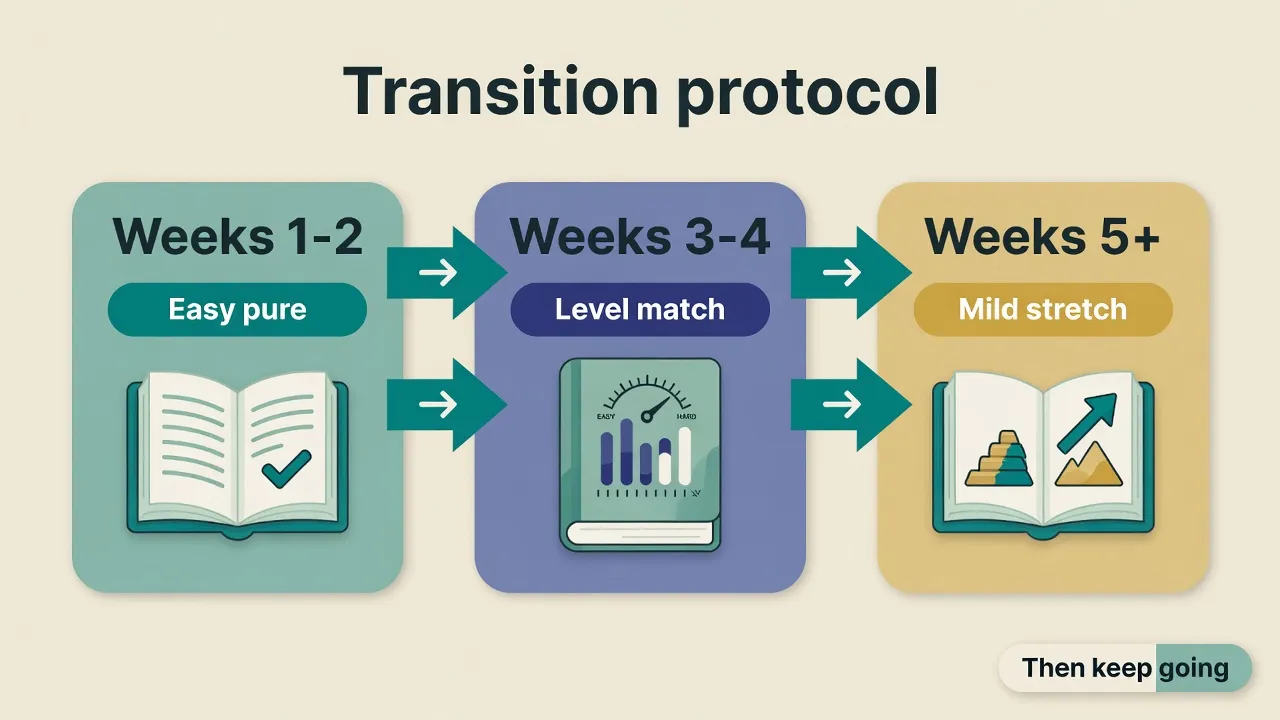
Track one simple metric: can you read a same-level page without the dual layout and still follow the story? If yes, keep going. If no, drop level or use more graded material - not more guilt.
What about A1-A2?
Fair question. Authentic prestige novels at A1 are often the wrong fight. Parallel dual classics can feel like a solution while the real need is comprehensible text at your level.
Prefer graded and adapted readers over dual-language classics you cannot actually process in L2. Lookups are fine. Always-on full translation pages still train less independence. Build volume at a true level first, then graduate.
How MovaReader fits
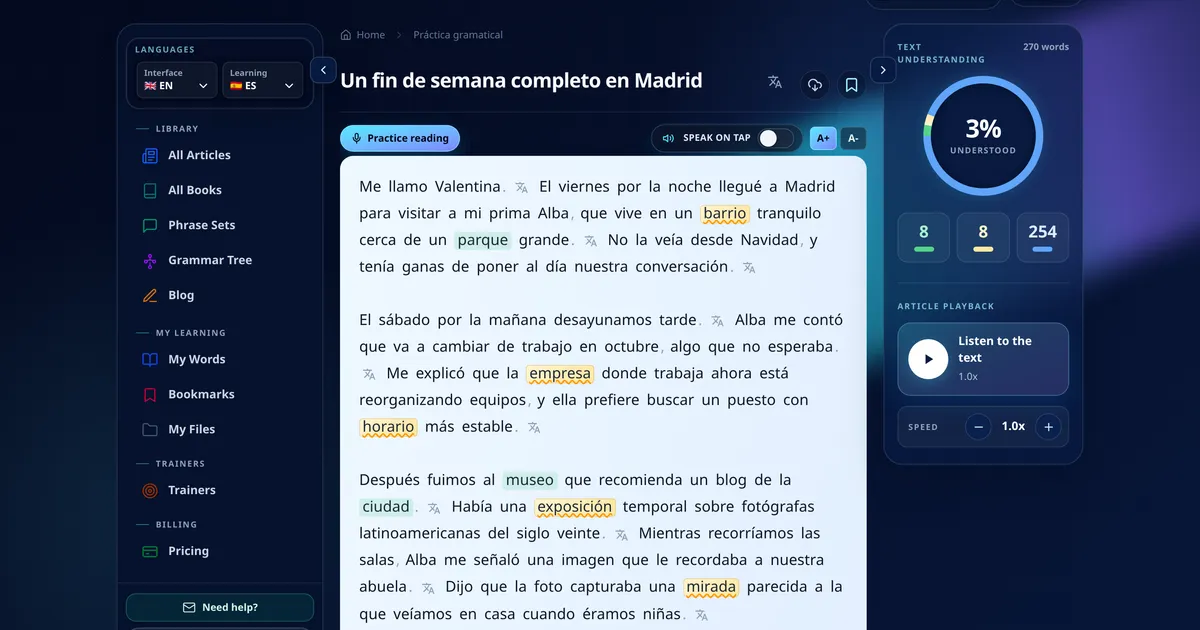
MovaReader is built around a pure reading surface plus help when you ask: tap a word or phrase, get contextual help, keep reading. The page stays in the target language by default.
What you get:
- Free graded article library with click-to-translate
- Free plan: about 20 word translations per day, plus listening
- Reader €1/month for more reading volume
- Pro €5/month for full trainers and extras
- Upload EPUB / files you own
Success looks like tapping less over time, not staying dependent forever. Try samples: Spanish A2. Full library: all articles. Plans: pricing. Demos: type training, phrase typing. Phrase practice: /en/phrases.
FAQ
Are parallel texts always bad?
No. They can lower fear and let you meet longer stories early. The risk is making always-on L1 your permanent default if the goal is independent language feel.
How long is a scaffold OK?
Think weeks or short projects, not years as the only mode. Add pure pages as soon as easy originals are possible. Check whether you can read a same-level page without the dual layout.
Is looking up a word the same as a parallel text?
No. One targeted lookup after a try is on-demand help. A full L1 column always visible is a different habit - your eyes learn the cheap path.
What about beginners (A1-A2)?
You need comprehensible text more than prestige novels. Graded readers beat dual-language classics you cannot process in L2. Lookups are fine; always-on full translation pages still train less independence.
What about interlinear notes?
Embedded L1 can reduce eye-darting but can also make L1 inescapable inside the line. Use sparingly, then move to pure text with optional help.
How does the free plan work here?
Free graded library and click-to-translate with a daily cap (about 20 word translations a day). Reader €1/month for more reading volume. Pro €5/month for trainers. Upload books you own. Help appears when you ask.
Next steps
- Remember the screensaver metaphor: if L1 is always on screen, practice the hard part on purpose.
- This week, read at least one pure page at a comfortable level. Look up only blockers.
- If A1-A2, pick graded text before dual classics.
- If you want to try MovaReader: open all articles, try a sample, and only then decide if Reader or Pro fits.
Parallel texts are training wheels with a use-by date. Use them to get moving. Then practice balance - pure page, try first, help when stuck. Language feel lives in those stretches where the story holds without the English side lighting up.
Keep reading with translations inside the text
With a free account, an unknown word translates with one tap, and the words you are learning wait for you in the trainer.
Free account: 7 days of Pro, then 20 word translations a day or a paid plan.