Ilya Frank Method and Bilingual Reading: When It Helps, When It Stalls
Frank-style and parallel texts can start volume and calm anxiety. They can also train a translation habit. See when bilingual helps, three clear limits, and an original-first loop with help only on click.
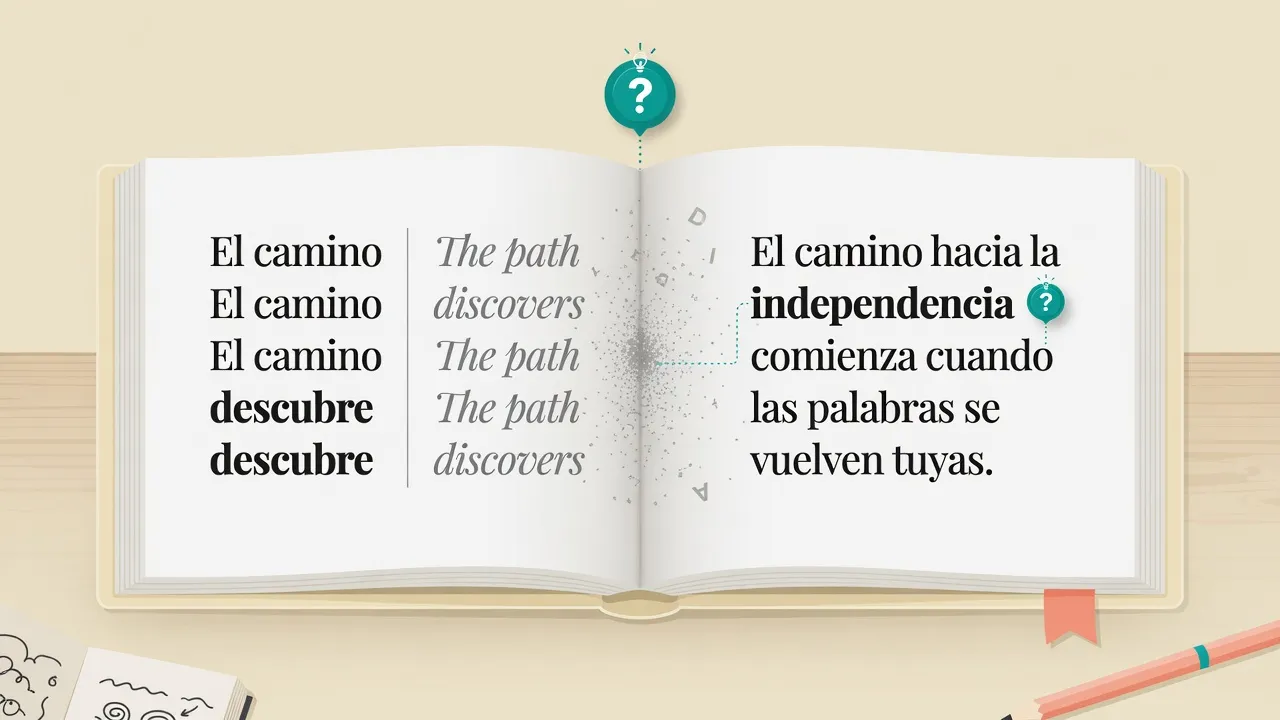
You want real pages, not another drill set. So you pick a bilingual book, an interlinear edition, or a dual-language app. For a while it feels smart: meaning is right there, anxiety drops, and you finish chapters again.
Then you open a plain English (or Spanish) page with no translation beside it. The wall comes back. That is not failure. It is a common side effect of always-on support.
The short answer: bilingual formats (Ilya Frank segments, page-parallel books, dual-language apps) help most when you are a true beginner, high-anxiety, or need volume before pure L2 feels possible. They stall when L1 stays always visible: less guessing, a translation habit, and a hard jump to unaided originals. A practical alternative is original-first text near your level with help only on demand (word or phrase click), then a short reread in L2. Use bilingual as a start scaffold, not a permanent home.
If the name Ilya Frank is new: it is a popular reading format that pairs short foreign-language segments with built-in gloss notes, then a clean reread of the same stretch. It sits in the same family as parallel texts and dual-language readers.
Here is the map for this guide:
- what the Frank method actually does
- how parallel / bilingual formats work
- when bilingual reading is genuinely useful
- three limits of always-on L1
- Frank vs page-parallel vs original + on-demand (table)
- a step-by-step original-first reading loop
- how MovaReader fits (honest freemium)
- FAQ
No fluency countdown. No "this method destroys your brain." Just a fair look at scaffolding and independence.
What is the Ilya Frank method?
Ilya Frank's approach is a scaffolded reading format, not a full language school in one book. In plain terms:
- The text is split into short segments (a few sentences or a small paragraph).
- You first meet an adapted pass: the L2 segment with literal and lexical notes tucked in parentheses or as interlinear-style help. Hard words and phrases get a quick gloss so meaning does not collapse.
- You then read the same segment clean, without notes - the classic "now swim on your own" pass.
- Some later editions or personal routines flip the order when you are ready: clean first, adapted second only if needed.
The philosophy is simple: get volume and meaning early, before you bury yourself in drill-heavy grammar. You keep turning pages. You stay inside a story. For many learners who only knew word lists, that felt (and still feels) like a breakthrough.
It is not a complete language method by itself. Speaking, writing, and free conversation still need separate practice. That is not a put-down of Frank-style books. It is just the honest job description: they are input scaffolds for reading, not a full curriculum.
Keep that distinction. A good scaffold can start your reading life. A permanent dual page can freeze it.
How do parallel and bilingual formats work?
Frank editions are one member of a wider family. Formats differ, but they share a space: L1 support is always or very easily available while you chase volume.
Frank / interlinear-style segments
Gloss lives inside or under the L2 stretch. You get help without flipping to a full translation page. Then you reread clean. The rhythm is: support, then solo on the same chunk.
Page-parallel bilingual books
L2 and L1 sit side by side or on facing pages. One column (or page) is the original; the other is your language. Easy to check long stretches. Also easy to read the L1 column first and call it "reading."
Dual-language and parallel apps
Often a toggle, split view, or always-visible translation pane. Some also offer tap-word lookup - which already moves toward on-demand help if L1 is hidden by default.
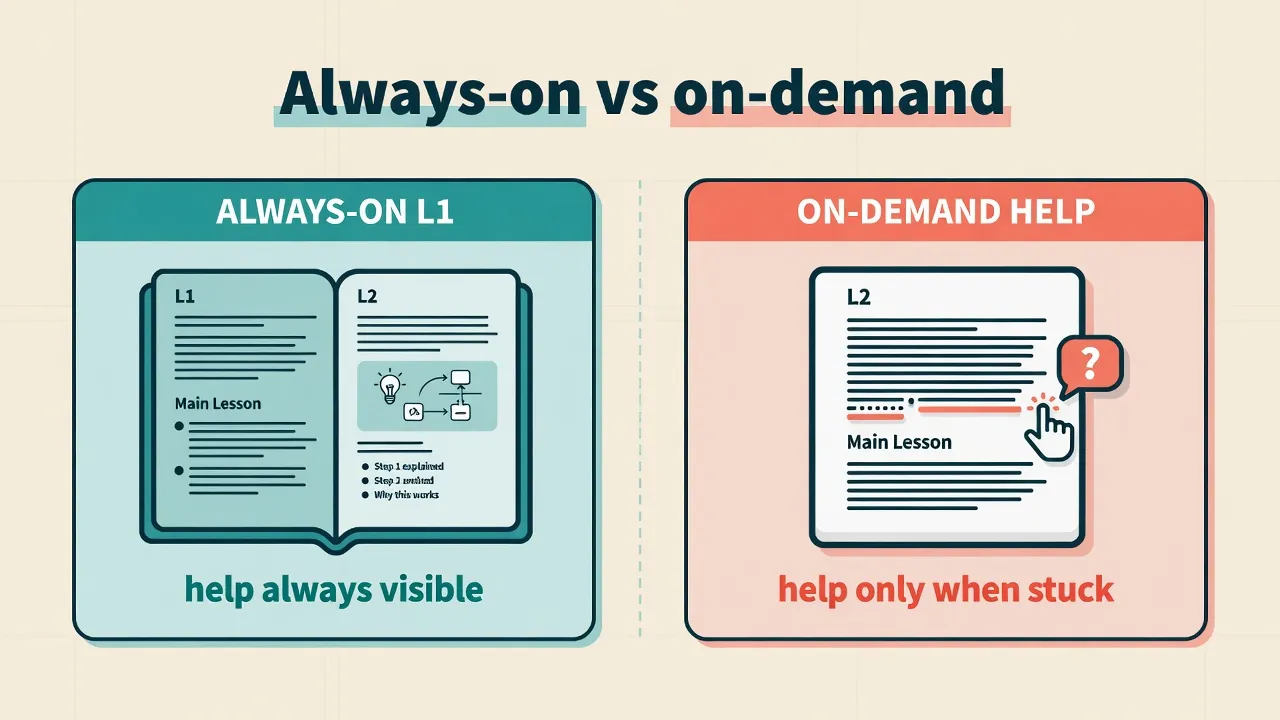
Same family problem: when help never leaves the screen, your eyes have a permanent escape hatch.
Here is the visual contrast many learners feel in their bones - always-on bilingual layout versus a clean original page with help only when you ask:
When is bilingual reading actually useful?
Scaffolding is not a sin. Permanence can be.
Bilingual and Frank-style formats earn their keep in real situations:
- True beginners bootstrapping the first pages of connected text. A wall of pure L2 with zero lifeline can stop the habit before it starts.
- High anxiety. Fear of the blank original page is real. Dual support softens the wall so you can sit still and finish something.
- Offline / pre-digital life. Part of why these formats got popular: good digital dictionaries and tap-to-translate were not always in your pocket. A book that carried its own gloss was practical, not "lazy."
- Volume and habit before pure L2 stamina exists. You need pages under your belt. Bilingual can buy that runway.
- Occasional long-stretch check after you already tried L2. Intentional, not default: "I gave this paragraph a real shot; now I verify."
There is also a practical gap many mid-level learners hit: good comprehensible input near their level can be thin. When graded pure L2 material is missing, bilingual can be a lifeline, not a moral failure. The question is not "Did I ever use parallel texts?" It is "Am I still living there when I could switch?"
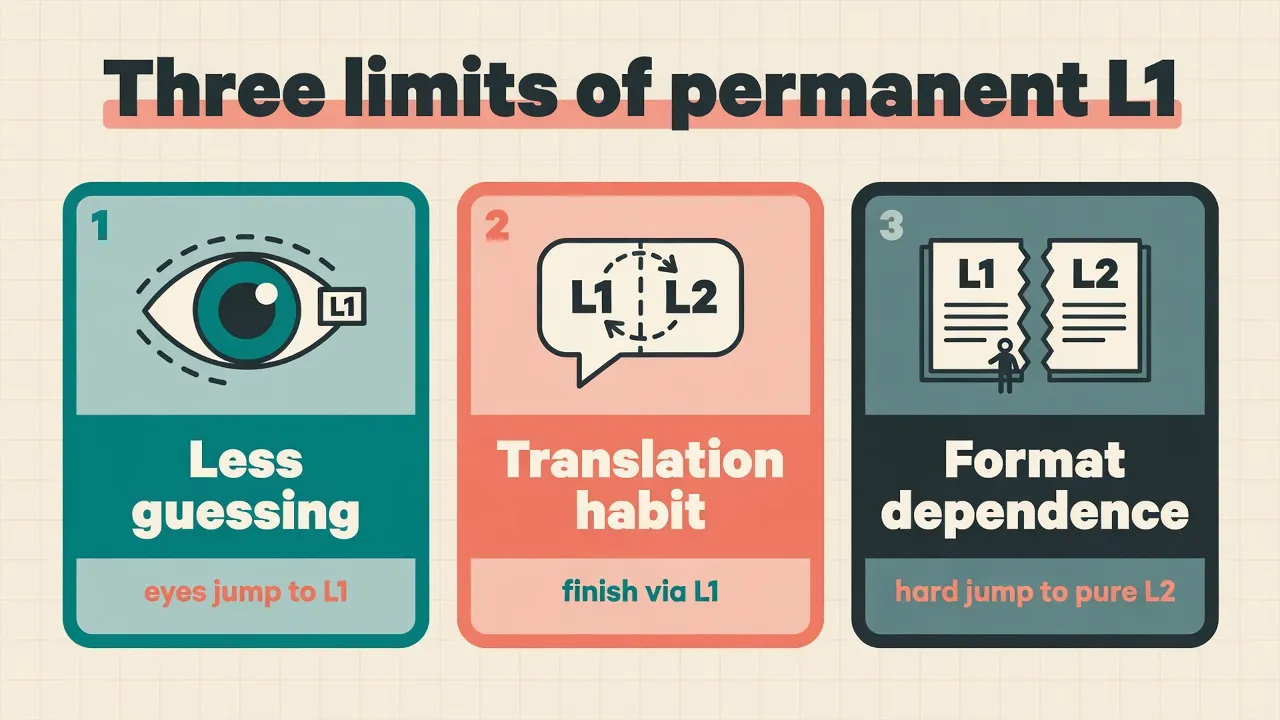
Three limits of always-on L1
These are limits of always-visible help, not proof that Frank or parallel books are garbage.
Think of training wheels that stay on after you can already balance. The bike still moves. You just never learn the next skill.
1. Eye-slide and less guessing
Visible L1 invites less form-meaning work in L2. Even when you "start with English," one hard phrase and your eyes slide to the translation. Guessing from context - the skill free reading needs - gets less practice every session.
2. Translation habit
You finish the dual book and feel productive. Fair: you processed a story. But if meaning almost always arrived via L1, you may still process the next pure page the same way: hunt, translate, move on. Progress can be real for plot, and still weak for L2 stamina.
3. Hard cliff to pure L2
After months of only glossed or parallel editions, an unaided original can feel brutal. Not because you "wasted time," but because the jump is huge: no notes, no facing page, no segment reset. The cliff is a design risk of permanent dual support, not a personal flaw.
Two quieter notes (not a fourth scare headline):
- Literary or older series register may not match the speech you need for modern media.
- Reading alone will not finish speaking and writing for you.
The loop that keeps wheels on looks like this: try L2 → glance L1 → skip the guess → need L1 more next time.
Frank vs page-parallel vs original + on-demand
Same family of support - different L1 visibility, different risks. No speed-to-fluency ranking. Match the mode to your goal today: bootstrap vs independence.
| Mode | L1 visibility | Best for | Main risk |
|---|---|---|---|
| Frank / interlinear segments | High in the adapted pass | Early volume, anxiety | Stay on adapted pass; weak transfer to pure L2 |
| Page-parallel bilingual | High (side-by-side) | Checking long stretches | Read the L1 column first |
| Original + on-demand help | Hidden until click | Building an L2-first habit at the right level | Text too hard → click swamp |
There is no single winner for every learner. Early on, always-on L1 can be the right tool. Later, the skill you want is: read L2 first, ask for help only when stuck, reread without reopening the full translation.
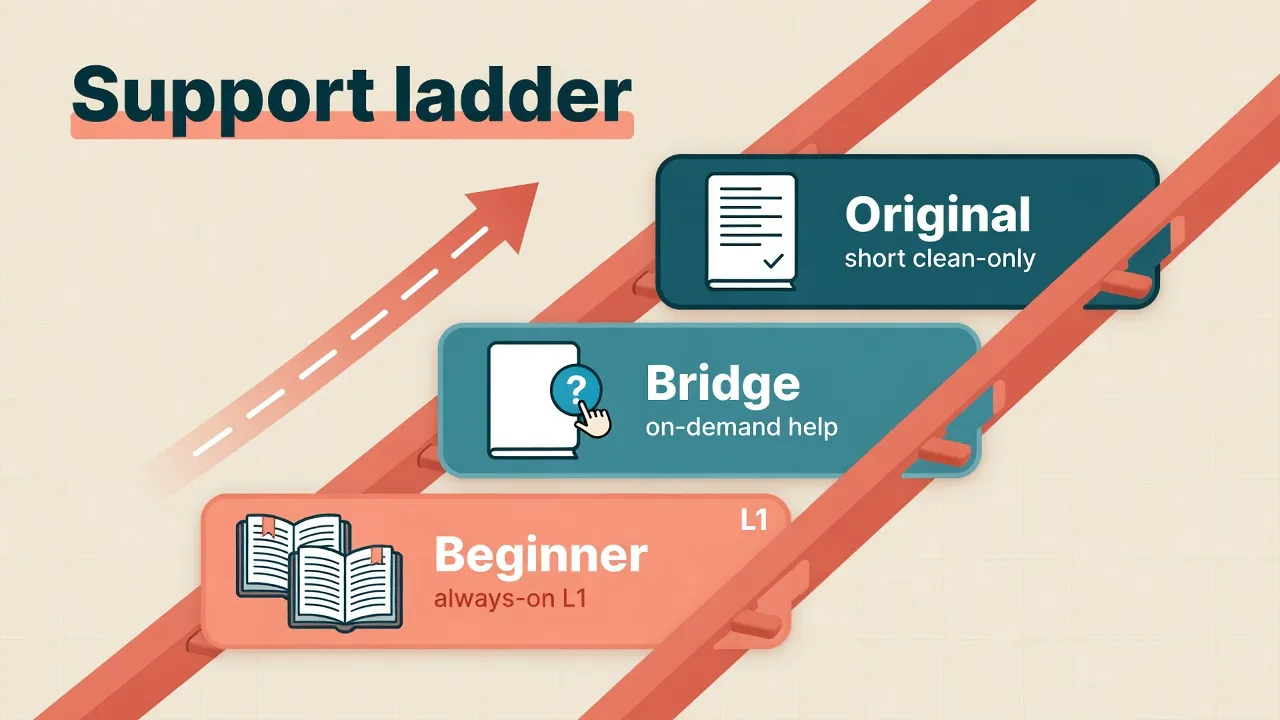
A simple support ladder many people climb over time:
| Stage | Support | Goal |
|---|---|---|
| Early | Always-on L1 (Frank / parallel) OK | Volume without freeze |
| Next | Original + on-demand only | L2-first habit |
| Stretch | Short clean-only sessions | Independence stamina |
Original-first reading loop (step by step)
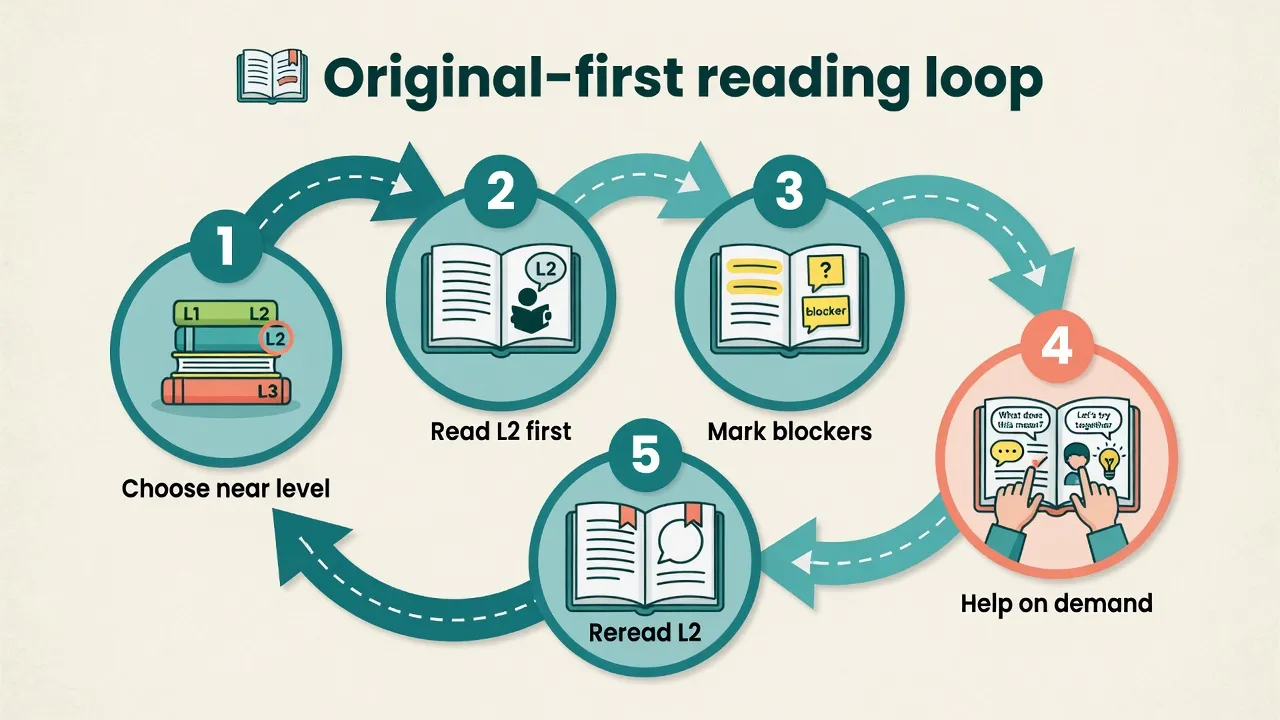
Hide L1 by default. Help only when stuck. Reread in L2. That is the whole idea.
- Choose text near your level. Graded articles or books where you already know most words. Pride novels full of unknown density are a wall, not a badge. If almost every line blocks you, change the text - not your willpower. See also adapted vs original books if level honesty is the sticky point.
- Read L2 first for a short stretch (a paragraph or half-page, not a whole hard chapter in one breath).
- Guess from context; mark only blockers. Skip words that do not stop the story.
- Help on demand - word or phrase - not whole-page L1. One click on what actually blocked meaning.
- Reread the same stretch in L2 so meaning sticks without reopening a full translation pane.
- Continue, and end the session with one short unaided recap (mental or spoken): what happened?
- Gradually reduce help. Try short clean-only sessions. Scaffold down; do not dual forever by default.
Lookup economy rule: blockers only. A few targeted clicks plus a reread beat a swamp of full-page translation.
If you want a low-pressure place to try the loop today, open one text from the free graded library - for example an English A2 sample if that matches your level - and run 10-15 minutes: L2 first, click only blockers, reread.
How MovaReader fits (honest product)
After bilingual scaffolding, the next skill is original-first reading with help only when you ask. That is the loop MovaReader is built for - not a campaign against Frank.
In practice:
- You read a clean original-looking page (L1 not always painted beside the text).
- When a word or phrase blocks meaning, you click it for translation in context.
- You can listen while you read (listening is often unlimited on freemium).
- You warm up on a free graded library so level stays honest.
- You can open an EPUB or file you legally own when you are ready for longer authentic material (how to use).
Plans, said plainly:
| Plan | What you get |
|---|---|
| Freemium | Free graded library + click-translate on supported texts + about 20 word translations per day + listen often unlimited |
| Reader €1/month | More room for reading translations when freemium lookups are not enough |
| Pro €5/month | Full trainers when review and practice are the bottleneck |
Details live on pricing. Figures can move; treat the site as source of truth at purchase time.
What we do claim: word/phrase click-translate, listen, graded free reading, own legal EPUB, optional trainers on Pro.
What we do not claim: a whole-sentence sarcasm or cultural AI decoder as a sold product mode; English-to-English as a magic distinct mode; unlimited AI tutor mid-article (that would contradict freemium caps); free unlimited commercial novels as a full catalog. We do not host licensed commercial novels by default. Bring legal files you own when you want that shelf.
Soft next step, not a fluency path: one graded text, 10-15 minutes, L2 first, click blockers only, reread. Optional trainer demos when review is the bottleneck: type training and phrase typing.
FAQ
What is the Ilya Frank method in one minute?
Text is split into short segments. First you read an adapted pass: the L2 segment with literal and lexical notes (parenthetical or interlinear-style help). Then you read the same segment clean, without notes. Later some editions flip order (clean first, adapted second). It is a volume-and-meaning scaffold, not a full language system that covers speaking and writing by itself.
Is parallel or bilingual reading bad?
No. It is a useful scaffold when you need early volume, lower anxiety, or a bridge before pure L2 feels possible. The risk is not "using bilingual once." The risk is always-on L1 forever: eye-slide to the translation, less guessing in L2, and a hard jump when the dual page disappears.
When should I switch off bilingual support?
When the adapted or parallel pass feels effortless, but pure L2 still feels impossible only because L1 was always there. Move to text near your level with help on demand (word or phrase), then short clean-only stretches. Switch by goal (independence), not by shame or a fixed calendar promise.
How many lookups per page is OK?
Blockers only - words or phrases that stop the story. If almost every line needs help, the text is too hard: change level, not willpower. A short stretch with a few targeted clicks, then a reread in L2, beats a swamp of full-page translation.
Is MovaReader free? What are the limits?
There is a free graded library with click-translate on supported texts. Freemium includes about 20 word translations per day; listen is often unlimited. Reader €1/month for more reading translations when volume grows; Pro €5/month for full trainers. You can open an EPUB or file you legally own. We do not host free unlimited commercial novels as a full catalog. Product help is word/phrase translation + listen + trainers - not a whole-sentence sarcasm or cultural AI decoder sold as a magic tutor. See pricing and the free graded library.
Does the same approach work for English and Spanish?
Yes. Original-first reading at the right level, with on-demand help, works for both as L2. The Ilya Frank name is stronger in UA/RU discourse; Spanish readers often meet the idea first as textos paralelos / lectura bilingüe. Same limits, same loop: hide L1 by default, click blockers, reread in L2.
Next steps
Bilingual formats can start volume and calm the blank-page fear. Independence needs L2 first, text near your level, and help that stays hidden until you ask.
Concrete action for today:
- Open one graded article near your level from the free library.
- Run the loop for 10-15 minutes: L2 first → blockers only → reread.
- If freemium lookups run out and reading is still the priority, Reader is €1 - more room to practice, not a fluency guarantee. Full detail on pricing.
Frank-style and parallel texts are tools. Use them when they open the door. When the door is open, practice walking through it without the dual page always beside you.
Learn languages by reading!
Try MovaReader for just €1 — read texts with instant translation and interactive vocabulary training.
Free plan: 20 word translations/day and unlimited listening. Pro (€5/mo) unlocks full trainers.