Tips & Methods
Where to Start Learning English: First Week + A1 Path
Overwhelm is normal. Here is one simple system for week one: goal, level band, 15 minutes a day, phrases, light grammar, and an easy text - not ten apps and a restart loop.
You open three apps, a PDF course, and a "basic English" YouTube playlist. Day one feels productive. Day two you skip one app. By Monday you restart the whole pile and search again: where to start learning English, for real?
That loop is not a talent problem. It is a resource pile with no order. You do not need ten more bookmarks. You need one calm system for week one.
Here is the simple version. Start with one clear goal, about 15 minutes a day, high-frequency phrases in real context, light grammar (to be, Present Simple, subject-verb-object order), and easy graded reading early - not a pile of ten apps. Check roughly whether you are nearer A1 or A2. Then follow a simple first-week plan instead of restarting every Monday. Speaking can wait for low-shame practice; input and usable chunks build the base first.
Below: why the pile feels so heavy, how to set a goal and level band, a day-by-day 7-day plan, the three building blocks (phrases, light grammar, easy reading), a realistic schedule, mistakes and speaking, tools that help, and FAQ.
Why does starting English feel so overwhelming?
Search "how to start" and you get Duolingo vs BBC vs alphabet drills vs a speaking partner by Friday. Commodity lists add tools. They rarely give order.
Overwhelm is normal. The fix is a simple stack, not another bookmark.
| Approach | Typical beginner result |
|---|---|
| 5+ apps, no reading | Streaks, shallow phrases, restart loop |
| Grammar book only | Rules without usable chunks |
| Native Netflix day 1 | Overwhelm, quit |
| Simple system | 15 min + phrases + light grammar + easy reading → sustainable exposure |
One line worth keeping: system beats resource pile.
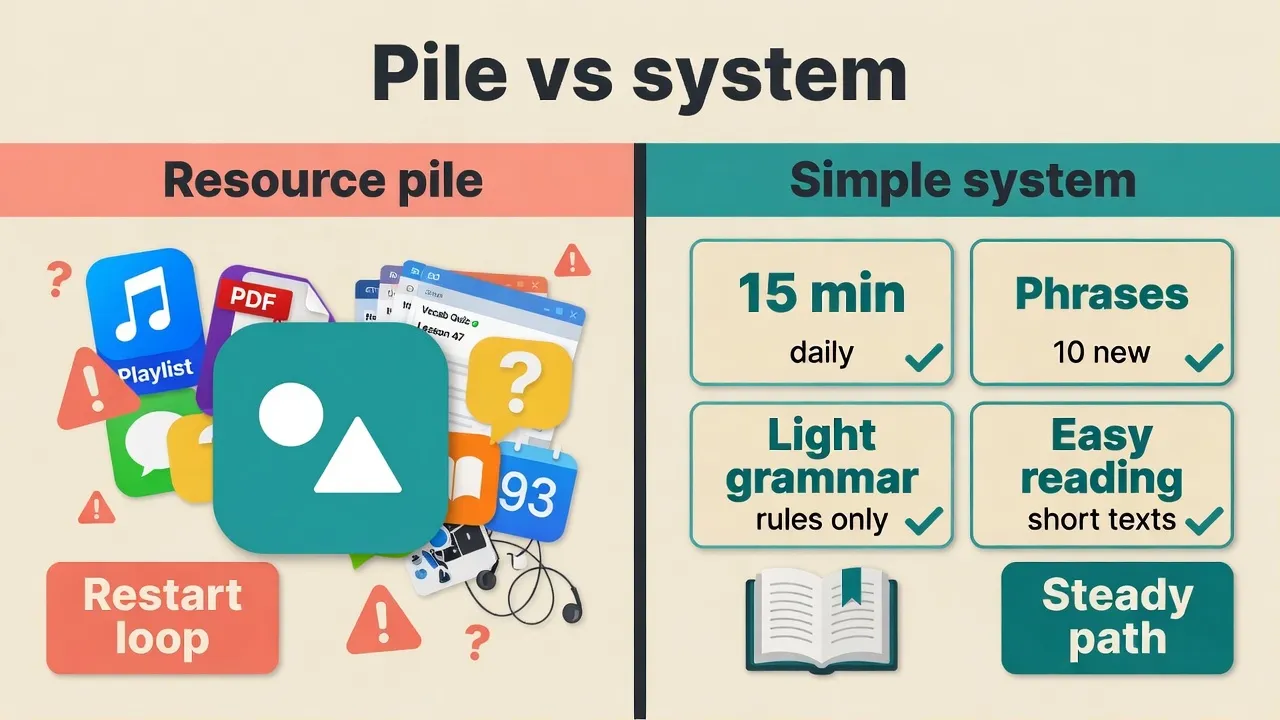
Left: apps, tabs, and restarts. Right: one goal, one slot, phrases, light grammar, one easy text.
What goal and level should you set first?
One concrete goal (not "become fluent")
Vague fluency is a quit engine. Pick one near-term use so your phrases have a job:
- Travel: airport, hotel, food orders
- Work: short emails, meetings, job ads
- Media: series or books with support (later stretch)
Write the goal in one sentence. That sentence steers day 3 phrases more than any "top 1000 words" list.
A1 vs A2 orientation (not a free exam)
Many "absolute zeros" already know alphabet bits, song lines, and loanwords. Use that foothold.
| Band | Rough feel |
|---|---|
| A1 | Greetings; I am / I have / I want; very short texts with heavy support |
| A2 | Can refresh foundation; longer easy texts; still not native Netflix as study default |
A free external placement test (Cambridge or British Council style sites) is fine for orientation. It is not a certificate. Later you can mark progress on a language map when you care about longer-term bands - not required on day one.
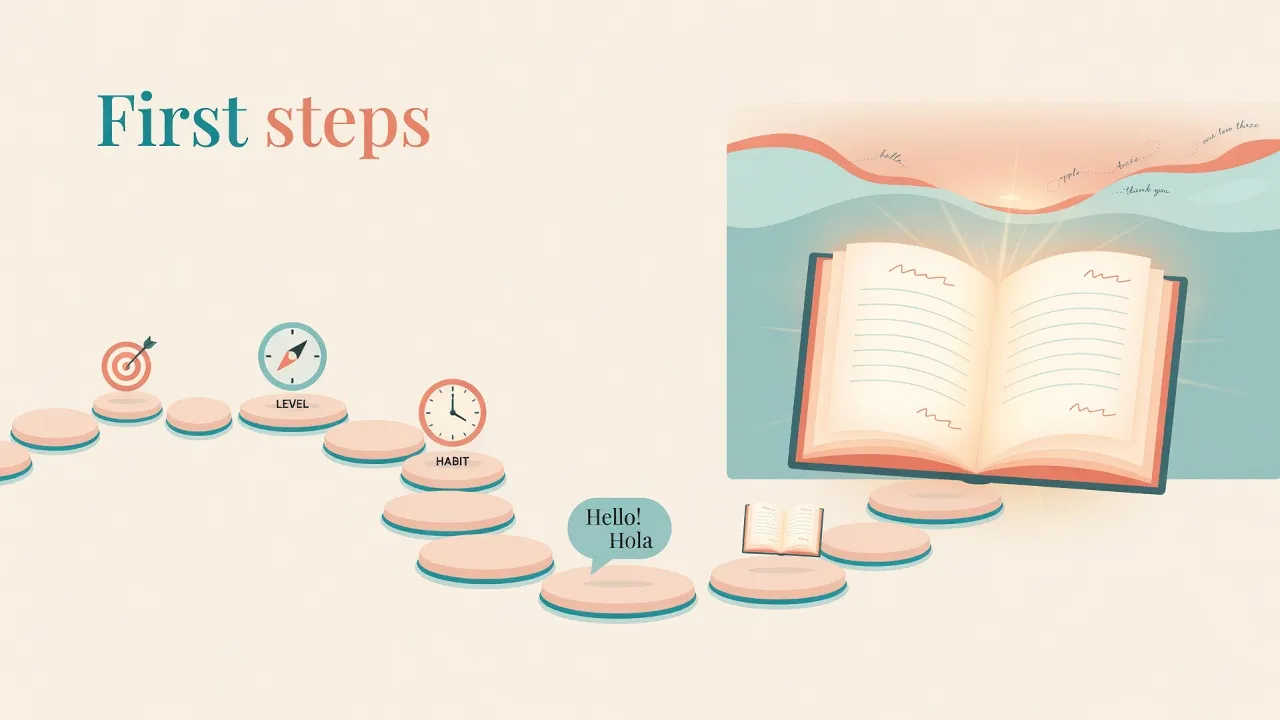
Order of first steps (one compass, not five metaphors):
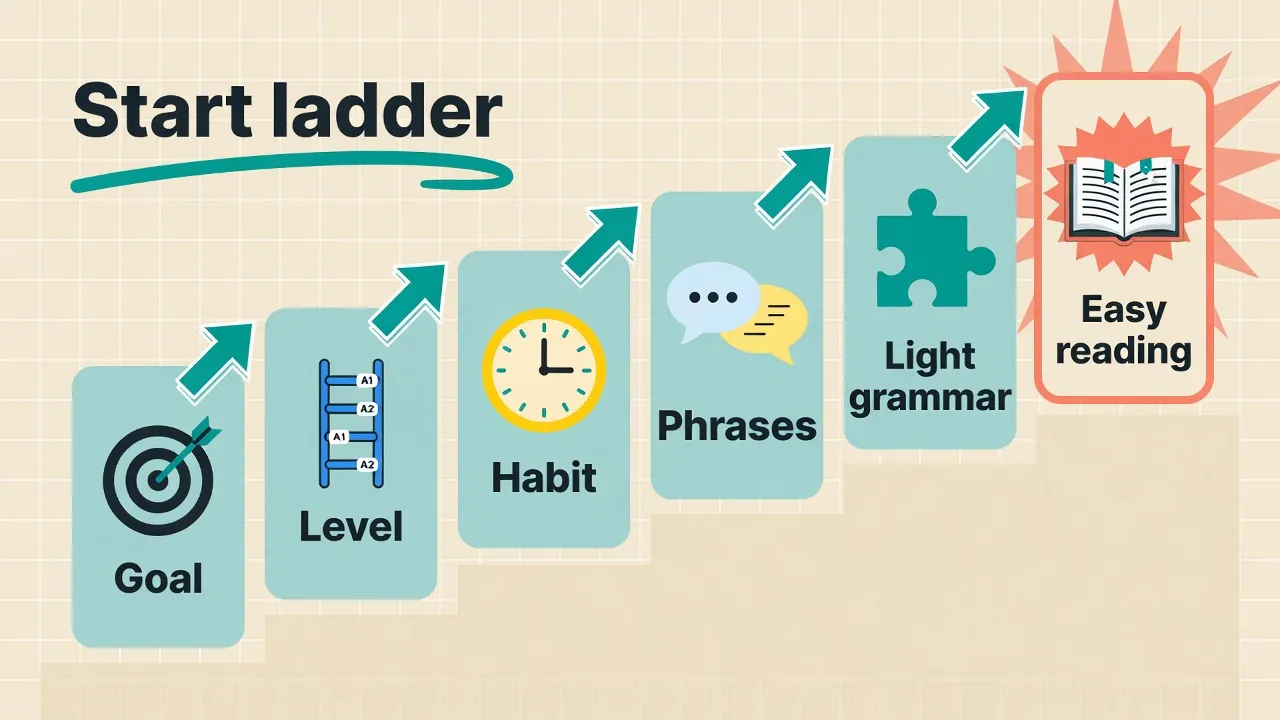
Goal → level band → daily habit → phrases → light grammar → easy graded reading.
First week learning English: a 7-day plan
One calm week. A foothold, not "finish A2 by Sunday."
| Day | Focus | Concrete action |
|---|---|---|
| 1 | Goal + level | Write one near-term goal; rough A1 vs A2 check (external free test OK - orientation only) |
| 2 | Habit slot | Pick a fixed 15-min window; optional phone/UI in English for ambient exposure |
| 3 | Core phrases | Greetings; I am / I have / I want; question words - in short sentences, not isolated dictionary rows |
| 4 | Light grammar | SVO word order + to be (am/is/are) |
| 5 | Present Simple | Habits + 5-10 personal sentences about your day |
| 6 | Easy graded reading | First short A1/A2 EN text; translate blockers only; keep reading for meaning |
| 7 | Review + plan week 2 | Revisit phrases; short free write or speak-to-self; choose next easy text |
Missed a day? Continue the next day. No guilt spiral. Week one is a foothold, not a certificate.
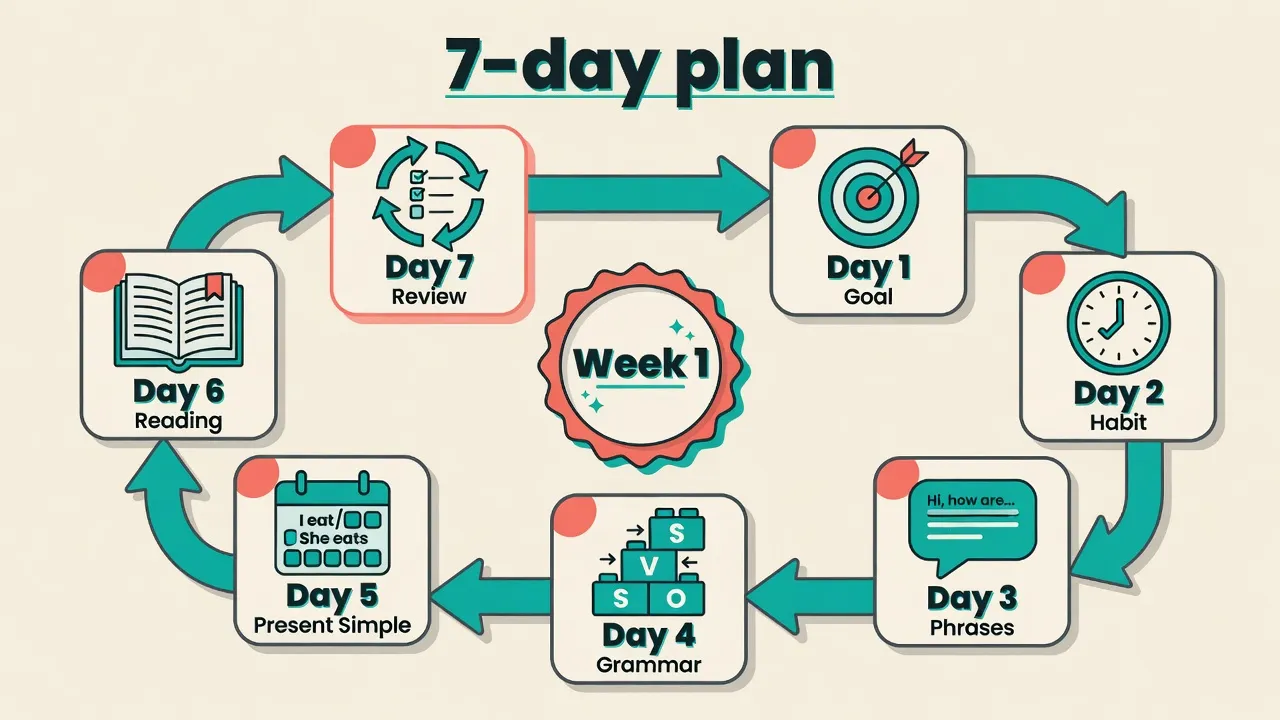
Days 1-7 in a loop: set the goal, lock the slot, build chunks, meet an easy text, review.
On day 6 you do not need Dickens. You need a short, finishable graded piece and help only on words that break the sentence. Free samples live under all articles.
Core building blocks: phrases, light grammar, easy reading
After the week table, three pillars. Method, not a 200-word glossary dump.
High-frequency phrases in context
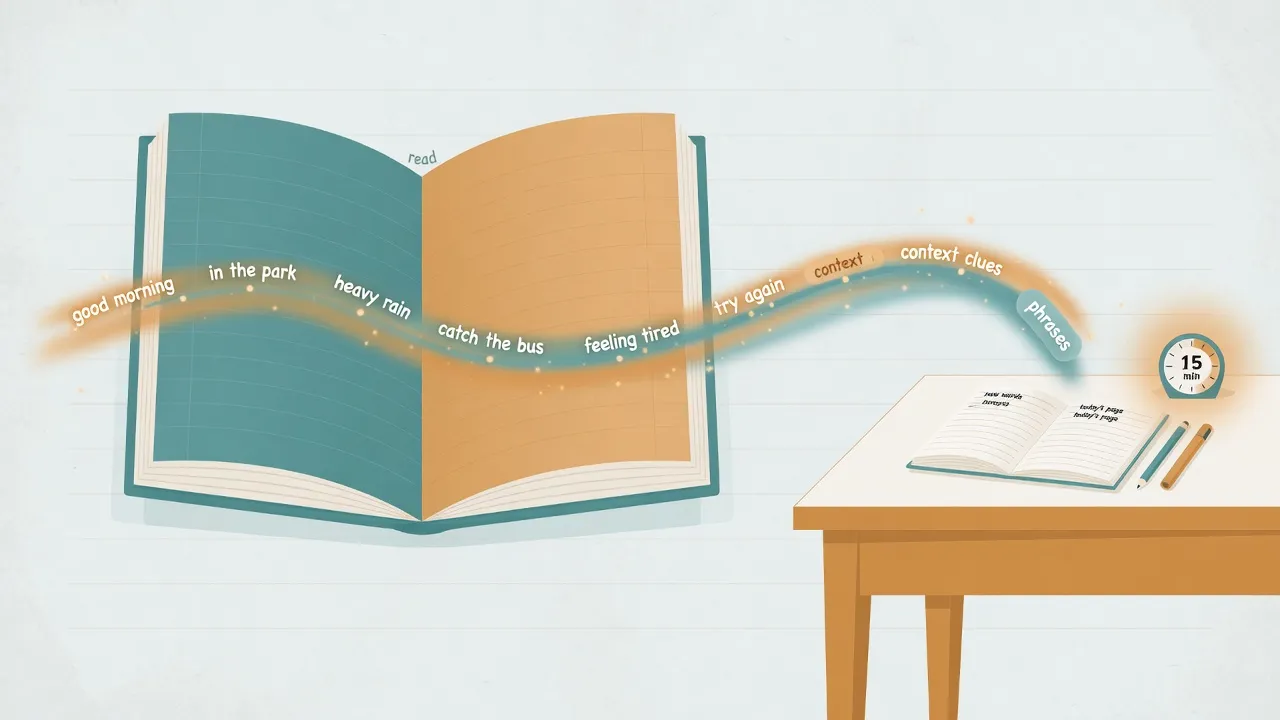
Prefer chunks in short sentences over isolated dictionary rows.
| Chunk type | Example seeds |
|---|---|
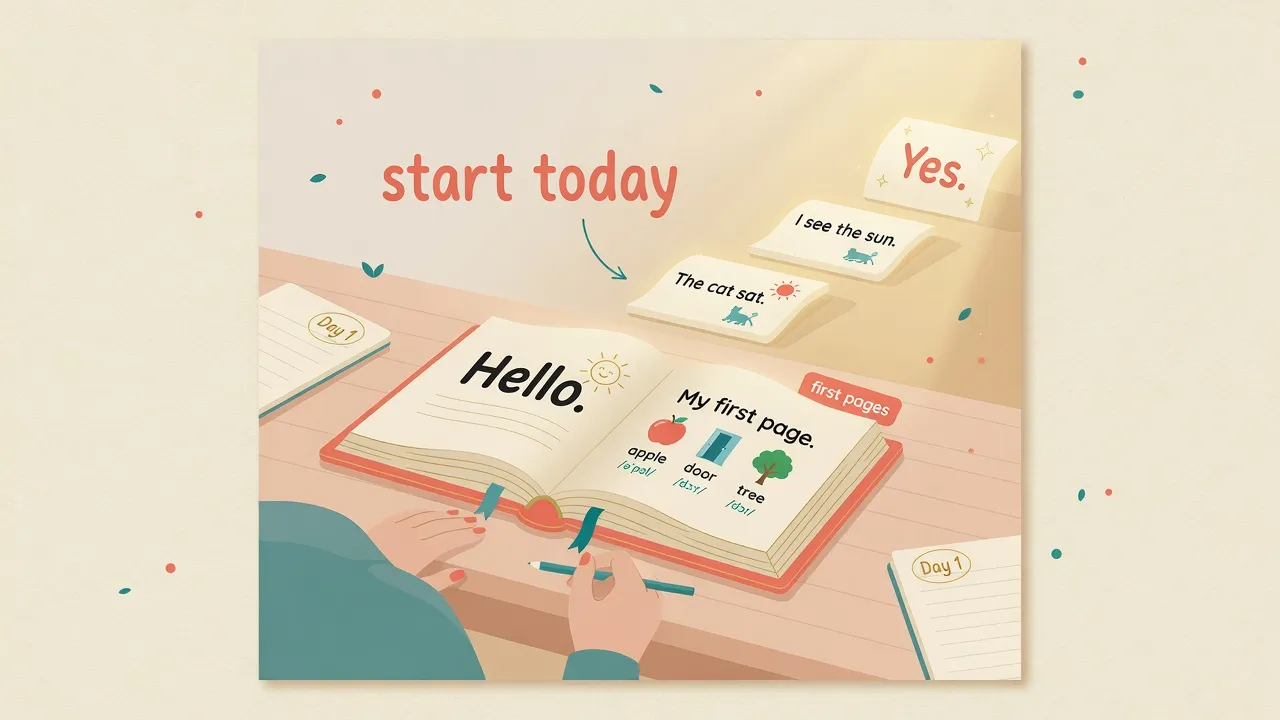
| Greetings / goodbyes | Hello. / Hi. / Good morning. / See you. / Bye. |
| Core identity | I am… / My name is… / I have… / I want… / I need… |
| Question words | Who / What / Where / When / Why (+ a short full sentence) |
| Polite mini-moves | Please. / Thank you. / Excuse me. / Sorry. |
Pick phrases that serve your day-1 goal (travel, work, media). Phrasal verbs and idiom lists can wait; they are a later expansion, not week-one homework. If you want that topic later, see how to learn phrasal verbs and idioms after your foothold sticks.
Light grammar only (skeleton, not 12 tenses)
Skip the full tense chart in week one. You need a skeleton you can use:
- Word order: Subject + Verb + Object
- to be present: am / is / are
- Present Simple for habits (5-10 personal day sentences)
- Simple questions and negatives: short yes/no and wh- forms; basic not / don't
That is enough to build small true sentences about your life. Deeper grammar guides can wait until the skeleton feels automatic.
Easy graded reading early (the pattern machine)
Reading early is not "read only after perfect grammar." It is pattern exposure without speaking shame.
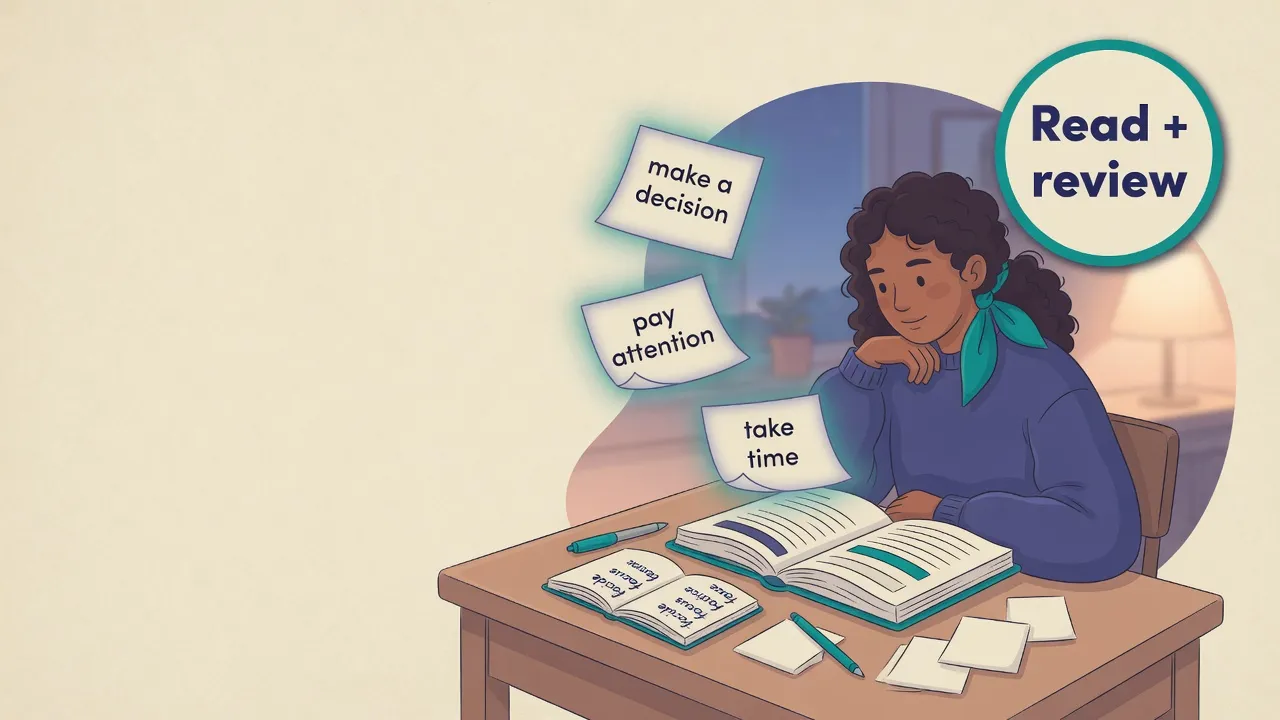
easy A1/A2 text → read for meaning → translate blockers only
→ save a few phrases/words → light review → optional trainers later
| Do | Avoid day one |
|---|---|
| Very easy graded EN text | Native Netflix as study default |
| Translate blockers only | Lookup every adjective |
| Short finishable piece | Dickens / hard originals |
| Pattern exposure without speaking shame | "Read only after perfect grammar" |
When texts get longer later, the five-finger rule helps pick a page that is not too hard. Graded vs original is a separate topic: adapted vs original books. If every word becomes a dictionary tab, how to stop translating in your head is a useful next read - still for easy texts first.
How long should you study each day?
Regularity beats hero sessions. Fifteen to twenty minutes daily beats three hours once a week.
| Piece | Guidance |
|---|---|
| Length | 15-20 minutes daily beats 3 hours once a week |
| Anchor | Coffee, commute end, before bed - an existing habit |
| Missed day | Continue next day; no guilt spiral |
| Ambient (optional) | Phone/UI English - not a full immersion fantasy |
| Week 2+ | Keep the same slot; swap content (new easy text, phrase review), not the whole stack |
Day 2 of the plan is just this: lock the window. Content can change; the slot is the system.
What about mistakes and speaking?
Mistakes are data, not shame. You will mis-say to be, forget a plural, or invent a word. That is normal adult learning, not proof you should quit.
Speaking does not have to be a high-shame conversation on day one. Quiet practice works: whisper, self-talk, or five personal sentences about your day (day 5 and day 7 already invite that). Full conversation can wait until usable phrases stick. A teacher is optional for feedback and speaking practice; it is not mandatory to start.
If perfectionism freezes you, a related read is fear of mistakes and perfectionism.
Free graded start and plan limits
You can run the whole 7-day plan with a notebook. A reading app only reduces friction when you meet real text.
MovaReader is a reader with a free graded library, click-translate for blockers, and optional phrase/word trainers - not a full school replacement. The useful loop for week one: easy graded text → read for meaning → click blockers only → keep reading.
Practical path:
- Follow the 7-day plan offline if you want (notebook works).
- On day 6+, try a free graded EN sample: all articles.
- Translate blockers only; keep reading for meaning.
- Optional demos: phrase typing and type training.
- Progress marks later on the language map.
- Compare plans on pricing.
| Need | Realistic plan |
|---|---|
| Try the week + free graded start | Free plan (~20 word translations/day; listening often free) |
| Real reading volume with translations | Reader €1/mo |
| Trainers beyond reading | Pro €5/mo |
| Commercial book you care about | Your legal EPUB/file - not an unlimited hosted bestseller warehouse |
To read a book you own, upload your legal EPUB via how to use. Saving a few words is useful, but saving alone does not build fluency.
FAQ
I am absolute zero - alphabet first or phrases first?
Learn letter sounds enough to read simple words, then jump to high-frequency phrases in short sentences. Do not spend weeks only on alphabet drills before you meet real chunks. Many "zeros" already know song lines, logos, and loanwords - use that foothold.
Are apps enough, or do I need a teacher?
Apps can support a habit; alone they often become streak theater. A teacher is optional for feedback and speaking practice. The system still needs phrases, light grammar, and easy input. Reading graded text early helps even if you study alone.
How long toward solid A2 or B1?
Many months of regular practice for most adults - depends on start point and weekly hours. No site can promise a calendar miracle. Aim for weekly footholds (phrases that stick, one easy text finished), not a 30-day fluency ad.
When should I start speaking?
Quiet practice (self-talk, five personal sentences) can start early. High-shame conversation can wait until you have usable phrases. Mistakes are normal either way - treat them as data, not proof you should quit.
Can I start with reading if I know almost no words?
Yes, with very easy graded texts and help on blockers only - not Dickens. Day 6 of the plan is a short supported text, not a novel. Read for meaning; translate what breaks the sentence; skip optional color words. Browse all articles when you are ready.
Is free enough on a reading app / what are the free plan limits?
Free path: graded library + about 20 word translations/day; listening often free. Reader ~€1/mo for more translation volume; Pro ~€5/mo for trainers. Commercial bestsellers are not hosted for you - upload your legal EPUB when you want a book you own. Details stay on pricing. Click blockers, keep reading.
Next steps this week
Overwhelm is normal. Order beats more apps.
Week one in one breath: one goal, rough A1/A2 band, 15 minutes a day, high-frequency phrases, light grammar, one easy graded text. Solid A1-A2 is a path of months, not a weekend certificate.
Do this:
- Run days 1-7 as written.
- On day 6, open one graded EN article from all articles.
- Translate blockers only; stop while you still want more.
- Optional: try phrase typing for a few chunks.
- Stay on the free plan while testing; move to Reader €1 on pricing only when the daily translation cap stops real pages.
- Later marks: language map. When easy articles feel short, how to read your first book in English is a natural next step.
The tool cuts lookup friction. The free plan has daily limits. The system still starts with you.
Learning English?
The English version of MovaReader teaches Spanish and Ukrainian. To read English with a translation for every word, open the reader in Ukrainian or Spanish:
Книги англійськоюЦя стаття українськоюLibros en inglésEste artículo en español