Tips & Methods
How to Learn Phrasal Verbs and Idioms Without Endless Lists
Long verb-by-verb lists blur similar forms. Group phrasal verbs and idioms by situation, notice them in full sentences while you read, save them and meet them again.
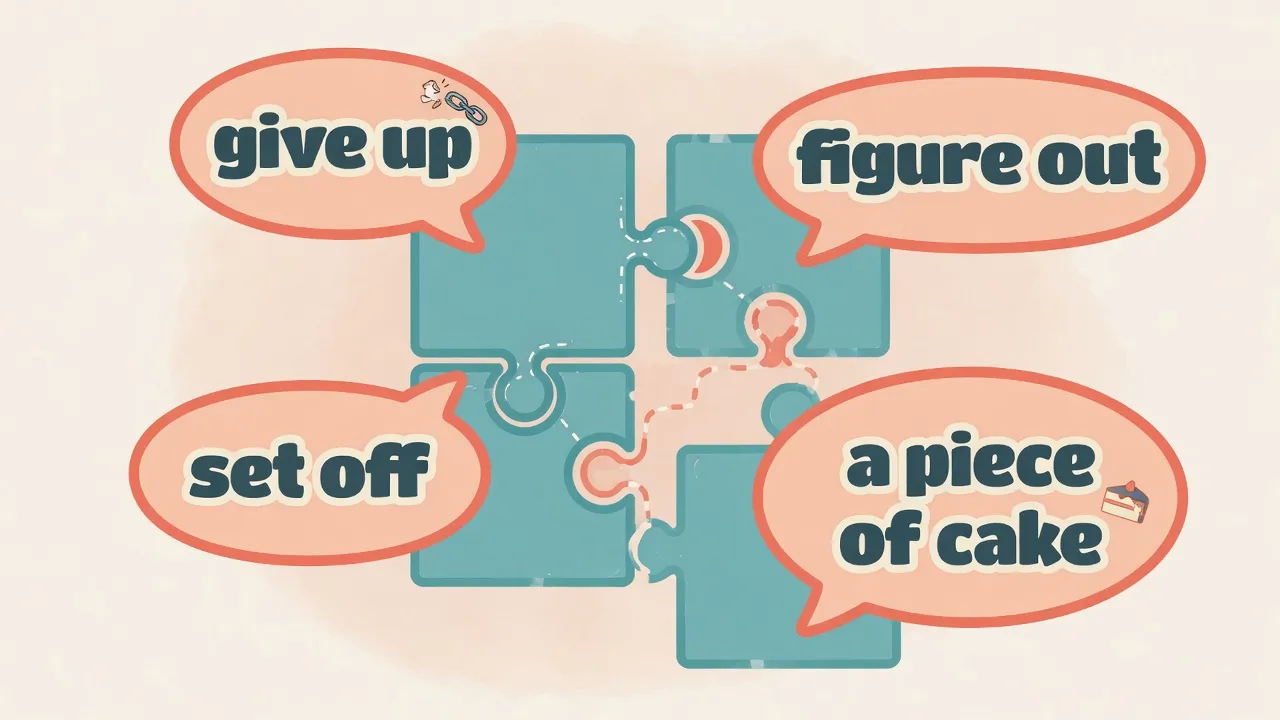
You are watching a film or a YouTube clip. Every separate word looks fine. Then the line lands - give up, figure it out, run out of time - and the whole phrase still feels foggy. That gap is common from B1 upward. It is not a talent verdict. Real English leans hard on phrasal verbs and idioms, and those units do not unpack word by word.
Here is the simple version. Do not memorize every phrasal verb under get or put as a long list. Your brain mixes similar forms. Learn them as whole chunks: group a few by theme (travel, work, daily life), notice them in full sentences while you read, save the phrase, then re-meet it with light typing or spaced practice. You need many encounters over time, not one week of lists.
Below: what they actually are, why get-lists stall you, a themes-plus-context loop, five everyday examples, tools that help, and a short FAQ. Big lookup inventories live on phrases.
What are phrasal verbs and idioms?
Two different "opaque chunks." Same learning idea: keep the whole unit in a real sentence.
A phrasal verb is a verb plus one or more particles (up, out, off...). The meaning is often not literal.
- Give means transfer something.
- Give up means stop trying or quit.
An idiom is a fixed multi-word expression. The whole meaning is not the sum of the words.
- A piece of cake is not dessert when someone says the exam was a piece of cake. It means something was easy.
| Type | Shape | Example | Plain sense |
|---|---|---|---|
| Phrasal verb | verb + particle(s); meaning often not literal | give up | stop trying / quit |
| Idiom | fixed multi-word expression; whole meaning | a piece of cake | something easy |
You do not need every item in a giant list. You need the ones that keep showing up in what you watch and read. Treat them as sticky chunks - whole phrases your brain can retrieve - not as loose dictionary rows.
Here is the anatomy in one simple picture: verb + particle, new meaning.
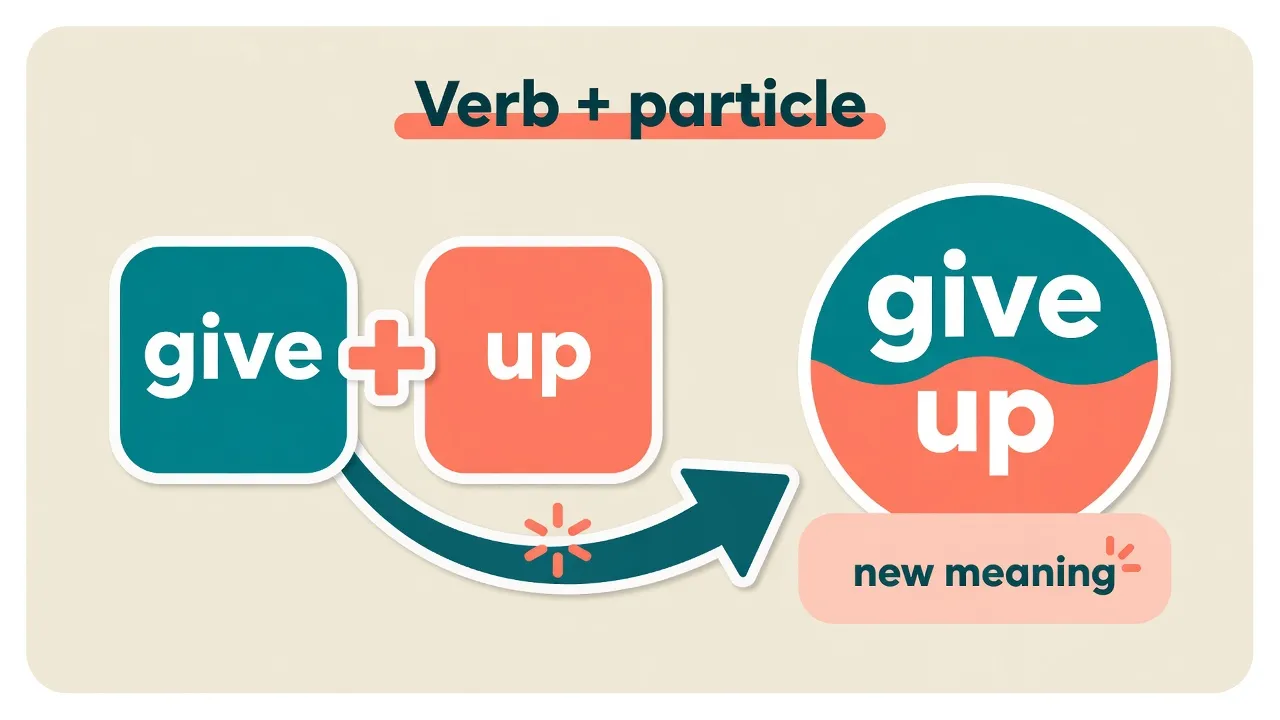
Definitions alone do not fix learning. The usual trap is how people study them next.
Why memorizing get-lists fails
Alphabet sheets and "all get + particle" rows feel productive. You tick boxes. Then real talk freezes when particles look and sound almost the same.
A tight chaos sample (not a study list):
- get in / get out / get along / get away / get over
Similar shape. Weak situation memory. Under time pressure you grab the wrong particle. Studying every up verb as another row has the same problem: form similarity without a scene to hang on.
Particle "flavors" exist (up, out), but theme + full sentence beats base-verb mega-lists for real use.
Alphabet rows feel busy; theme clusters stick. Side by side:
| Approach | What you do | What your brain stores | Result in real use |
|---|---|---|---|
| Alphabet / get-list | All get + particles (or all put, all take) | Similar forms, weak situation | Mix particles; slow recall |
| Theme + context | Few phrases for travel / work / daily life, each in a full sentence | Situation → whole chunk | Faster retrieval; less mix-up |
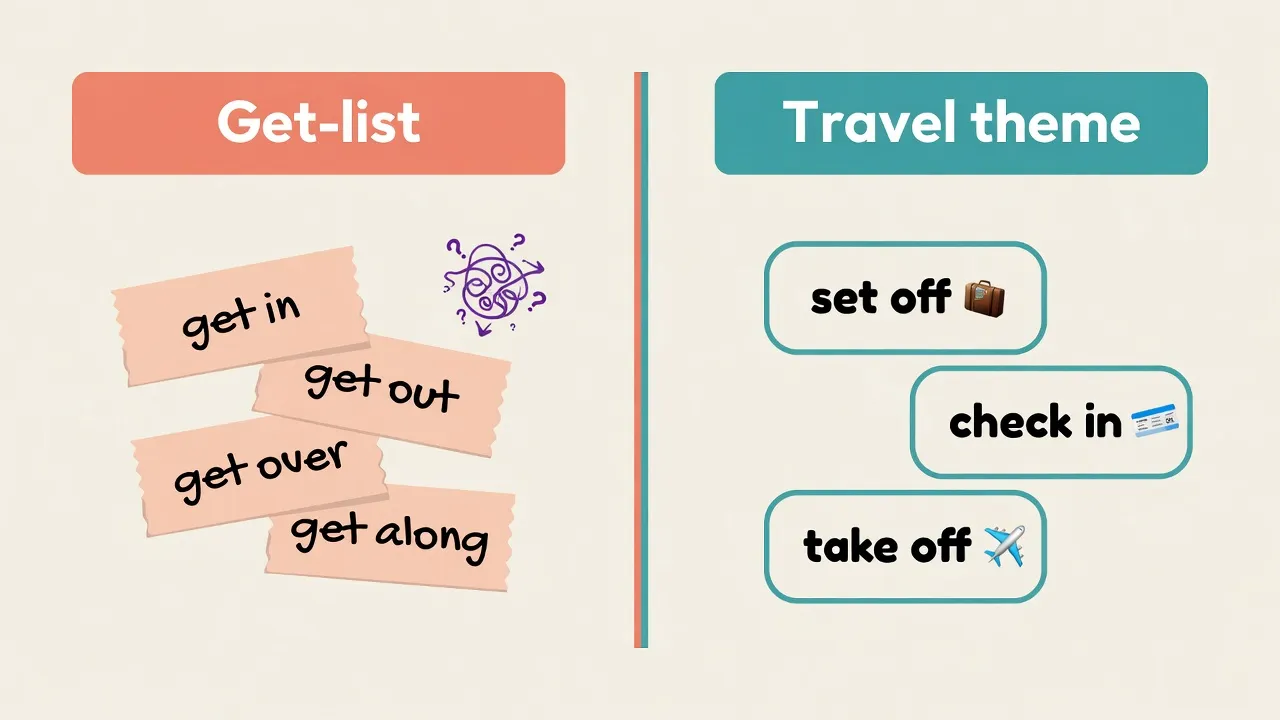
So what instead? Three linked habits - not secrets. Small sets, re-meet often.
How to learn them: themes, context reading, active practice
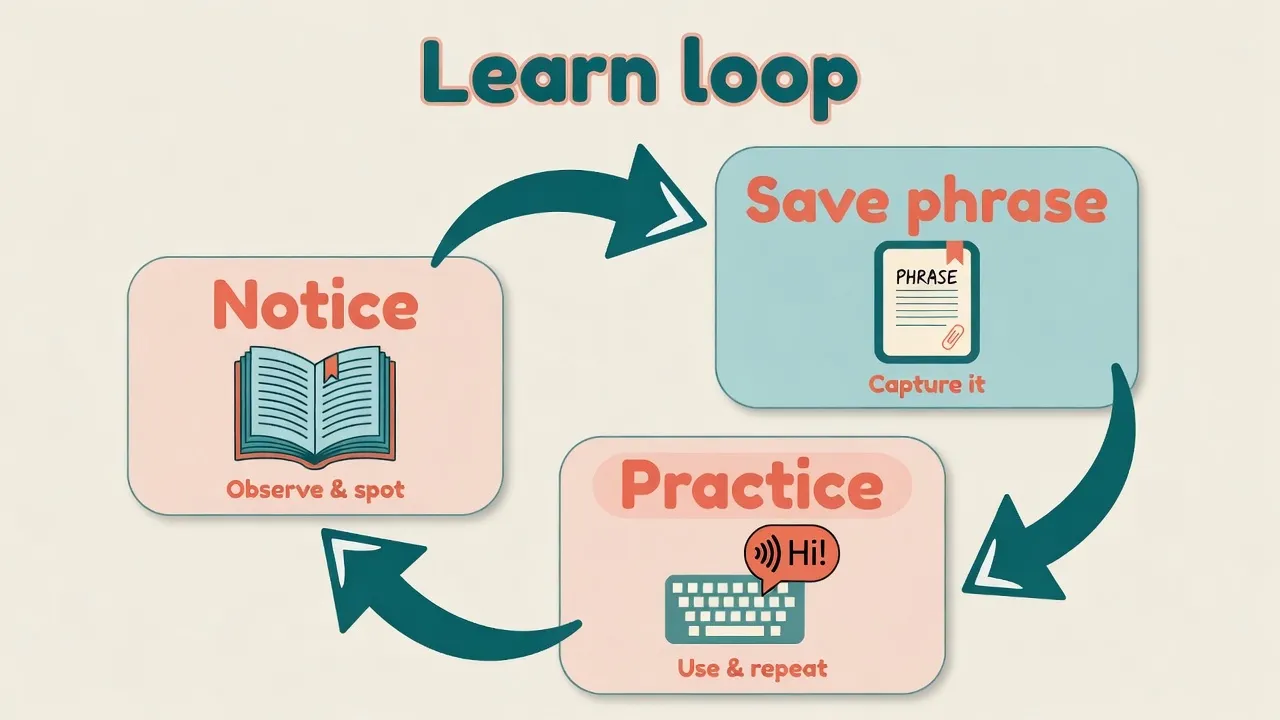
If you are looking for how to learn phrasal verbs without drowning in tables, use this loop. Keep sets small. Return to the same chunks. No personality transplant required.
Group by theme (not by base verb)
Pick one situation and a handful of phrases that live there. Travel works well as a demo:
| Phrase | Situation (travel) |
|---|---|
| set off | leave / start a journey |
| check in | register at hotel or airport |
| take off | plane leaves the ground |
| look around | explore a place |
Your brain stores "airport / trip" → whole chunk, not "another get row." Work, daily life, or meetings work the same way: few items, clear scene.
Want a larger themed inventory later? Browse phrases.
Grouping also pairs well with less word-by-word decoding. See how to stop translating in your head if that habit still owns every line.
Notice in full sentences while reading
A naked dictionary line is easy to forget. A full sentence carries tone, partners, and situation.
Practical loop:
read near-level text
  → notice PV/idiom in full sentence
  → click-translate only if it blocks meaning
  → save whole phrase
  → re-meet later (reading again / type / light speak)
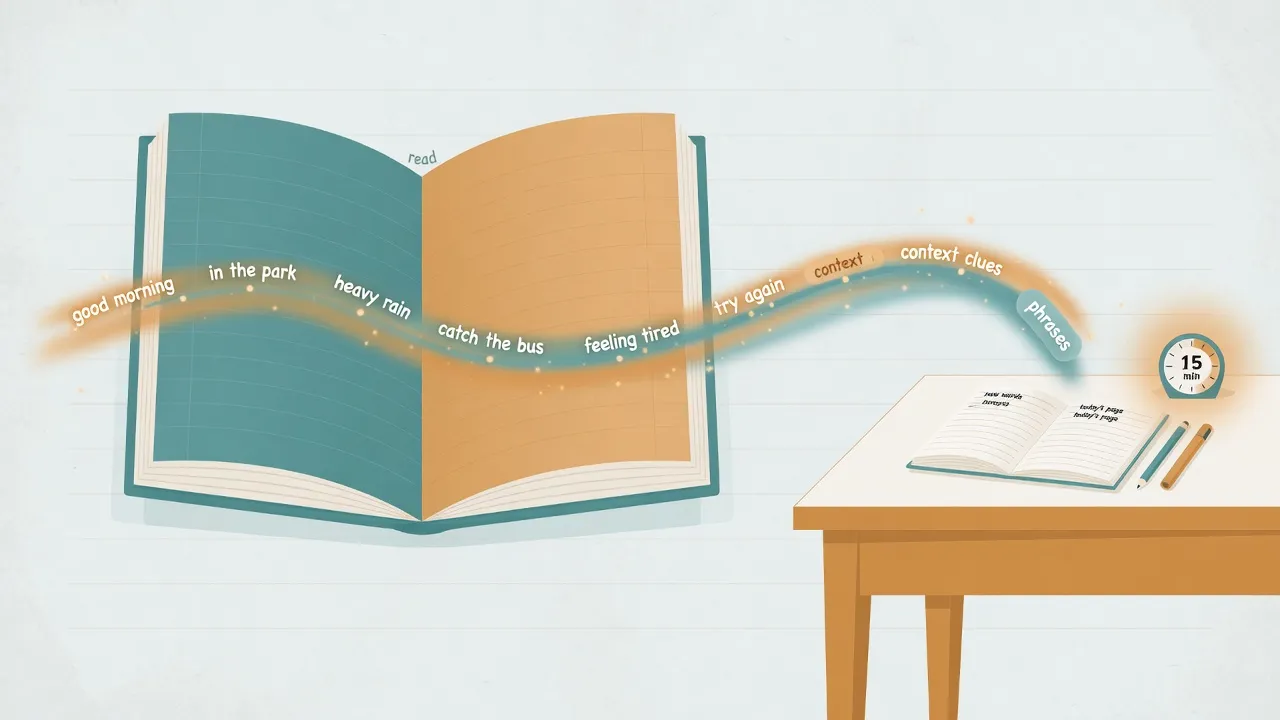
Start with a short graded page you mostly understand - browse the free library in all articles. Notice one to three phrases. Save the whole phrase, not a bare lemma.
If the page is too hard, step down a level and keep noticing. Reading vocabulary that actually supports comprehension is covered in vocabulary for reading comprehension and the B1 path in build B1 vocabulary by reading. For a sibling angle on meeting phrasal verbs inside news-style context (different spine from this method post), see phrasal verbs in context through reading news.
Active practice (type, re-meet, light speak)
"I know it when I see it" is not the same as speed under pressure. Passive recognition is a start. Speaking needs a few active passes.
- Keep the full sentence you saved.
- Type the phrase once in context - try phrase typing (motor memory + structure). Optional second warm-up: type training demo.
- Re-meet later in reading or light spaced practice via phrases and trainers.
- Optional: say one short personal line with the same chunk (I need to figure out my train times).
Why re-meet matters is the same story as any vocabulary: forgetting is normal; returns make chunks stick. A related method piece is the forgetting curve and spaced practice (English examples still apply).
Five everyday phrasal verbs
Just five - enough to practice the method, not a catalog. One sense, one full sentence each.
| # | Phrase | Sense (plain) | Example sentence |
|---|---|---|---|
| 1 | figure out | understand / work out | I need to figure out how to fix my laptop. |
| 2 | catch up | exchange news / get up to date | Let's meet for coffee and catch up. |
| 3 | turn out | prove to be | The movie turned out to be really good. |
| 4 | run out of | have none left | We have run out of milk. |
| 5 | put off | delay | Don't put off your English practice. |
Want more items to look up or drill later? Open phrases. Do not turn this page into a second list.
Where MovaReader fits
You can run this method without paying. Tools only cut friction; time and encounters do the real work.
| Plan / path | What it is for |
|---|---|
| Free | Method works without a paywall; ~20 word translations/day; listening often free; free graded library + your own legal EPUB |
| Reader €1/mo | Unlimited reading translations when the daily cap bites on real pages |
| Pro €5/mo | Trainers depth when practice (not raw reading) is the bottleneck |
| Does not | Host unlimited commercial novels as default; replace live conversation; guarantee forever memory |
Today path:
- Browse all articles.
- Notice 1-3 phrasal verbs or idioms; save whole phrases.
- Type one sentence in phrase typing.
- Optional re-meet on phrases or trainers.
- When limits matter, check pricing (free plan · Reader €1 · Pro €5).
For bigger lookups and deeper drills, use the phrase pages and trainers.
FAQ
Should I learn all phrasal verbs with get, put, or take?
No. Long base-verb lists look productive, then similar forms interfere (get in / get out / get over). Learn each as a whole unit inside a situation, in a full sentence. Small sets you actually meet beat "all combinations of get."
Phrasal verb vs idiom - what is the difference?
A phrasal verb is a verb plus particle(s) with a meaning that is often not literal (give up = stop trying). An idiom is a fixed multi-word expression whose meaning is not word-by-word (a piece of cake = easy). Both stick better as chunks in context than as isolated glosses. See the short defs above - no second glossary needed.
Is a list of 100 phrasal verbs useful?
As a lookup inventory, yes. As your only study method, usually weak: no situation memory, easy particle mix-ups. Use big lists when you need to check a form; use reading + themes + re-meet when you want them to stick. For volume lookup and phrase practice, open phrases.
How do I remember them for speaking, not only recognition?
Passive "I know it when I see it" is not enough for speed under pressure. Keep the full sentence, re-meet the chunk (reading again or spaced practice), type it once (phrase typing), and optionally say one short personal line with the same phrase. Trainers help when practice depth is the bottleneck (trainers / phrases).
How many should I learn per week?
There is no fixed quota. A handful you actually meet in reading (often a few strong ones, not fifty cards) plus re-meet beats vanity counts. Quality of encounters over "I finished a 100-list." If the page is too hard, step down a level and keep noticing whole phrases.
Do I need Pro or a phrase trainer, or is reading enough?
Reading near your level, noticing the phrase, and saving the whole sentence works on the free plan: ~20 word translations/day, free graded library, own legal EPUB. Phrase typing and light re-meet already help. Reader €1/mo when the daily translation cap bites during real pages. Pro €5/mo when trainers depth is the bottleneck. Neither replaces live conversation or "forever memory" in a week - tools reduce friction; time and encounters do the work.
What to do next
Stop base-verb mega-lists. Group a few phrases by theme, meet them in full sentences while you read, save the chunk, then type or re-meet it. Five everyday examples on this page are enough to practice the loop; larger inventories live on phrases.
Today: one short text you mostly understand, three to five saved phrases, one typing pass. You do not need every phrasal verb this month. You need the ones that keep showing up to stick as whole chunks.
Learning English?
The English version of MovaReader teaches Spanish and Ukrainian. To read English with a translation for every word, open the reader in Ukrainian or Spanish:
Книги англійськоюЦя стаття українськоюLibros en inglésEste artículo en español