Tips & Methods
How to Start Reading in English: A2-B1 Method and First Books
A practical A2-B1 start: a free graded sample, first books you can finish, common traps, and a short daily reading loop that keeps you going.
You know the loop. The English book is already on the shelf. You open it, hit a wall of unknown words on page three, and put it back "until your level is ready." Then another grammar course. Another deck of flashcards. Another promise that next month you will finally read for real.
Here is the quieter truth: you can start reading earlier than that. You need the right difficulty, a short daily slot, and a way to handle blockers without turning every page into a translation exam.
This guide is for anyone starting English reading around A2-B1 - including Ukrainian and other Slavic speakers who grew up with school-style accuracy habits. Same method either way: graded first, finishable books second, hard titles later.
Plain answer. Start with short graded texts at your level (usually A2), not a dense novel. Open a random page: if you understand roughly 80-90% without help, stay; if you are under about 70%, drop a level. Free path today: the English A2 sample in MovaReader. Add one light book you can actually finish only when graded feels easy. Protect 15-20 minutes most days. A living habit beats "B2 certificate in two weeks."
One product note first: MovaReader does not host commercial novels like Harry Potter as free chapter 1. There is a free graded library with click-translate. Longer books are files you own (for example EPUB) and upload yourself.
If you only need a first move, use this table.
| Your state now | First step | Why |
|---|---|---|
| A1 / barely full sentences | Short graded texts, 10-15 min | Fewer blockers; build habit |
| A2 | English A2 sample + 1 light story | ~80-90% comfort zone |
| A2-B1 | Graded 4 days + light book 2 days | Speed + plot motivation |
| Book dies after 5 pages | Lower the level; do not force | Decoding is not reading |
The page rule that saves months: open a random page. About 80-90% clear without help means daily reading material. Under ~70% means "later project," not tonight's main track.
Try right now (no book purchase): English A2 sample. If the page feels comfortable, keep going with the plan below. More free texts: all articles.
Why beginners struggle to "just open a book"
1. Too ambitious a start
Harry Potter, dense business nonfiction, or a "C1-looking" novel at A2 is a classic trap. Motivation is high. Lookup load is higher. After a week the book becomes proof that "reading is not for me," when the real issue was level, not character.
2. The translate-every-word habit
School trains accuracy. For foreign-language reading that habit backfires: you stop for every sky-color adjective and lose the plot. Reading means following meaning, not building a 100% vocabulary protocol of the page.
Ukrainian- and Slavic-speaking learners often feel this extra hard. You were rewarded for precise translation at school. Real reading rewards momentum with selective checks.
3. Mixing up "study" and "read"
Cards, tests, and rules matter. If almost all your input is short exercises, your brain never settles into long paragraphs. A story or article gives volume and natural word connections that isolated drills do not.
4. No slot in the day
A two-hour "Saturday for English" usually loses to fifteen quiet minutes most days. Reading is a habit skill, not a weekend marathon you punish yourself with after a busy week.
What "easy English" means on day one
On A2-B1, easy usually means:
- short chapters or clear scenes
- lots of dialogue, or a simple past-tense narrative
- concrete topics: school, work, travel, family, friendship, city life
- vocabulary that repeats
- (optional) a plot you already know in your first language or from a film
Easy does not mean, as your first daily track:
- a long fantasy series with dozens of names
- dense nineteenth-century classics as the main book
- poetry as the core project
- specialized legal or medical nonfiction "because it is useful for my career"
Useful is not always right for first daily reading. Career texts can wait until the reading habit is alive.
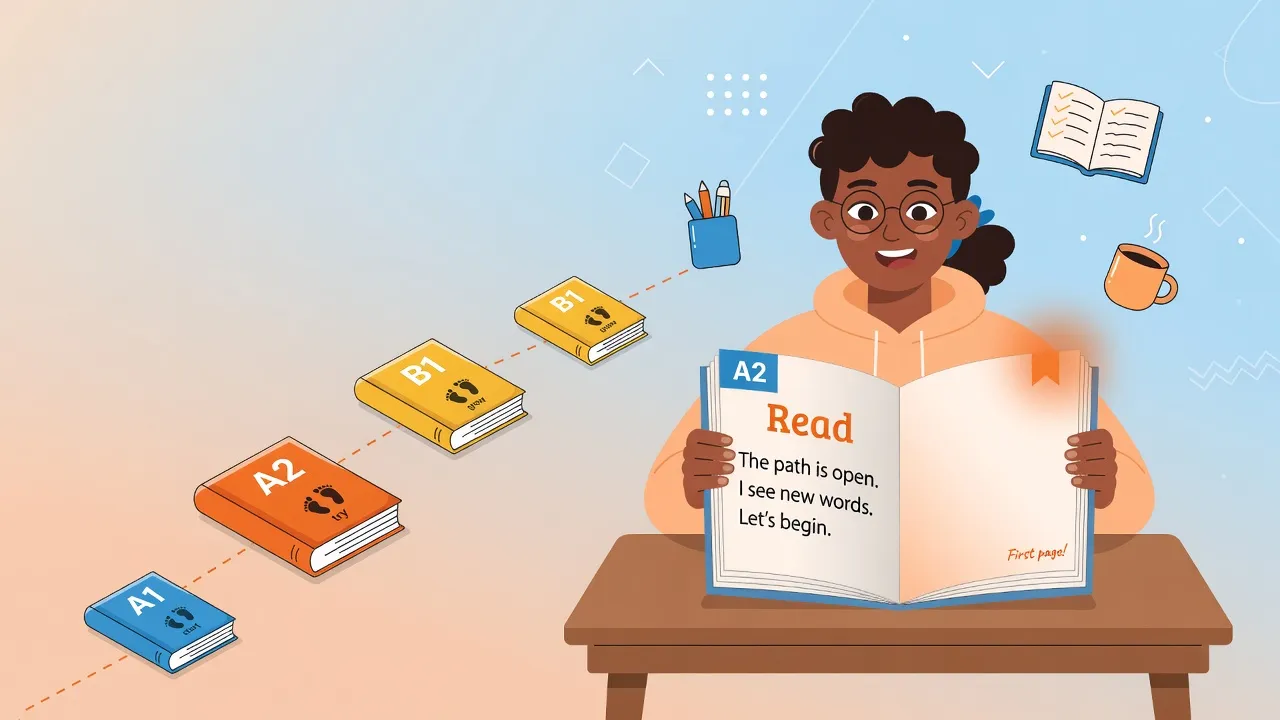
Think of levels as a ladder, not a single jump:
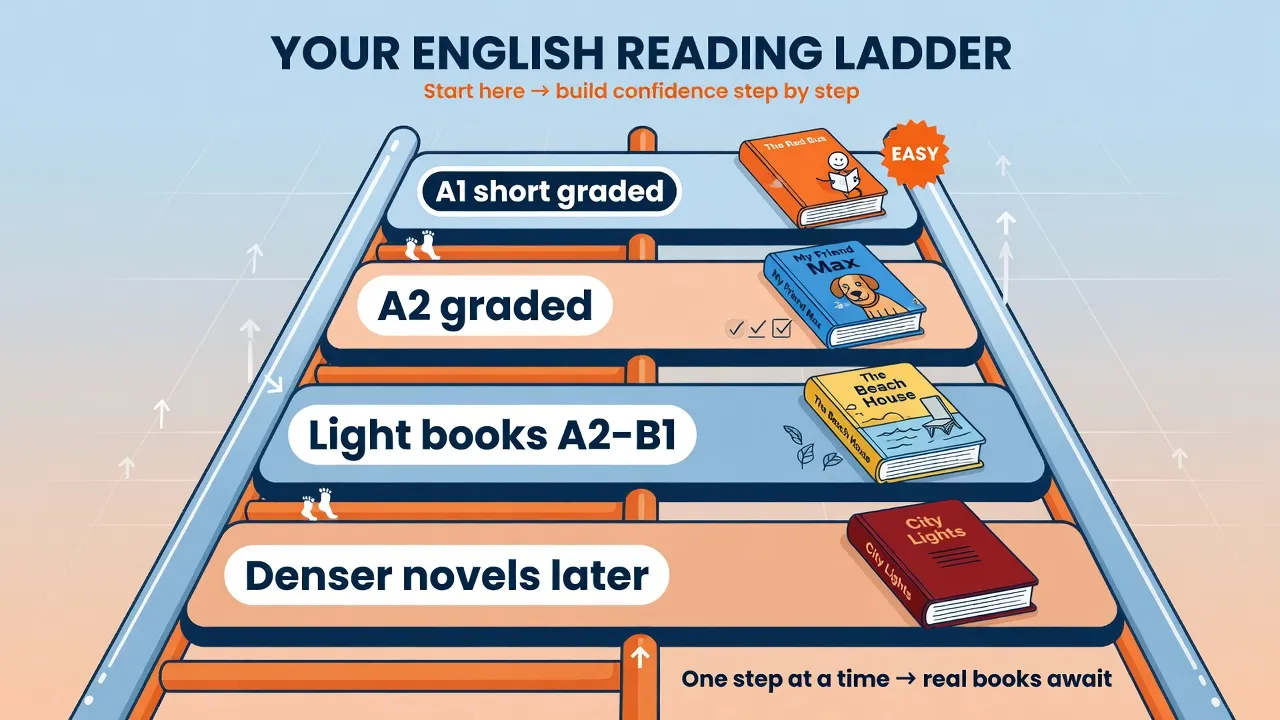
Three layers of start (not one perfect novel)
You do not need one magical book. You need a path with three layers: free graded warm-up, one finishable light book, and a delay for titles that are too heavy right now.
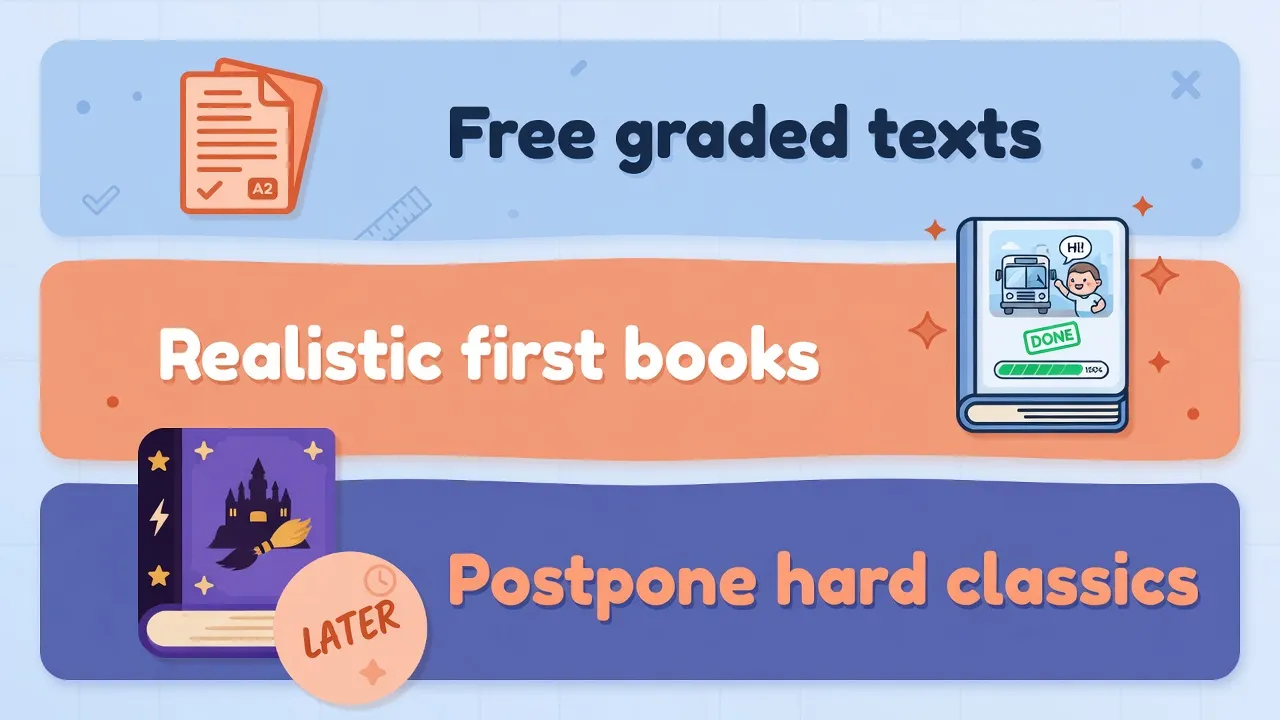
Layer 1: Free graded texts (required warm-up)
This is the cleanest start: short, leveled, no EPUB purchase yet.
- Optional UI warm-up if Ukrainian is comfortable for you: Ukrainian A1 sample
- Browse more: all articles
Goal of layer 1: learn to click only blockers - the words or phrases without which the sentence has no meaning - not every almost-familiar word.
Layer 2: Realistic first books (when the sample already feels easy)
These are finishable titles many A2-B1 readers can actually complete. Bands are approximate; always re-check with the 80-90% page rule.
| Book | Band | Why it works | Watch for |
|---|---|---|---|
| Fantastic Mr Fox (Roald Dahl) | A2 | Short, humor, clear plot | British flavor |
| Charlotte's Web (E.B. White) | A2 | Clean prose, real emotion | Farm vocabulary |
| Diary of a Wimpy Kid | A2-B1 | Diary form, school English | Slang and jokes |
| The Old Man and the Sea | A2-B1 | Short, simple sentences | Sea vocabulary |
| Wonder (R.J. Palacio) | A2-B1 | Modern language, short chapters | Informal dialogue |
| The Alchemist (English) | A2-B1 | Repeating ideas, quest shape | Philosophical lines |
Product note: MovaReader does not open "chapter 1" of these novels with a free button. Buy, borrow, or use a legal file you own, then upload an EPUB if you read in the app. See How to use.
Layer 3: Titles to postpone
- Full Harry Potter as your first experiment (comfort often needs solid B1-B2)
- Thick adult literary fiction
- Poetry as the main track
Motivation matters. If the goal is to finish, collect short wins first. You can always return to the big series later with better stamina and a bigger core vocabulary.
Traps for beginners (and Slavic speakers)
These show up for many learners. Ukrainian- and Slavic-speaking readers often recognize them immediately.
False friends and "almost familiar" words
English and Ukrainian share fewer obvious cognates than English and Spanish, but international-looking words still mislead. Do not trust the form 100%. Check blockers in context.
Word order, articles, and phrasals
a / an / the, in / on / at, and phrasal verbs (get up, look after, figure out) are easier when you meet them many times in real text, not only in a rules table. Reading is where they stop being abstract.
Full mental translation into your first language
Translating every sentence in your head is exhausting. Session goal: understand what happened, not produce a simultaneous oral translation. If you lose the plot without translating, the text is too high for daily work.
Shame of "kids" books
An adult with Fantastic Mr Fox is a strategy, not a failure. A children's or YA book at A2 often beats a "serious" novel you abandon after twelve pages. Finishability is the skill you are training first.
The 15-20 minute method (so you do not burn out)
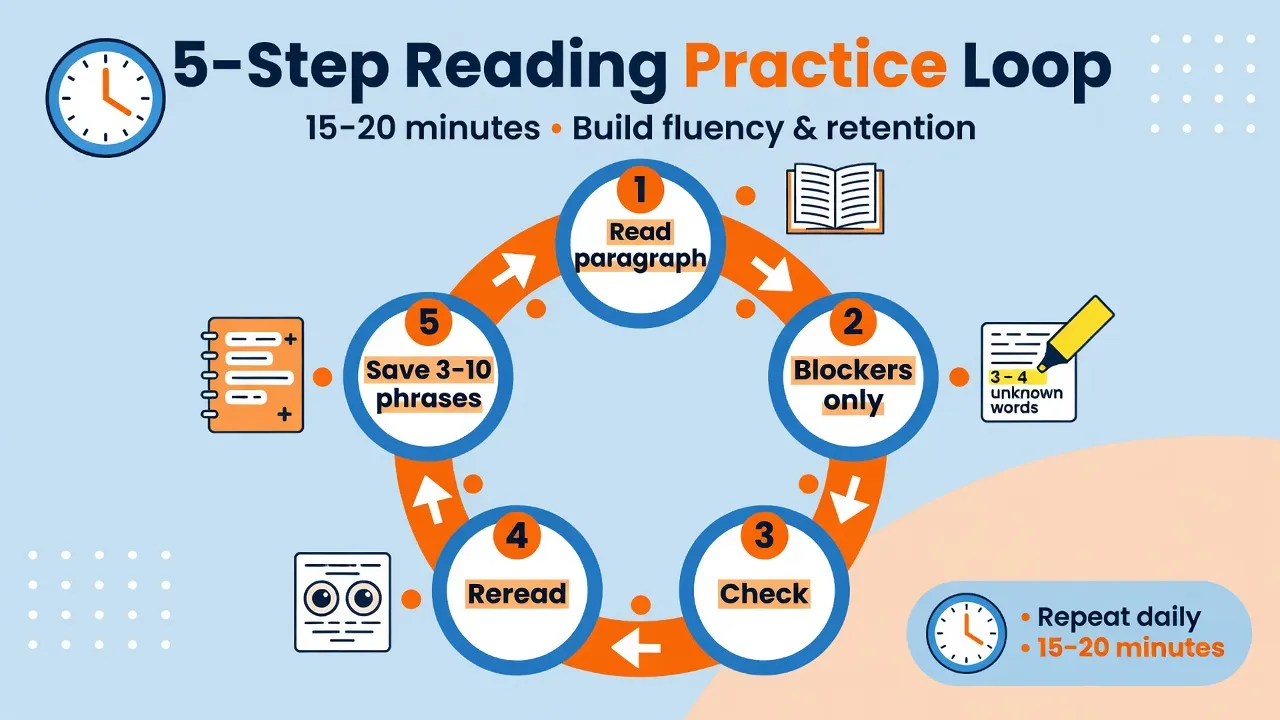
Short sessions beat heroic weekends. Here is a loop you can repeat most days.
Step 1. One main track per week
Do not jump between news, social media English, and Tolkien in the same evening. Pick one main track for the week so vocabulary and rhythm can stick.
Step 2. Paragraph cycle
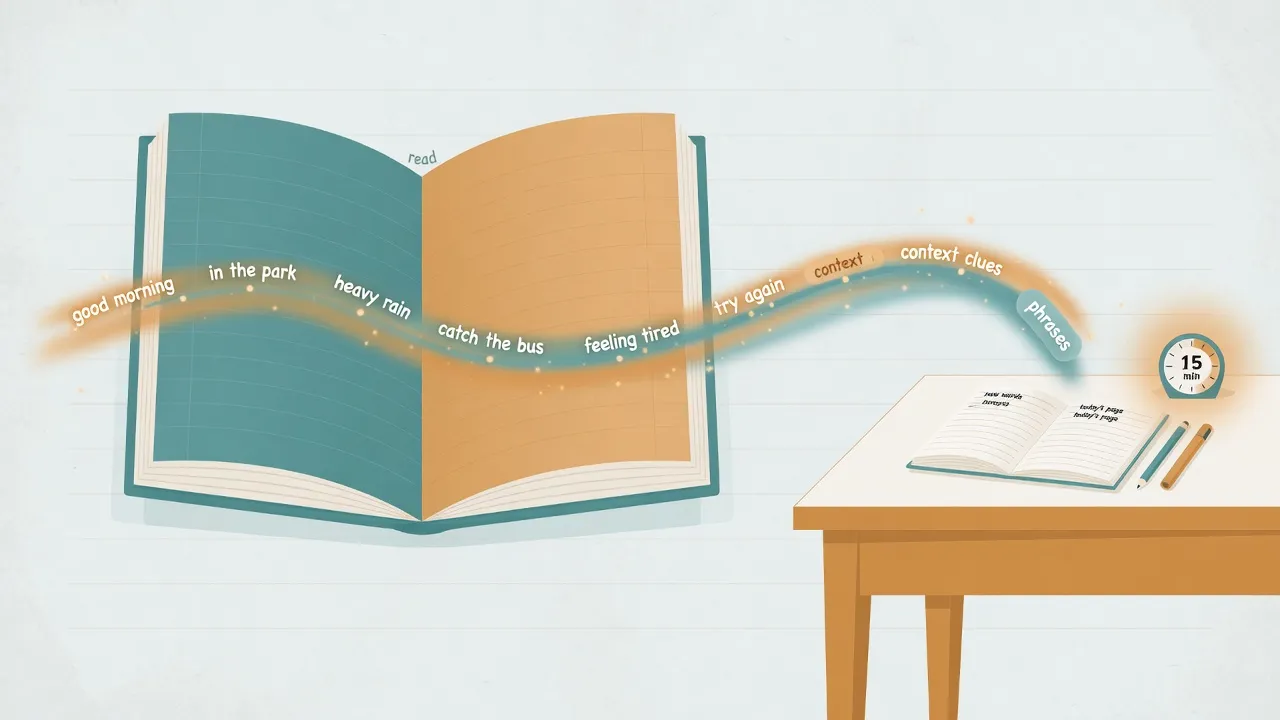
- Read the paragraph once without clicking.
- Mark only words or phrases without which the sentence has no meaning.
- Check those.
- Reread the paragraph.
- Save 3-10 useful phrases per session, not forty isolated words.
Phrases beat single adjectives. "Look after the kids" trains more reading power than three random color words.
Step 3. Short, almost daily
Fifteen to twenty minutes most days beats two guilty hours once a week. You may stop mid-chapter. Leaving the story open is fine; quitting for a month is the real problem.
Step 4. Weekly scheme
- 4 days: free graded English texts in the library
- 2 days: your book (EPUB or paper)
- 1 day: review saved phrases (try phrase typing demo or word training demo)
Step 5. Audio after text, not before
If listening exists for the text, play it when the written page already makes sense. Audio on an opaque page often adds noise instead of magic.
A simple 14-day plan
Days 1-3. Only one or two more pieces from all articles. Goal: a 15-minute habit, few lookups.
Days 4-7. Same graded track, plus one day of phrase practice with a demo.
Days 8-14. Add two short sessions with a light book from the table (Fantastic Mr Fox, Diary of a Wimpy Kid, or another title that passes the page rule). If you look up almost every sentence, spend another week on graded only.
Success metric is not "B2 in 14 days." Success is: you did not quit, and page two already feels easier than page one.
How to use MovaReader
MovaReader is built for reading with support, then turning unknown bits into practice - not for pretending a 500-page fantasy is beginner material.
- Warm up on free graded texts in all articles and learn click-translate.
- Upload your own file (EPUB and similar) when you are ready for a longer book. Guide: How to use.
- Click blockers only, not every new adjective.
- Train a small phrase set with phrase typing demo or type training demo; full trainers when you need more volume.
- Know the free plan limits: free includes listening and about 20 word translations per day. Unlimited translations: Reader €1. Full trainers: Pro €5/month. Details: Pricing.
What MovaReader does not do:
- replace legal buy or borrow of commercial books
- make a B2 novel "A2 easy" by magic
- choose the right difficulty for you
Free path for today
- Word training demo
- Phrase training demo
- Only then - an EPUB you own and one light book from the table above
FAQ
From which level can I start reading English?
From A1: very short graded texts. From A2: graded daily plus light stories. A full novel as your only material is often early - mix layers instead of forcing one hard title.
How many pages per day?
Start with 2-5 pages or about 15 minutes. Raise volume when you open the dictionary less often. Time is often kinder than page targets on tough weeks.
Do I need a parallel text in my first language?
Not as the main mode. Parallel text is fine to check one hard paragraph. If your eyes stay on the first-language column, you barely train English reading.
Should I start with Harry Potter?
If you already know the story and you are solid B1, try a sample chapter. At A2 most people do better with one or two easier finishes first. Familiar plot helps, but name density and chapter length still pile up.
What if I do not understand a sentence?
Do not translate everything. Guess from context. Check the blocker phrase. Save useful chunks (especially phrasal verbs), not every unknown adjective.
Is freemium enough?
For the start: yes - samples, listening, about 20 word translations a day. If longer sessions hit the limit, Reader at €1 helps. Full trainers are on Pro at €5/month.
Next steps
The best start is not the most prestigious book. It is the text you will finish this month.
Pick difficulty with the 80-90% rule. Protect daily 15-20 minutes. Use a tool to reduce friction, not to pretend a thick fantasy series is A2 homework.
Clean start today:
When graded feels easy, upload an EPUB you own and keep the same short loop. That is enough. The shelf can wait; the habit cannot.
Learning English?
The English version of MovaReader teaches Spanish and Ukrainian. To read English with a translation for every word, open the reader in Ukrainian or Spanish:
Книги англійськоюЦя стаття українськоюLibros en inglésEste artículo en español