Curated Resources
Graded English Reading A1-A2: Easy Stories by Level
Graded English reading for A1-A2: short situation stories you can finish, how to pick your level, and a clear path to an easy short book.
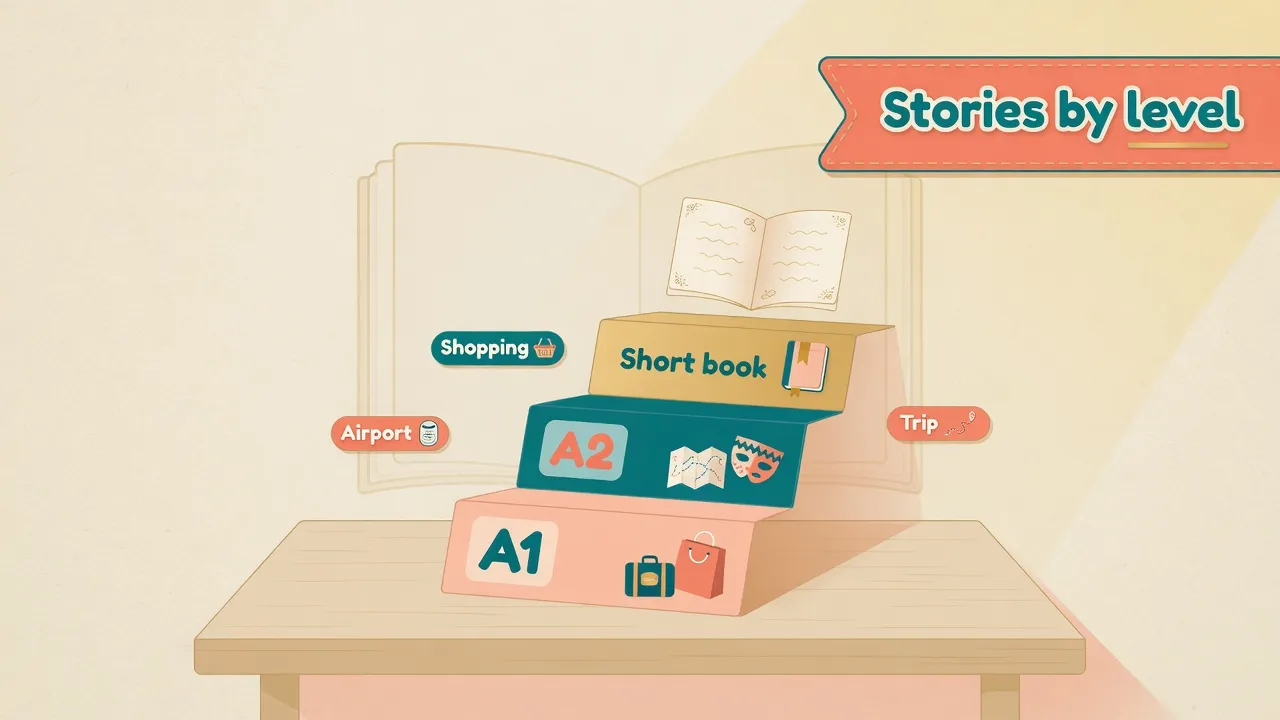
You search for easy English stories by level. What you get is either a shopping list of commercial "graded readers," or a PDF of a famous novel with an "A2" tag that is not A2. You want something simpler: a short text you can finish today without translating every line.
Graded English reading at A1-A2 is controlled text - short situation stories you can finish without translating every line - not a pile of commercial classics labeled "easy." Start with daily life (airport, shopping, family, trip), stay when a page feels about 80-90% clear, and only then stretch. Below: real free library links by level, a 15-minute method, a weekly plan, and a realistic path toward a short easy book. MovaReader is a free graded library with click-translate, not a warehouse of licensed bestsellers.
Quick route:
- Explore all articles (guests see English content first by default - useful here)
- Try one A1 sample, for example At the Airport, or another story from the lists below
- Translate only the words that block sense
- Later, when you want a short book: easy English books A2-B1
What this guide covers: what graded reading is · how to choose level · free A1 list · free A2 list · why situations win · 15-minute method · weekly plan · path to a short book · how to use MovaReader · FAQ.
Spanish speakers learning English are a natural audience for this topic (the URL slug is Spanish for that market), but the ladder works for any beginner who wants finishable English stories by CEFR. If your first language is Spanish, you may already know some airport and shop words from travel or media. Still start on a page you can finish - cognates help, they do not replace a level that fits.
What graded reading is (and is not)
A graded text is written or adapted for learners: limited vocabulary, shorter sentences, a clear plot or theme, and a CEFR band as a guide (A1, A2, B1...). Think of it as a ladder rung, not a museum label. The point is a text you complete, not a text that impresses someone else.
It helps you:
- stack pages without burning out
- see the same structures many times
- build a "I read in English" habit before a long book
- practice useful situations (travel, shopping, health, free time)
It is not:
- a pirate bestseller PDF with an "A2" sticker
- a dense legal essay or business dump sold as "easy reading"
- an unadapted 19th-century classic only because it is free
Golden rule: at A1-A2, prefer stories and situations over high-formality dumps. An airport dialogue teaches more usable English than a C1 contract extract or a literary review wall. If a page makes you feel clever for five minutes and quit on page two, it failed as daily input.
How to choose your level without fooling yourself
Trust the page in front of you, not only the CEFR on a course certificate. Here is how each band often feels, and what to read now:
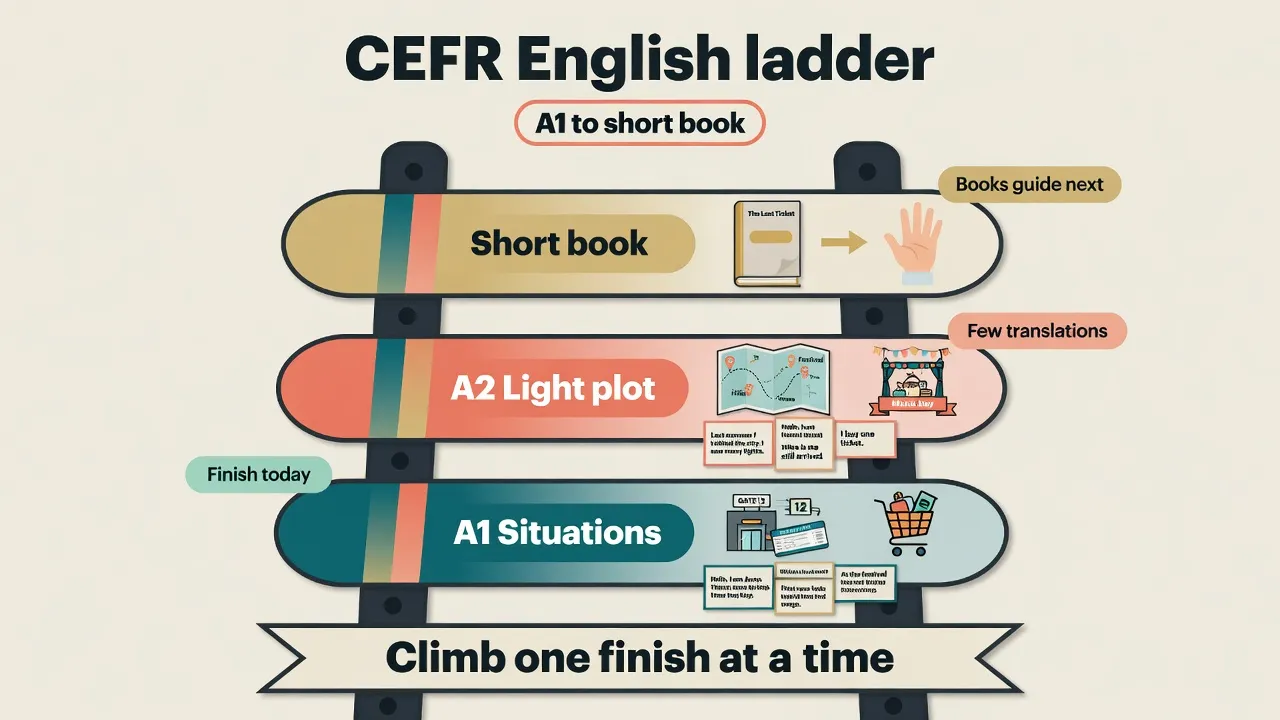
| Realistic level | How it feels | What to read now |
|---|---|---|
| A1 | Short sentences, objects and actions, lots of repetition | Very concrete situation stories |
| A2 | You can follow a full scene; still slow on phrasals and nuance | Travel, festivals, sport, simple plans |
| A2-B1 | You want more plot or short book chapters | More A2 + a short realistic book (books guide) |
| Still not "easy" | Translate almost every line; quit mid-page | Drop one rung; prestige is not progress |
One-page test:
- about 80-90% clear without help: good daily text
- about 70-80%: OK if the topic hooks you
- under about 70%: you are decoding, not reading
Do not use the CEFR from a course title or an official exam as your only compass. Use the page you have open. If you later pick a paper book, a quick finger check on a random page can help; we cover that in the five-finger rule for book level. For free graded stories, the one-page test above is enough.
Free library: where to start in MovaReader
Open All articles. As a guest, the default list prioritizes English content, which matches this goal. Filter by level or theme when you need to; do not pick the "most serious" text just to feel advanced.
What the product actually has:
- free graded library texts (English and other languages)
- click-translate inside the reader
- listening while you read (within the free plan's rules)
- word and phrase practice demos
- option to upload an EPUB or file you own legally when you want your own book
What it does not have:
- "read Harry Potter chapter 1 free" buttons
- licensed commercial novels hosted by default
Free plan limits come later in this guide. For a first day, one free article is enough.
Real A1 stories (easy English, concrete situations)
These are real library links. At A1, situation + repeatable vocab wins.
1. At the Airport
Why it works at A1: check-in, gates, bags, short instructions. Travel vocab that reappears in almost any real airport.
How to read: one pass without stopping; mark only words that block where you are or what to do.
Use it if: you travel or plan to travel and want practical English, not literary style.
2. Shopping for Souvenirs
Why it works: prices, sizes, "how much," service dialogue. Close to a real shop conversation.
Watch-out: units and currencies can distract; the goal is the purchase scene, not memorizing money systems.
Use it if: service conversations stall you.
3. Emergency Situations
Why it works: help vocabulary, clear places and actions. A little tension keeps attention.
Watch-out: not a medical manual - reading input only. Skip a line if the topic scares you.
Use it if: you want "I need help" English without technical dumps.
4. Football (Soccer)
Why it works: actions and roles repeat; a familiar field for many learners (including many Spanish speakers).
Watch-out: fan jargon. If you hate football, pick another story from this list; motivation wins.
Use it if: you already know the sport in your first language and need English for the same field.
5. Family Traditions
Why it works: family, habits, celebrations - everyday emotional vocab that is easy to picture.
Watch-out: customs may differ from yours; guess from context before translating every adjective.
Use it if: you prefer people stories over travel instructions.
Mini plan A1 (5-7 days): one article per day, or the same twice (day 1 read, day 2 reread + 5 saved phrases). Do not mix five themes in one day if 10 minutes already tires you.
Real A2 stories (a bit more plot and plans)
At A2 you can hold a longer scene: plans, culture, higher-energy sport. Still prefer narrative and situations over formal dumps.
1. Planning a Trip Abroad
Why it works at A2: itineraries, dates, decisions, "should we / let's." Natural bridge from A1 airport to a real trip or a short travel book.
How to read: read the full plan; summarize in 2-3 sentences after, not while reading.
Natural next step: when this feels comfortable, look at short books in easy English books A2-B1.
2. Festivals Around the World
Why it works: culture, places, customs; descriptive vocab without literary prose.
Watch-out: festival proper names. Do not memorize all of them; keep reusable verbs and adjectives.
Use it if: hotel dialogues bore you but light culture hooks you.
3. Extreme Sports
Why it works: actions, risk, gear, sensations; movement and advice structures with more energy than "a day at the office."
Watch-out: sport-specific terms. Translate blockers only on pass 1.
Use it if: you want A2 with energy.
Mini plan A2 (1-2 weeks):
| Day | Text | Focus |
|---|---|---|
| 1-2 | Planning a Trip Abroad | Global sense + 5-8 plan phrases |
| 3-4 | Festivals Around the World | Description + light culture vocab |
| 5-6 | Extreme Sports | Actions and advice |
| 7 | Reread the hardest one | Fewer translation clicks than day 1 |
When A2 feels easy, do not jump to a dense report. Take another A2 or a short realistic book - not a C1 wall.
Why stories and situations beat "serious" texts at A1-A2
The web loves prestige material: legal extracts, dense essays, business dumps labeled easy. Search engines and course blogs often reward titles that sound advanced. For a real A1-A2 reader that usually means:
- too many subordinate clauses
- low-frequency vocabulary
- little useful repetition
- zero win feeling
A short shopping or travel story gives you:
- visual context (you know what is happening)
- phrases you can reuse in real life
- an ending (you close the text and feel progress)
- a better comprehension-to-time ratio
Here is the simple version: at beginner bands, finishable beats impressive. You are training the habit of reading English, not proving that you can open a hard PDF. Save formal texts for when A2-B1 already feels steady. Prestige is not the same as comprehensible input.
15-20 minute reading method
You do not need a two-hour session. Fifteen to twenty minutes most days beats a guilty weekend marathon. Here is the loop:
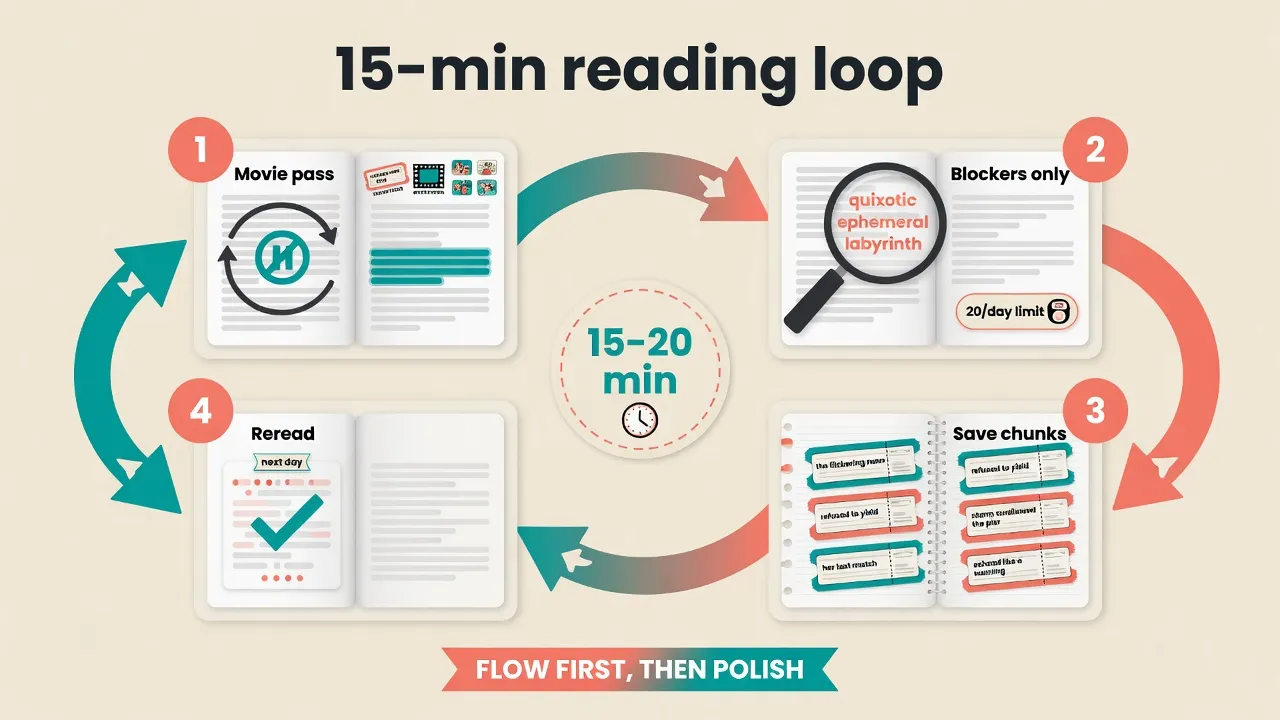
Pass 1: "movie pass"
Read a paragraph or the whole section without stopping. Answer only: what is this about?
Pass 2: minimal translations
Translate only sense-blockers - the words that kill the meaning of the sentence. Not every pretty adjective.
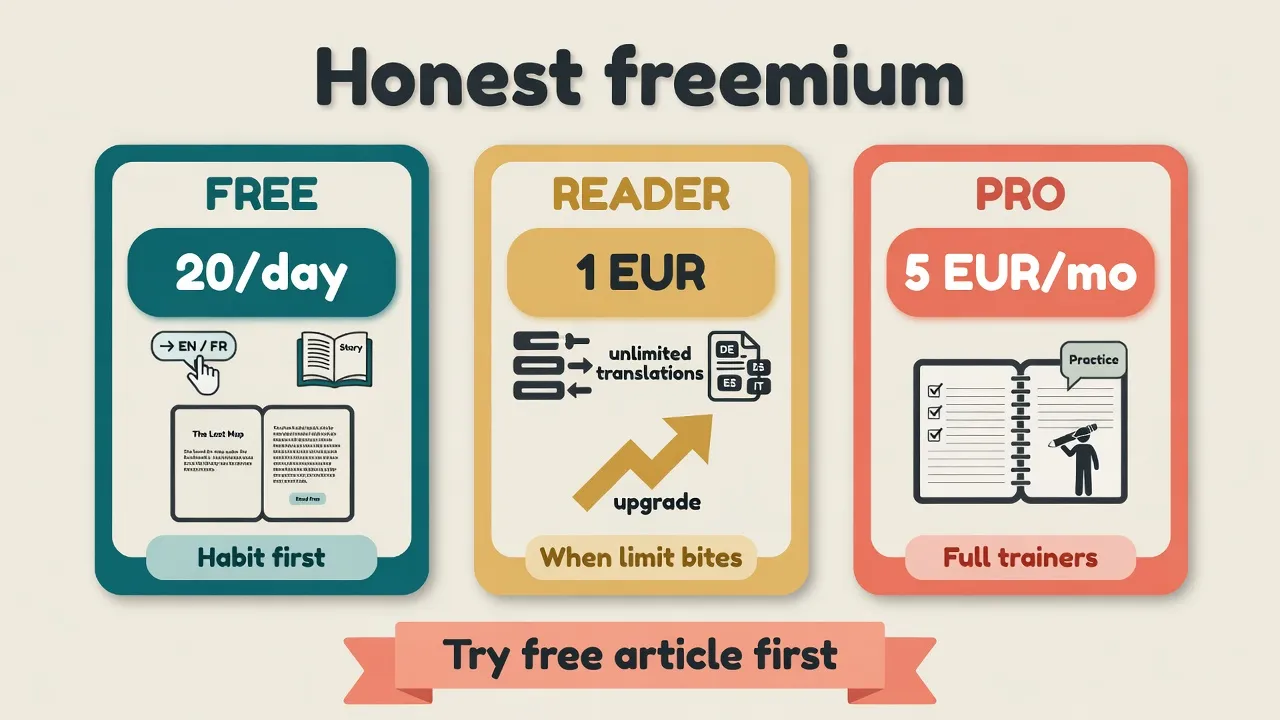
On the free plan, MovaReader gives you 20 word translations per day. That pushes a healthy habit: fewer clicks, more context. If you need unlimited translations as a daily habit, Reader is €1. Details on Pricing.
Save chunks, not dictionaries
5-10 phrases or collocations per session: boarding pass, how much is this, we should book. Better than 40 loose words you will never use.
Short fixation (optional, 3-5 minutes)
Say or write three sentences from the text. For interactive practice: phrase typing demo. Full trainers sit on Pro (€5/month); you do not need that on day one.
Reread tomorrow
The same article next day with fewer clicks beats a new article every hour.
Realistic weekly plan (A1-A2)
Fifteen minutes most days is the spine. Treat the table as a default, not a courtroom. Swap days when life is busy; keep the short block.
Miss a day? Do not "catch up" with 90 minutes of guilt. Return to the 15-minute block.
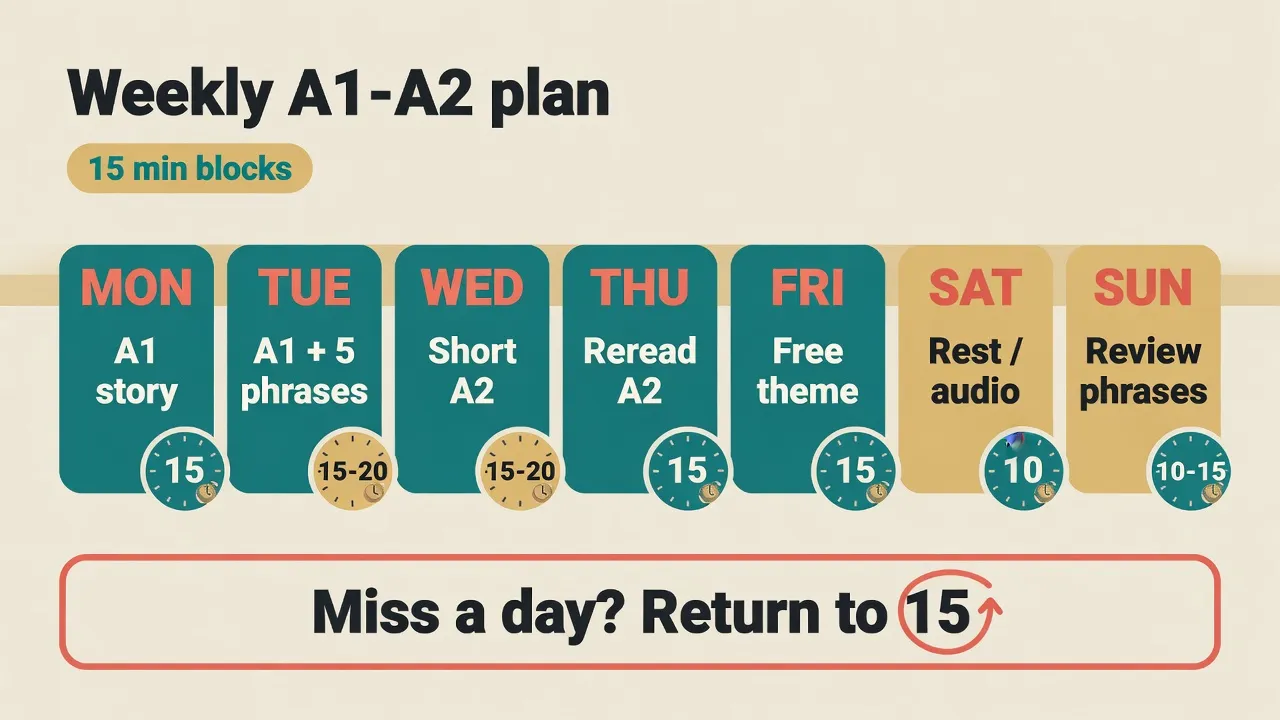
| Day | Activity | Time |
|---|---|---|
| Mon | 1 A1 from the list above | 15 min |
| Tue | Same or other A1 + 5 phrases | 15-20 min |
| Wed | 1 short A2 | 15-20 min |
| Thu | Reread A2 + phrase demo | 15 min |
| Fri | Free theme in all articles | 15 min |
| Sat | Rest or audio if it helps | 10 min |
| Sun | Review saved phrases | 10-15 min |
After two or three calm weeks, you will know whether A1 still feels right or A2 is your daily home. That signal matters more than any certificate.
If you want a wider view of where English and Spanish sit on the product map, peek at the language map once you have a reading habit. For product UI basics, How to use MovaReader is optional onboarding.
From graded text to a short book (without burnout)
A realistic order:
- A1 situational (airport, shopping, family) - IDs 446, 452, 455, 591, 603
- A2 with a bit more plot (trip, festivals, sport) - IDs 456, 608, 681
- More A2 until you translate little
- Short realistic book (not a 500-page prestige tome)
- Only then denser material
For step 4, use Easy English books A2-B1: realistic titles, a "not yet" list, and the same comprehension rule. MovaReader does not host those commercial novels by default; if you have a legal EPUB, you can upload it. The free library stays your daily warm-up.
When you leave the comfort zone of graded text and wonder about originals, the trade-offs are covered in graded readers vs original texts.
If you also study Spanish as an L2 (separate goal from this English ladder), the twin hub is Spanish graded reading stories by CEFR.
How to use MovaReader
A clear path:
- Open All articles and pick an A1 or A2 text from this page.
- Click-translate only sense blockers.
- Practice a handful of phrases in the phrase typing demo.
- If you often hit the free plan's limit: Reader €1 (unlimited translations) or Pro €5/month (full trainers). Compare on Pricing.
- When you want a long book later, upload your legal file.
The free plan in one line: listening plus 20 word translations/day; Reader and Pro optional once the habit exists.
What you do not need to do:
- register to unlock a novel chapter by chapter
- believe a C1 legal text is graded A2
- pay before reading at least one free article
Typical mistakes (and the fix)
Same traps show up every week. Here is the fix.
| Mistake | What happens | Fix |
|---|---|---|
| Ego pick ("too basic") | Quit page 2 | Drop to the level you finish |
| Translate every word | Burn quota, no flow | Blockers only |
| Vocab lists only, zero stories | Test OK, paragraph fail | Prioritize scene text |
| Jump A1 → dense essay | Frustration | Several A2 first |
| Illegal bestseller PDFs | Legal + quality risk | Legal graded + books you own or borrow |
FAQ
Is a story or a news piece better to start?
At A1-A2, a story or dialogue situation usually wins: characters, a goal, natural repetition. Simple news is fine if the topic hooks you. Avoid long political quote walls and dense reportage labeled "easy."
How many graded texts before a book?
No magic number. Practical signal: several A2 texts in a row with few translations, and you want more plot. Then try a short book from the A2-B1 books guide - not a dense classic because it is famous.
Can I read only 10 minutes a day on mobile?
Yes. Daily 10 minutes of a real article beats monthly guilt marathons. Graded situations fit trains, queues, and short pauses. Start with something finishable like At the Airport.
Are 20 translations a day enough?
On a well-chosen text, yes. Dozens of clicks per page means the text is too hard or you are over-translating. Heavy daily habit that hits the cap often: Reader €1 for unlimited translations. Compare pricing.
Does MovaReader include novels like The Little Prince or Harry Potter?
Not by default as a licensed commercial library. You get free graded articles plus the option to upload files you own legally. There is no "read chapter 1 free in the app" for third-party novels.
What is graded reading in one line?
Controlled learner text with a CEFR band - built so you can finish it, not so it impresses anyone.
Start now
Graded English reading by CEFR level is simple to say and easy to do wrong: either you choose A1-A2 stories you can finish, or you get lost in "impressive" material that is not graded at all.
Today:
- Open all articles
- Pick one A1: Airport, Souvenirs, Emergency, Football, or Family Traditions
- Or one A2: Trip Abroad, Festivals, Extreme Sports
- Translate little, save phrases, repeat tomorrow
- When book time comes: easy books A2-B1 and current prices on pricing
You do not need a famous novel or a C1 text dressed as A2. You need the next page you can actually finish.
Learning English?
The English version of MovaReader teaches Spanish and Ukrainian. To read English with a translation for every word, open the reader in Ukrainian or Spanish:
Книги англійськоюЦя стаття українськоюLibros en inglésEste artículo en español