Reading Strategies
Graded Readers vs Original Texts at A2: How to Mix Them
Not "only graded" and not "Harry Potter tomorrow." How A2 learners mix controlled texts with finishable originals, pick smarter first books and use reading tools well.
If you are stuck around A2, you have probably heard two loud opinions.
One says: stay on graded readers until B1, maybe longer. The other says: throw them away and open Harry Potter today.
Both miss something. The first can trap you in comfort (every page feels easy, so growth slows). The second can trap you in prestige (dense classic or fantasy day one, then quit after page two and blame yourself).
Here is the plain answer.
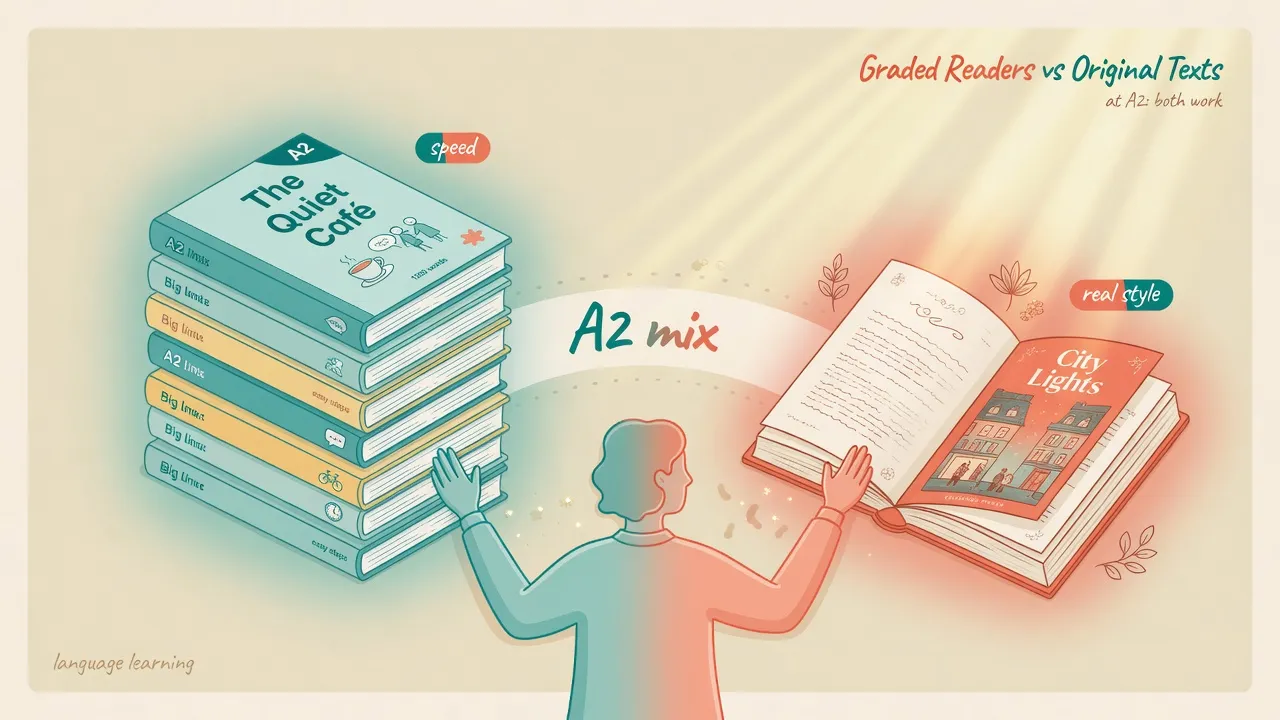
At A2, graded readers (controlled texts) are for speed, confidence, and finishable volume. Easy originals are for real collocations, tone, and motivation - if you pick finishable books and look up blockers only. You do not need to quit graded forever or wait for B2 to touch real books. Use a weekly mix, and shift the ratio when pages start to feel doable. Below: what each tool is good for, a simple week plan, EN and ES first-original types, and a tool path.
What this guide covers: graded strengths and limits, why originals feel brutal, a comparison board, a weekly mix ladder, first original types with English and Spanish examples, the 80% rule, a soft tool path, myths, a 4-week plan, and FAQ.
The aim is simple: tools and a habit that survives real weeks.
What are graded readers actually good for at A2?
Graded readers are texts rewritten or written for learners. Publishers usually control them with headword lists and CEFR bands (A1, A2, B1...). Oxford Bookworms and Penguin Readers are classic series. Many apps and sites also publish short graded articles.
Typical features: shorter sentences, limited vocabulary range, clearer plot scaffolding, and fewer dense cultural asides.
That is not "fake language." It is training wheels for form and flow. At low A2, that is often exactly what you need so you can practice reading instead of constant decoding.
What graded readers do well
Here is why controlled texts still earn their place at A2.
| Benefit | Why it matters at A2 |
|---|---|
| Finishable wins | Finishing chapters builds the habit of reading |
| High comprehension | You practice reading, not constant decoding |
| Repeated core vocab | High-frequency words become automatic |
| Low emotional cost | You are less likely to quit after page two |
Where graded readers get weak
The comfort trap is not that graded texts are "fake." It is staying on them forever when every page is already too easy.
| Limitation | Risk if you never leave them |
|---|---|
| Narrow collocations | You meet safe patterns more than street or literary ones |
| Flat register | Less slang, irony, and style shifts |
| Over-comfort | If every page is ~98% known, growth slows |
| Artificial dialogue | Some rewritten classics sound stiff |
Bottom line: graded readers are excellent phase tools, not a permanent diet. Keep them for volume; add stretch when pages start to feel doable.
If you learn Spanish and want free graded volume by level, see free graded Spanish readers and Spanish stories by CEFR.
Why do original texts feel brutal at A2?
Open a dense original page with only a dictionary and A2 vocabulary, and this loop is common:
- You look up too many words.
- You lose the plot.
- You feel stupid.
- You quit and blame yourself.
The failure is often method and text choice, not intelligence.
Common prestige-trap moves at A2: starting with prestige classics instead of clear narrative; choosing dialect, archaic style, or heavy description first; translating every unknown adjective; reading only when you are already tired at night.
Original text can work at high A2 if the story is plot-driven or already known, chapters are short, you accept a slower pace, and you look up blockers only (words that break the whole sentence).
Graded vs original: which tool when?
Same skill (reading), different job. Pick the tool for today's goal - do not convert religions.
Here is the comparison board in one view:
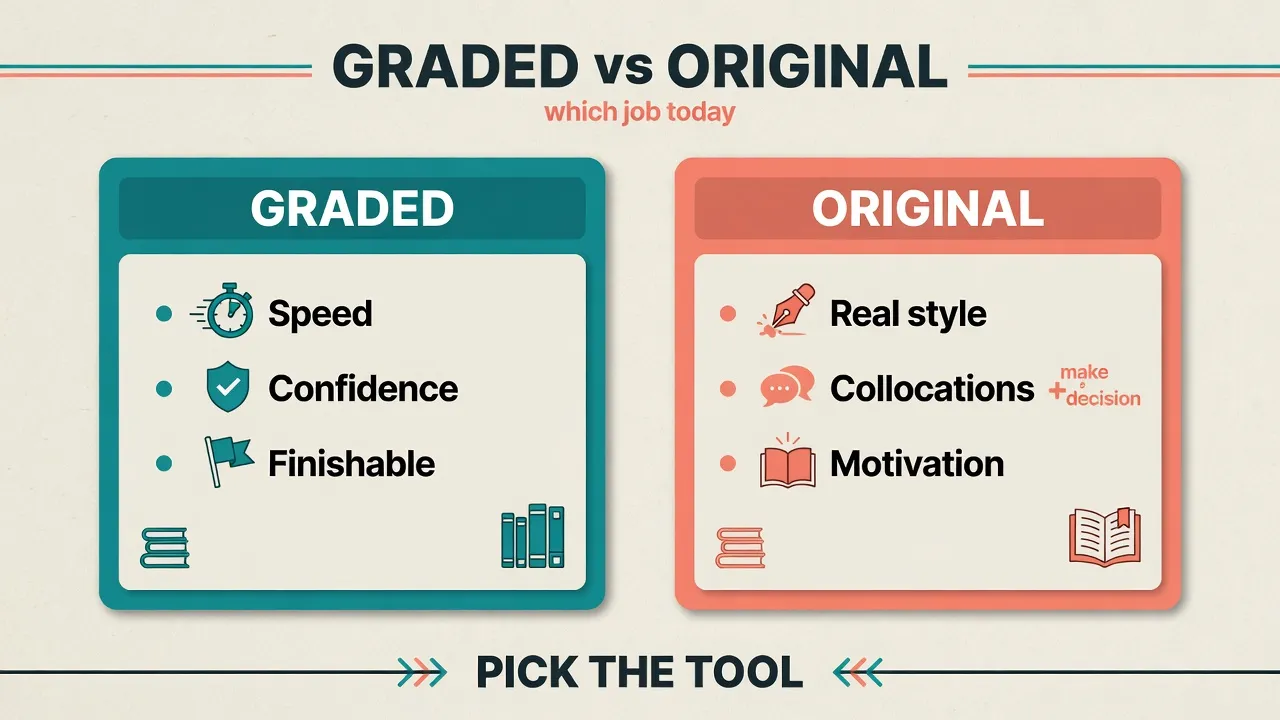
| Job | Graded / controlled | Easy original |
|---|---|---|
| Best for | Speed, confidence, core vocab reps | Real collocations, tone, motivation |
| Wins when | You need finishable volume without rage-quit | Story is plot-driven, known, or short-chapter |
| Fails when | Every page is too easy forever (comfort trap) | Prestige pick + translate-every-word (prestige trap) |
| A2 default use | ~4 days/week volume | ~2 days/week stretch + fun |
On a tired Tuesday, graded is often smarter. On a free Saturday with a known story, an easy original can be the fun one. Match the page to the day.
How do you mix graded readers and real books each week?
You do not need to quit graded forever or wait for B2 to touch real books. You need a week that fits real life.
A useful weekly mix for A2-B1:
| Day type | Text type | Goal |
|---|---|---|
| ~4 days | Graded / controlled short texts | Fluency, automatic core vocab |
| ~2 days | Easy original or known-story book | Real style + motivation |
| ~1 day | Phrase review | Move chunks from passive to usable |
Think of it as a ratio dial, not a badge:
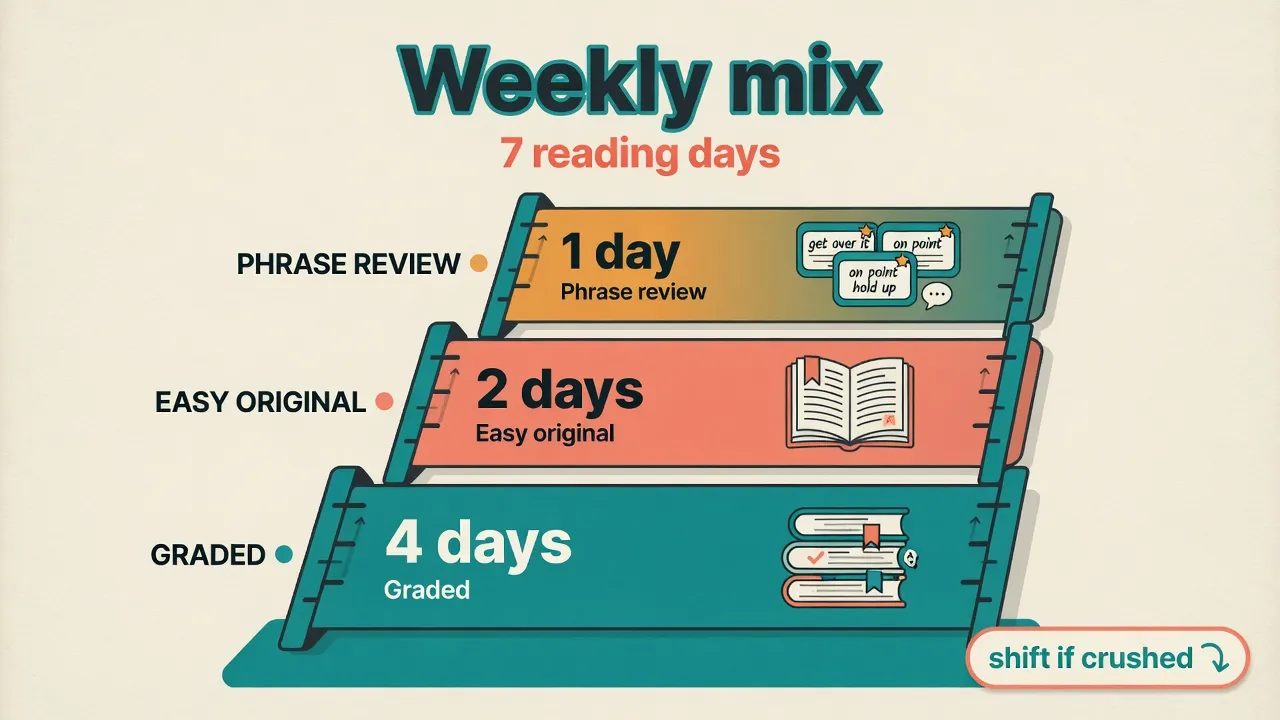
If originals still crush you, shift graded-heavy for two weeks, then retest with an easier book. If graded pages feel like pure comfort, nudge one more original session into the week.
When should I stop graded readers?
You do not need a hard stop. Reduce graded days when easy originals become finishable. Many B1 learners still use graded material on tired days - that is smart recovery, not failure. No purity badge for "never graded again."
What first original books work at A2? (English and Spanish examples)
Better first targets than dense literary prose:
- modern YA with a clear plot
- simple thrillers with short chapters
- books you already know in another language
- light nonfiction with concrete topics (travel, simple explainers, popular science for general readers)
Harder early: experimental literary fiction, poetry as your main project, very long historical sagas, heavy dialect-driven dialogue.
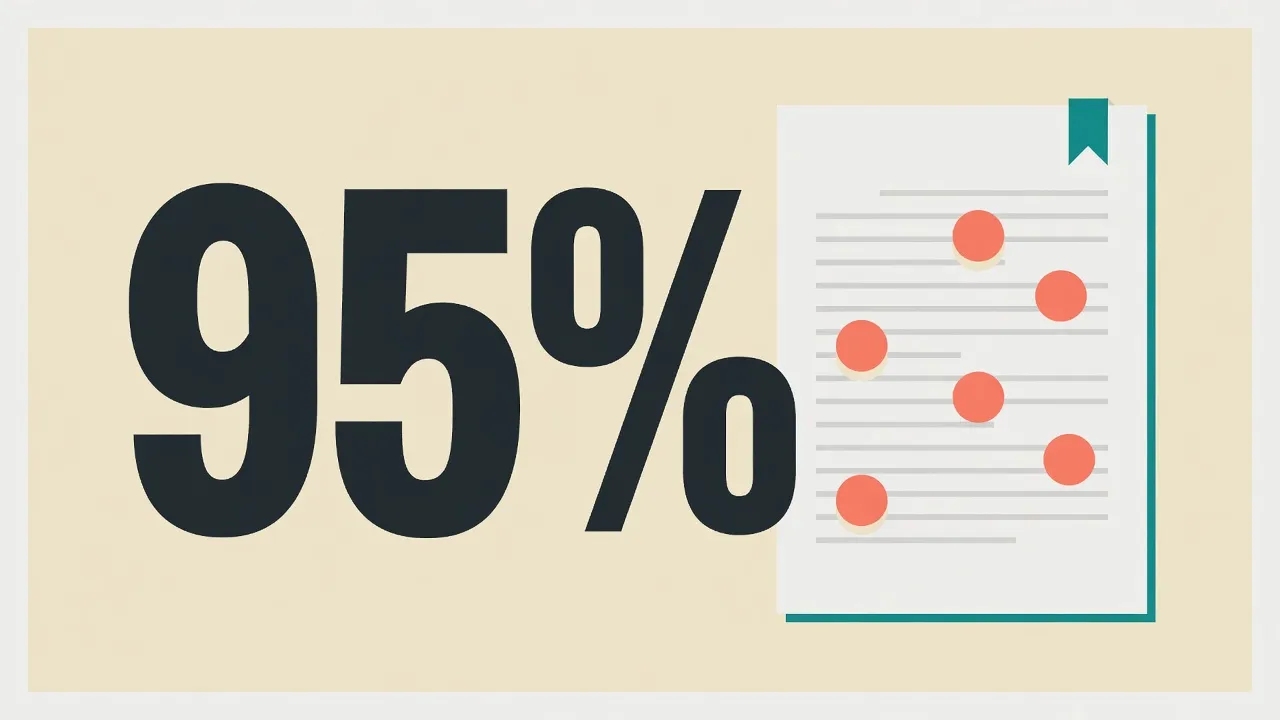
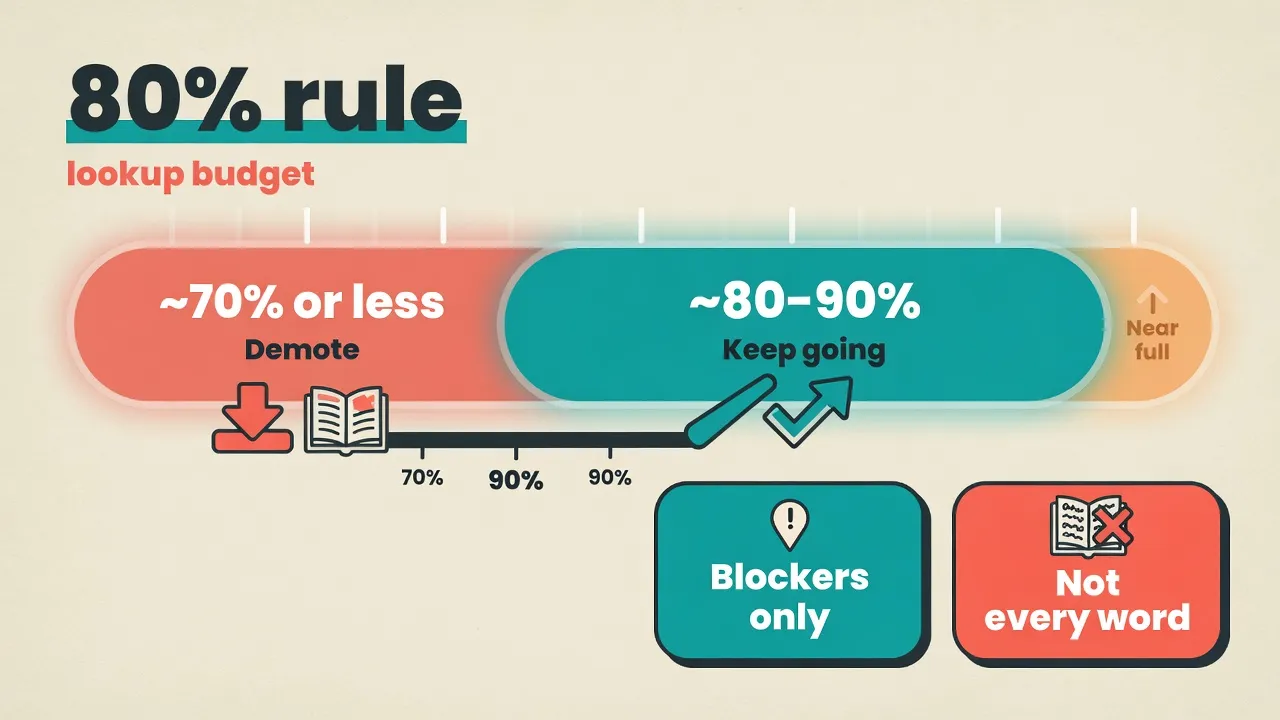
Rule of thumb: open a random page. Roughly 80-90% without help → keep. Under ~70% and every sentence needs a dictionary → demote it this month.
Use owned EPUB or files for commercial titles. Prefer finishable over impressive. No pirate hosts.
English examples (types + real titles)
A few finishable directions for English as L2 - not a full encyclopedia.
| Type | Example (real title) | Why A2-friendly | Watch-out |
|---|---|---|---|
| Clear modern YA | Wonder (R.J. Palacio) | Short chapters, strong plot pull, everyday school voice | Full length; emotional themes |
| Short literary classic | The Old Man and the Sea (Ernest Hemingway) | Short whole book; plain sentence style | Sea lexis; still literary tone |
| Known-plot YA (later stretch) | Holes (Louis Sachar) | Clear story engine; chapter momentum | Some cultural/US school context |
| Prestige / dense fantasy | Popular long fantasy series | High motivation later | Not week-1 default if dense (prestige trap) |
| Light nonfiction | Short travel essays or general-reader science explainers | Concrete topics, reusable vocab | Jargon spikes on technical pages |
Wonder or Holes as a stretch after graded volume days often beats day-one prestige fantasy. The Old Man and the Sea is short enough to finish, but sea words still need a lookup budget.
Spanish examples (types + real titles)
Same rules for Spanish as L2: everyday voice and known plot beat prestige.
| Type | Example (real title) | Why A2-friendly | Watch-out |
|---|---|---|---|
| Clear YA / school life | Manolito Gafotas (Elvira Lindo) | Everyday Spanish, dialogue-heavy, school and family life | Madrid/colloquial pockets; ego if it feels "for kids" (reframe as smart scaffolding) |
| Known story (short) | El Principito (Antoine de Saint-Exupéry) | Plot already known in many L1s; short book | Some poetic lines; not pure street Spanish |
| Short-chapter YA mystery | El asesinato de la profesora de lengua (Jordi Sierra i Fabra) | Page-turn push; teen school setting; finishable chapters | Crime/school slang; series quality varies |
| Free graded volume days | MovaReader free Spanish A1/A2 articles (samples 1127, 1209) | Legal free volume + click-to-translate practice | Still mix originals you own later |
| Known YA in translation (optional) | Spanish edition of Wonder (La lección de August) | Same scaffolding as the English pick | Translation register differs from original ES YA |
If a "kids book" feels wrong for your ego, reframe it: known plot is scaffolding, not a demotion. For deeper free graded Spanish lists, use the sister posts linked above.
What method works for both graded and original?
Same method for both. Only the page difficulty changes.
- One pass for gist - read a paragraph once without stopping at every unknown word.
- Mark blockers only - a blocker breaks the whole sentence. Color adjectives can wait.
- Check, reread, move on - look up blockers, reread the paragraph, continue.
- Save 3-10 useful chunks - phrases beat giant word dumps.
- Prefer 15-20 minutes daily - short sessions beat a heroic weekend that never returns.
The 80% rule and your lookup budget
Use a simple band when you test a book:
| Band | What to do |
|---|---|
| ~80-90% without help | Good independent stretch - keep the book |
| ~70-80% | Stretch with blockers-only; short sessions |
| Under ~70% + constant lookup | Wrong tool or wrong book this month - demote |
Your lookup budget is blockers, not every color adjective. Translate-everything kills the plot and the habit.
Support tools can lower friction. They do not turn B2 prose into A1. Book choice still matters.
How does MovaReader fit this mix?
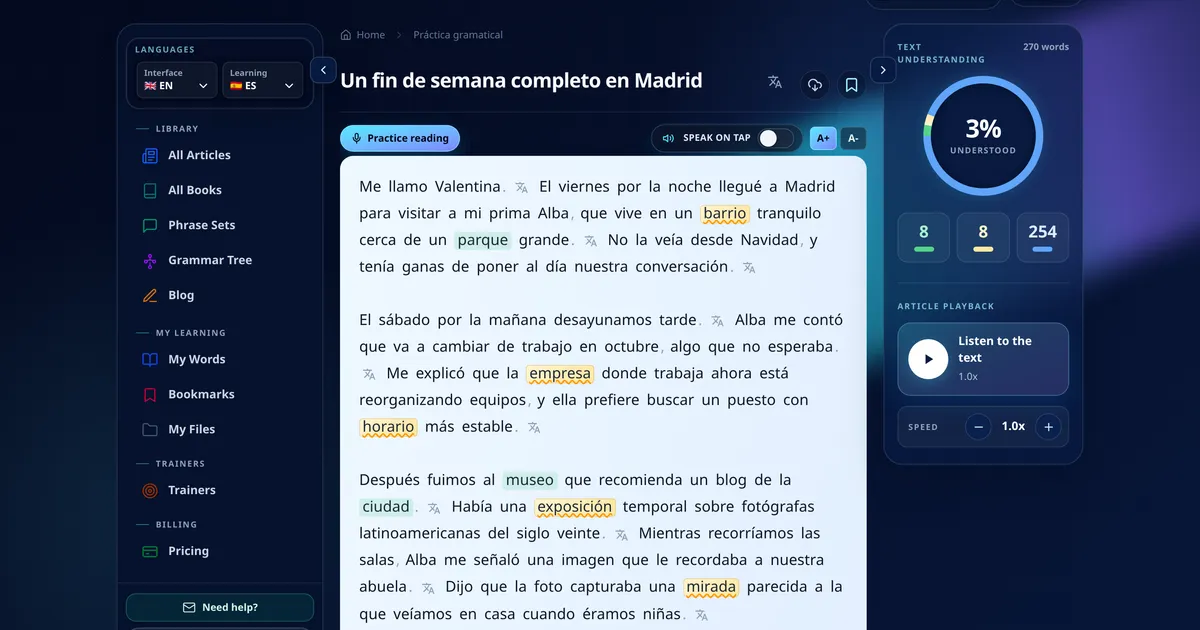
MovaReader fits this mix. Free graded library for daily easy wins and click-to-translate. Upload EPUB or other files you own when you want a real book in the same interface. Listening is available on freemium once the page is understandable. Trainers on demos and Pro help with phrases you decide to keep. For Spanish, the book catalog shows both sides of the mix with one title: Don Quijote as an A2 adaptation and the full original as a C2 goal.
Suggested free start:
- Spanish learners: Spanish A1 sample or Spanish A2 sample. English learners (or anyone): browse All Articles.
- Optional trainers: Word training demo, Phrase training demo.
- When the habit is stable: upload an EPUB you own - How to use.
- Pricing: freemium (20 word translations/day, unlimited listening), Reader €1 for unlimited translations, Pro €5/mo for full trainers - Pricing.
- Vocab orientation by research ranges: Language map.
For Spanish graded volume by level, also see free graded Spanish readers online and Spanish graded reading stories by CEFR.
Myths to drop
Do graded readers keep you at A2 forever?
Only if you never raise difficulty and never touch authentic input. Stagnation comes from the comfort trap, not from the format itself.
Are originals always better?
Not if they kill the habit. A finished graded chapter teaches more than an abandoned prestige page.
Does AI make every original easy?
Support reduces friction. It does not turn B2 prose into A1. You still need a sane book choice and a lookup budget.
Are teachers who recommend graded readers outdated?
No. Many recommend them because they work for confidence and volume. The upgrade is graded plus controlled steps into authentic text.
Sample 4-week transition plan (A2)
Success is boring and useful: pages finished per week and a lower lookup rate - not a fantasy CEFR jump chart.
| Phase | Focus |
|---|---|
| Weeks 1-2 | Daily graded short texts; one easy original scene or chapter on the weekend only; track: can you finish without rage-quitting? |
| Week 3 | Graded for speed days; two original sessions mid-week; save only high-value phrases |
| Week 4 | If original sessions feel hard but doable, keep the mix. If every page is lookup hell, return to graded-heavy for two weeks and pick an easier original |
Adjust the dial. Do not punish yourself for a heavy graded week when life is noisy.
FAQ
Should A2 learners use graded readers or original texts?
Both. Use graded texts for volume, speed, and confidence. Use carefully chosen easy originals for real style and motivation. The skill is the mix and the book choice, not picking a purity team.
When should I stop graded readers?
You do not need a hard stop. Reduce graded days when easy originals become finishable. Many B1 learners still use graded material on tired days - that is smart recovery, not failure.
What is the biggest mistake with original books at A2?
Choosing prestige over readability, then translating every word. A dense classic or long fantasy on day one often becomes a quit loop: too many lookups, lost plot, then self-blame. Pick finishable narrative first; look up blockers only.
Do graded readers use "fake" English or Spanish?
They use simplified language. That is not useless. It is training wheels for form and flow. It becomes a problem only if controlled texts are your only long-term diet and every page stays too easy.
How do I mix graded readers and real books in one week?
A practical A2-B1 pattern: about four days graded or controlled short texts, two days easy original or known-story reading, one day phrase review. If originals crush you, shift graded-heavy for two weeks, then retest with an easier book.
Can I upload any book to MovaReader?
You can upload files you own or have rights to use. MovaReader is not a pirate library of commercial novels, and it does not host licensed novels by default with one-click free chapters.
Is there a guaranteed timeline from A2 to B2 via reading?
No tool can guarantee that. Hours of comprehensible input, speaking practice, and consistency matter more than format slogans or a CEFR jump chart.
Final takeaway
Graded readers are training tools. Original texts are the sport. Athletes use both.
If you are at A2, keep the wins from controlled texts, add originals you can actually finish, and use reading support to reduce friction. Start with a free graded sample, keep the weekly mix, then introduce one realistic original file you own when the habit is stable. Use the language map if you want rough CEFR orientation for words you mark.
Keep reading with translations inside the text
With a free account, an unknown word translates with one tap, and the words you are learning wait for you in the trainer.
Free account: 7 days of Pro, then 20 word translations a day or a paid plan.