Curated Resources
Which García Márquez Book to Start With in Spanish (Difficulty Ladder)
A reading order by difficulty for García Márquez in Spanish: short stories first, Macondo last, plus practical tips for reading the originals without burning out.
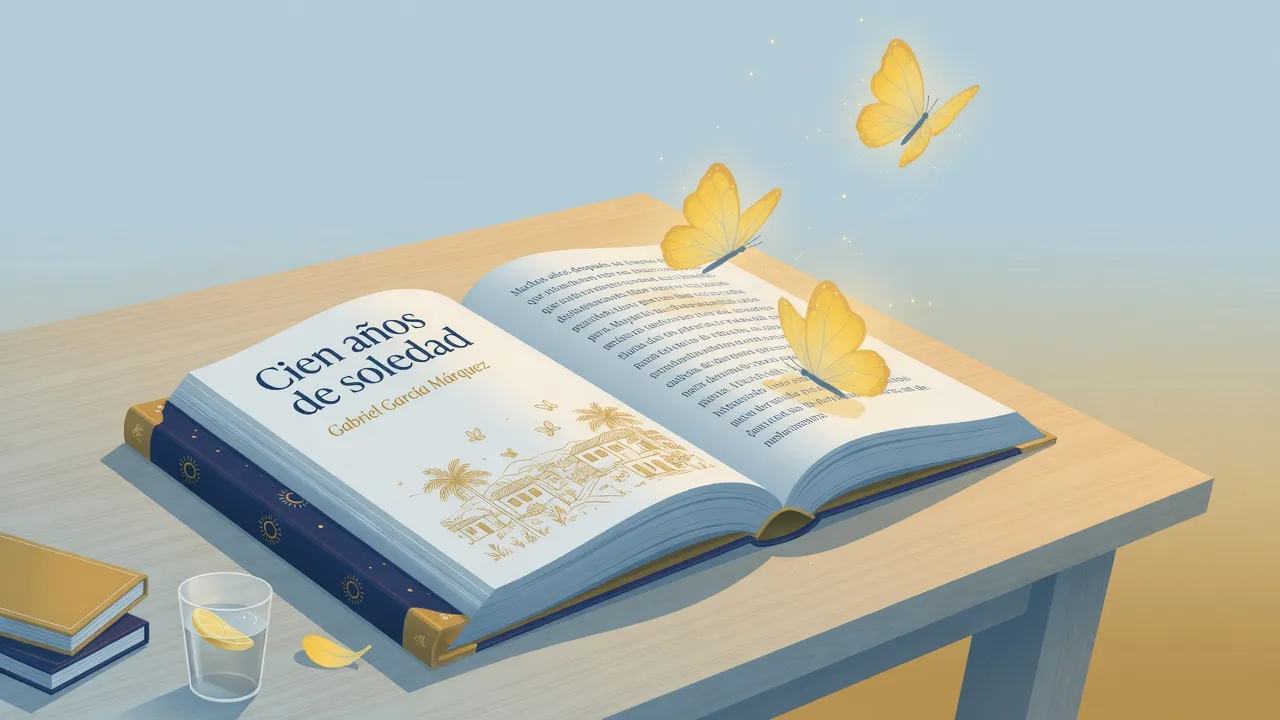
You open Cien años de soledad in Spanish because everyone says start with the famous one. The first sentence holds three layers of time. A name you have never met. Butterflies or ice or a firing squad. Your dictionary gives a gloss for every word. The page still does not feel like a story.
That is not a failure of will. It is the wrong first step for most Spanish learners.
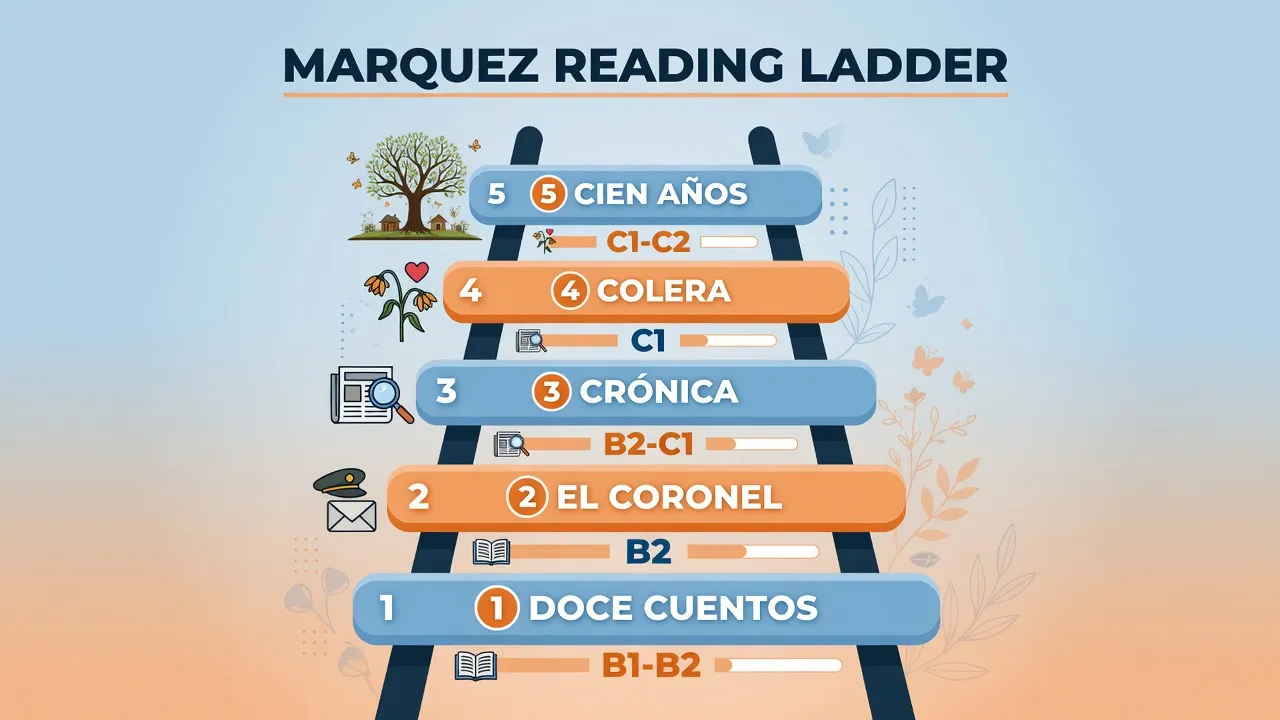
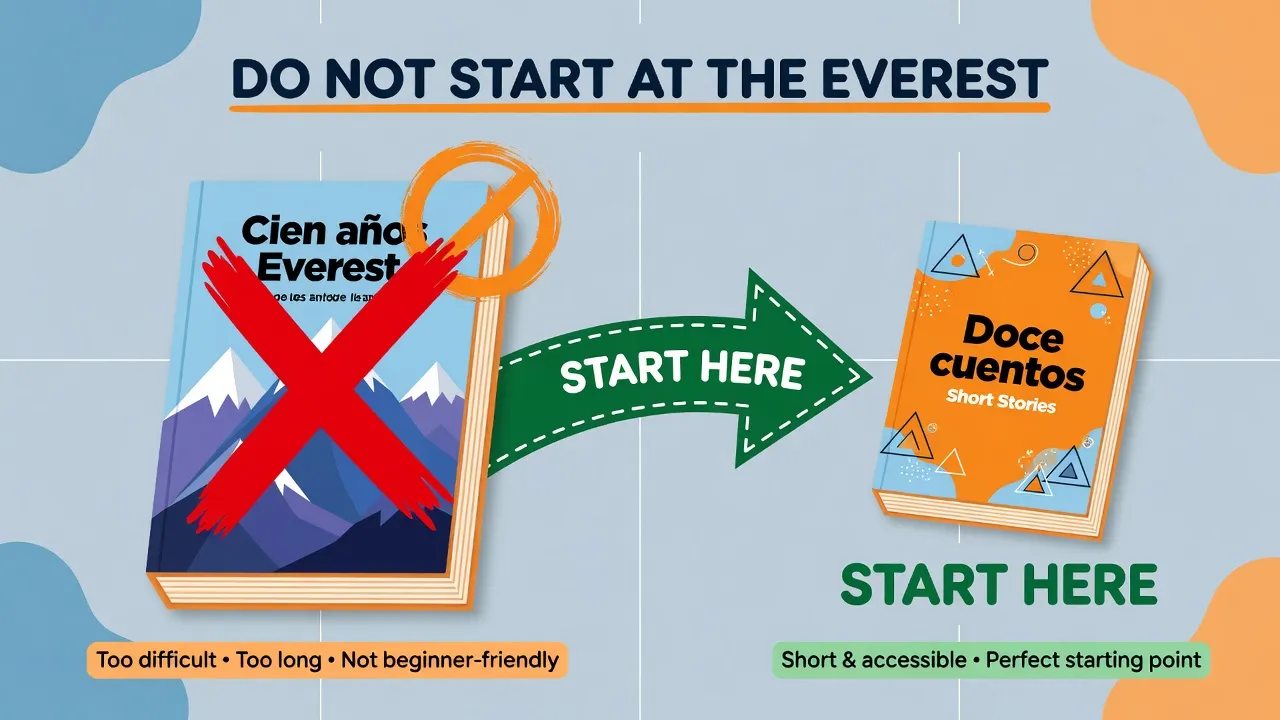
Short answer. Do not start Márquez with Cien años de soledad if Spanish is still B1-B2. Begin with Doce cuentos peregrinos (short stories, roughly B1-B2) or the short novel El coronel no tiene quien le escriba (about B2). Then Crónica de una muerte anunciada (B2-C1), then El amor en los tiempos del cólera (C1), and only later the Macondo Everest (C1-C2). Pick the step where you understand most of a random page without translating every word.
Here is the same ladder at a glance:
| Work | Level (soft) | Pages (approx) | Magical realism | Best for |
|---|---|---|---|---|
| Doce cuentos peregrinos | B1-B2 | ~270 (stories) | Moderate | First contact |
| El coronel no tiene quien le escriba | B2 | ~90 | Minimal | First short novel |
| Crónica de una muerte anunciada | B2-C1 | ~120 | Low | Structure and reread |
| El amor en los tiempos del cólera | C1 | ~350 | Medium | Long immersion |
| Cien años de soledad | C1-C2 | ~420 | Maximum | After easier wins |
Buy or borrow a legal edition first. If solid B1 still feels thin for Gabo, warm up on free graded Spanish in all articles, then come back.
Why read Márquez in Spanish (not only translation)
Good translations of García Márquez exist. They still lose things you came for if Spanish is the language you are training.
Rhythm. His long sentences are not padding. They rise, pause, and land like a piece of music. English can retell the plot. It rarely keeps the same breath.
Time and verbs. Spanish past layers (pretérito, imperfecto, pluscuamperfecto, futures of the past) let him stack memory and destiny in one clause. That game is native to the Spanish page.
Colombian color. Words like mariposas amarillas, aguacero, hamaca, and coastal speech flavors carry place. Glossaries help. The texture still lives in Spanish.
The famous first line of Cien años de soledad is a good example of why the original matters - and a bad first homework assignment if you are still building confidence:
«Muchos años después, frente al pelotón de fusilamiento, el coronel Aureliano Buendía había de recordar aquella tarde remota en que su padre lo llevó a conocer el hielo.»
Three times at once. One name you must keep. Ice as wonder. Keep that sentence as a north star for later. Do not make it your day-one mountain.
The trap: word-by-word dictionaries on metaphors
When Márquez writes that someone llovía por dentro (literally "rained inside"), a word list returns rain plus inside. Useful for weather. Useless for the feeling on the page.
Metaphors here are not garnish. They are how the story speaks. Literal gloss after literal gloss can make you feel busy and still lost.
What actually helps:
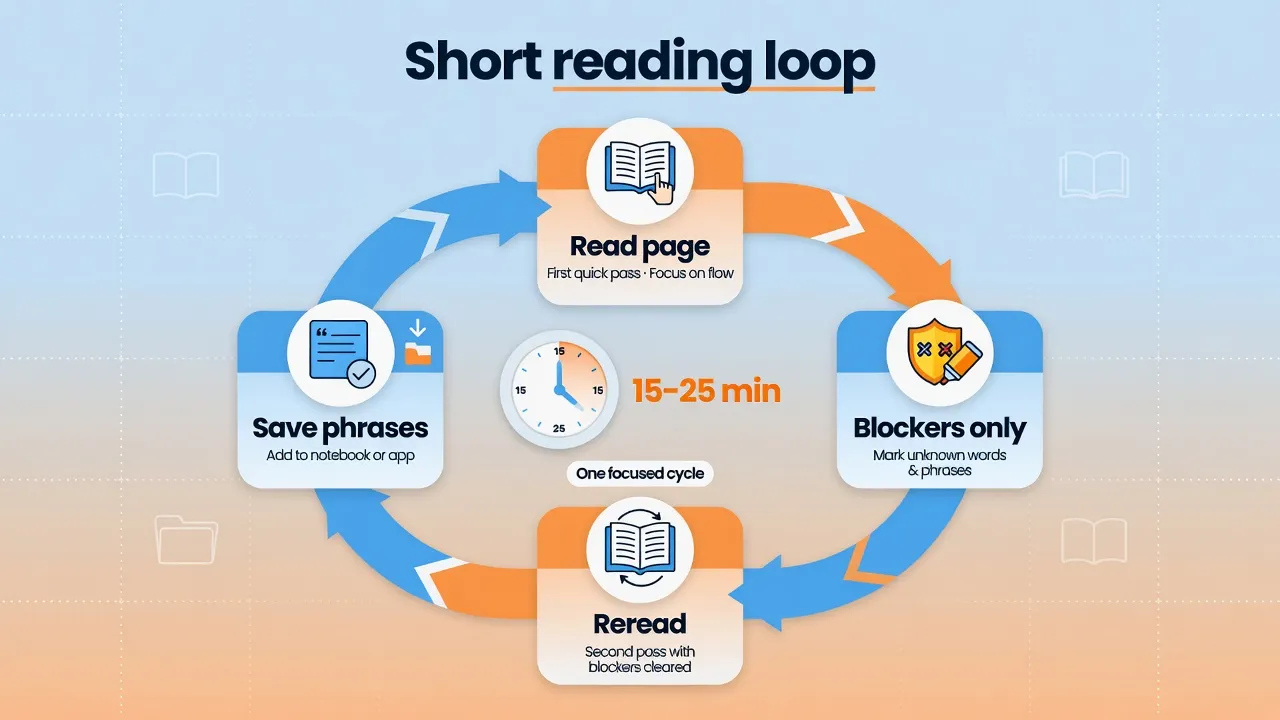
- Read a full paragraph once for shape before you look anything up.
- Guess from context. Then click only blockers (words that kill the sentence meaning).
- Reread the same stretch after one or two lookups.
- Save 3-10 phrases you want to reuse, not every adjective.
A reader tool can speed lookups and keep phrases next to the line you were reading. Understanding still comes from rereading, not from a single perfect gloss.
If you want to feel the click-and-practice loop before you open a novel, try Spanish phrases practice and Spanish typing practice.
Difficulty ladder: five steps from short stories to Macondo
This is a learner difficulty order, not publication order and not a "greatest hits" shelf. Many English-reader guides push fame first. For original Spanish practice, short forms and clearer sentences first usually win.
Level 1: Doce cuentos peregrinos - start here for most
Difficulty: B1-B2 | Stories | ~270 pages total
English title you may see: Strange Pilgrims. Twelve self-contained stories. European settings for many pieces, which means fewer dense local realia than full Macondo.
Why it is the softest entry:
- Each story is a complete session (often ~15-25 pages). You get a finish line.
- Syntax is often tighter than the long novels.
- Magical moments appear, but not as a 400-page storm.
Starter picks inside the book:
- Buen viaje, señor presidente - often the most accessible.
- Me alquilo para soñar - short and magical.
- El avión de la bella durmiente - more realistic, fewer heavy metaphors.
«La mujer soñó que entraba en un cuarto vacío y encontraba a un recién nacido envuelto en periódicos.»
Grammatically plain. Image still strong. That balance is why this collection works as first contact.
Watch for: story-to-story vocabulary resets. You will meet new sets of nouns. That is fine - you are training stamina, not one continuous cast list.
Tip: finish one story before you judge the whole book. A weak session on story three does not cancel a good session on story one.
Level 2: El coronel no tiene quien le escriba - first short novel
Difficulty: B2 | Short novel | ~90 pages
An old colonel waits for a pension letter that never arrives. Almost no magical realism. Social pressure, poverty, and a household that runs on coffee spoons and hope.
Why it is a strong second step:
- Short enough for a weekend if sessions are steady.
- Repeated everyday vocabulary on purpose (the life is circular; the lexis is too).
- Minimal "what is real?" fog - you can track plot without decoding rain of flowers every page.
«El coronel destapó el tarro del café y comprobó que no había más de una cucharadita.»
Plain domestic detail. In context it is not about coffee. It is about scarcity.
Watch for: quiet dialogue and understatement. If you skip too many lines because "nothing is happening," you miss the point.
Tip: read for mood and repeated objects (café, gallo, carta, plata). Save household phrases you will actually reuse.
Level 3: Crónica de una muerte anunciada - structure masterclass
Difficulty: B2-C1 | Novella | ~120 pages
You know the murder is coming. The book is not a who-done-it so much as a how-everyone-let-it-happen. Journalistic clarity, circular retellings, honor culture, and community voice.
Why it sits in the middle of the ladder:
- Language is often cleaner and more report-like than the big novels.
- The same events return from new angles - vocabulary recycles with new light.
- Plot momentum is high, so sessions feel short even when the Spanish is dense.
«El día en que lo iban a matar, Santiago Nasar se levantó a las 5.30 de la mañana para esperar el buque en que llegaba el obispo.»
Lo iban a matar treats the killing like a calendar fact. Grammar is narrative pressure, not a drill.
Watch for: names, rumors, and who said what. Keep a tiny cast list on paper if you mix speakers.
Tip: many learners and guides recommend Crónica as the first full Márquez for B1-B2. Fair advice if you want a short novel with pull. This page still puts Doce and Coronel first when you care about short sessions and softer entry. Prefer the "first full novella" angle? See our guide which Márquez book to read first in Spanish.
Level 4: El amor en los tiempos del cólera - long immersion
Difficulty: C1 | Novel | ~350 pages
A love story stretched across decades. Lush description. Medicine, boats, cities, food, bodies, waiting. English title: Love in the Time of Cholera.
Why it belongs after the short works:
- Vocabulary range is huge. You will not know every domain word. You do not need to.
- Sentence length and emotional texture rise. Stamina matters as much as grammar.
- Medium dose of the Márquez "more than realism" feel without full Macondo genealogy chaos.
«Era inevitable: el olor de las almendras amargas le recordaba siempre el destino de los amores contrariados.»
Bitter almonds, cyanide, thwarted love - layers in one smell. Save the whole sentence if it hits you. Do not pause twenty times on every modifier in the next paragraph.
Watch for: long stretches of setting. Skim once for place, then reread a key paragraph if you care about craft.
Tip: treat this as a multi-week project. 15-25 minutes a day beats a heroic Sunday that ends in quit.
Level 5: Cien años de soledad - Everest, last
Difficulty: C1-C2 | Novel | ~420 pages
The Buendía family. Macondo. Rain of flowers, insomnia plague, names that return generation after generation. Maximum magical realism. Maximum name chaos.
Why it is last for learners:
- Dozens of characters with recycled names (Aureliano, José Arcadio, Remedios…).
- Sentence monsters. Some run like paragraphs.
- Reality and miracle share the same calm tone, so "literal vs symbolic" is always in play.
Watch for: family trees and time jumps. A simple list of who is whose child saves hours of reread panic.
Tip: arrive here after wins on the lower rungs. Courage is useful. Habit is better. If a random page still forces a lookup every line, step down - that is strategy, not defeat.
Comparison table again (simple to Everest)
Same spine, scannable when you only need a reminder:
| Work | Level | Pages | Magic | Best for |
|---|---|---|---|---|
| Doce cuentos peregrinos | B1-B2 | ~270 | Moderate | First contact |
| El coronel no tiene quien le escriba | B2 | ~90 | Minimal | First novel |
| Crónica de una muerte anunciada | B2-C1 | ~120 | Low | Structure / reread |
| El amor en los tiempos del cólera | C1 | ~350 | Medium | Long immersion |
| Cien años de soledad | C1-C2 | ~420 | Maximum | After easier wins |
Page rule: open a random page. If you are mostly comfortable without constant lookup, stay. If you look up every line, step down the ladder - or warm up on free graded Spanish first.
How to read Márquez without burning out
Do not translate every word
Even native readers do not pin every image. Aim for scene sense: who does what, what changes, what the weather (or the town) is doing to people. Unknown adjectives can wait if the verb and object are clear.
Prefer short sessions
Fifteen to twenty-five minutes of real attention beats a rare marathon. Stop mid-chapter if your eyes glaze. Mark the line. Come back tomorrow.
Read a stretch aloud
His prose is meant to be heard. After a page you already understand roughly, read it aloud once. Listening after text (if you have audio for a legal edition) also helps rhythm stick.
Keep a small "Márquez lexicon"
A personal list of words he returns to: soledad, presagio, estirpe, diluvio, mariposas, destino, olvido. These are keys to his world. Practice a few saved phrases in phrase typing or type training so they stop feeling exotic.
If comprehension drops under ~70-80%, step down
That threshold is not science. It is a friendly signal. Frustration is not a badge. A finished Coronel teaches more Spanish than an abandoned Cien años on the shelf.
Optional: translation first for plot courage
Some learners read a translation of Crónica or Cólera first, then the Spanish. Fine for courage. Still treat the Spanish text as the language track when you practice. Do not live forever in bilingual parallel if your goal is reading Spanish cold.
A MovaReader reading path
MovaReader does not host commercial Márquez novels, so you read from your own legal copy.
What does help:
- Warm up on free graded Spanish if Gabo is still too hard - start from all articles. Sample Spanish pieces such as this A2-friendly text or another short Spanish sample if you want lighter sessions first.
- Buy, borrow, or otherwise obtain a legal EPUB you own. Then upload it - see how to use.
- Click blockers only, not every pretty adjective.
- Save 3-10 phrases per session and practice them in the demos above.
- Freemium: unlimited listening + about 20 word translations per day free. Reader €1 for unlimited translations when long sessions need more lookups. Pro €5/month for full trainers. Details on pricing.
If B1 still feels early for any Márquez, that is normal. Build flow on graded Spanish, then take rung 1 of the ladder.
FAQ
Which Márquez book should I start with in Spanish?
Most learners: Doce cuentos peregrinos. If you want a short novel with little magic: El coronel no tiene quien le escriba. Save Cien años de soledad for later. If you already know you like plot-forward novellas and solid B2, Crónica de una muerte anunciada is a popular first full work - just not the only good entry.
Can I start with Cien años de soledad?
Only if you are already comfortable at solid C1 with long sentences, many names, and dense description. Otherwise it becomes a quit test, not a reading habit. The book will still be there after Doce, Coronel, and Crónica.
Is B1 enough for original Spanish Márquez?
B1 can start short stories carefully - one tale at a time, lots of rereading. B2 is more realistic for El coronel or Crónica. Below that, free graded Spanish first, then return.
Should I read a translation first, then Spanish?
Optional for plot courage. Keep Spanish as the main track when the goal is language. A translation can lower fear. It should not replace the original forever if Spanish practice is the point.
How long should I read per day?
Fifteen to twenty-five minutes of focused reading beats rare three-hour attempts. Stop mid-chapter if needed. Consistency beats drama.
Is freemium enough for these books?
For short sessions, samples, listening, and about 20 word translations a day, freemium can work. Longer lookup-heavy sessions often need Reader €1. Full trainers are Pro €5/month. See pricing. Either way, you still need a legal copy of the novel.
What after El coronel or Crónica?
If Coronel felt comfortable, try Crónica next for structure and momentum. If Crónica felt easy, test a random page of Cólera. If that page is red (lookup every line), stay on short forms longer or reread a favorite Doce story for confidence.
Is this the same as "which Márquez first" for English readers?
No. Publisher lists often optimize for fame and English editions. This page is a difficulty ladder in original Spanish for learners. For a Crónica-first angle aimed at "first full novella," use our post which Márquez book to read first in Spanish.
Next step
Pick ladder step 1 (Doce cuentos) or step 2 (El coronel). If a random page is still red, warm up in all articles. When you own a legal EPUB, upload it via how to use, click only blockers, save a few phrases, and practice them. Macondo can wait until the lower rungs feel like reading - not decoding.
Keep reading with translations inside the text
With a free account, an unknown word translates with one tap, and the words you are learning wait for you in the trainer.
Free account: 7 days of Pro, then 20 word translations a day or a paid plan.