Reading Aloud vs. Silent Reading: The Counterintuitive Hack for Perfect Pronunciation
You've been reading in your target language for months. Your vocabulary is growing, your grammar intuition is sharpening, and you can follow complex plots without reaching for a dictionary every other sentence.
But then someone asks you to say something out loud — and the words come out mangled, hesitant, and nothing like the smooth sentences you've been reading in your head.
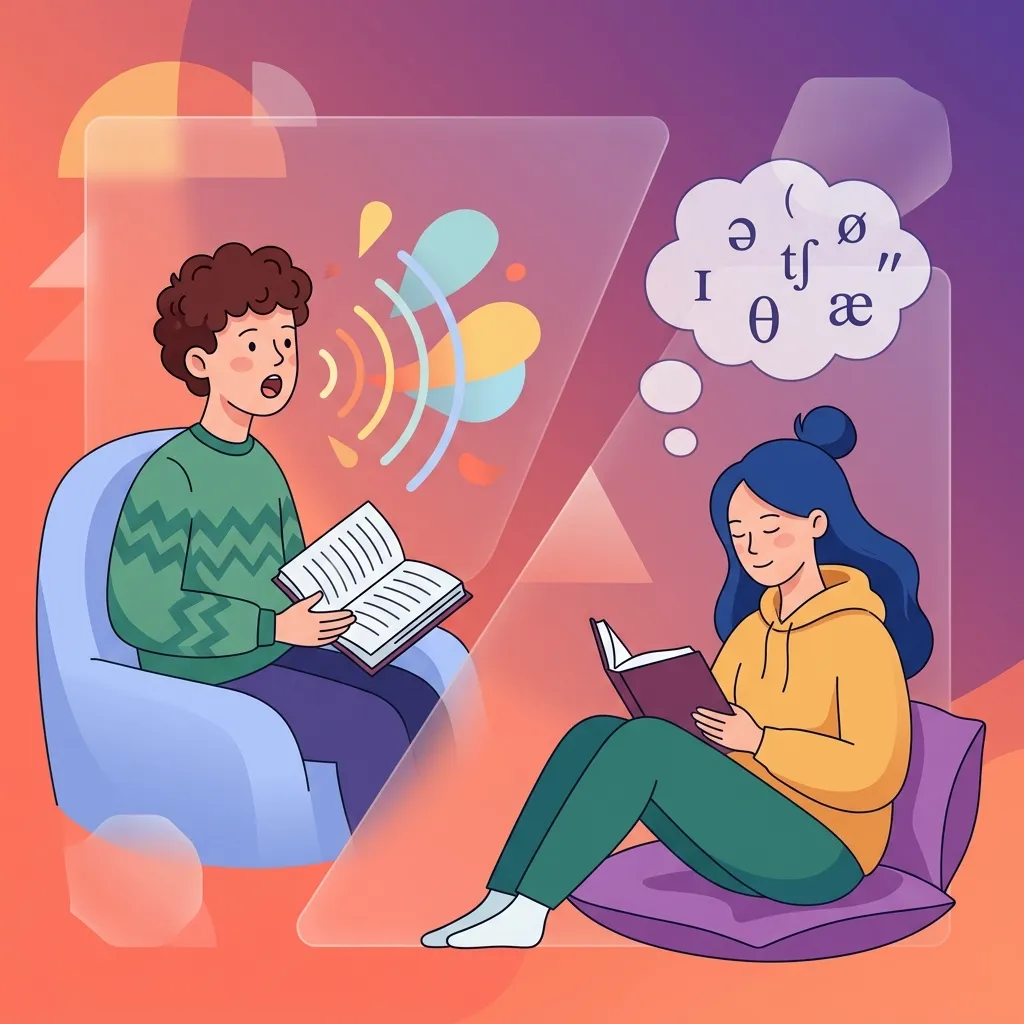
Sound familiar? You're not alone. There's a massive gap between reading comprehension and spoken fluency, and most learners never bridge it because they ignore one deceptively simple practice: reading aloud.
Why Silent Reading Creates a Pronunciation Blind Spot
When you read silently, your brain takes shortcuts. It doesn't process every syllable — it recognizes word shapes, skips over unfamiliar phonemes, and fills in the gaps with approximations from your native language.
This is efficient for comprehension. It's catastrophic for pronunciation.
Consider this sentence from a Spanish novel:
"El murmullo de las hojas se confundía con el susurro del río que serpenteaba entre las colinas."
When you read this silently, your brain registers meaning: leaves, river, hills. But did you mentally pronounce serpenteaba correctly? Did you roll the double r in murmullo? Did you nasalize the n in confundía before the d?
Almost certainly not. Your inner voice used English phonetic rules and moved on. After hundreds of pages of this, you've essentially practiced bad pronunciation thousands of times — reinforcing errors instead of correcting them.
The Science Behind Reading Aloud
Research from the University of Waterloo calls it the "production effect": words that are spoken aloud during learning are remembered significantly better than words that are only read silently. But the benefits go far beyond memory.
When you read aloud, you activate three neural pathways simultaneously:
- Visual processing — your eyes decode the text
- Motor production — your mouth, tongue, and vocal cords physically produce the sounds
- Auditory feedback — your ears hear what you just said and compare it to your internal model
This triple activation creates a feedback loop that silent reading simply cannot replicate. Your brain isn't just understanding the language — it's physically rehearsing it.
A 2019 study published in Memory & Cognition found that the production effect is even stronger in a second language, precisely because the phonetic patterns are less automatic and require more conscious processing.
The Problem With Reading Aloud on Your Own
Here's where most advice articles stop: "Just read aloud more!" And technically, they're right. But there's a critical flaw in this approach.
If you don't know how a word sounds, reading it aloud just reinforces your wrong pronunciation.
Imagine learning English and encountering the word "colonel" for the first time. You read it aloud as "kol-oh-nel" — and now that incorrect pronunciation is physically embedded in your muscle memory. You'd need to hear the correct version ("kernel") before reading aloud would actually help.
This is the paradox of reading aloud for language learners:
- You need to hear correct pronunciation before you speak
- But stopping to look up every word's pronunciation destroys your reading flow
- And losing flow kills motivation — which kills the habit entirely
What you actually need is a way to hear the correct pronunciation of entire sentences while you read, so you can shadow the native-like delivery in real time.
The Shadowing Technique: Where Reading Meets Speaking
Shadowing is a technique originally developed for training simultaneous interpreters at the United Nations. The concept is simple:
- Listen to a native speaker say a sentence
- Immediately repeat it, mimicking their rhythm, stress, and intonation
- Move to the next sentence
The power of shadowing lies in what it trains beyond individual sounds. When you shadow, you absorb:
- Prosody — the musical rise and fall of sentences
- Connected speech — how words blend together ("want to" → "wanna", "going to" → "gonna")
- Stress patterns — which syllables and words carry emphasis
- Natural pacing — the rhythm that makes you sound fluent rather than robotic
These are the elements that separate a B1 speaker from a C1 speaker, and no amount of grammar study or vocabulary flashcards will teach them. They can only be acquired through repeated auditory exposure combined with physical production.
The problem? Traditional shadowing requires separate audio materials — podcasts, audiobooks, YouTube videos. You're constantly switching between your reading material and your listening material, which fragments your practice and reduces both comprehension and pronunciation gains.

How MovaReader Turns Every Page Into a Speaking Class
This is exactly the problem MovaReader's premium Text-to-Speech sync was designed to solve.
Here's how it works: you upload any EPUB book to MovaReader and open it. With the TTS feature, you can have the AI narrator read any sentence or paragraph aloud — using natural, high-quality pronunciation that captures the rhythm and intonation of a native speaker.
But unlike a standard audiobook, you're not just passively listening. You're reading the text simultaneously and can pause, rewind, and shadow specific sentences as many times as you need.
The workflow is dead simple:
- Read a paragraph silently first to understand the meaning
- Tap the TTS button to hear the AI narrator deliver the sentence
- Shadow the narrator — repeat the sentence out loud, matching their pacing and intonation
- Move to the next paragraph and repeat
This transforms a 20-minute reading session into a 20-minute pronunciation drill — without any of the tedium associated with traditional pronunciation exercises. You're not repeating random sentences from a textbook. You're practicing with sentences from a story you're genuinely engaged in.
Five Practical Exercises to Maximize Your Reading-Aloud Sessions
Here are specific drills you can do with any book in MovaReader to accelerate your pronunciation gains:
1. The Echo Drill
Listen to the TTS narrator read one sentence. Wait two seconds. Then repeat the entire sentence from memory, focusing on matching the exact intonation. This trains your auditory memory and forces you to internalize the sentence's melody, not just its words.
2. The Speed Match
Read a paragraph aloud at your natural pace. Then listen to the TTS narrator read the same paragraph. Notice where you paused that a native speaker wouldn't, and where you rushed through syllables that deserve emphasis. Re-read the paragraph, adjusting your speed to match.
3. The Whisper Technique
Shadow the narrator at a whisper. This might sound counterintuitive, but whispering forces you to focus on mouth position and airflow rather than volume. It's particularly effective for mastering sounds that don't exist in your native language — like the Spanish "rr", the French "r", or the English "th".
4. The Emotion Copy
Choose a dialogue scene from your book. Listen to how the TTS narrator delivers each line, then read the same lines aloud with exaggerated emotional expression. This trains you to use prosody for meaning — something that textbook pronunciation drills completely ignore.
5. The Record and Compare
Read a passage aloud and record yourself on your phone. Then play the TTS narrator reading the same passage. Listen to both recordings back-to-back. The differences will be immediately obvious — and surprisingly specific. You'll notice exactly which sounds and stress patterns need work.
Silent Reading Still Has Its Place
Let's be clear: this isn't an argument against silent reading. Silent reading is essential for building vocabulary, developing grammatical intuition, and maintaining the high-volume input that Krashen's comprehensible input hypothesis tells us is crucial for acquisition.
The optimal strategy uses both:
- Silent reading for volume and comprehension (your daily 15-30 minute reading session)
- Read-aloud sessions for pronunciation and fluency (10-15 minutes, 3-4 times per week)
The key insight is that these don't have to be separate activities with separate materials. With MovaReader, you can seamlessly switch between silent reading and TTS-assisted shadowing within the same book, on the same page, in the same session.
The Compound Effect: What Happens After 30 Days
Most learners who start reading aloud with a model to shadow report noticeable changes within two to four weeks:
- Week 1-2: You start hearing your own errors. Your ears become more attuned to the gap between your pronunciation and the model. This feels uncomfortable but is actually the first sign of progress.
- Week 2-3: Certain common words and phrases start "clicking." You no longer have to think about how to pronounce "environment" or "desarrollo" — the correct pattern is becoming automatic.
- Week 3-4: People start commenting that your accent has improved. You notice yourself using natural connected speech patterns ("would have" → "would've") without conscious effort.
The reason this works is motor learning: pronunciation is fundamentally a physical skill, like playing piano or riding a bicycle. You can't learn it by reading about it. You have to do it — repeatedly, with feedback, and with a correct model to compare against.
Why Most Pronunciation Apps Get This Wrong
Most pronunciation apps isolate words from context. You repeat "through," "thorough," "though" a hundred times and feel like you've practiced. But when those words appear in natural speech — embedded in real sentences, at native speed, with connected speech patterns — you stumble.
The advantage of reading aloud with MovaReader is that you're practicing pronunciation in context, at sentence level, with material you care about. The sentences come from real books. The vocabulary is relevant to your interests. And the TTS narrator delivers them with the natural rhythm and connected speech patterns you need to absorb.
This is the difference between practicing scales and playing actual music. Both are valuable, but only one makes you a musician.
Your Next Step: The Reading Aloud Challenge
Here's a concrete challenge to put this into practice:
- Open a book in MovaReader that you're currently reading or want to start
- Find a chapter you've already read silently (so you understand the content)
- Turn on the TTS feature and shadow the narrator for just 5 minutes
- Do this every day for one week
Five minutes. That's it. If you find yourself going longer because you're enjoying it — even better.
After one week, record yourself reading a passage from the book without the TTS narrator. Then compare it to how you sounded before you started. The difference will convince you better than any article ever could.
Traditional language courses charge hundreds of dollars for pronunciation coaching. Accent reduction programs cost even more. But the reality is that the most effective pronunciation practice happens when you combine reading — something you should already be doing — with systematic speaking practice.
MovaReader's Premium plan (€5/month) gives you unlimited access to the TTS sync feature, turning every book into your personal pronunciation coach. Combined with the AI-powered smart dictionary and phrase training tools, it's the most cost-effective path to not just understanding a language, but actually sounding like you speak it.
Start with the basics at €1/month, or unlock the full speaking-class experience with Premium. Either way, stop reading in silence when your pronunciation is begging you to speak up.
Learn languages by reading!
Try MovaReader for just €1 — read texts with instant translation and interactive vocabulary training.
Try for €1