Grammar in Context
Why Grammar Drills Fail to Transfer - and How Reading Builds Usable Patterns
Drills train test-taking. Reading trains pattern recognition under real meaning. Here is the practical shift, with four reading traps and a 30-day plan.
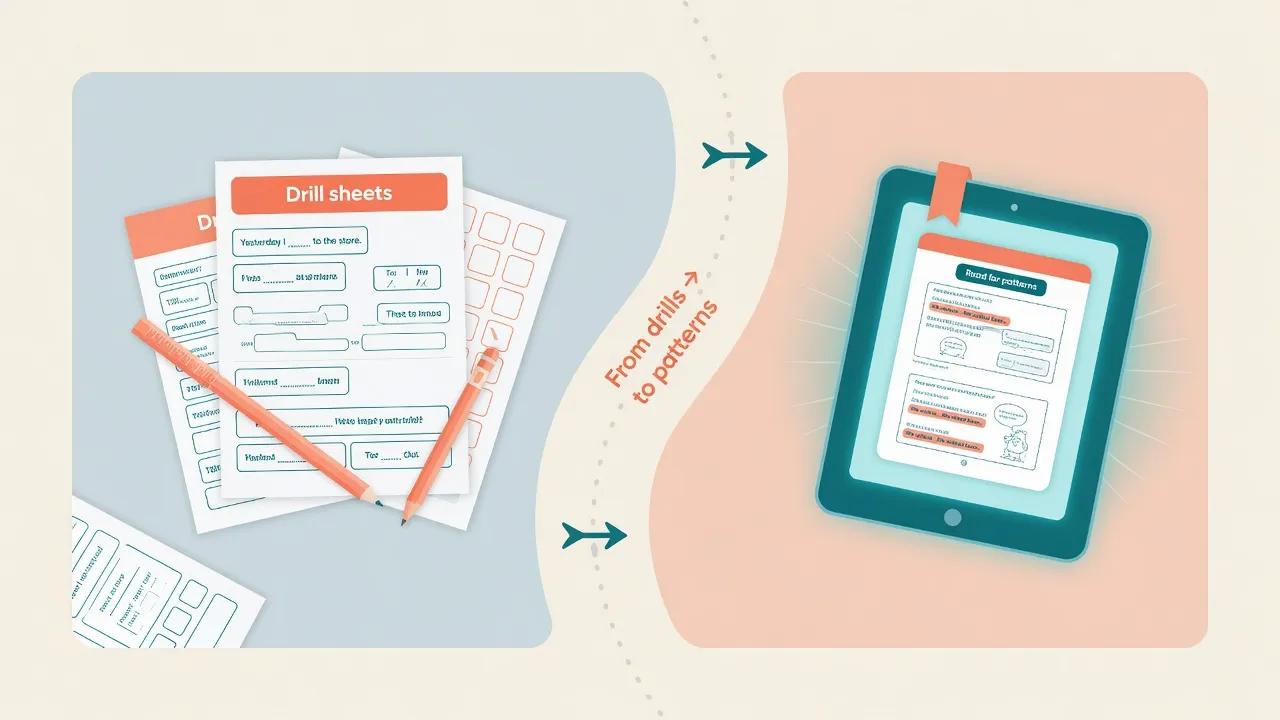
You finished the worksheets. Past Simple versus Past Continuous until your eyes glazed over. You can still recite the third conditional on paper. Then you open your mouth - and the rule is gone.
That is not laziness. It is often a mismatch between what drills train and what real-time language needs. You got good at the sheet. Conversation does not wait for the sheet.
The short answer: Grammar drills and gap-fills mostly train slow, conscious checking - great for tests, weak for real-time speech. Usable grammar grows when you meet forms inside meaning: lots of reading you mostly understand, plus light review of phrases that matter. Rules still help as a map after you have seen the pattern - not as the whole diet.
Below: what drills actually train, why many exercises feel like Sudoku, how reading builds patterns under meaning, what research supports without slogans, four traps when reading still fails, a practical 30-day detox, where rules still fit, why school rewards scores, a realistic learner arc, and how MovaReader can support the shift.
What drills train (and what they do not)
Fill-in-the-blank grammar mostly activates conscious, analytical problem-solving. You spot the time marker. You retrieve the rule. You write the form. You feel productive.
Speaking and fast listening lean on something else: fast, automatic control under meaning. Closer to riding a bike than filling a tax form.
Two plain labels help early, then we can keep them short:
| Label | Plain meaning |
|---|---|
| Explicit / test grammar | Slow, conscious rule check (time marker → rule → form) |
| Procedural / ready grammar | Fast automatic feel under meaning (bike, not tax form) |
Stephen Krashen put the contrast bluntly: you can learn about grammar and still fail to use it under time pressure. Acquisition and conscious study are not the same path. For the full hypothesis map, see our note on comprehensible input and Krashen's framework - here we only need the practical bite: knowing a rule on paper is not the same skill as firing the form while meaning moves.
What the worksheet trains is not what the conversation demands:
| Drill session | Conversation or fast reading |
|---|---|
| Time to think | Little or no time |
| One gap, one rule | Many choices at once |
| Clear "right answer" | Approximations and repair |
| Explicit memory | Implicit pattern feel |
Here is that contrast as a board: slow test grammar on one side, ready grammar under pressure on the other.
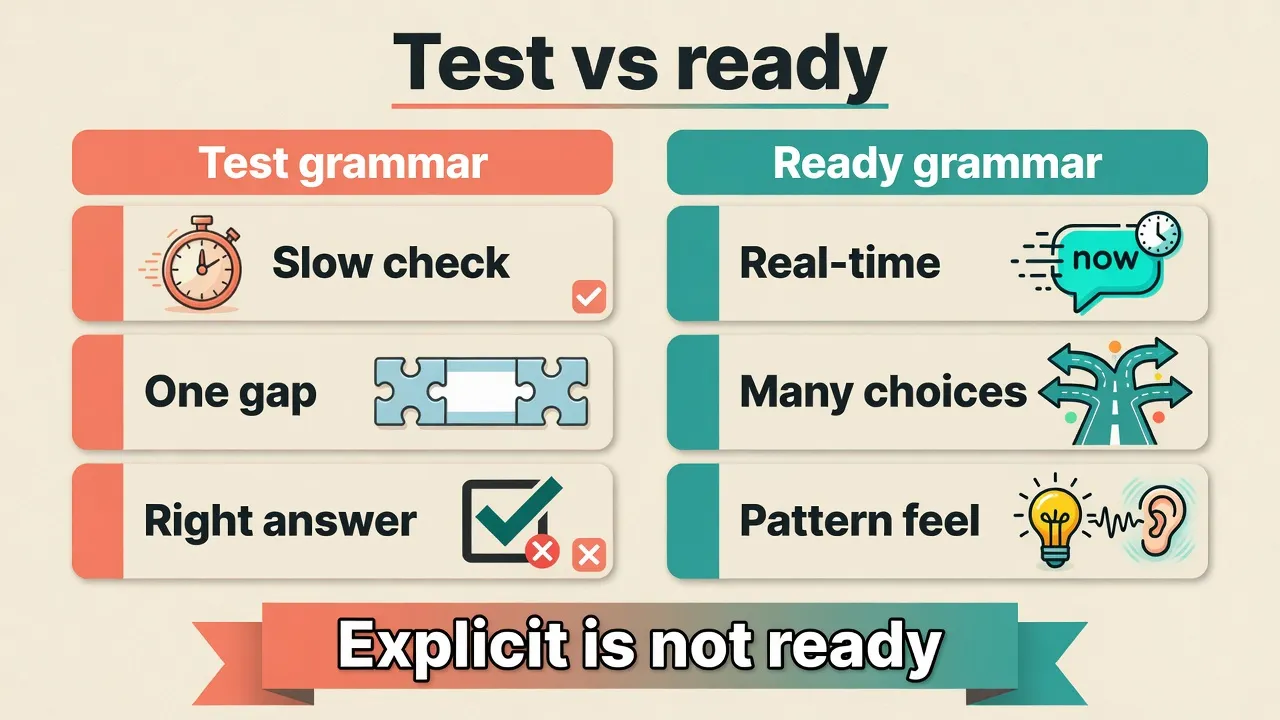
A high score on discrete-point tests can sit next to freeze in use. Teachers and researchers sometimes call that inert knowledge - knowledge that exists for the quiz but does not show up when you need it. In plain words: the answer is in your head for the blank, not in your mouth for the story.
So the sticky line is simple. Test grammar ≠ ready grammar. Scoring a blank is not the same skill as using the form while meaning is moving.
That is also why grammar drills fail so often for real-time use. Not because "grammar is useless." Because the training loop and the use loop are different.
Why your brain treats many exercises like Sudoku
Many exercises feel productive because they are puzzles. You are smart. You like solving them. That feeling is real - and still incomplete.
Typical item:
She ___ (go) to the store yesterday.
You reason: yesterday → past → went. Correct. Productive feeling. File under "I can figure this out if I slow down."
What often did not happen:
- hearing the form in fluent speech
- linking it to a story you care about
- producing it while planning the next idea
- seeing nearby variants in context
You solved a Sudoku-style sheet. The speaking-speed system may not update. The form never had to ride on meaning. It only had to fit a gap with a time marker as a clue.
A light callback for later: if your study week is all puzzle sheets and almost no stories, you are training gap logic more than pattern feel. That is fine for exam format practice. It is a thin diet for usable English or Spanish in real time.
How reading builds grammar differently
Imagine this line in a thriller:
"If she had known what was waiting behind that door, she would never have turned the handle."
Most learners do not pause to label "third conditional." They understand regret and danger. Across dozens of similar lines in different books and articles, the shape if + had + past participle ... would have ... becomes familiar as meaning, not as a formula card.
That is closer to how first-language grammar grows: massive meaningful exposure, not workbook weeks alone. Adults are not children - you can use maps and notes - but the core engine is still form under meaning, repeated often enough to feel familiar.
Input-first polyglots notice the same thing from the other direction. People who live in large amounts of listening and reading often report that patterns "start to sound right" before they can recite the textbook name. Steve Kaufmann's public method is one named version of that habit: more input, less obsession with drilling every rule first. For a person-focused walkthrough, see Steve Kaufmann's method and why polyglots read. You do not need to copy anyone's brand. You need the mechanism: patterns inside stories you care about.
If you are learning Spanish with a full reading method in mind - graded path, volume, how to move levels - our complete method for learning Spanish by reading goes deeper. This article stays on the drill-transfer problem and the detox plan.
One caveat: reading is not a spell. If you only skim, always translate every sentence, or only read baby-easy text, acquisition stalls. Method matters. That is why the four traps section exists - not to scare you off reading, but to keep reading useful.
Phrase harvest helps too. When a structure keeps showing up (had been waiting, se espera que..., would have gone), save a few real lines. That bridges recognition toward production without turning every page into a worksheet. For vocab growth from the same habit, see how to build B1 vocabulary by reading.
What the research supports
Blogs love clean multipliers. Real applied linguistics is messier. Treat the next bullets as direction, not a clinical guarantee.
What often shows up as supportive:
- Free voluntary / extensive reading frequently correlates with gains in vocabulary, writing, and sometimes measured grammar - especially versus no input at all.
- Learners who read graded or compelling texts can match or beat traditional instruction on some grammar measures in some studies. Results vary by design, hours, and tests used.
- Acceptability intuitions (what "sounds right") often grow with exposure more than with decontextualized drills alone.
What research does not cleanly support:
- "Reading replaces every exercise for every learner with 5x speed"
- "Never look at a grammar note again"
- "One app feature rewires your grammar in 30 days"
So: extensive reading is a strong bet for pattern feel and vocabulary. It is not a magic substitute for every goal. Exam format still needs exam practice. Stubborn high-value problems may still need a short, targeted drill. The win is shifting the default diet from gap-fills toward meaning-first input - not banning maps forever.
If you want the full theory stack (i+1, acquisition vs learning, limits), use the Krashen handoff linked above. Here we stay practical: why grammar drills fail to transfer, and what to do next week.
"I already read and still make mistakes" - four traps
If you already read and still stall, it is usually method - not proof that "reading is useless." Check these four first.
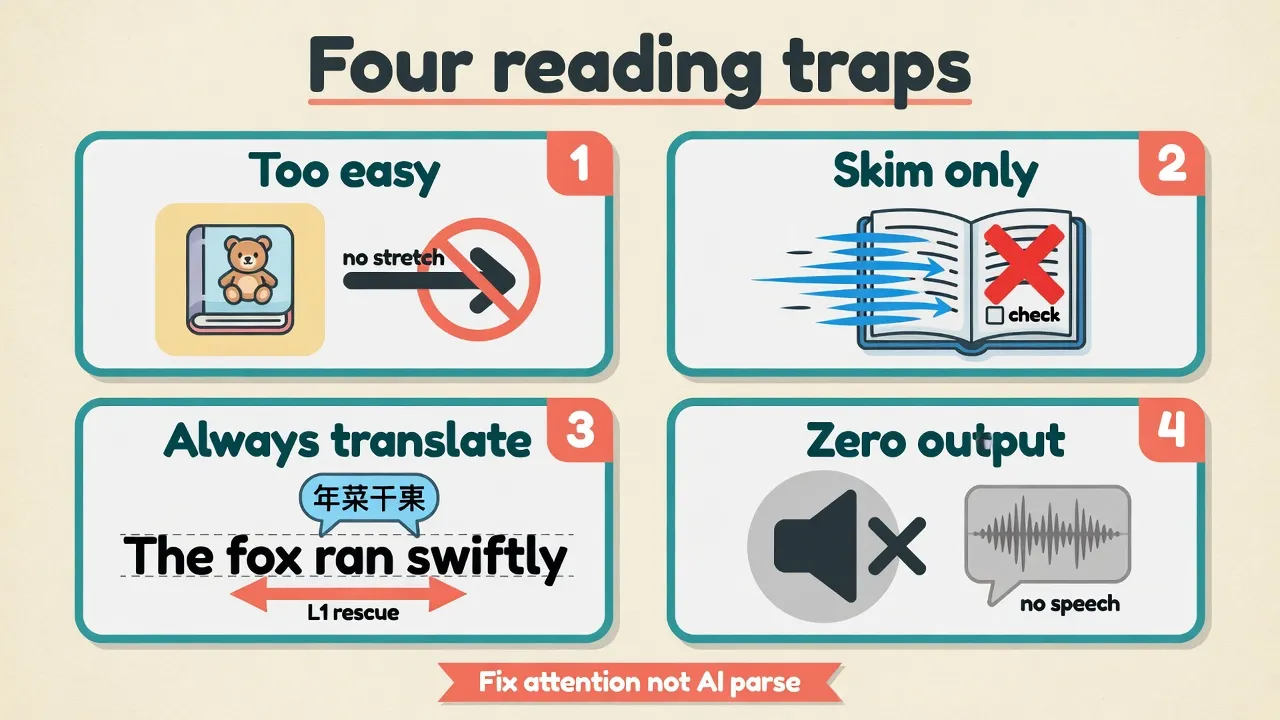
Trap 1: Text too easy
If nothing is slightly beyond you, you rarely meet new structures. Aim for mostly comfortable pages with occasional stretch sentences. Krashen's i+1 is a rough heuristic here, not a lab measurement you can score at home. If every page feels like a children's board book, step up a little.
Trap 2: Skimming without processing
Speed-running pages without reconstructing meaning gives your brain little grammar to log. You "finished" the chapter. You could not retell the paragraph. Use short checkpoints: What happened in this paragraph? If you cannot answer, slow down for that stretch - then resume easier pages.
Trap 3: Instant full-sentence translation every time
Occasional translation is fine. Constant L1 rescue can block direct form-meaning links. Prefer: guess → check the blocker word or phrase only → reread in the target language. You are training English or Spanish parsing, not a translation race.
Trap 4: Zero output loop
Reading builds recognition first. If you never write or speak, production lags. Add a tiny output step: rewrite one sentence, type a saved phrase, summarize aloud for 60 seconds. Recognition is not failure - it is step one. Step two is a small, regular output snack.
None of these traps need an AI that draws a visual parse of every line. They need attention and good level choice. Fix the method before you blame the medium.
A practical 30-day grammar detox
This is a shift away from workbook dependency - think diet change, not miracle cure. The plan is a detox: less empty gap time, more meaning-first input, light phrase work, then a transfer check.
Here is the loop in one picture: read, notice the pattern, practice a small phrase, optional light rule - then check transfer after a month.
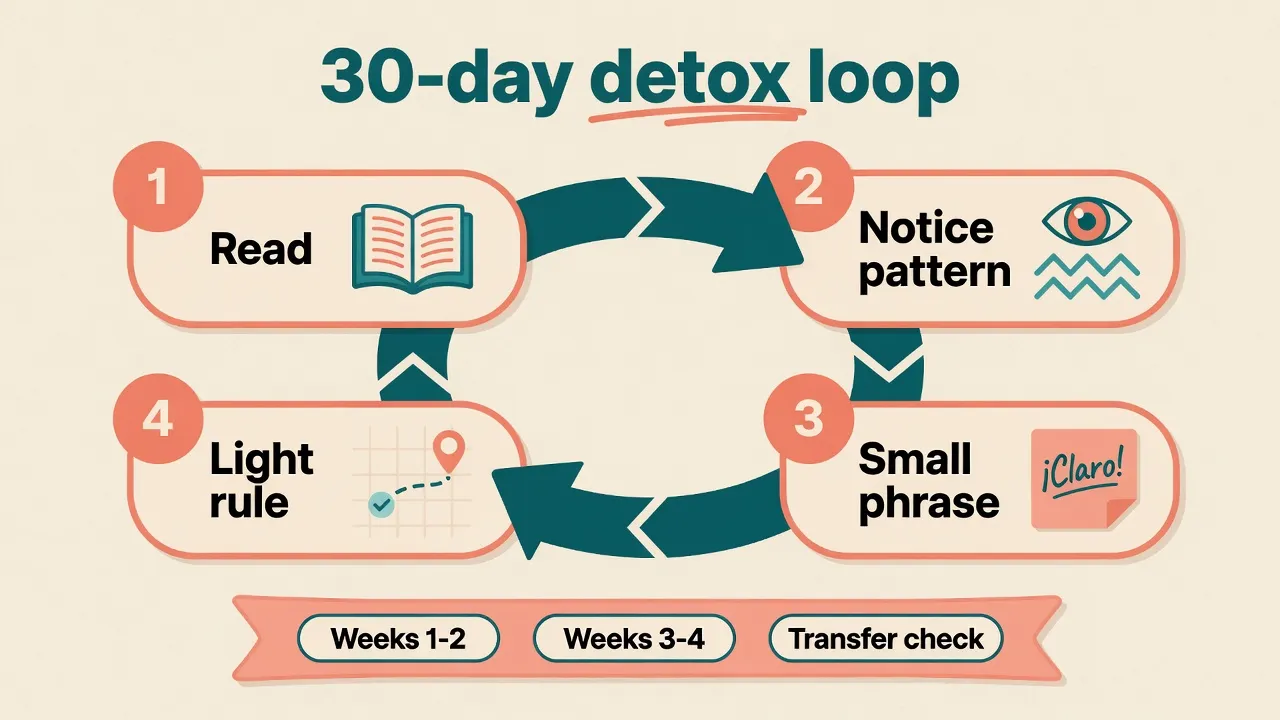
| Phase | Focus | Concrete actions |
|---|---|---|
| Weeks 1-2 | Half drill time → reading | 20 min/day; blockers only; ≤10 phrases/week; optional 5-min note after 3 sightings |
| Weeks 3-4 | Deeper input + light output | 30 min most days; notice recurrence; 5-8 line snack or phrase typing |
| After 30 | Transfer check | 2-min speak + short timed write; note what moved / still stalls |
Weeks 1-2: Replace half your drill time
- Pick one readable source: graded articles, a simple novel you own, or short stories at your level.
- Aim for about 20 minutes a day of reading.
- When a complex sentence blocks you: reread, find subject and verb, check only blocking words.
- Optional: one 5-minute grammar note after you have seen a pattern about three times - not before.
- Save ≤10 phrases per week that contain useful structures (had been waiting, se espera que..., would have gone).
Try free level-sensible samples:
Weeks 3-4: Deepen without workbook addiction
- About 30 minutes of reading most days.
- Notice recurrence: "I have seen this shape before." That recognition is learning.
- Output snack: write 5-8 lines about what you read, or type saved phrases. Free demos: word typing, phrase typing. Later you can keep phrases in Phrases.
- Keep one thin grammar reference for emergencies - a map, not a daily prison.
After 30 days: check transfer, not a publisher test
- Speak about two minutes about the book or article. Record once.
- Write a short paragraph under mild time pressure.
- Ask: did any "worksheet-only" forms appear more easily? Where do you still stall?
- Expect uneven progress. That is normal for implicit learning.
This transfer check is diagnostic. You are looking for movement: forms that used to live only on worksheets starting to show up when you care about the story.
Do grammar rules still have a place?
Yes - as a map, not the territory.
A balanced order for adult self-learners:
- Meet the structure in meaning-first input many times
- Brief explanation when you are curious or stuck
- Return to input (and a little output) immediately
School systems often reverse this: rule first, hope transfer happens. Gap-fills are easy to grade. Your goal is not a grade book; it is usable language.
If you care more about tests as a false progress scoreboard - scores that look good while speech stays stuck - that is a different angle. Our related post walks through why grammar tests are a weak progress metric and a softer "flashlight" view of rules.
School optimized for scoring, not always for acquisition
Discrete-point tests fit curricula, pacing guides, and ranking. Acquisition is messy and non-linear. That is logistics, not a conspiracy. Schools need scores they can compare. Your brain needs repeated meaningful meetings with structure.
Side by side: one path is built for ranking blanks; the other is built for messy, real use.
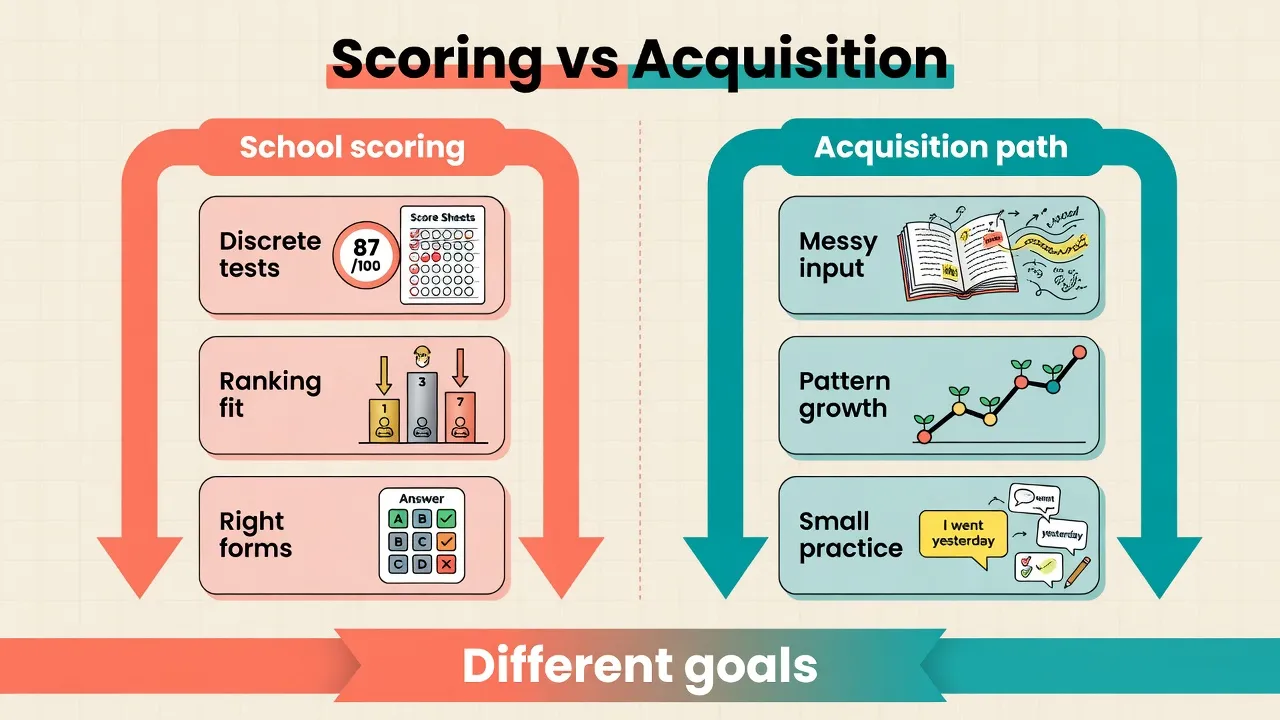
Once you leave the exam track - or once the exam is weeks away rather than tomorrow - you can reallocate hours toward:
- extensive reading
- listening to content you understand most of
- small deliberate practice on phrases you actually meet
Keep targeted drills only for stubborn, high-value problems (for example a preposition set you keep missing) or for exam-format rehearsal when you have a real deadline. The rest of the week can stop looking like endless blanks.
Sample learner arc
| Time | Realistic signal |
|---|---|
| Month 1 | Dictionary-heavy; complex sentences feel like puzzles |
| Month 3 | Some structures feel right before you can name them |
| Month 6+ | Occasional automatic use of forms you once only drilled |
Timelines vary by hours, language distance, and prior study. Anyone promising a fixed "compress to X weeks with our AI sentence breakdown" is selling certainty they cannot deliver. Progress often shows up as "that shape feels familiar" long before it shows up as a perfect monologue.
How MovaReader fits
MovaReader helps with supported reading and practice: free graded library, click-to-translate, unlimited listening, files you own, and trainers for phrases you actually met. That replaces many empty gaps for many learners because form rides on meaning.
What it offers:
- Graded article library - daily input at a saner difficulty (All articles).
- Click-to-translate - free plan: 20 word translations per day, unlimited listening. Reader (€1) for unlimited translations while reading. See pricing.
- Upload files you own (EPUB and similar). The app does not host full licensed commercial novels as free unlimited chapter buttons. How to use.
- Trainers / phrases - rehearse chunks you met in text. Full trainers on Pro (€5/mo). Paths: Trainers, Phrases, plus the demos linked in the detox weeks.
| Plan | What you get |
|---|---|
| Free plan | Free graded library + 20 word translations/day + unlimited listen |
| Reader €1 | Unlimited word translations while reading |
| Pro €5/mo | Full trainers |
A simple workflow:
- Read a graded text or your own file
- Checkpoint meaning every paragraph on hard pages
- Save a few structure-rich phrases
- Practice those phrases the next day
- Only then open a one-page grammar note if you are still confused
Optional: when you want a calmer view of which words you have been marking, open the language map - a compass for vocabulary volume.
Start soft: one graded text, three paragraph checkpoints, five saved phrases - practice those tomorrow instead of another empty gap-fill page.
FAQ
Should complete beginners skip all grammar?
Usually no. Absolute beginners need some scaffolding (pronouns, basic word order, present forms). Even then, tiny readable texts beat endless conjugation tables alone. Scaffold first, then grow with meaning-first pages as soon as you can.
Will reading fix my accuracy for exams like Cambridge or DELE?
Reading helps a lot for vocabulary and intuition. Exam packs still teach task format. Use both if you have a deadline; do not only drill. Reading builds the feel; timed practice builds the test habit.
What if I love grammar explanations?
Keep them. Read first when possible, then reward yourself with the explanation. Metalanguage-only diets fail. Enjoying the map is fine; living only in metalanguage is not.
How do I choose reading difficulty?
Rough rule: dictionary every sentence → step down. Never meet new patterns → step up slightly. Free library samples are a low-risk test (Spanish A1, Spanish A2, or the full graded library). Mostly comfortable with occasional stretch is the lane.
Is intensive reading (slow, analytic) allowed?
Yes. Alternate intensive work on one hard page with extensive easier pages. Pure intensity forever causes burnout; pure skimming forever causes shallow gains. For a deeper split of the two modes, see intensive vs extensive reading.
Can I use bilingual books?
Sometimes, as training wheels. If your eyes live in the L1 column, you are not training L2 grammar parsing. Prefer L2-first pages with lookup on demand (blocker words only).
Final takeaway
Grammar tests are good at producing test-takers. Reading, listening, and small output loops are better at producing users.
You do not need more gap-fill pages. You need:
- input you mostly understand
- attention to meaning
- repeated meetings with real structures
- light review of phrases that matter
Today: open one free article, run three paragraph checkpoints, save five phrases - then practice those phrases tomorrow instead of another gap-fill page. That is how you learn grammar patterns through reading without waiting for a perfect worksheet score to feel ready.
Keep reading with translations inside the text
With a free account, an unknown word translates with one tap, and the words you are learning wait for you in the trainer.
Free account: 7 days of Pro, then 20 word translations a day or a paid plan.