Grammar in Context
Spanish el/la Gender: Learn by Reading
Stop treating el and la as a pure -o/-a quiz. Learn each noun with its article, use ending tendencies as training wheels, fix classic exceptions (mapa, día, mano, el agua), then get volume through reading you mostly understand.
You build a clean Spanish sentence. Partner, app, or textbook pokes the one tiny piece you got wrong: el or la. Day one felt safe (el libro, la mesa). Then el problema, la mano, and el día showed up, and ending math alone stopped feeling enough.
That freeze is common. Spanish noun gender is not a pure spelling quiz. The fix is simpler than a wall of exceptions: stick the article to the noun, use ending patterns as soft maps, then meet those pairs again while you read.
Spanish gender is easier when you stop choosing el or la as a separate quiz. Learn article + noun as one chunk (el problema, la canción, la mesa). Ending patterns help as tendencies, not guarantees; a short exceptions list and the el agua case save headaches. Then get volume by noticing those chunks while you read Spanish you mostly understand. Rules train; exposure finishes the job.
Below: why the -o/-a rule fails early, the chunk habit, a hedged endings table, common exceptions, why el agua is still feminine, a light adjective note, a reading loop, honest freemium limits, and FAQ. Spanish el/la first throughout. (If you also study French elsewhere, same idea: learn le/la with the noun; this guide stays Spanish.)
Why the -o / -a rule fails early
Day-one simplification is fine: many words in -o are masculine, many in -a are feminine. You can start there. Everyday Spanish breaks that shortcut fast.
Looks feminine (-a) but often masculine
- el mapa (map)
- el día (day)
- el problema (problem)
- el sofá (sofa)
Looks masculine (-o) but feminine
- la mano (hand)
- la foto (photo)
- la radio (radio)
- la moto (motorbike)
Small map of the four definite forms you will see constantly:
| Singular | Plural | |
|---|---|---|
| Masculine | el | los |
| Feminine | la | las |
Indefinite un/una follows the same gender. For learning, keep the focus on el/la chunks. You need a better habit than pure ending math: chunks + tendencies + exposure.
Learn gender as article + noun chunks
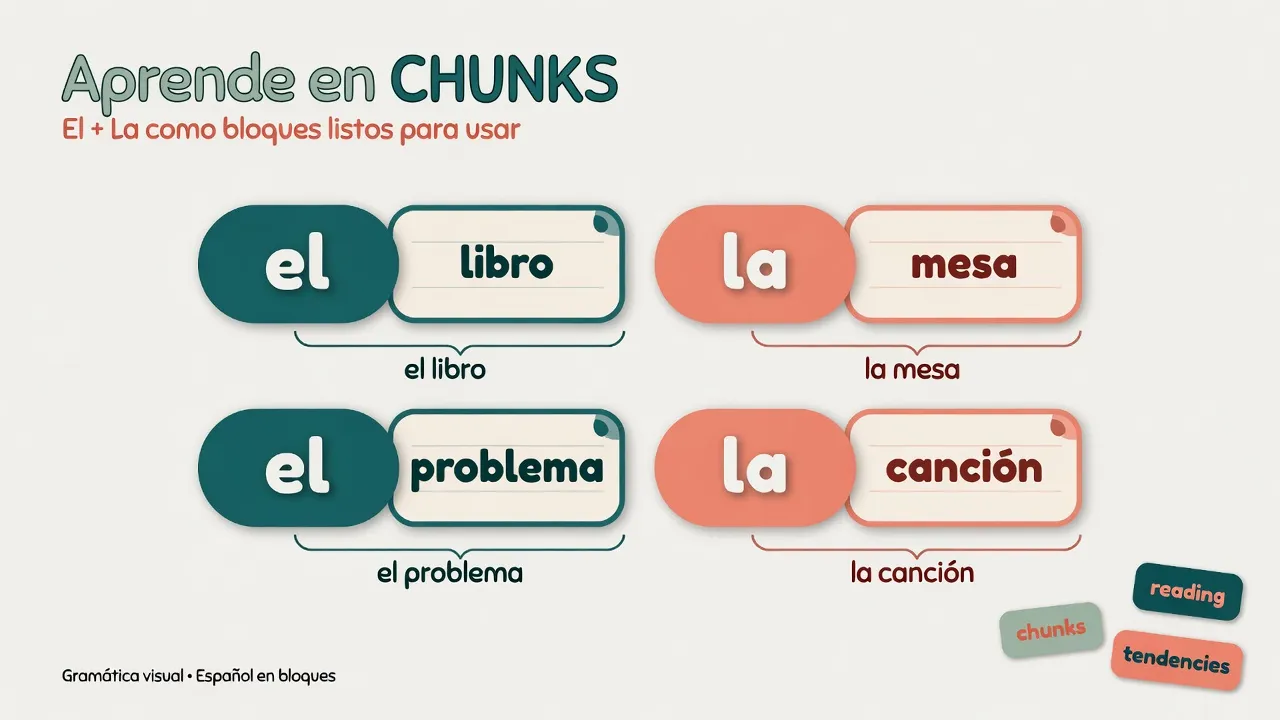
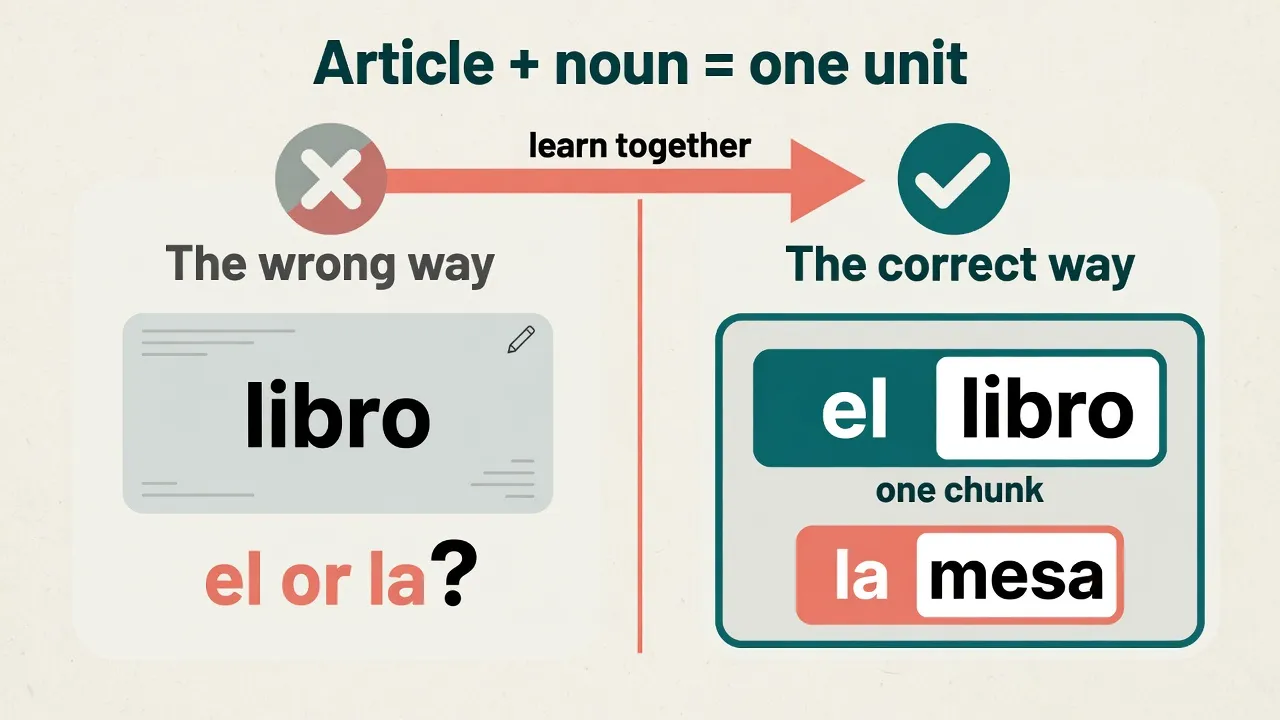
Study la mesa, not bare mesa. Study el río, not bare río. After many hits of la canción, the word canción starts to "bring" la with it. That fused unit is the whole method spine.
On flashcards and vocab lists, always include the article (or a short phrase). Bare mesa trains a hole; la mesa trains the pair. When you learn a new noun, say the chunk aloud once: el problema, la ciudad, el día.
Rules still matter. They are training wheels for sticky doubts. Chunks stop you freezing mid-sentence when the ending looks "wrong."
Here is the idea in one picture: article fused to the noun, not a bare-noun quiz.
Ending tendencies (training wheels, not laws)
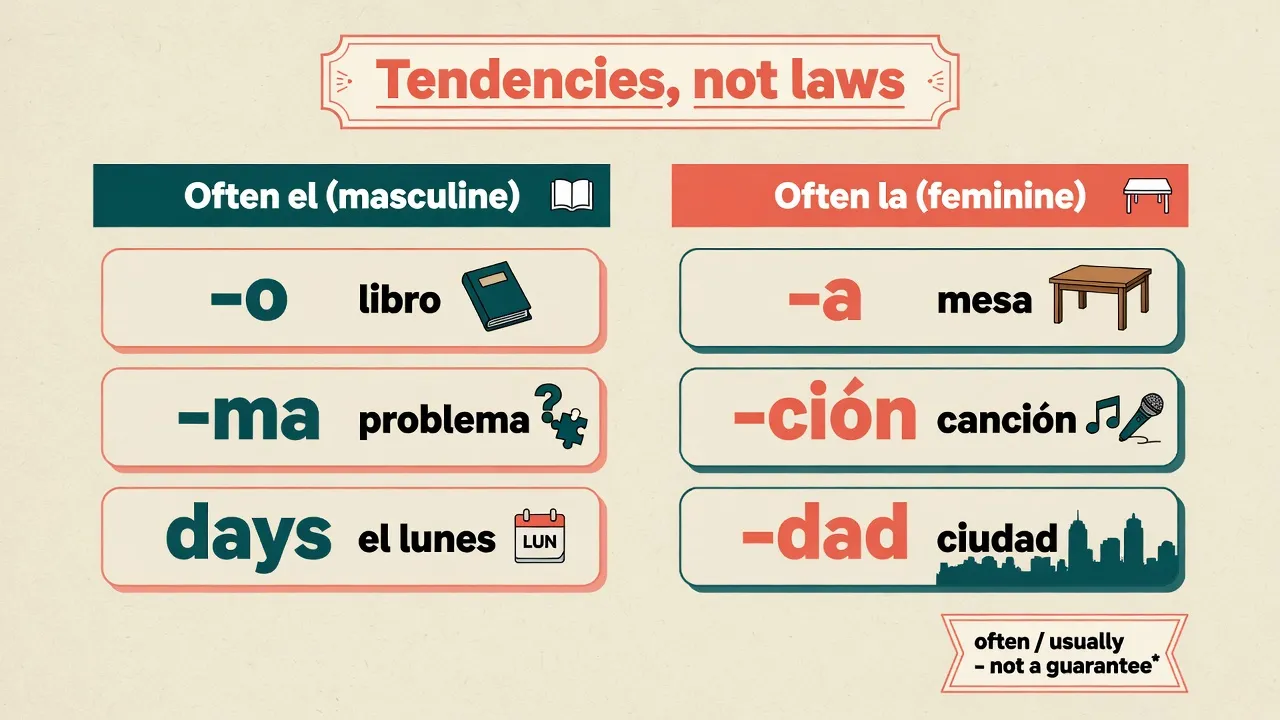
Use this as a map of tendencies you will also meet in texts - not as a court of law. Often, usually, almost always: those hedges are intentional. There is no honest fixed coverage percent that replaces noticing.
| Tendency | Often el / masculine | Often la / feminine | Hedge note |
|---|---|---|---|
| Classic | -o (libro, gato) | -a (mesa, casa) | Many exceptions (next section) |
| People | male form / default (el médico) | female form (la médica) when marked | Professions vary by speaker; learn with the article |
| Common fem. endings | - | -ción / -sión (canción, televisión), -dad / -tad (ciudad, libertad), -tud (juventud), -umbre (costumbre) | -ción almost always la - still not forever magic |
| Greek-ish -ma / -ema / -ama | often el (problema, sistema, tema, programa) | - | Looks feminine to English eyes; usually masculine |
| Other useful | days (el lunes), many rivers (el Tajo) | - | Light notes only; do not expand into an encyclopedia |
Your job is not to recite the grid. It is to recognize these shapes while reading and attach el or la.
Common exceptions you will meet early
Friendly list, not a shame list. When one of these appears in a text, save the whole chunk, not the bare word.
| Chunk | Why it surprises |
|---|---|
| el día | ends in -a, masculine |
| el mapa | ends in -a, masculine |
| el problema / el sistema / el tema | -ma often masculine |
| el sofá | stressed -á, masculine |
| la mano | ends in -o, feminine |
| la foto / la moto / la radio | shortened forms of feminine full words (fotografía, and so on) |
| el agua / el águila / el alma | still feminine nouns - next section |
A few words change meaning with gender (el capital / la capital; el cura / la cura). Learn those as pairs when you meet them. Do not derail the whole habit for a dual-meaning deep dive.
Why el agua is still feminine
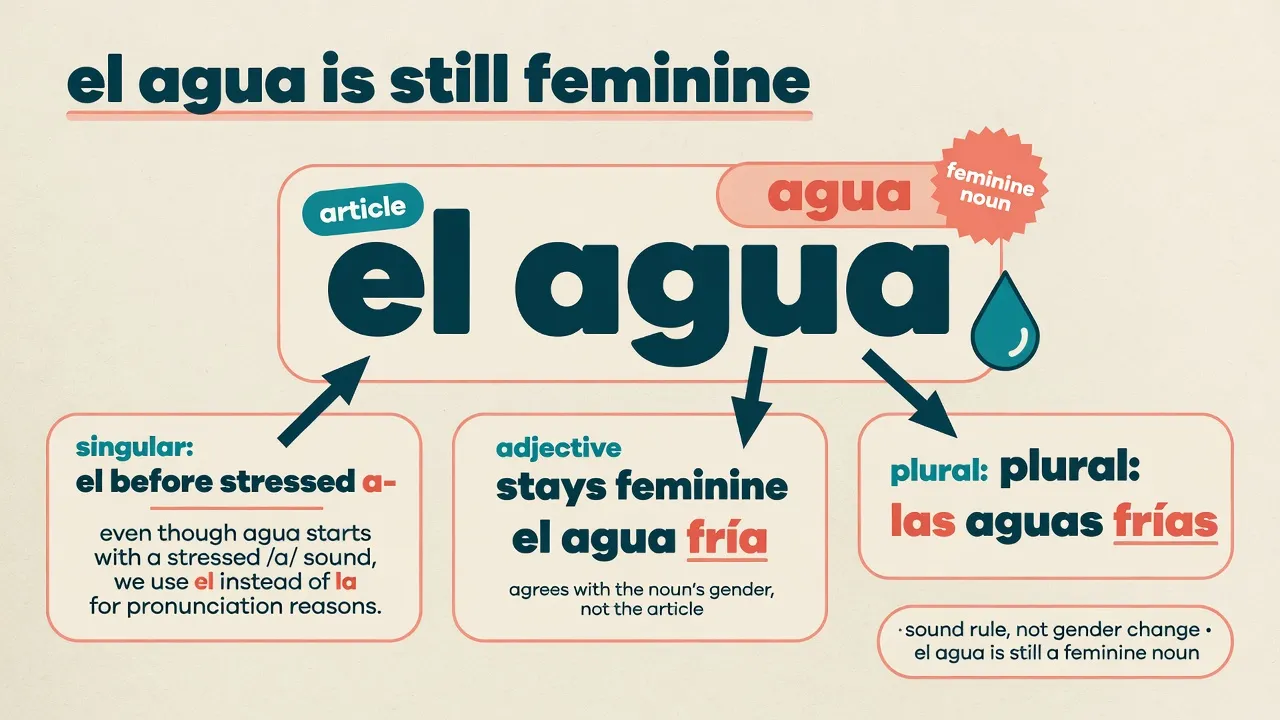
Classic curiosity case: el does not always mean the noun is masculine.
| Fact | Example |
|---|---|
| Noun agua is feminine | gender lives on the noun |
| Singular definite article becomes el before stressed a- / ha- (sound) | el agua, el águila, el hacha, el alma |
| Adjectives stay feminine | el agua fría, el águila calva |
| Plural returns to las | las aguas, las águilas |
| Indefinite often in the same phonetic zone | un agua, un águila (light mention) |
Mini examples:
El agua estaba fría y transparente.
Las aguas del lago estaban frías.
A rule-memorizer needs a special card. A reader who has seen el agua fría many times just knows the chunk.
Adjective agreement follows the noun
Short note, not a full agreement course. Once the gender of the noun is solid, adjectives match it.
| Noun chunk | Adjective match |
|---|---|
| el gato | el gato negro |
| la gata | la gata negra |
| el día | el día perfecto |
| la noche | la noche perfecta |
| el agua (feminine noun) | el agua fría |
el agua fría proves gender sits on the noun, not only on the surface form of the article. Reading pays twice: you absorb article+noun and matching endings in the same sentence.
Reading method: notice the chunk, keep the story
Method over more tables. Volume of correct input beats one perfect rule sheet.
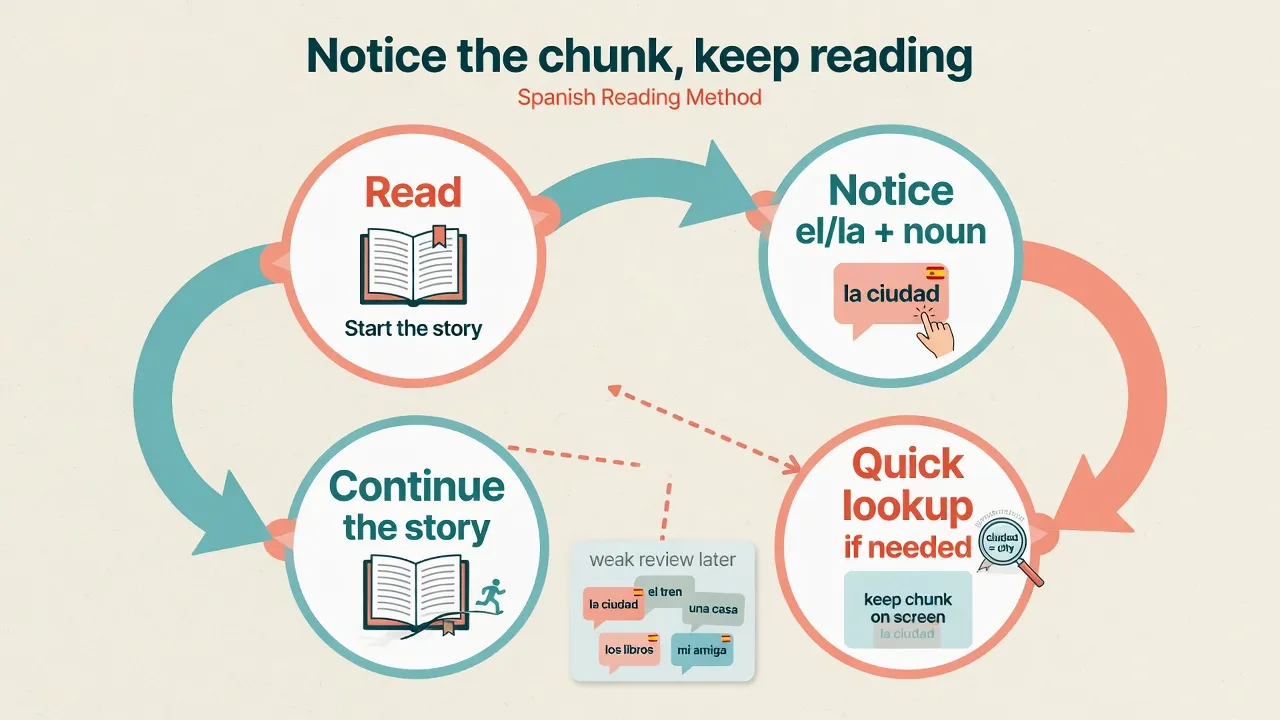
- Pick Spanish you mostly understand (graded article, simple news, easy story).
- When you see a noun, glance at its article - read la ciudad as a unit.
- If unknown: click-translate or look up without leaving the sentence if you can; keep el/la on screen.
- Optional: save 5-10 new chunks a day, not 40 bare words.
- Do not stop every line to run the endings table - the table is for sticky doubts after reading.
Noticing walkthrough (pause → name the chunk → continue):
- La ciudad es grande. → chunk la ciudad. Continue.
- El problema no es nuevo. → chunk el problema (ends in -a, still masculine). Continue.
- El agua fría del río. → el agua + feminine adjective. Continue.
Try the habit on free graded samples: ES A1 story and ES A2 story, or browse graded Spanish articles.
Many encounters beat one perfect rule sheet. If parallel texts let you live only on the translation side, gender noticing gets weaker - stay inside Spanish you can mostly follow.
How MovaReader helps (honest)
MovaReader is for the reading loop, not a gender X-ray. Click-to-translate keeps article + noun in context so you can notice la ciudad and el problema without jumping out of the sentence. It does not paint every noun as a special gender data point or act as a gender oracle. You still notice; the app lowers lookup friction.
What you get in practice:
- free graded Spanish library with click-to-translate
- upload EPUB or files you legally own when you outgrow samples
- ~20 word translations a day on freemium
- Reader €1/mo for unlimited translations
- Pro €5/mo for full trainers
- unlimited listening on freemium where offered
Soft path: open one short graded paragraph today and notice five el/la chunks. Start freemium on all articles. When the daily translation cap breaks flow, step to Reader. Use Pro only if trainers are the bottleneck. Clear pricing lives on /en/pricing; how noticing works in-app is on /en/how-to-use. Optional practice after reading: everyday Spanish phrases practice, free Spanish vocabulary trainer, trainers, phrases.
Chunks + tendencies + reading volume. The product is a quiet reading companion, not a grammar encyclopedia.
FAQ
Why is it el mapa / el día if they end in -a?
Ending tendencies are not laws. Learn these as whole chunks (el mapa, el día). Many -ma words are masculine too (el problema, el sistema, el tema). When one of these appears in a text, save the full chunk, not the bare word.
Is agua masculine or feminine? Why el agua?
Feminine noun. Singular el before stressed a- (and often ha-) is about sound: el agua, el águila, el alma. Adjectives stay feminine (el agua fría). Plural returns to las (las aguas).
Do -ción words always take la?
Almost always (la canción, la nación, la televisión). Treat as a very strong tendency. Still attach the article when you learn each word; do not treat it as forever magic.
Should I memorize rules or learn words with el/la?
Both, different jobs. Rules and ending tendencies are training wheels for sticky doubts. Lasting feel comes from chunks (la mesa, el problema) plus lots of examples in context while you read.
Does reading really help gender, or only speaking practice?
Reading multiplies article+noun encounters per minute. Speaking with feedback helps too; they are not enemies. Volume of correct input matters. Notice the chunk, keep the story - do not stop every line for a table lookup.
Will natives still understand me if I mix el/la?
Often yes from context, especially early. Mixing still costs clarity and confidence. Chunks reduce avoidable friction. No fluency guarantee either way.
Takeaway
Stop pure -o/-a quizzes. Chunk el/la + noun. Use ending tendencies as wheels. Know the classic exceptions and el agua. Get volume from Spanish you enjoy and mostly understand.
Related Spanish grammar on the same site: por vs para, Spanish word order, and English a/an/the if you want the same chunk-and-noticing method on English articles. Tools help with friction; they do not replace noticing.
Keep reading with translations inside the text
With a free account, an unknown word translates with one tap, and the words you are learning wait for you in the trainer.
Free account: 7 days of Pro, then 20 word translations a day or a paid plan.