Language Learning Psychology
Imposter Syndrome in Languages: Why Your Real Level Is Often Higher
You catch the cafe chat, the radio joke, the headline, then call yourself a fake. Imposter syndrome in languages feeds on invisible wins. Coverage ranges, finished pages and five counters to the critic.
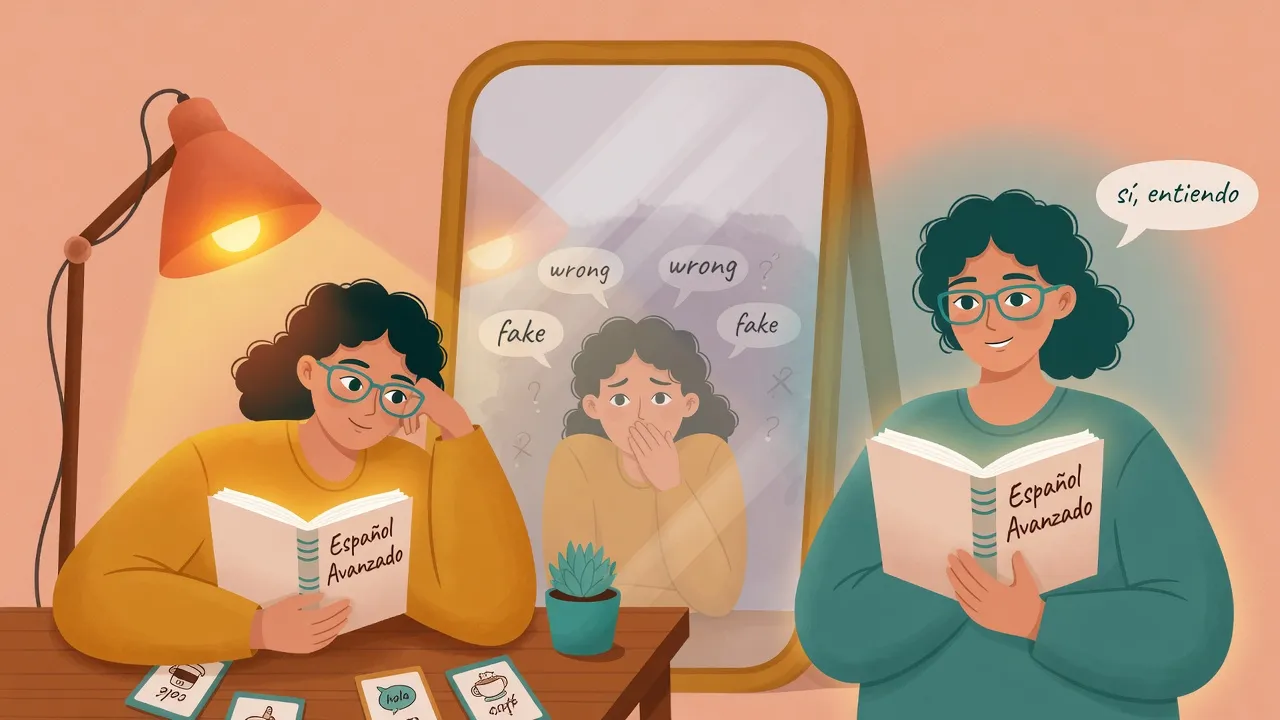
Have you ever sat in a cafe abroad, half-listening to the table next to you, and realized you understood almost every word - then still refused to say you "speak" the language? You order coffee without panic. A radio joke lands. A newspaper headline on the next seat makes sense. And a tiny voice still whispers: you're faking it.
That gap has a familiar name online: imposter syndrome (you will also see impostor - same feeling). It is not only for corner offices. Language learners meet it when success and self-doubt share the same afternoon.
Imposter syndrome in languages is the gap between what you can already do and what your anxiety lets you claim. Many intermediate and advanced learners underrate themselves because unknown words feel loud while known words go invisible. The fix is not a pep talk: use reading coverage as a guide (often roughly 80-90% at a useful edge; higher for easy everyday text), count finished pages, and collect private evidence. That does not mean you are secretly fluent - it means feelings lag competence.
Below: feel versus evidence, why better learners often feel worse, coverage ranges, five lies, the polyglot trap, a measure protocol, how MovaReader helps, and FAQ.
Feelings lag competence: why the critic is loud
Same day can hold real success and a fraud voice. You followed the chat. You got the joke. You still walk away thinking you do not count.
Anxiety is not a vocabulary meter. It measures threat and social risk. Your word file can be solid while the critic runs hot.
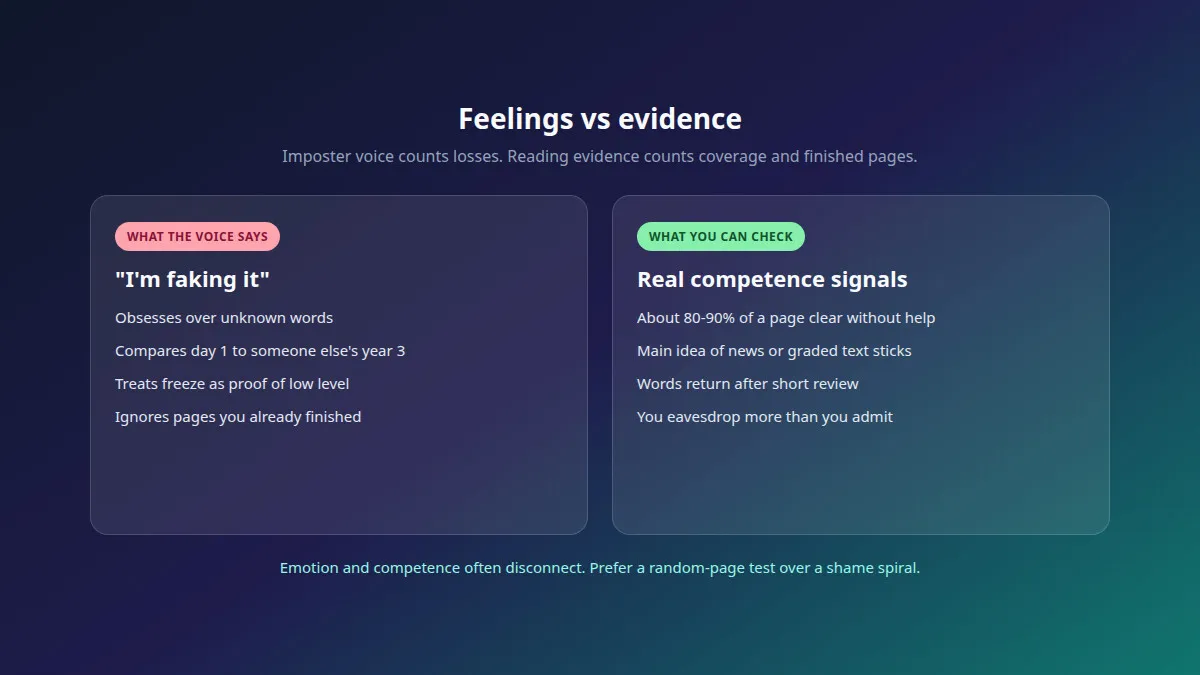
| Feel (loud) | Fact / evidence (quieter) |
|---|---|
| "I'm faking it" after a cafe order that worked | You completed a real exchange in the target language |
| One unknown word = total failure | Most of the page or chat still made sense |
| Freeze at the counter = empty vocabulary | Adrenaline squeezed working memory; words often return when calm |
| "Everyone else is better" | Peers hide doubt; feeds show highlight reels |
| "I forgot it, so I never knew it" | Forgetting is part of memory work; recognition can return |
| Confidence 1-10 quiz | Coverage feel on a real text + finished pages |
Think of a white shirt with three stains. Your brain stares at the unknown 10-20% and ignores the clean cloth. That bias is ordinary - not proof you are a fraud.
The impostor phenomenon is a known concept (Clance and Imes lineage). This is not a clinical diagnosis. It is a practical look at how skill and self-story drift apart.
Why better learners often feel worse
At A1, every new word can feel like a trophy. You count wins. At B1-B2, every gap can feel like failure. You start counting losses. The scoreboard flips even when skill is climbing.
Beginners sometimes overrate early trophies. Intermediates often underrate because gaps get louder. That is the reverse of beginner overconfidence in plain language.
Skill may still need work. Speaking may lag reading. The accurate claim is narrower: many learners under-rate relative to evidence. They finish a page, get the joke, order coffee - then call themselves fakes.
For triggers and different recovery moves, see the sibling piece impostor syndrome in foreign languages. This post stays with cafe energy, coverage evidence, five lies, and a measure protocol.
The coverage rule: known words hide, unknowns stick
Lexical coverage research (Laufer; Hu and Nation; Nation; Schmitt and colleagues) talks about ranges for comfortable reading - guides for this kind of text, not a diploma for every URL.
| Known-word band (guide) | What it often means in practice |
|---|---|
| Roughly 80-90% | Useful stretch / edge if sense still holds; expect some lookups |
| Around ~95% | Often discussed as adequate for everyday text with light support |
| Around ~98% | Often discussed as comfortable unassisted extensive reading |
Personal percentage is text-specific. News, novels, and technical PDFs differ. Unknowns stick; knowns go invisible - and that bias feeds the fraud voice.
Try a small experiment. Open a mainstream article in your target language. Notice how many words you recognize versus how hard you fixate on the few you do not. Sense may still hold when a handful of words snag you.
For text choice, Krashen's comprehensible input is a useful metaphor (i+1: stretch, not chaos) - a guide for picking pages, not a level guarantee.
Graded texts plus click-to-translate can cut dictionary hell on an edge session. Browse all articles and pick something slightly scary.
Coverage is a compass for "can I read this?", not a secret exam score.
Five lies your language imposter syndrome tells you
The critic speaks in absolutes. Answer with realistic counters.
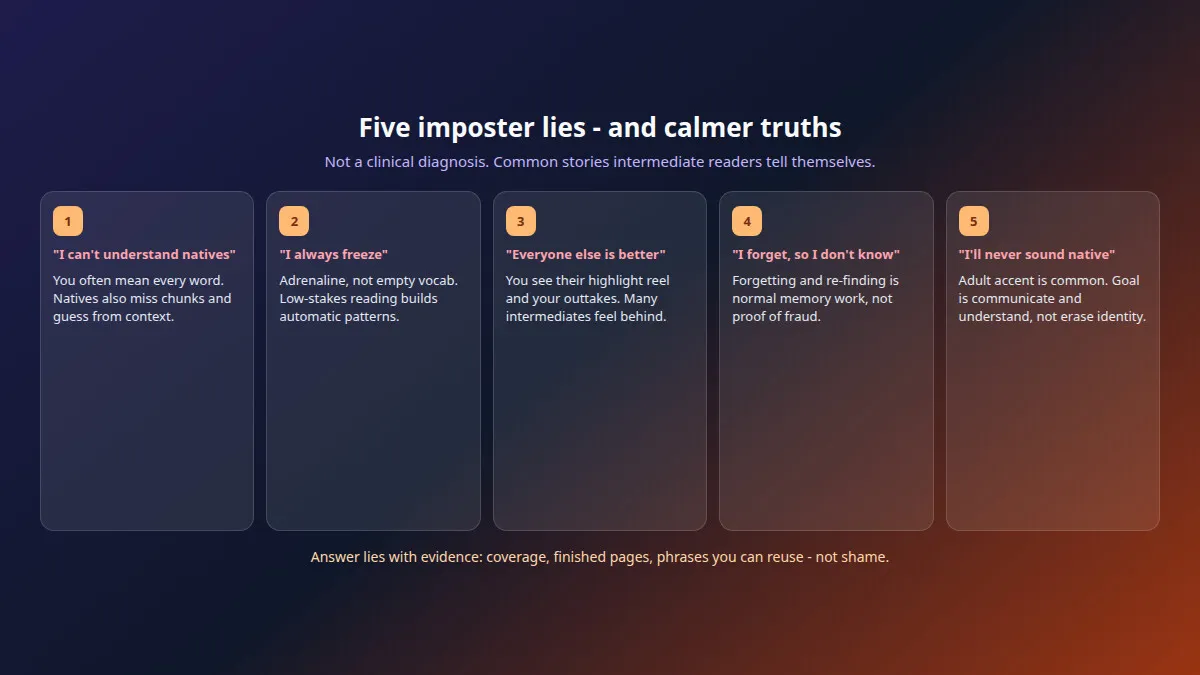
Lie 1: "I can't understand native speakers"
What you often mean is: not every word, every accent, every speed. Real listening is partial for natives too. People mishear, guess from context, and zone out. Understanding the gist and asking "can you repeat?" is competence, not fraud. Following the cafe chat and only losing a side detail is skill under noise - not proof you understand "nothing."
Lie 2: "I always freeze when I have to speak"
Freeze is often adrenaline and working-memory squeeze, not an empty vocabulary file. You can read at home and stall at the counter: same language, different nervous-system load.
Calm pages build patterns at low social risk, so words are less blank later. Reading still does not replace live speaking. Related: fear of mistakes and perfectionism.
Lie 3: "Other learners are way ahead of me"
Peers hide insecurity. Social feeds show highlight reels. The "everyone else is better" feeling is common - treat it as a pattern, not a world poll. Fix: private evidence (finished pages, kinder coverage on similar texts), not scrolling rivals.
Lie 4: "I keep forgetting words, so I must not really know them"
Forgetting is part of memory work, not proof of fraud. Recognition today after a blank yesterday is normal learning. Ebbinghaus and the forgetting curve: retrieval strengthens memory. A word that slipped and returned was not "never known."
Lie 5: "I'll never sound like a native"
Probably true for many adult learners - and that is fine. Goal: communicate, connect, comprehend - not erase identity. Accent is not a moral grade.
The polyglot trap: reels vs private numbers
Instagram and TikTok polyglots switch languages in sixty seconds. The camera hides years of boring pages. You compare their highlight reel to your unedited day - the comparison is rigged.
Real progress is private: last month harder pages felt like fog; this month similar texts feel kinder, or you finish more pages. That climb rarely goes viral. If "stuck" is louder than "fraud," see the B1-B2 plateau guide. Stuck feel is not zero skill.
Evidence protocol: replace "I feel terrible" with checks
If imposter syndrome feeds on ambiguity, starve it with simple measures.
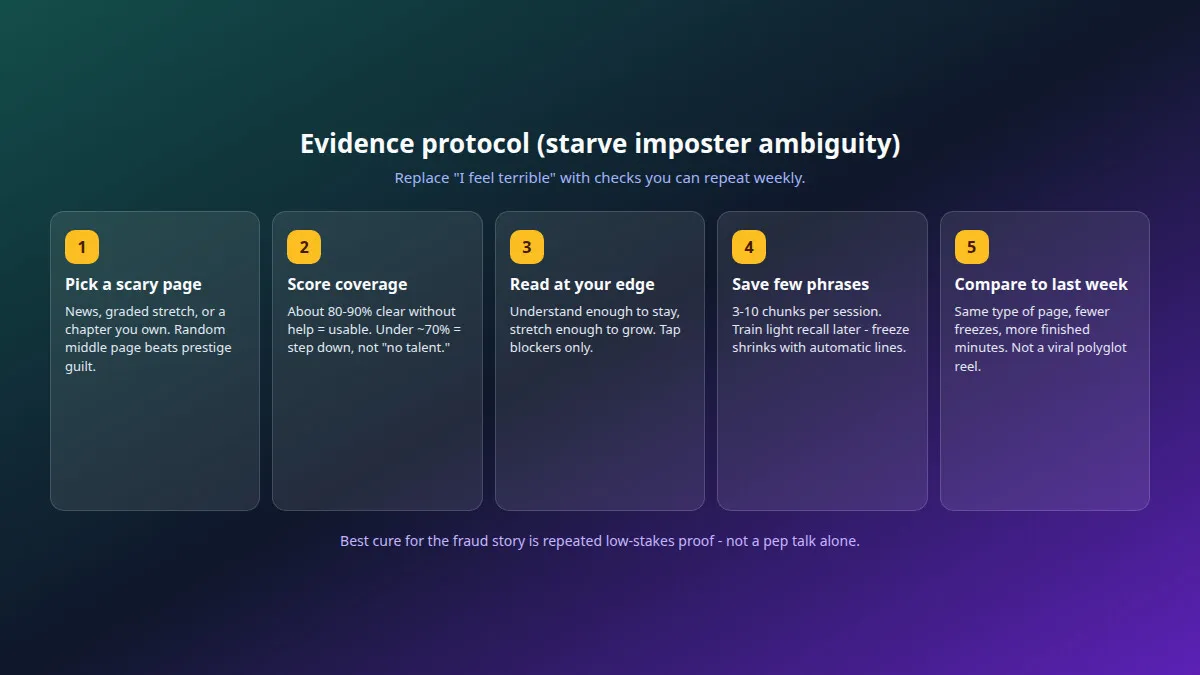
Step 1: Pick a text that scares you a little
A newspaper editorial, a graded stretch piece, or a chapter you would avoid. Write one sentence about how you feel before you start - baseline mood, not a final grade.
Step 2: Check coverage feel on that text
Mark sense-breakers versus flow. Sense should still hold. Aim roughly for a high known-word band (often ~80-90% at a useful edge).
Tools help: graded library, click-to-translate for blockers, optional personal marks. They cut friction. Start with all articles, Spanish article 1209.
Step 3: Focus on the gap, not the abyss
A short unknown list is a plan. "I know nothing" is a mood. Learn a handful of high-value phrases from this text, not the whole dictionary.
Step 4: Read at the edge and finish pages
Stay engaged, not lost in dictionary hell - and not pure comfort forever. Finished pages count as evidence. Completion beats doomscrolling unknowns. Soft: Krashen and input.
Step 5: Optional - train phrases for production
When ready, move passive recognition into active practice. Try type training and phrase typing. Speaking with humans still matters later.
Step 6: Re-check the same kind of text later
Same article or similar difficulty after one or two weeks. Note private signals: more pages finished, fewer freezes on known patterns, calmer feel. Personal graph only.
Why traditional self-assessment fails
"How confident are you from 1 to 10?" measures emotion under imposter conditions. CEFR descriptors describe what you can do. Anxiety answers "I can't" right after you just did it.
Prefer text-level evidence and finished work over vibe quizzes. If you like a personal mark trail, the language map can hold marks you set (optional).
How MovaReader helps
MovaReader supports private reading evidence, not pep-talk therapy: free graded library path, click-to-translate for sense-breakers, optional language-map marks and phrase trainers, plus upload of your EPUB or file where the product allows. Coverage feel + finished pages + realistic counters are the method. Tools only cut friction.
- Browse all articles - pick a stretch text (Spanish A2 1209).
- Read; tap sense-breakers only.
- Finish the page; write one line of private evidence.
- Optional: save phrases; try type training or phrase typing.
- Own files when ready (how to use); optional marks on the language map.
- Check pricing when volume or trainers become the bottleneck.
| Need | Realistic plan |
|---|---|
| Test the evidence habit on free graded texts | Free plan (~20 word translations/day) |
| Daily page volume without constant tap walls | Reader €1 |
| Trainers for active phrase practice | Pro €5/mo |
What it does not do: cure imposter syndrome, host licensed commercial novels for free or replace conversation practice.
FAQ
Is it normal to feel like a fraud when I understand most of a conversation but still won't say I "speak" the language?
Yes - very common from intermediate levels up. Your ears can track the cafe chat while identity lag says "fake." Understanding most of a real exchange is skill evidence; the fraud voice is not a CEFR examiner. Collect private proofs (finished pages, gist you retold, sense-breakers you needed) instead of waiting for a perfect self-label.
What's the difference between imposter syndrome and actually being a beginner?
A true beginner has thin evidence: short texts collapse, simple exchanges fail often. Imposter-style underrating shows up when evidence is already there (joke, coffee order, finished page) but the story stays "fraud." Use evidence, not vibes. Under-rating and true low skill both exist. This is not medical advice.
How do I measure my language level without a full CEFR exam?
Skip the "confidence 1-10" vibe quiz when anxiety warps it. Pick a slightly scary text, note coverage feel (often ~80-90% at edge if sense holds; ~95% for easier everyday text with support), finish the page, write one line of what you understood. Re-check a similar text later. Private check for this material, not a CEFR certificate.
Does reading really help with speaking anxiety or freeze?
It can help foundation: calm pages build patterns at low social risk. Freeze is often adrenaline, not an empty vocabulary file. Reading still does not replace live speaking or social practice, and does not guarantee freeze-free speech. Related: fear of mistakes.
Why do social media polyglots make me feel worse?
You compare their 60-second highlight reel to your unedited day. The camera hides boring pages. That comparison is rigged. Track private numbers: more finished pages, kinder coverage on similar texts, fewer freezes on known patterns.
Can I start collecting evidence on the free MovaReader tier?
Yes for the habit. The free plan includes the graded library with click-to-translate, about ~20 word translations/day. Upload your own EPUB where the product allows. When daily volume hits the tap wall, Reader is €1. Pro is €5/mo when trainers are the bottleneck - not required to start. Details: pricing.
Next steps
Today: open one slightly scary text in all articles; finish a page; write one line of evidence ("understood the plot / got the joke / only N sense-breakers").
This week: two more edge sessions; optional phrase train on the demos; no doom-compare on polyglot reels during that block.
Tools reduce friction. They do not certify you or delete nerves overnight. The fraud voice gets quieter when the page is finished and the stains are counted - not when you argue with it.
Keep reading with translations inside the text
With a free account, an unknown word translates with one tap, and the words you are learning wait for you in the trainer.
Free account: 7 days of Pro, then 20 word translations a day or a paid plan.