
No Language Talent Is a Myth - What Actually Drives Spanish Progress
I'm not a language person" is a convenient story - and usually wrong. Five reasons Spanish stalls, honest 6-month ranges, and a graded reading path without fake fluency promises.
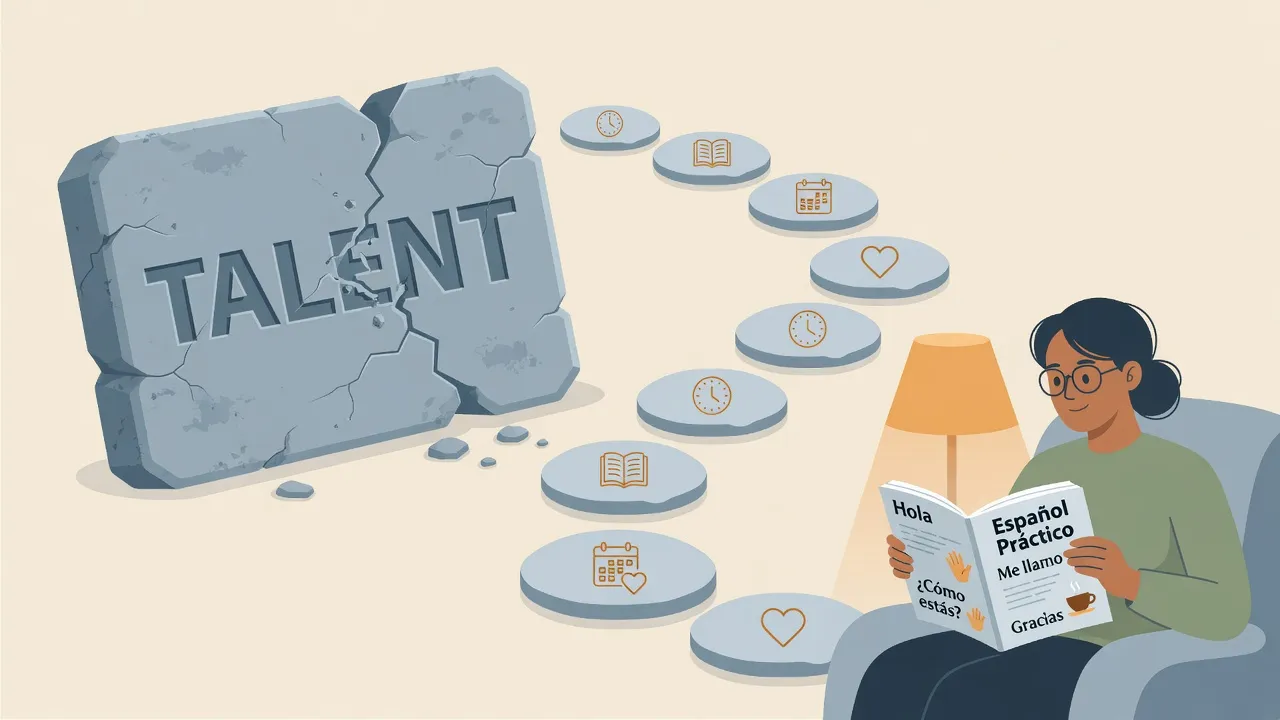
Month three of Spanish class. The person next to you jokes with the teacher in full sentences. You still mix ser and estar, freeze on basic verbs, and land on the same conclusion: "I have no talent for languages."
If that sounds familiar, you are in a huge crowd. Here is the part people skip: almost everyone who says this already speaks a native language fluently - one of the hardest skills a human brain builds. "My brain is not built for languages" rarely fits that picture.
The short version: "No language talent" is usually a story about method, contact hours, level-fit input, regularity, and fear - not a genetic off switch. Individual differences (working memory, sound sensitivity, other languages, free time, anxiety) change speed and comfort. They do not turn Spanish into can / cannot. Six months is a useful planning horizon with ranges, not a fluency certificate for everyone. Most adults can still make real Spanish progress by fixing difficulty, weekly contact, and interesting input - not by "fixing character."
If ser / estar still blur after months of class, check level, hours, and boring textbooks before you invent a missing gene.
Below: where the talent myth comes from, five real reasons Spanish feels stuck, what "talent" actually is, an illustrative six-month Spanish reading plan, and an honest product path. No "speak Spanish fluently in 6 months" sales line - that is the point.
Where the "language talent" myth comes from
School labels and "not a language person"
School often runs on one textbook, one pace, one exam calendar. Who kept up became "talented." Who lagged became "not a language person." Teachers rarely asked: does this method fit you, is the material at your level, do you touch the language outside the hour?
Adults recycle that label. A fast classmate in Spanish 101 looks gifted. A slow month on verbs feels like destiny. The label is convenient. It is also a weak diagnosis.
What practice and research actually keep repeating
Differences between learners are real. None of them is a hard off switch for Spanish.
What shows up again and again is simpler:
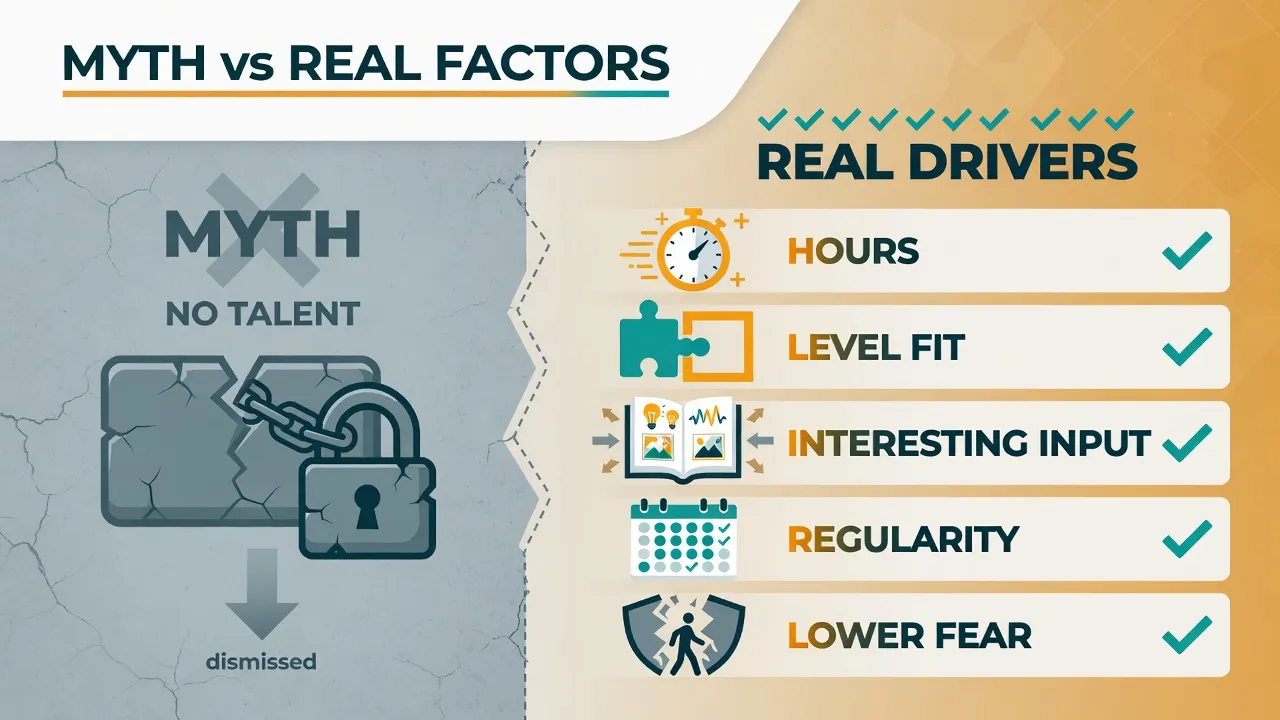
- Contact hours - real weekly time in Spanish (class, reading, listening, talk)
- Level-fit input - material you mostly understand (~80-95%) with mild novelty
- Regularity - 15 minutes most days beats a heroic weekend once a month
- Motivation and emotion - interest fuels hours; boredom and shame cut practice
Comprehensible input (Krashen-style) is a useful compass, not a cult and not a fluency guarantee: the brain keeps more of what it almost understands. That is an antidote to the talent myth, not a magic certificate.
Here is the same idea as a board - myth label on one side, drivers you can change on the other:
5 real reasons your Spanish feels stuck
These are Spanish-specific, not generic polyglot theory.
1. Wrong difficulty level
Jumping from A1 into raw Cien años de soledad, dense news, or native forums is not a talent test. It is bad learning design. A brain does not "acquire" what is 100% dark. You need steps.
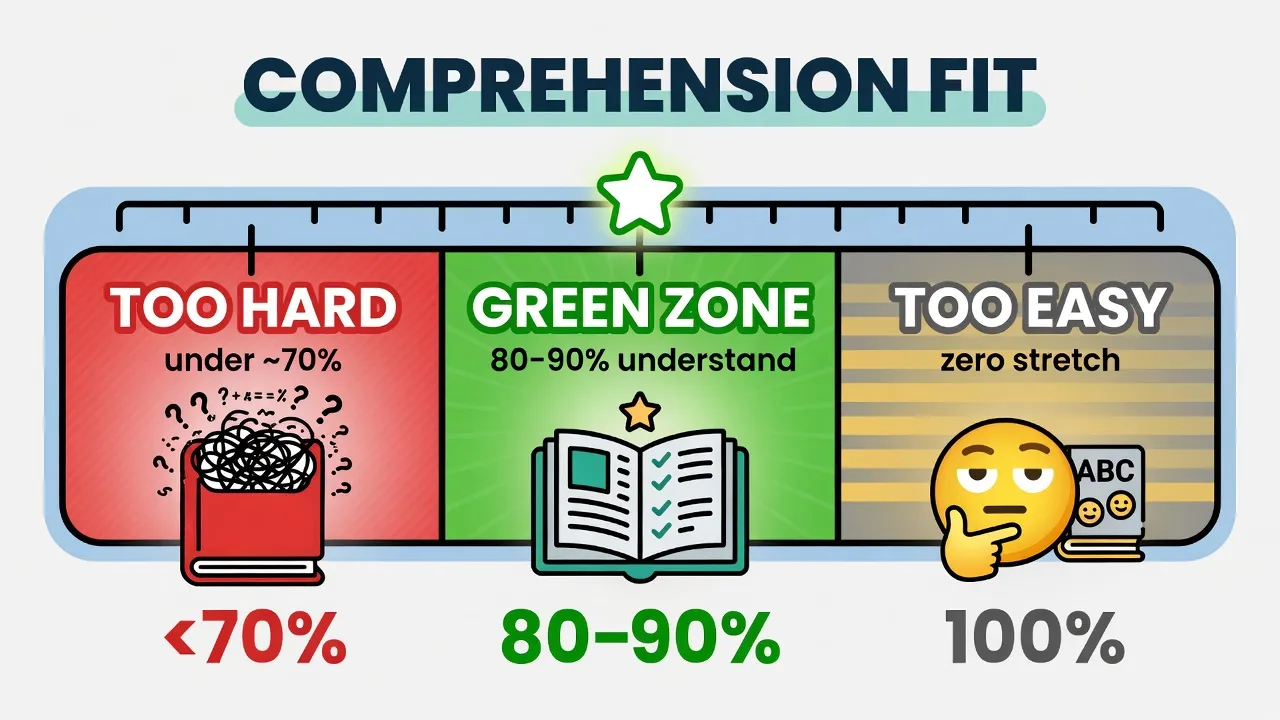
Practical rule: open a random page. If you understand about 80-90% without help, the level fits. If you are under ~70%, step down. 100% opaque is a design error, not proof you lack a language gene.
Free samples to calibrate: Spanish A1, Spanish A2, then browse all articles.
2. Boring, artificial content
"El gato está en la mesa" does not stick. Words from a story, a joke, a recipe you will cook, or a topic from your job do. Interest is not a luxury. It is fuel for the hours you need.
3. Too little contact with the language
Two class hours a week is a thin layer. Kids look "talented" partly because they live in the language for hours a day. Compare weekly contact, not magic genes. Two hours of class plus a few hours of level-fit reading and listening is a different story than class alone.
4. Fear of mistakes and perfectionism
Shame blocks speaking - and sometimes even reading aloud. That is psychology, not a missing chromosome. Safe volume of messages you mostly understand beats one perfect grammar rule once a week.
5. Comparing yourself to others
The fast peer may have lived abroad, spoken another Romance language, or already seen the unit. You see the outcome, not the process. Unfair comparison feels like talent. It is usually hidden head start.
What "talent" really is
Researchers talk about several pieces - trained and partly innate. None of them equals a verdict of "no talent for languages":
| Piece | What it is | How it grows |
|---|---|---|
| Working memory | Holding new bits while you read | Hard-but-clear texts |
| Phonological sensitivity | Hearing and producing sound patterns | Listening + reading aloud |
| Motivation | Decides how many hours you actually stack | Interest + lower friction |
| Strategies | Guess from context, ignore noise, return later | Practice and coaching, not birth |
Reframe: ability is often habits + conditions + experience. Differences affect speed, not destiny. You can improve Spanish without waiting for a personality transplant.
(For a broader aptitude essay without the Spanish reading ladder, there is a related theory post: no talent for languages - myth and fluency claims. This page stays on Spanish progress and a graded path.)
Realistic 6-month Spanish plan (ranges, not a certificate)
Six months is a handy planning horizon. It is not a promise that you will speak Spanish fluently in half a year.
Outcomes depend on start level (A0 vs A2), hours per week, other languages in your head, and what you mean by "speak" - travel chat, work email, friendly conversation, literature. The plan below is illustrative and reading-supported. Adapt it.
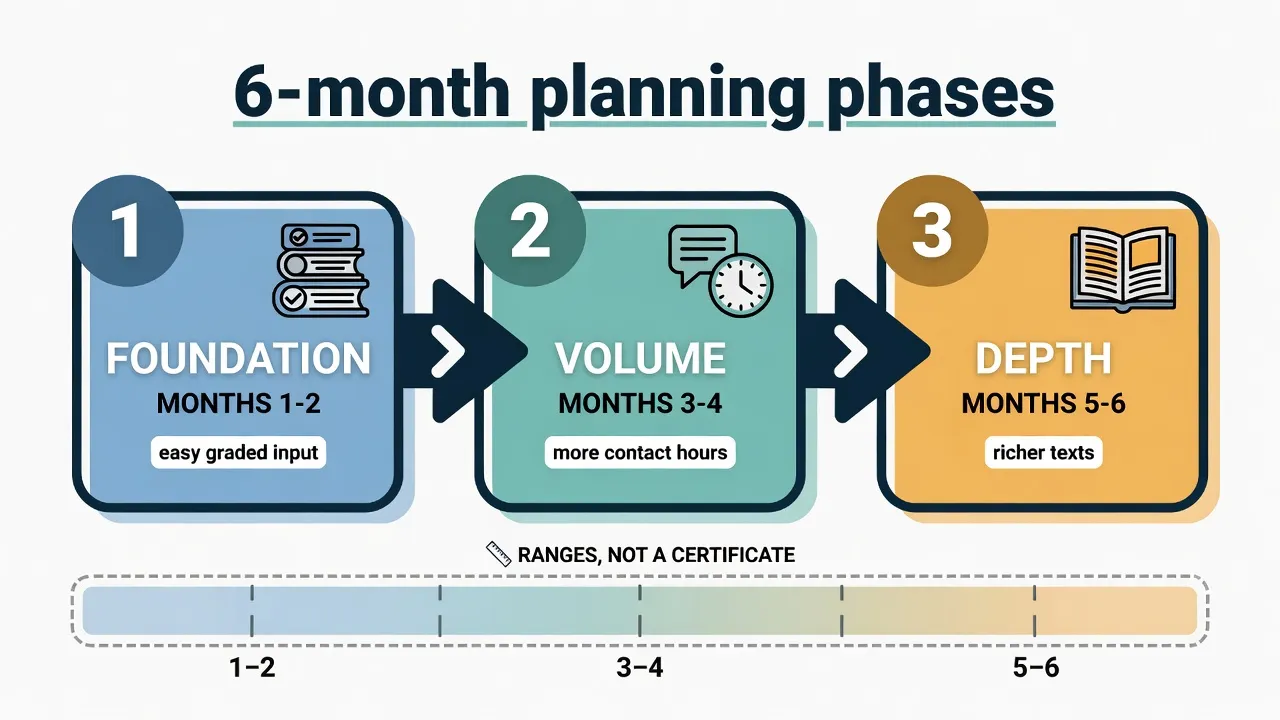
Months 1-2: trust foundation (~15-20 min/day)
Habit first. First hundreds of words in context - not "500-800 guaranteed to every reader."
- Short adapted texts at your real level
- Translate only sentence-blockers
- Save 3-10 useful phrases per session, not 40 isolated lemmas
- Free path: ES A1 sample, ES A2 sample, all articles
Months 3-4: volume (~20-30 min/day)
Fewer lookups per page. More finished texts.
- Topics you care about (work, kitchen, travel, sport, IT)
- Mix graded pieces with slightly harder ones
- Optional: an EPUB you legitimately own inside the app
- Light practice of saved phrases
Months 5-6: depth + light activation (30+ min on good days)
- Longer texts that are still mostly clear
- Audio after the written page already reads
- Short speaking or writing from phrases you saved
Honest half-year outcomes (often, not promised): faster reading at your level, wider passive vocabulary, less panic with simple media, more confidence in class.
What usually needs more than six months: professional fluency, near-native accent, any novel on any topic. That is normal. You are not obligated to read Cien años de soledad after a few months. Márquez density is literature, not a talent exam. Prefer lighter narratives and graded pages first.
Rough weekly contact (orientation only - no fake personal scores):
| Weekly contact (rough feel) | Story people often tell |
|---|---|
| 2 h class only | "I have no talent" after months of thin input |
| 2 h class + 2-3 h reading/listening | Steady foundation more likely |
| Daily immersion hours | Peers look "gifted" partly from volume |
How to use MovaReader honestly
MovaReader helps with supported Spanish reading: graded pages, click-to-translate, saved phrases, optional trainers and listening. It does not replace a talent myth with an app miracle. It also does not replace live speaking with a tutor, class, or conversation partner.
What you get:
- Free graded library + word translation by click
- Own files (for example an EPUB you have the right to read)
- Trainers for saved words and phrases (full on Pro; free demos exist)
- Listening on freemium (works better once the page is mostly clear)
What you do not get: a free full library of commercial novels, a six-month fluency guarantee, or a magic "brain model" that turns you into a native speaker.
Tiers as advice (see pricing when you need numbers):
| Plan | What it is for | Honest numbers |
|---|---|---|
| Freemium | Prove one honest page | Graded library + ~20 word translations/day + listening |
| Reader €1 | Real reading volume | Unlimited translations |
| Pro €5/mo | Full trainers after you save | Trainers beyond demos |
Path today:
- All articles
- Level sample: ES A1 or ES A2
- Demos: word trainer, phrase trainer
- Own file + workflow: how to use
- Upgrade only when freemium lookups block real volume
Courses and reading apps do different jobs. A short comparison:
| Criterion | Typical courses / textbook | MovaReader (honest) |
|---|---|---|
| Pace | Group schedule | Your 15-30 min/day |
| Content | Often artificial dialogues | Graded articles + your own files |
| Free limit | Varies | ~20 word translations/day |
| Role | Live instruction + accountability | Reading foundation + less friction |
One line that stays true: MovaReader does not replace live speaking practice. It builds understanding and vocabulary so conversation is less of a blank wall.
FAQ
Is it true that some people have "no talent for languages"?
Usually not as a hard switch. Memory, sound sensitivity, prior languages, and anxiety differ - and they change speed and comfort. They rarely mean "impossible forever." School labels and thin methods hide hours, level fit, and fear more often than a missing gene.
Can I speak Spanish in 6 months?
Honest ranges only. Sometimes you can handle simple conversational topics after many hours, regular input, and clear goals. Not for everyone. Not for every definition of "speak" (travel chat is not work Spanish is not literary ease). Plan habits and phase ranges. Do not buy a marketing deadline. Professional fluency usually needs more than half a year of part-time study.
Is reading enough on its own?
Reading is a strong lever for vocabulary, structure feel, and confidence with text. Most people still need listening and some speaking or writing for balance. Reading builds a foundation. It does not replace live conversation.
Where do I start if I am A1?
Very light graded Spanish and short daily sessions - not prestige novels. Use the 80-90% rule: if a page is mostly dark, step down. Free path: ES A1 sample, then ES A2 when ready, browse all articles. Translate only sentence-blockers. Save a few useful phrases per session.
Is it too late after 30-40?
No. Adult brains often need more clarity and strategy, but they do not switch off. Shame and bad level fit hurt more than age alone.
Do I have to drop grammar completely?
No. Drop only grammar with no messages you understand. Short form notes after you meet the pattern in a text often stick better than naked tables once a week.
Does language talent exist at all?
Nuanced answer: aptitude-like differences are real, and they are small next to method and hours. They are not a verdict that you cannot improve Spanish. Speed is not destiny.
Next steps
The "no talent" story is convenient - it shifts blame off tools and conditions. It is weak at explaining how adults actually learn a second language.
You do not need a special gene to improve. You need hours, material at your level, interest, and lower friction - without fake guarantees. Open one honest page today. Judge yourself by whether you return tomorrow, not by whether you "woke up fluent" in week two.
Learn languages by reading!
Try MovaReader for just €1 — read texts with instant translation and interactive vocabulary training.
Free plan: 20 word translations/day and unlimited listening. Pro (€5/mo) unlocks full trainers.